
Implementing AI Agents and Automation for Business Growth
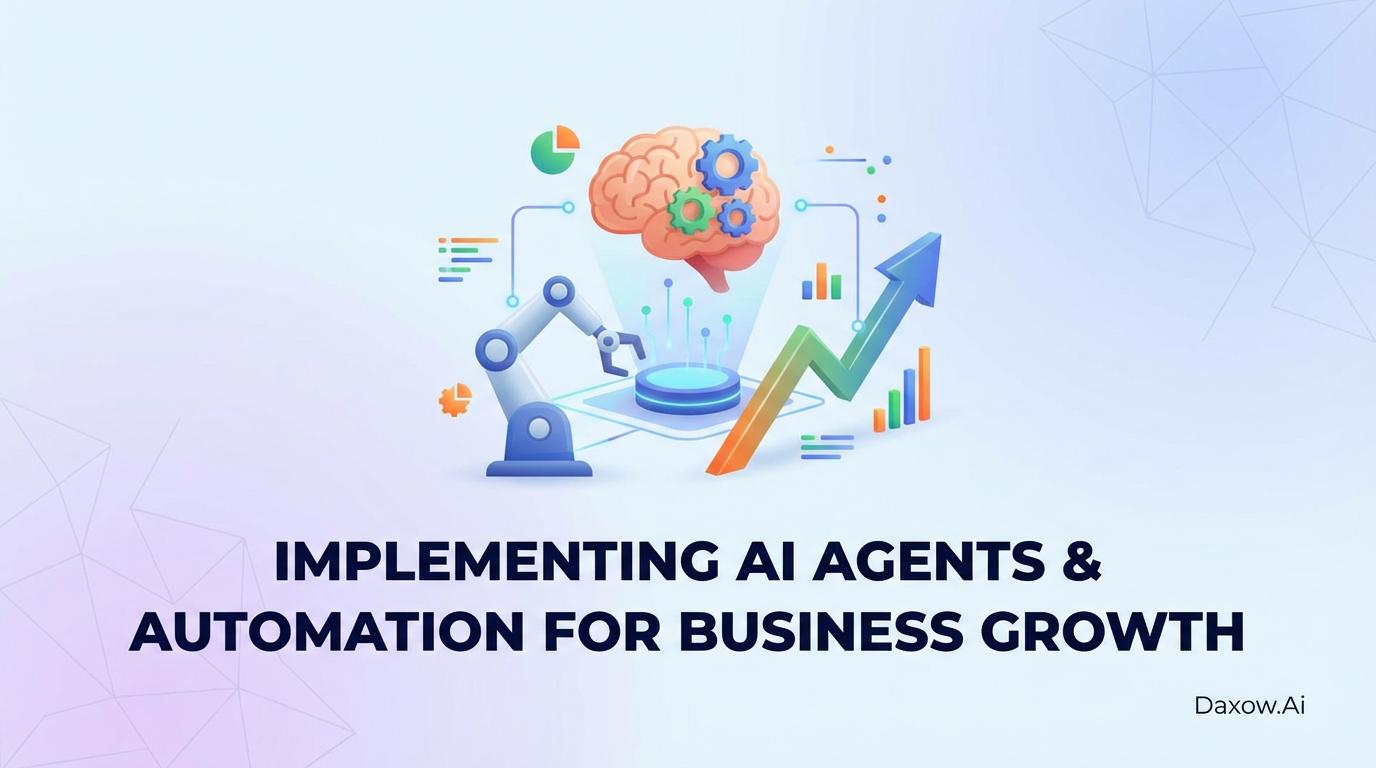
Learn how to implement AI agents and workflow automation to cut costs, boost productivity, and realize rapid ROI — use cases and Daxow.ai's rollout framework.
Unlocking Business Growth: Implementing AI Agents and Automation for Strategic Advantage
Estimated reading time: 12 minutes
Key Takeaways
- Implementing AI agents and automation transforms workflows into strategic business capabilities, driving cost reduction and productivity gains.
- Industry use cases from e-commerce to finance demonstrate measurable impacts such as faster decisions, improved customer experience, and compliance assurance.
- Daxow.ai delivers custom, integrated AI automation solutions with a proven five-step implementation framework ensuring ROI and regulatory alignment.
- Data quality, governance, and stakeholder engagement are critical for success and avoiding compliance risks.
- Clients commonly achieve 200–300% ROI within 12 months by scaling automations and layering predictive intelligence.
Table of Contents
- Unlocking Business Growth: Implementing AI Agents and Automation for Strategic Advantage
- Practical Use Cases: AI Agents and Automation across industries
- How AI Agents and Workflow Automation Drive Transformation
- Implementation Steps and Best Practices
- Estimating ROI and Business Value
- How Daxow.ai Delivers End-to-End AI Automation
- Frequently Asked Questions
Unlocking Business Growth: Implementing AI Agents and Automation for Strategic Advantage
What does “implementing AI agents and automation” mean for decision-makers? At its core it is the integration of autonomous AI agents with workflow automation to handle multi-step processes, learn from data, and take real actions inside business systems. Combined, these technologies create a hyperautomation layer that:
- Reduces operational costs by 20–50% in targeted processes.
- Automates routine inquiries (70–80% of standard support questions), freeing teams for strategic work.
- Accelerates decision-making with predictive insights and real-time monitoring.
- Scales capacity during volume spikes without proportional headcount increases.
These outcomes depend on aligning automation with business goals, ensuring data quality, and embedding governance to avoid shadow AI and compliance risks. Daxow.ai helps organizations map the highest-value opportunities and implement AI agents and workflow automation that integrate with existing CRMs, ERPs, and support platforms.
Practical Use Cases: AI Agents and Automation across industries
E-commerce — personalization, fulfillment, returns
- Use case: An AI agent analyzes browsing and purchase data to produce personalized recommendations and dynamic pricing. Workflow automation handles order routing, inventory updates, and returns processing.
- Impact: Higher conversion rates, lower cart abandonment, reduced stockouts. Companies report significant uplift in average order value and reduced manual reconciliation time.
- Daxow approach: Build an agent that connects product catalogues, order management, and analytics; implement automated workflows for returns and fulfillment exceptions; monitor performance and retrain models for seasonality.
Customer Support Automation — contact deflection and SLA improvements
- Use case: AI agents triage tickets, resolve 70–80% of routine questions, escalate complex issues, and update CRM records automatically.
- Impact: Faster response times, improved NPS, and lower per-ticket cost.
- Daxow approach: Deploy chatbots integrated with ticketing systems, implement escalation workflows, and create feedback loops so agents improve with live interactions.
Healthcare — triage, records summarization, claims automation
- Use case: Agents pre-screen patient inquiries, summarize clinical notes for physicians, and automate claims submission and compliance checks.
- Impact: Reduced administrative burden, faster patient triage, and better audit trails.
- Daxow approach: Securely connect EHRs and document repositories, build compliant NLP pipelines for summarization, and automate scheduling and follow-ups using AI-driven prioritization.
Finance — fraud detection, compliance, and reconciliation
- Use case: Real-time transaction surveillance with predictive models flags anomalies; automation generates compliance reports and reconciles accounts.
- Impact: Reduced fraud losses, improved regulatory reporting accuracy, and fewer manual accounting exceptions.
- Daxow approach: Integrate transaction streams and ledgers, deploy models with explainability features, and automate alerting and reconciliation workflows.
Real Estate — lead qualification, valuations, and document automation
- Use case: Virtual agents qualify inbound leads, produce preliminary valuations from public and internal datasets, and auto-populate listings from signed documents.
- Impact: Faster lead-to-deal cycles, fewer manual entry errors, and improved agent productivity.
- Daxow approach: Connect MLS/CRM systems, extract structured data from contracts, and run valuation models that feed into automated follow-up sequences.
HR — recruitment, onboarding, and retention prediction
- Use case: AI agents screen resumes, schedule interviews, answer benefits questions, and predict turnover risk using sentiment and performance signals.
- Impact: Shorter time-to-hire, more consistent onboarding, and proactive retention strategies.
- Daxow approach: Automate screening and interview scheduling, create knowledge bases for employee questions, and deploy early-warning dashboards to HR.
How AI Agents and Workflow Automation Drive Transformation
AI agents are not just smarter chatbots. They orchestrate multi-step processes, act on behalf of users, and learn from outcomes. Workflow automation provides the scaffolding to execute these processes reliably at scale.
Key capabilities that drive transformation:
- Orchestration: Agents coordinate tasks across systems (CRM, ERP, ticketing) to complete end-to-end processes without manual handoffs.
- Data-driven decisions: Predictive models surface demand forecasts, fraud risks, or staffing needs so teams act proactively.
- Continuous improvement: Feedback loops enable agents to refine behavior—improving accuracy in lead qualification or triage over time.
- Resilience and scalability: Automation handles peak loads and reduces operational fragility.
Examples of combined outcomes:
- A support workflow where an AI agent reads incoming messages, pulls account context from CRM, suggests responses, and closes straightforward tickets—reducing average handling time and increasing first-contact resolution.
- A finance pipeline where invoices are extracted via document automation, routed for approval, and reconciled automatically—cutting processing time by weeks in some cases.
Daxow engineers AI agents that execute real tasks—triggering workflows, updating records, and producing audit-ready logs—so businesses capture both operational and compliance value.
Implementation Steps and Best Practices
1. Define goals and identify processes
- Map current workflows and quantify pain points.
- Prioritize use cases with clear KPIs (cost savings, cycle time reduction, NPS improvement).
- Example objective: Reduce invoice processing costs by 30% within 6 months.
2. Evaluate data and select tools
- Assess data quality, accessibility, and integration needs.
- Choose platforms that support NLP, model retraining, and robust API connectivity.
- Ensure data governance and security from the start.
3. Build and train cross-functional teams
- Include business owners, engineers, data scientists, and compliance leads.
- Provide training and define ownership to prevent shadow AI.
- Create a governance model for model updates and incident response.
4. Deploy, test, and monitor
- Start with pilots or proofs-of-concept to validate outcomes.
- Implement security and adversarial testing where relevant.
- Monitor accuracy, drift, and user satisfaction; keep version control and rollback plans.
5. Measure and iterate
- Track KPIs (ROI, cycle times, accuracy, NPS).
- Iterate quickly—retrain models, refine workflows, and scale successful pilots across teams.
Best practices to avoid common pitfalls:
- Do not skip data quality checks—poor data derails most projects.
- Avoid deploying without stakeholder buy-in—lack of adoption kills value.
- Embed ethics and compliance into model development and monitoring.
- Document processes and decisions for audits and future improvements.
Daxow’s implementation methodology follows these steps: discovery workshops, technical design, pilot build, integration and rollout, and continuous optimization—ensuring alignment with business objectives and regulatory requirements.
Estimating ROI and Business Value
Organizations implementing AI automation see measurable results when they focus on high-value processes.
Quantifiable outcomes:
- Cost reductions: 20–50% in automated processes.
- Productivity gains: Up to 40% time savings for teams.
- Speed to value: Payback often occurs in 3–6 months for targeted automations.
- Long-term impact: 5–10x ROI through scaled insights and operational resilience.
Real-world benchmarks:
- Customer support automation reduces per-ticket costs and increases capacity without proportional hiring.
- Finance automation reduces error rates and shortens monthly close cycles.
- Sales automation that qualifies leads and schedules demos increases conversion rates and shortens sales cycles.
Daxow clients commonly realize 200–300% ROI within 12 months by focusing on automations that deliver immediate labor savings and then layering predictive intelligence for revenue impact. We measure success using baseline metrics and continuously compare pre- and post-deployment KPIs to justify expansion.
How Daxow.ai Delivers End-to-End AI Automation
Daxow.ai is a full-service AI automation agency that helps companies discover, build, and scale AI-driven workflows. Founded in Estonia in 2024, our team brings product-grade engineering, data science, and integration expertise to enterprise and startup projects.
What we do:
- Discovery & process analysis: Map workflows, identify bottlenecks, and prioritize automations that deliver clear ROI.
- Custom AI agent design: Build autonomous agents that perform real-world tasks—triaging support, qualifying leads, extracting data, and orchestrating workflows.
- Workflow automation: Implement robust workflows that connect systems, enforce rules, and manage exceptions.
- Integrations & data connectivity: Connect CRMs, ERPs, ticketing systems, and document stores to create a single source of truth.
- Deployment & governance: Secure deployments with version control, monitoring, audit logs, and retraining pipelines.
- Continuous optimization: Monitor performance, retrain models, and expand automations to new domains.
How we deliver value:
- End-to-end ownership reduces project friction and accelerates time-to-value.
- Tailored integrations ensure automation works with your existing toolset.
- Operational focus ensures automations reduce manual tasks and improve productivity across teams.
- Transparent measurement provides CFOs and leaders with the data needed to scale investments responsibly.
Example engagement workflow
- Discovery workshop to identify 3–5 priority processes.
- Prototype an AI agent for one high-impact workflow (4–8 week sprint).
- Pilot with a business unit and measure KPIs.
- Iterate, harden for security and compliance, and roll out company-wide.
Frequently Asked Questions
What are AI agents in business automation?
AI agents are autonomous software entities that perform tasks by interacting with data and business systems, orchestrating multi-step processes, and learning from outcomes to improve performance over time.
How do AI agents improve customer support?
AI agents can triage and resolve routine inquiries automatically, escalate complex issues, and update CRM records, resulting in faster response times, improved customer satisfaction, and reduced support costs.
What industries benefit most from AI automation?
High-volume, rule-based, and data-intensive industries such as e-commerce, healthcare, finance, real estate, and HR see significant benefits from AI agents and workflow automation.
How does Daxow.ai ensure compliance and ethics in AI projects?
Daxow.ai embeds governance practices into all stages of AI deployment, includes compliance leads in cross-functional teams, and implements monitoring to detect and prevent risks such as shadow AI and regulatory violations.