
Implementing AI Agents and Automation for Business Transformation
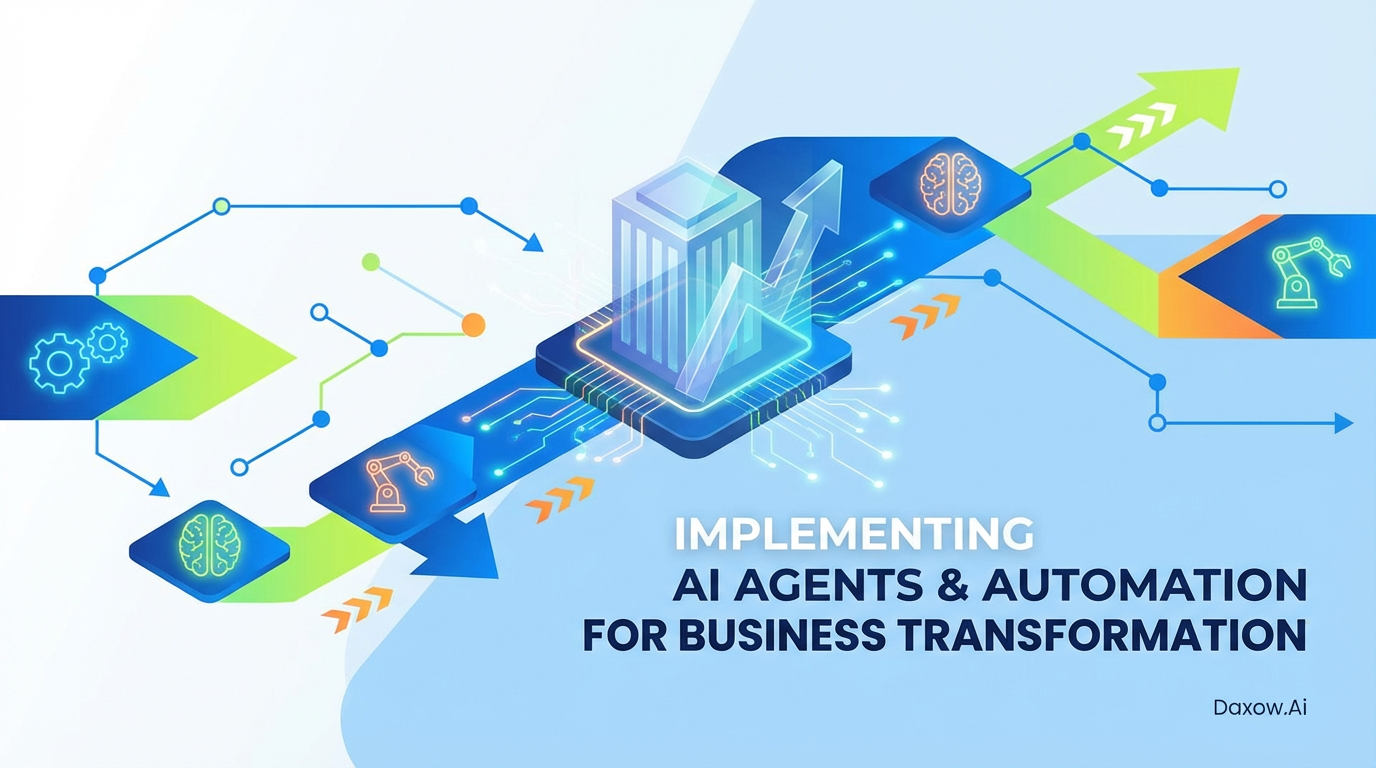
Step-by-step guide to prioritize use cases, run pilots, and scale AI agents and workflow automation to boost productivity and measurable ROI.
Implementing AI Agents and Automation: A Strategic Guide for Business Transformation
Estimated reading time: 15 minutes
Key Takeaways
- AI agents and automation transform manual, error-prone tasks into scalable, intelligent workflows delivering up to 40% productivity gains.
- Daxow.ai partners with businesses to design custom AI agents and integrate automation with existing CRMs and ERPs for faster value realization.
- Practical use cases span e-commerce, healthcare, finance, real estate, HR, customer support, and SaaS operations.
- A strategic, step-by-step implementation roadmap reduces risk, optimizes data readiness, pilot testing, and scale-up.
- Governance, ethics, user training, and clear ROI measurement are essential for sustainable AI automation success.
Table of Contents
- Why This Strategic Guide Matters
- Core Business Problems Solved
- Practical Use Cases Across Industries
- How AI Agents and Automation Deliver Value
- Implementation Steps and Best Practices
- Calculating ROI and Proof Points
- Governance, Ethics, and Change Management
- Daxow.ai: From Strategy to Execution
- Getting Started: A Practical Approach
- Conclusion and CTA
- Frequently Asked Questions
Why This Strategic Guide Matters
AI automation and AI agents do more than execute rules. They learn from interactions, predict outcomes, and orchestrate multi-step workflows across systems.
Organizations that adopt AI agents report up to 40% productivity gains and significant cost reductions. Typical operational savings range from 20–50%, with specialized pilots producing faster approvals, fewer errors, and better customer experiences.
For leaders, the opportunity is clear: use AI to reduce manual tasks, scale capacity without proportional hiring, and convert operational processes into continuous, data-driven advantages.
Core Business Problems Solved
- Repetitive administrative workloads that consume talent hours.
- Slow, inconsistent customer support and sales qualification processes.
- Fragmented data across tools (CRM, ERP, document stores) that blocks automation.
- Compliance and fraud risks that require near-real-time monitoring.
- Inability to scale processes during demand spikes.
Practical Use Cases Across Industries
E-commerce
- Use case: Automate order processing, inventory reconciliation, dynamic pricing, and returns handling.
- Impact: Reduced fulfillment times by 30–50%, lower stockouts, and improved on-time delivery rates.
- How Daxow helps: Build AI agents that integrate with your e-commerce platform and ERP to predict demand, automate reordering, and trigger fulfillment workflows—reducing manual inventory audits and eliminating invoice mismatches.
Healthcare
- Use case: Automate patient triage, appointment scheduling, clinical documentation extraction, and readmission risk prediction.
- Impact: Faster response times, higher patient satisfaction, and better care coordination.
- How Daxow helps: Design HIPAA-aware chatbots and workflow automation that connect to EHR systems for secure data extraction, automated scheduling, and clinician alerts—while maintaining audit trails and compliance.
Finance
- Use case: Real-time fraud detection, automated compliance checks, KYC onboarding, and loan decisioning.
- Impact: Fraud losses can drop substantially; approvals accelerate to meet customer expectations.
- How Daxow helps: Deploy AI agents that monitor transactions, escalate anomalies, and populate compliance reports automatically. Integrations with banking ledgers and KYC providers reduce manual review time and mitigate regulatory risk.
Real Estate
- Use case: Lead qualification, automated property valuations, contract review, and virtual-tour scheduling.
- Impact: Faster deal cycles and increased lead-to-deal conversion.
- How Daxow helps: Implement AI agents that score leads from multiple channels, schedule viewings, extract contract clauses, and notify agents of priority opportunities—improving sales automation and follow-up.
HR and People Operations
- Use case: Resume screening, candidate matching, onboarding workflows, and predictive attrition modeling.
- Impact: Shorter time-to-hire, improved quality of hire, and lower voluntary turnover.
- How Daxow helps: Create AI-assisted hiring funnels, automated onboarding checklists, and employee support bots to handle routine queries—freeing HR to focus on strategic talent development.
Customer Support and SaaS Operations
- Use case: 24/7 customer support automation, ticket triage and routing, and knowledge-base updating.
- Impact: Faster SLAs, higher customer satisfaction, and reduced support headcount pressure.
- How Daxow helps: Develop AI-driven support agents that interpret customer intent, surface relevant knowledge articles, and execute backend fixes via integrations—reducing manual escalation and improving resolution rates.
How AI Agents and Automation Deliver Value
What distinguishes AI agents from traditional automation
Traditional automation (e.g., basic RPA) is rule-based and brittle. AI agents combine machine learning, natural language understanding, and decision logic to act proactively and adapt to new inputs.
- Orchestrate multi-step processes across systems.
- Learn from interactions and reduce error rates over time.
- Generate actionable insights from unstructured data.
Primary value levers
- Efficiency gains: Automate rule-based tasks like data entry and reconciliation to free 20–40% of employees’ time.
- Scalability: Handle volume spikes without proportional hiring.
- Customer impact: Personalize interactions at scale through AI-driven recommendations and support.
- Risk reduction: Detect fraud and compliance issues in near real-time.
Daxow’s role in delivering value
- We identify automation opportunities with the highest ROI and build AI agents that execute real work—routing tickets, creating invoices, qualifying leads, and updating records.
- We integrate AI systems with your business tools and CRMs to ensure data flows are seamless and secure.
- We provide dashboards and monitoring so you can track productivity, error rates, and customer metrics continuously.
Implementation Steps and Best Practices
A structured, iterative approach reduces risk and accelerates outcomes. Below is a practical roadmap to implement AI agents and workflow automation.
-
Define clear objectives and KPIs
- Focus on high-impact processes with measurable outcomes: time saved, error reduction, cost per transaction, or NPS improvement.
- Example KPI: Reduce invoice processing time by 50% within six months.
- How Daxow helps: Conducts discovery workshops to map current workflows and define measurable objectives aligned with strategic goals.
-
Assess data readiness and compliance
- Evaluate data quality, volume, lineage, and regulatory constraints (e.g., GDPR, HIPAA).
- Prepare datasets for model training: structure, label, and anonymize as required.
- How Daxow helps: Builds secure data pipelines, implements data-cleaning routines, and ensures compliant storage and access controls.
-
Assemble a cross-functional team
- Include business owners, IT, data engineers, data scientists, and end-users.
- Assign an owner for change management and a product owner to prioritize iterations.
- How Daxow helps: Provides project management, technical delivery, and training for stakeholder alignment and adoption.
-
Select tools and run a focused pilot
- Choose platforms that balance speed and extensibility. Use pre-built components where possible to accelerate delivery.
- Pilot a single use case with a clear success definition.
- How Daxow helps: Prototypes AI agents rapidly, connecting to your systems for an airtight pilot with defined metrics and a plan to scale.
-
Integrate, test, and validate
- Conduct end-to-end testing, bias audits, and compliance checks.
- Implement fallback and human-in-the-loop controls for critical decisions.
- How Daxow helps: Runs rigorous QA, implements role-based access, and configures monitoring and alerting for exceptions.
-
Monitor, optimize, and scale
- Track model drift, KPIs, and user feedback. Retrain models and expand automation based on results.
- Use dashboards for real-time visibility and continuous improvement.
- How Daxow helps: Provides ongoing monitoring, performance optimization, and scaling strategies—ensuring the AI automation continues to meet objectives.
Best practices and common pitfalls
- Start small, prove value, then scale.
- Prioritize user training and change management early.
- Avoid vague goals; set measurable KPIs.
- Mitigate bias with transparency and regular audits.
- Ensure robust data governance to prevent model drift.
Calculating ROI and Proof Points
Metrics to measure success
- Time saved per task and percentage reduction in manual hours.
- Error rate reductions and cost per error avoided.
- Throughput increases (e.g., tickets processed per hour).
- Customer metrics: CSAT, NPS, and first-response time.
- Financial outcomes: operational cost reduction and revenue uplift from improved conversions.
Example ROI scenario (e-commerce)
- Baseline: 10 full-time staff handling order reconciliation at €40k/year each.
- Automation impact: Reduce manual effort by 60%, saving six FTE-equivalents (€240k/year).
- Additional benefits: 30% faster fulfillment, reducing lost sales and returns.
- Typical payback: Pilot costs recovered within 6–12 months; ROI of 3–5x within 12–18 months.
How Daxow quantifies ROI
- We set baseline KPIs during discovery, run pilots to validate improvements, and provide transparent reporting on time saved, error rates, and financial impact.
- Our approach ties technical metrics to business outcomes to demonstrate clear ROI.
Governance, Ethics, and Change Management
- Implement AI governance: model versioning, access controls, audit logs, and ethical review boards.
- Train users and create champions to support adoption.
- Perform regular bias and compliance checks and keep stakeholders informed with clear reporting.
Daxow.ai: From Strategy to Execution
- Process analysis: We map and prioritize workflows to identify the biggest automation opportunities.
- Custom AI systems: We design and build AI agents tailored to your business objectives and data landscape.
- End-to-end automation: From data ingestion and model training to integrations and production orchestration, we manage the full lifecycle.
- System integrations and connectivity: We connect AI agents to CRMs, ERPs, ticketing systems, and document stores to ensure workflows execute end-to-end.
- Managed monitoring and optimization: We operate dashboards, retrain models as needed, and provide SLAs for uptime and performance.
Getting Started: A Practical Approach
- Step 1: Request a process analysis to identify high-impact automation candidates.
- Step 2: Run a scoped pilot with defined KPIs and a clear success plan.
- Step 3: Integrate, monitor, and scale automation across additional processes.
- Step 4: Maintain continuous improvement with retraining, governance, and stakeholder alignment.
Conclusion and CTA
Implementing AI Agents and Automation: A Strategic Guide for Business Transformation is not a technology experiment—it's a practical pathway to reduce manual tasks, increase productivity, and unlock measurable ROI. Whether your priority is customer support automation, sales automation, document automation, or end-to-end workflow automation, Daxow.ai can design, build, and operate AI agents that execute real work and deliver business outcomes.
Book a free consultation with Daxow.ai today to request a process analysis for your company and start building a custom AI system that reduces operational costs, improves productivity, and drives sustainable business automation. Contact us to transform how your organization works.
Frequently Asked Questions
What are AI agents and how do they differ from traditional automation?
AI agents leverage machine learning and natural language understanding to act proactively, orchestrate multi-step workflows, and adapt to new information, unlike traditional rule-based automation which is limited to static instructions.
How can I measure the ROI of implementing AI automation?
ROI can be measured by assessing time saved, error reduction, throughput improvements, customer satisfaction metrics, and financial impact such as cost savings and revenue uplifts tied directly to automation projects.
Is my business data secure when integrating AI systems?
Yes. Daxow.ai implements secure data pipelines, compliance-aligned data handling (e.g., GDPR, HIPAA), and role-based access controls to ensure your data is protected throughout the AI automation lifecycle.
How do I get started with AI automation for my company?
Begin with a process analysis to identify automation opportunities, define clear objectives and KPIs, pilot select use cases, and then scale successful initiatives. You can contact Daxow.ai to start this journey.