
Practical Guide to Implementing AI Agents for Workflows
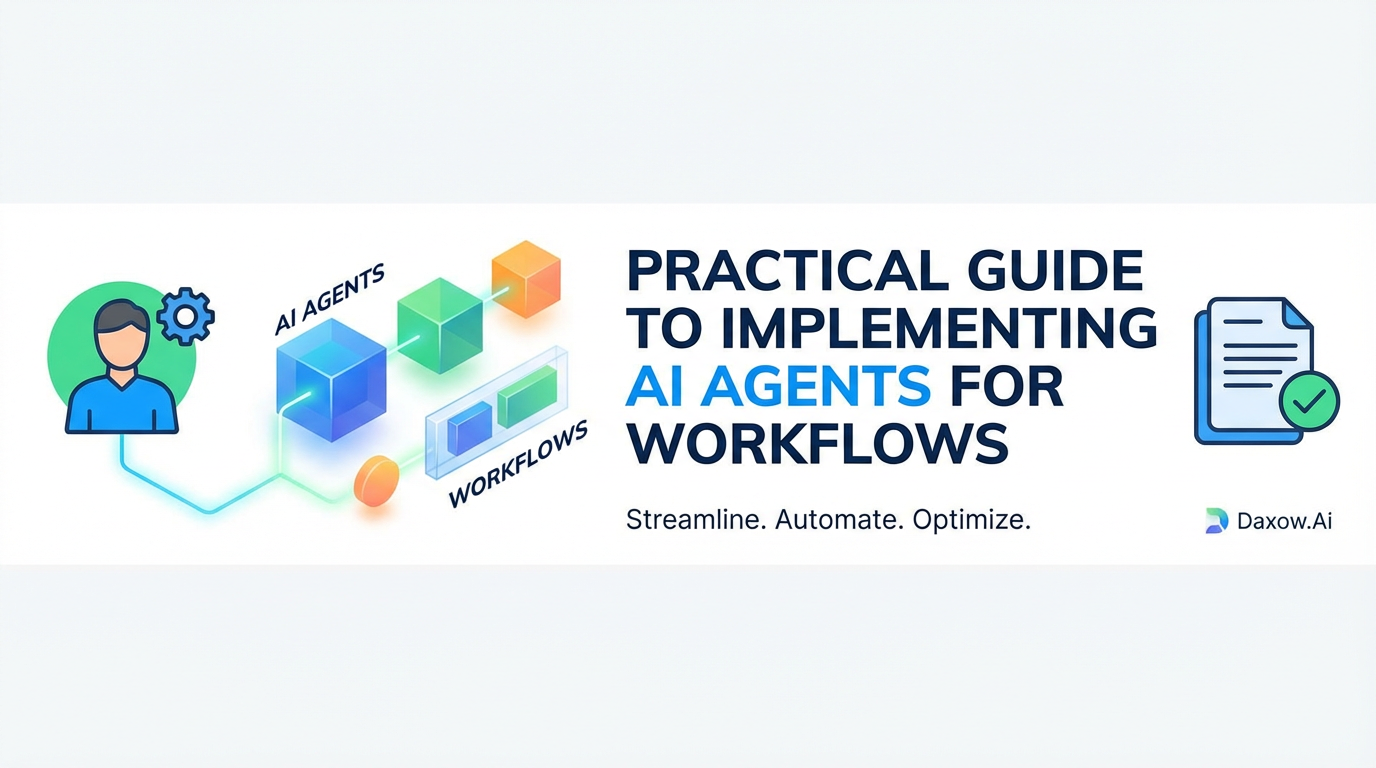
Practical roadmap to plan, build, and scale AI agents for workflow automation. Use cases, implementation steps, ROI metrics, and governance for enterprises.
Implementing AI Agents for Workflow Automation: A Practical Guide for Businesses
Estimated reading time: 15 minutes
Key Takeaways
- AI agents automate routine, rules-based work to boost productivity and reduce costs.
- Real-world use cases demonstrate transformative impacts across industries like retail, finance, healthcare, and more.
- A step-by-step framework guides businesses from discovery to scaling and governance.
- Technical best practices ensure secure, compliant, and observable AI workflows.
- Daxow.ai provides tailored AI automation solutions with proven ROI and enterprise integration expertise.
Table of Contents
- Implementing AI Agents for Workflow Automation — Strategic Value and Business Outcomes
- Practical Use Cases: How AI Agents and Workflow Automation Deliver Value Across Industries
- Implementing AI Agents for Workflow Automation — Step-by-step Framework
- Technical Considerations When Implementing AI Agents for Workflow Automation
- Common Pitfalls and How to Avoid Them
- Quantifying ROI: How AI Automation Pays Back
- How Daxow.ai Helps You Implement AI Agents for Workflow Automation
- Practical Checklist to Start Implementing AI Agents for Workflow Automation
- Frequently Asked Questions
Implementing AI Agents for Workflow Automation — Strategic Value and Business Outcomes
AI agents are autonomous or semi-autonomous systems that can perform tasks, make decisions, and interact with systems or people. When integrated into workflow automation, they shift routine, rules-based, and data-intensive work from humans to machines.
Core benefits
- Reduce manual tasks: Automate repetitive work such as data entry, form processing, and ticket triage.
- Improve productivity: Free skilled employees to focus on high-value activities.
- Enhance customer experience: Deliver faster responses and consistent interactions via customer support automation and intelligent chatbots.
- Lower operational costs: Reduce error rates and processing times; scale without linear increases in headcount.
- Enable new capabilities: Real-time lead qualification, intelligent routing, and proactive alerts.
Key metrics to track
- Time saved per task or process (hours/person/week).
- Error reduction rate (before vs after).
- Ticket first-response and resolution times.
- Conversion lift from sales automation and lead qualification.
- Cost per transaction or customer interaction.
- Return on investment (time to recoup implementation costs).
Practical Use Cases: How AI Agents and Workflow Automation Deliver Value Across Industries
E-commerce and Retail
- Use case: Order exceptions and returns processing.
- Problem: Manual verification of return reasons, refund eligibility, and restocking.
- AI agent action: Extract order and customer data, verify return policy compliance, authorize refunds, open restocking tickets, and update inventory.
- Business outcome: Faster refunds, fewer manual reviews, and improved customer satisfaction. Companies typically reduce processing time from days to minutes.
- Use case: Personalized post-purchase experiences.
- AI agent action: Analyze purchase history, trigger tailored upsell or support workflows, and schedule follow-ups.
- Business outcome: Higher lifetime value and improved retention.
Finance and Insurance
- Use case: Document intake and claims triage.
- Problem: High volume of PDFs, scanned documents, and unstructured emails.
- AI agent action: Extract structured data, validate against policy rules, flag anomalies, and route claims for approval.
- Business outcome: Lower processing costs, faster claims cycles, and reduced fraud risk.
- Use case: KYC and onboarding.
- AI agent action: Automate identity verification, cross-check against databases, and populate CRM and compliance systems.
- Business outcome: Faster onboarding, reduced compliance backlog, and improved auditability.
Healthcare
- Use case: Patient intake and care coordination.
- Problem: Administrative burden on clinicians; delayed triage.
- AI agent action: Extract patient history from intake forms, schedule appointments, send pre-visit instructions, and escalate urgent cases.
- Business outcome: Reduced administrative overhead, shorter wait times, and improved patient outcomes.
- Use case: Prior authorization automation.
- AI agent action: Gather clinical data, complete forms, and submit to payers with status tracking.
- Business outcome: Faster approvals and fewer denied claims.
Real Estate and Property Management
- Use case: Lease document processing and tenant onboarding.
- AI agent action: Extract lease terms, perform credit checks, generate customized lease packets, and schedule move-ins.
- Business outcome: Faster leasing cycles and better tenant experiences.
- Use case: Maintenance request automation.
- AI agent action: Classify requests, schedule vendors, track completion, and handle follow-ups.
- Business outcome: Improved SLA compliance and lower resolution times.
HR and Administration
- Use case: Recruitment and candidate screening.
- AI agent action: Parse resumes, evaluate against job requirements, prioritize candidates, and schedule interviews.
- Business outcome: Faster time-to-hire and reduced recruiter workload.
- Use case: Employee onboarding automation.
- AI agent action: Coordinate paperwork, set up accounts, and provide initial training resources.
- Business outcome: Better new-hire experience and faster productivity ramp.
Implementing AI Agents for Workflow Automation — Step-by-step Framework
1. Discovery and process mapping
- Identify high-impact processes by volume, cost, and frequency.
- Map current workflows and decision points.
- Quantify manual effort, error rates, and cycle times.
- Deliverable: Prioritized automation roadmap with target KPIs.
2. Data assessment and integrations
- Inventory data sources: CRMs, ERPs, email, documents, and third-party APIs.
- Evaluate data quality and identify gaps needing cleansing or enrichment.
- Plan integrations to maintain data connectivity and security.
- Deliverable: Integration design and data pipeline plan.
3. Solution design and agent specifications
- Define the agent responsibilities, triggers, inputs, outputs, and escalation rules.
- Specify AI components: NLP for extraction, classification models for routing, decision logic for approvals, and RPA for UI automation.
- Build conversational flows for customer-facing agents.
- Deliverable: Technical design and proof-of-concept scope.
4. Build and test
- Develop modular agents and workflows.
- Implement robust logging, observability, and error handling.
- Run pilot tests with controlled traffic and shadow mode to compare human vs agent decisions.
- Deliverable: Tested pilot ready for limited deployment.
5. Deploy, monitor, and iterate
- Deploy to production with rollback plans.
- Monitor KPIs, agent accuracy, and user feedback.
- Implement continuous learning cycles for model retraining and rule refinement.
- Deliverable: Production system with governance and optimization plan.
6. Scale and governance
- Expand agents to additional processes and regions.
- Establish change control, compliance checks, and performance SLAs.
- Maintain documentation and training materials.
- Deliverable: Scaled automation platform and governance playbook.
Technical Considerations When Implementing AI Agents for Workflow Automation
Model selection and orchestration
- Combine pre-trained models with fine-tuning for domain specificity.
- Use orchestration layers to route tasks between AI models, rules engines, and human agents.
- Best practice: Start with hybrid workflows—AI agents plus human-in-the-loop—for complex decisions.
Data security and compliance
- Ensure encrypted data at rest and in transit.
- Maintain audit trails for decision-making and approvals.
- Comply with domain-specific regulations (e.g., HIPAA in healthcare, GDPR in EU).
- Best practice: Embed access controls and anonymization where needed.
Integration and legacy systems
- Use connectors and APIs for CRM, ticketing, accounting, and ERP systems.
- For systems without APIs, use secure RPA with monitoring and idempotent actions.
- Best practice: Design integrations to be modular and replaceable.
Observability and human oversight
- Implement dashboards for accuracy, throughput, and exception rates.
- Set clear escalation paths for complex or ambiguous cases.
- Best practice: Define SLOs for agent performance and maintain SLAs for stakeholders.
Common Pitfalls and How to Avoid Them
- Pitfall: Automating the wrong processes.
- Avoidance: Prioritize processes with measurable volume and clear rules.
- Pitfall: Insufficient data or poor data quality.
- Avoidance: Invest in data pipelines and cleansing before automation.
- Pitfall: Ignoring user adoption and change management.
- Avoidance: Involve end-users early, provide training, and iterate with feedback.
- Pitfall: Over-automation of nuanced decisions.
- Avoidance: Keep human-in-the-loop for judgment-heavy tasks and gradually increase autonomy after proven reliability.
Quantifying ROI: How AI Automation Pays Back
Example: Support automation
- Baseline: 50 support agents, average handle time 20 minutes per ticket, 10,000 tickets/month.
- After AI agents: 30% of tickets automated, average human handle time reduced to 15 minutes for remaining tickets.
- Savings: 3,000 tickets automated × 20 minutes = 1,000 agent-hours saved/month.
- Result: Lower staffing needs, faster responses, and higher CSAT. Annualized savings can cover implementation costs within 6–12 months depending on setup.
Example: Sales lead qualification
- Baseline: 5,000 leads/month, manual qualification conversion 5%, 1 salesperson = 40 hours/week.
- After AI agents: Automated lead scoring and qualification for 70% of leads, conversion rate improves to 7% on prioritized leads.
- Savings: More efficient allocation of sales effort and higher revenue per lead. ROI achieved through increased closed deals and reduced wasted outreach.
How Daxow.ai Helps You Implement AI Agents for Workflow Automation
Daxow.ai specializes in designing and delivering end-to-end AI automation systems that meet enterprise requirements. Our services include:
- Discovery and process analysis to identify high-impact automation opportunities.
- Custom design of AI agents and workflow automation tailored to your business rules and data.
- Integration with your CRM, ERP, ticketing systems, and other business tools to maintain data fidelity and process continuity.
- Building secure, auditable pipelines for document automation, data extraction, and chat-based customer support.
- Deployment, monitoring, and continuous improvement to maximize ROI and maintain compliance.
- Training and change management to ensure adoption and measurable productivity gains.
Typical Daxow.ai engagement
- Phase 1: Process analysis and roadmap (2–4 weeks).
- Phase 2: Proof-of-concept (4–8 weeks) implementing 1–2 high-impact agents.
- Phase 3: Production rollout and optimization (ongoing).
- Outcomes: Reduced manual tasks, faster cycle times, and a scalable architecture for future automation.
Practical Checklist to Start Implementing AI Agents for Workflow Automation
- Identify top 3 processes by volume and pain points.
- Measure baseline KPIs: time, cost, error rate.
- Catalog data sources and integration points.
- Define success metrics and acceptable error thresholds.
- Select a vendor or partner with experience in enterprise integrations and AI operations.
- Start with a pilot and plan for iterative improvements.
Frequently Asked Questions
What types of tasks can AI agents automate in workflows?
AI agents can automate routine, rules-based, and data-intensive tasks such as data entry, document processing, customer support interactions, lead qualification, and approvals.
How does Daxow.ai approach integrating AI agents into existing systems?
Daxow.ai designs custom AI agents that seamlessly integrate with CRMs, ERPs, ticketing, and other business tools using APIs, RPA, and secure data pipelines to maintain workflow continuity and data integrity.
What industries benefit most from AI workflow automation?
Industries such as E-commerce, Retail, Finance, Insurance, Healthcare, Real Estate, Property Management, HR, and Administration see significant improvements by automating manual processes with AI agents.
How do businesses measure ROI for AI agent implementations?
By tracking key metrics like time saved, error reduction, ticket resolution speed, conversion lifts, and cost per transaction, businesses can calculate payback periods and quantify financial benefits.