
Implementing AI Agents and Workflow Automation for Business Growth
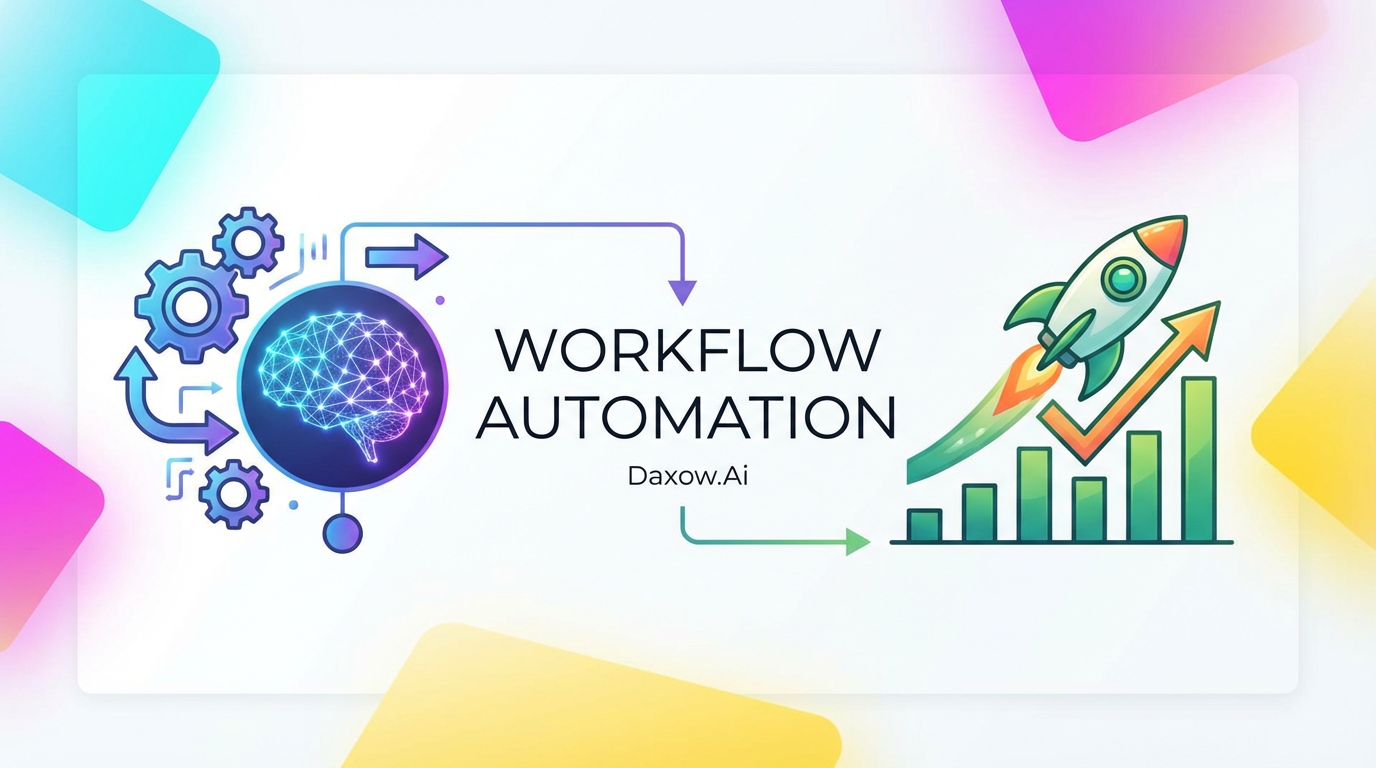
Cut costs and boost productivity with AI agents and workflow automation. Practical roadmap, industry use cases, and Daxow.ai implementation services.
Unlocking Business Growth: Implementing AI Agents and Workflow Automation
Estimated reading time: 12 minutes
Key Takeaways
- AI agents combined with workflow automation can reduce manual tasks by 50–70% and cut operational costs by up to 40%.
- Practical AI use cases span industries including e-commerce, healthcare, finance, real estate, HR, and customer support.
- Successful implementation requires a roadmap from process audit to scaled deployment with governance and optimization.
- Daxow.ai specializes in custom AI automation strategies integrated with CRMs, ERPs, and support systems to ensure measurable ROI.
Table of Contents
- Unlocking Business Growth: Implementing AI Agents and Workflow Automation
- Practical Use Cases Across Industries
- How AI Agents and Workflow Automation Drive Results
- Implementation Roadmap: From Process Audit to Scaled Automation
- Measuring ROI and Managing Risk
- Common Pitfalls and How Daxow.ai Prevents Them
- Getting Started — Practical Next Steps
- Frequently Asked Questions
Unlocking Business Growth: Implementing AI Agents and Workflow Automation
AI agents — autonomous software systems powered by machine learning and generative AI — combined with workflow automation create a new class of business automation. Unlike basic rule-based automation, AI agents can interpret unstructured inputs, make contextual decisions, and orchestrate multi-step processes across systems. That capability unlocks several strategic outcomes:
- Reduce manual tasks: Agents can handle high-volume, repetitive activities (data extraction, ticket triage, lead qualification), reducing manual effort by 50–70% in targeted processes.
- Improve productivity and decision accuracy: Real-time data processing and predictive analytics enable faster, more accurate decisions, boosting throughput and customer satisfaction.
- Drive cost reductions: Organizations can achieve up to 40% operational cost reduction by eliminating labor-intensive bottlenecks and reducing error rates.
- Scale without linear headcount growth: Agents process larger data volumes and transactions without proportional staff increases, supporting rapid growth with predictable costs.
Daxow.ai specializes in designing custom AI automation strategies that align these benefits with your core business objectives — from initial readiness audits to building AI agents and integrating them into CRMs, ERPs, and support systems.
Practical Use Cases Across Industries
E-commerce — Sales Automation and Inventory Forecasting
- Use case: AI agents qualify leads, generate personalized product recommendations, and predict inventory shortages.
- Business impact: Fewer stockouts, higher conversion rates, and lower cost-per-acquisition.
- Daxow.ai approach: Connect customer behavior data, order systems, and marketing platforms to deploy lead-scoring agents and predictive reorder workflows that trigger purchase orders automatically.
Healthcare — Patient Triage and Document Automation
- Use case: NLP-driven triage to classify patient symptoms, automated extraction of information from clinical documents, and compliance monitoring.
- Business impact: Faster response times, reduced administrative burden for clinicians, and improved regulatory adherence.
- Daxow.ai approach: Build HIPAA-compliant AI agents that integrate with EHR systems, extract structured data from unstructured notes, and route cases to the correct care pathway.
Finance — Fraud Detection and Invoice Reconciliation
- Use case: Real-time transaction surveillance for fraud patterns and automatic reconciliation of incoming invoices.
- Business impact: Reduced risk exposure, decreased audit times, and lower operational costs.
- Daxow.ai approach: Deploy anomaly detection models with explainability layers, connect to payment and accounting systems, and automate exception handling workflows.
Real Estate — Valuation, Listings, and Lead Qualification
- Use case: Market-data-driven property valuations, auto-generated listing descriptions, and automated buyer qualification.
- Business impact: Faster deal cycles, higher lead-to-deal conversion, and reduced time on market.
- Daxow.ai approach: Combine public market feeds with internal CRM data to power valuation agents and automated marketing content generators.
HR — Candidate Screening and Onboarding Automation
- Use case: Resume parsing, candidate scoring, and orchestrated onboarding (document collection, access provisioning).
- Business impact: Shorter time-to-hire, better candidate experience, and freed-up recruiter time for strategic hiring decisions.
- Daxow.ai approach: Implement AI agents that screen for qualifications, flag high-fit candidates, and trigger onboarding workflows across HRIS and IT systems.
Customer Support — Support Automation and Knowledge Management
- Use case: AI agents handle tier-1 support, route complex cases to specialists, and summarize interactions for knowledge base updates.
- Business impact: Higher first-response rates, reduced average handle time, and improved CSAT.
- Daxow.ai approach: Integrate chatbots with CRM and ticketing systems to automate triage, escalate with context, and feed continuous learning loops.
How AI Agents and Workflow Automation Drive Results
AI agents drive value by executing connected, multi-step processes that span teams and systems. Key capabilities include:
- Advanced data extraction: Pull structured information from invoices, contracts, emails, and images.
- Contextual decisioning: Use real-time data and historical patterns to route tasks, approve exceptions, or trigger actions.
- Predictive forecasting: Anticipate inventory shortages, customer churn, or fraud events before they occur.
- Continuous learning and feedback loops: Retrain models based on human corrections and changing business conditions.
These capabilities translate into measurable outcomes:
- Faster throughput: Agents process cases faster than manual workflows and maintain consistent SLAs.
- Reduced errors: Automated data validation and standardized decision rules reduce costly mistakes.
- Operational transparency: Audit trails and explainable AI provide traceability for compliance and governance.
- Human-AI collaboration: Agents handle scale while humans focus on strategic, creative, and relationship-driven work.
Daxow.ai designs agents to perform real operational tasks — not proofs-of-concept — ensuring integrations with CRMs, ERPs, support systems, and data lakes to create end-to-end automation.
Implementation Roadmap: From Process Audit to Scaled Automation
1. Define Precise Goals and Audit Readiness
- Actions: Identify top pain points, define KPIs (cost per process, throughput, NPS), and conduct a data quality audit.
- Daxow.ai role: Facilitate readiness workshops, build an AI-readiness scorecard, and map high-impact opportunities.
2. Prioritize High-Impact Workflows
- Actions: Select processes with high volume and repeatability for quick wins (e.g., invoice processing, ticket triage).
- Daxow.ai role: Run pilot scoping sessions and estimate potential cost savings and time-to-value.
3. Select Tools and Design Architecture
- Actions: Choose models and platforms that support integration, scalability, and explainability. Design data pipelines and security controls.
- Daxow.ai role: Recommend best-fit technologies, build integration blueprints, and ensure compliance and auditability.
4. Build Cross-Functional Teams
- Actions: Assemble product owners, data engineers, subject-matter experts, and change managers.
- Daxow.ai role: Provide experienced engineers and project managers to complement internal teams and run knowledge-transfer sessions.
5. Test, Deploy, and Monitor
- Actions: Validate models with holdout datasets, set KPIs (accuracy, precision, recall), and implement monitoring and alerting for drift.
- Daxow.ai role: Execute phased rollouts, instrument dashboards for KPI tracking, and establish retraining pipelines.
6. Scale with Governance and Optimization
- Actions: Modularize solutions, embed audit trails, and expand across business units after successful pilots.
- Daxow.ai role: Support scaling across regions and systems, implement governance frameworks, and run continuous improvement cycles.
Measuring ROI and Managing Risk
Measuring results and controlling risk are crucial for sustaining momentum.
Key metrics to track:
- Cost per transaction or process.
- Time saved per case (hours/day).
- Error rate reductions and compliance exceptions.
- Throughput and SLA adherence.
- Customer satisfaction (CSAT, NPS) and lead-to-deal conversion rates.
Risk and mitigation:
- Data quality issues: Mitigate via preprocessing pipelines, validation rules, and human-in-the-loop checkpoints.
- Model drift: Monitor model performance and set retraining schedules.
- Shadow IT and unauthorized tools: Enforce governance policies and provide approved interfaces that deliver value quickly.
- Compliance and security: Build privacy controls, encryption, and audit logs from day one.
Daxow.ai’s deployments include built-in monitoring, retraining orchestration, and governance components to protect value and ensure sustainable ROI.
Common Pitfalls and How Daxow.ai Prevents Them
- Pitfall: Starting with a complex, low-value process.
Remedy: Daxow.ai prioritizes high-impact, high-volume workflows to deliver quick wins and build credibility. - Pitfall: Poor data quality undermining model performance.
Remedy: We perform detailed data audits and implement transformation pipelines and validation rules before modeling. - Pitfall: Lack of cross-functional ownership and change management.
Remedy: We embed change management and train teams, ensuring adoption and operational handover. - Pitfall: Vendor lock-in or brittle point solutions.
Remedy: We design modular, API-driven architectures that integrate with existing CRMs, ERPs, and data platforms. - Pitfall: Ignoring compliance and auditability.
Remedy: We design for traceability, explainability, and regulatory controls from the outset.
Getting Started — Practical Next Steps
- Run an internal process audit to identify top 3 repetitive workflows by volume and cost.
- Build an AI-readiness scorecard focused on data accessibility, security, and stakeholder alignment.
- Pilot one high-impact automation with measurable KPIs and a 6–12 month payback target.
- Plan integrations with core systems (CRM, ERP, ticketing) and define governance for continuous improvement.
Daxow.ai will partner with you through these steps: we assess readiness, design and build AI agents, integrate systems, and manage deployment and scaling to ensure your automation delivers real business outcomes.
Conclusion and Call to Action
Unlocking Business Growth: Implementing AI Agents and Workflow Automation transforms manual, error-prone processes into scalable, measurable assets. With clear prioritization, strong data practices, and modular architecture, organizations can achieve substantial cost reductions, productivity gains, and faster decision-making. Daxow.ai provides end-to-end services — from process analysis and custom AI agent development to integrations, compliance, and long-term support — to ensure your automation initiatives deliver sustainable ROI.
Book a free consultation with Daxow.ai today to request a process analysis for your company and begin designing a custom AI system that reduces manual tasks, boosts productivity, and drives measurable business value. Contact us to build your AI automation roadmap and deploy AI agents that execute real work.
Frequently Asked Questions
What are AI agents and how do they differ from traditional automation?
AI agents are autonomous software systems powered by machine learning and generative AI capable of interpreting unstructured data and making contextual decisions, unlike traditional rule-based automation which operates on fixed rules.
How quickly can businesses expect ROI from implementing AI workflow automation?
Many organizations see payback on selected AI initiatives within 6–12 months, driven by cost savings, productivity improvements, and error reductions.
Which industries benefit most from AI agents and workflow automation?
AI agents provide value across industries including e-commerce, healthcare, finance, real estate, HR, and customer support by automating complex, repetitive, and data-intensive processes.
How does Daxow.ai ensure compliance and data security in AI implementations?
Daxow.ai embeds privacy controls, encryption, audit logs, and regulatory compliance features from day one, ensuring AI systems operate securely and transparently.