
Implementing AI Agents and Workflow Automation for Business Growth
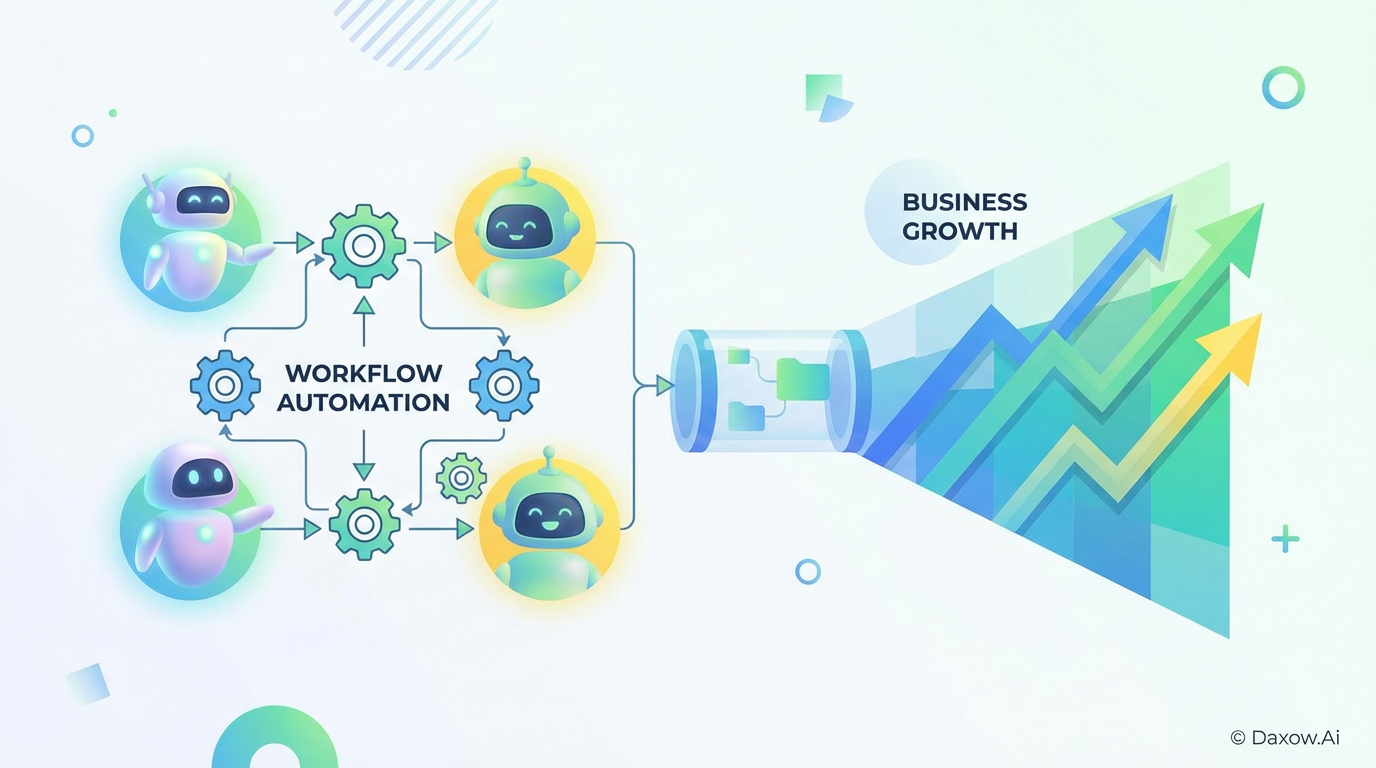
Practical guide to implementing AI agents and workflow automation—use cases, phased roadmap, ROI metrics, and how Daxow.ai builds production-grade solutions.
Unlocking Business Growth: Implementing AI Agents and Workflow Automation
Estimated reading time: 15 minutes
Key Takeaways
- AI agents and workflow automation reduce manual tasks and improve productivity across industries.
- Practical use cases span e-commerce, customer support, finance, healthcare, real estate, and HR.
- A phased implementation roadmap helps minimize risk and accelerate ROI.
- Technical design focuses on scalability, security, auditability, and seamless integration.
- Measuring KPIs is critical to demonstrate business value and guide optimization.
- Daxow.ai delivers end-to-end AI automation from discovery to ongoing support with compliance and governance.
Table of Contents
- Why AI Agents and Workflow Automation Matter
- Practical Use Cases: How AI Agents and Workflow Automation Deliver Value
- Implementation Roadmap: Phases to Implement AI Agents and Workflow Automation
- Technical Design: How AI Agents Orchestrate Workflows
- Measuring ROI: KPIs That Matter
- How Daxow.ai Delivers End-to-End AI Automation
- Governance and Compliance — Ensuring Safe Automation
- Getting Started — A Practical Checklist
- Frequently Asked Questions
Why AI Agents and Workflow Automation Matter
AI agents and workflow automation work together to create systems that do more than simply execute tasks: they reason, adapt, and orchestrate multi-step processes across tools and teams. By combining machine learning, natural language processing (NLP), and integrations with CRMs, ERPs, and ticketing systems, businesses can:
- Reduce manual tasks across high-volume operations such as support, finance, and HR.
- Improve productivity by up to 40% in repetitive functions through faster processing and fewer errors.
- Scale operations with consistent performance and 24/7 availability.
- Free human teams for strategic, revenue-generating work rather than low-value processing.
AI agents outperform traditional automation for processes that involve unstructured data, decision-making, or conversational interfaces. Workflow automation ensures these agents execute reliable, auditable sequences across systems.
Practical Use Cases: How AI Agents and Workflow Automation Deliver Value
E-commerce — Order Processing, Inventory, and Personalization
- Use case: End-to-end order processing — from order ingestion to fulfillment confirmation and exception handling (e.g., out-of-stock).
- Benefits: Faster order turnaround, fewer fulfillment errors, and improved customer satisfaction. AI-driven demand forecasting reduces stockouts and excess inventory.
- Example metrics: 30–50% reduction in manual order interventions; 10–25% reduction in stockouts.
- Daxow.ai role: Build AI agents that integrate with your e-commerce platform, warehouse management system, and CRM to automate order routing, returns processing, and personalized customer notifications.
Customer Support — Ticket Triage and Resolution
- Use case: Customer support automation with AI agents that triage incoming tickets, suggest responses, resolve routine queries, and escalate complex issues to agents with full context.
- Benefits: Faster first response times, higher agent productivity, consistent quality, and reduced average handling time.
- Example metrics: 40% productivity improvement in high-volume channels; 20–30% increase in resolution rate at first contact.
- Daxow.ai role: Design conversational AI and workflow automation that connect to helpdesk platforms, knowledge bases, and CRM records to automate responses, route issues, and provide agents with real-time recommendations.
Finance — Invoice Processing and Compliance
- Use case: Invoice intake, OCR-based data extraction, automated approval workflows, and reconciliation with accounting systems.
- Benefits: Significant reduction in manual data entry, faster close cycles, and lower error rates.
- Example metrics: Up to 90% reduction in data-entry errors; 50% faster invoice processing.
- Daxow.ai role: Implement document automation and AI agents for intelligent extraction, validation, exception handling, and integration with ERP and accounting systems.
Healthcare — Scheduling, Triage, and Documentation
- Use case: Patient scheduling automation, symptom triage chatbots, and automated documentation extraction for clinical records.
- Benefits: Reduced administrative overhead, improved patient access, and faster response times for non-emergency inquiries.
- Example metrics: 20–40% reduction in administrative scheduling time; faster triage for routine inquiries.
- Daxow.ai role: Build HIPAA-compliant AI agents that integrate with EHRs, patient portals, and scheduling systems while ensuring security and auditability.
Real Estate — Lead Qualification and Transaction Workflows
- Use case: NLP-driven lead qualification, automatic property matching, viewing scheduling, and contract workflow automation.
- Benefits: Faster lead-to-viewing cycles, higher conversion rates, and reduced follow-up workload for agents.
- Example metrics: 30–60% faster lead qualification; improved conversion by automating follow-ups.
- Daxow.ai role: Create lead qualification agents that parse inbound messages, score leads, and trigger CRM workflows with personalized follow-ups.
HR — Onboarding and Candidate Screening
- Use case: Resume parsing, automated pre-screen chat interviews, onboarding document automation, and employee FAQ bots.
- Benefits: Reduced time-to-hire and smoother onboarding experiences.
- Example metrics: 30–50% reduction in hiring time; lower administrative burden on HR teams.
- Daxow.ai role: Deliver AI agents for applicant screening, automated scheduling, and onboarding checklist orchestration integrated with your HRIS.
Implementation Roadmap: Phases to Implement AI Agents and Workflow Automation
Phase 1 — Assess and Plan (4–8 weeks)
- Identify high-impact workflows for quick wins — e.g., ticket triage, invoice reconciliation, or order processing.
- Define measurable goals: cost reduction, throughput improvement, NPS or resolution times.
- Assemble a cross-functional team: business SMEs, IT, data owners, and a change management lead.
- Deliverables: process maps, target KPIs, and a prioritized backlog of use cases.
Phase 2 — Select Technology and Prepare Data (6–12 weeks)
- Evaluate platforms for integration capabilities, scalability, compliance, and vendor support.
- Clean and annotate data sources: knowledge bases, historical tickets, invoices, and CRM records.
- Design integrations with CRMs, ERPs, and other back-end systems to ensure data flows and context.
- Deliverables: target architecture, data readiness plan, and integration requirements.
Phase 3 — Pilot and Deploy (4–20 weeks per use case)
- Start with a single, high-ROI pilot (e.g., returns processing or ticket triage).
- Deploy AI agents in a monitored mode with human-in-the-loop for exceptions and supervision.
- Collect metrics and user feedback; iterate rapidly to improve performance.
- Deliverables: pilot performance report, updated models, and rollout plan.
Phase 4 — Monitor, Govern, and Optimize
- Establish monitoring for performance, bias, and operational metrics.
- Implement retraining schedules and feedback loops to keep models current.
- Define escalation paths and clear ownership for continuous improvement.
- Deliverables: governance framework, retraining pipeline, and operational dashboards.
Best Practices to Reduce Risk and Improve Adoption
- Start small with high-ROI workflows to build internal champions.
- Prioritize data readiness and integrations — reliable automation depends on clean data and strong connectors.
- Design human-in-the-loop flows for safety, quality assurance, and user confidence.
- Invest in change management and training to increase adoption and reduce resistance.
- Align automation with governance, security, and compliance (GDPR, HIPAA where relevant).
Technical Design: How AI Agents Orchestrate Workflows
AI agents function as orchestration layers that connect to business systems, apply intelligence, and trigger workflows. Key components include:
- Input layer: Channels (email, chat, forms) where data and requests enter.
- AI layer: NLP for intent classification, ML models for predictions, and rules engines for deterministic logic.
- Orchestration: Workflow engine that sequences tasks, calls APIs, and coordinates human handoffs.
- Integration layer: Connectors to CRM, ERP, ticketing, and document systems.
- Monitoring and feedback: Dashboards, logging, and retraining pipelines.
Design considerations:
- Scalability: Architect for multi-channel, multi-language support and growing data volumes.
- Resilience and auditability: Maintain full logs and transaction trails for compliance and troubleshooting.
- Security and compliance: Apply data protection, encryption, and access controls.
- Interoperability: Prefer APIs and standardized connectors to minimize custom point-to-point integrations.
Measuring ROI: KPIs That Matter
Real business value comes from measurable improvements. Track these KPIs to quantify impact and justify scaling:
- Operational KPIs:
- Cost per transaction
- Average handling time (AHT)
- Throughput (items processed per hour)
- Error rate (data-entry errors, processing exceptions)
- Customer and revenue KPIs:
- Net Promoter Score (NPS)
- First contact resolution (FCR)
- Conversion rates for sales automation
- Strategic KPIs:
- Time-to-hire or time-to-close
- Compliance audit pass rates
- Employee time reallocated to strategic tasks
Typical ROI scenarios:
- Labor savings: automation can reduce manual workload by up to 50% in targeted roles.
- Error reduction: data tasks often see error reductions of up to 90% with correct automation.
- Speed to value: organizations following a phased approach achieve objectives 3–5x faster, with potential ROI of 200–400% within 12–18 months.
How Daxow.ai Delivers End-to-End AI Automation
Daxow.ai was founded to help organizations move beyond pilots and deliver production-grade AI automation that drives measurable business outcomes. Our approach focuses on business value, reliability, and seamless integration.
Discovery and Process Analysis
- We begin with a process analysis to identify high-impact workflows and define measurable targets.
- Deliverables: prioritized automation roadmap and a quantified business case.
Custom AI Agent Design and Integration
- We design AI agents tailored to your use cases: conversational agents for support, document automation for finance, and predictive agents for sales and operations.
- Agents integrate with your tech stack — CRMs, ERPs, ticketing systems, and databases — to execute end-to-end workflows.
Implementation, Pilot, and Scale
- We build, test, and deploy pilots with human-in-the-loop controls to ensure safety and reliability.
- Post-pilot, we operationalize monitoring, retraining pipelines, and governance to scale across teams and channels.
Ongoing Optimization and Support
- Continuous improvement is part of our delivery: retraining models, updating workflows, and expanding automation footprints.
- We provide training, documentation, and change management support to maximize adoption and ROI.
Learn more about our solutions on our Solutions and Services pages.
Governance and Compliance — Ensuring Safe Automation
Security and governance are non-negotiable. Daxow.ai embeds compliance, privacy, and ethical safeguards into every project:
- Data minimization and encryption strategies.
- Role-based access controls and audit logs.
- Bias monitoring and fairness testing for models.
- Compliance mapping for GDPR, HIPAA, and industry-specific regulations.
Getting Started — A Practical Checklist
- Identify 2–3 high-impact processes for a pilot.
- Gather historical data and documentation for those processes.
- Establish success metrics and an executive sponsor.
- Engage a partner to design and deliver an end-to-end solution.
If you’re unsure where to begin, Daxow.ai offers a structured process analysis to uncover opportunities, quantify ROI, and produce a prioritized roadmap.
Frequently Asked Questions
What industries benefit most from AI agents and workflow automation?
Industries with high-volume repetitive processes such as e-commerce, customer support, finance, healthcare, real estate, and HR typically see the greatest benefits.
How long does it take to implement AI automation?
Implementation timelines vary by use case but typically follow a phased roadmap spanning several weeks to months, starting with assessment and planning, then technology selection, pilot deployment, and scale.
How does Daxow.ai ensure data security and compliance?
Daxow.ai applies data minimization, encryption, role-based access, audit logging, and complies with GDPR, HIPAA, and industry-specific regulations to safeguard client data.
Can AI agents handle unstructured data?
Yes, AI agents excel at processing unstructured data using NLP, ML models, and OCR, enabling automation of complex decision-making and conversational workflows.