

Implementing AI Workflow Automation for Business Growth
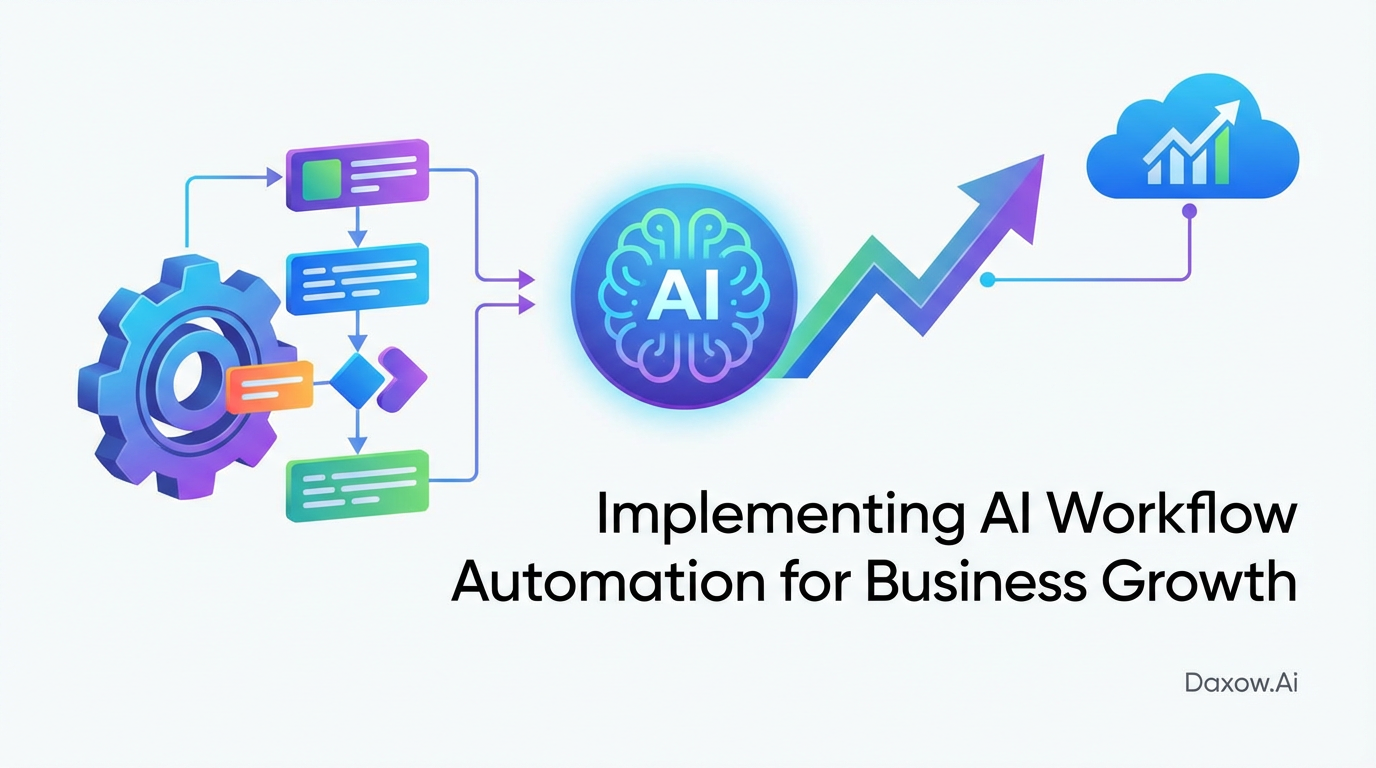
Practical guide to implementing AI workflow automation: steps, use cases, ROI, and how Daxow.ai builds scalable AI agents to drive growth.
Unlocking Business Growth: Implementing AI Workflow Automation
Estimated reading time: 15 minutes
Key Takeaways
- AI workflow automation transforms repetitive tasks into scalable, 24/7 operations enabling faster and cheaper processes.
- Businesses see 30–50% cost reductions, 40–70% faster task completions, and up to 30% productivity gains within the first year.
- Strategic implementation involves assessment, technology selection, pilot deployment, and continuous optimization.
- Daxow.ai partners deliver custom AI agents integrated with existing systems, ensuring compliance and measurable ROI.
- Practical use cases span e-commerce, healthcare, finance, real estate, HR, and customer support.
Table of Contents
- Unlocking Business Growth: Implementing AI Workflow Automation in Practice
- How AI Agents and Workflow Automation Drive Transformation
- Implementation Steps and Best Practices — A Practical Framework
- Measuring ROI and Business Value
- Real-world Implementation Examples — Actionable Use Cases
- How Daxow.ai Works With You — From Discovery to Continuous Improvement
- Frequently Asked Questions
Unlocking Business Growth: Implementing AI Workflow Automation in Practice
Unlocking Business Growth: Implementing AI Workflow Automation is no longer a theoretical advantage — it is a practical roadmap for companies that want to reduce manual work, scale operations, and improve customer outcomes. For decision-makers across startups, enterprises, and service teams, the promise of AI automation and AI agents is measurable: faster processing, lower costs, and better customer experiences. This article synthesizes industry research and proven practices into an actionable guide that shows how businesses can implement workflow automation, deploy AI agents, and capture rapid ROI. Throughout, we explain how Daxow.ai partners with organizations to design, deploy, and scale custom AI systems that deliver tangible business value.
Why this matters now
- AI automation converts repetitive, rule-based tasks into scalable systems that run 24/7.
- Organizations that adopt structured AI implementations achieve objectives 3–5x faster and realize sustained efficiency and customer satisfaction improvements.
- Practical outcomes include 30–50% reductions in process costs, 40–70% faster task completion, and 20–30% productivity gains within the first 6–12 months.
Strategic importance for the business
- Reduce manual tasks: Tasks such as data entry, invoice processing, and routine inquiries consume disproportionate resources.
- Improve decision-making: Predictive insights reduce risk and improve responsiveness.
- Ensure compliance and reliability: Automation can embed regulatory controls (e.g., HIPAA, financial compliance) and auditing capabilities.
- Unlock human capital: Automation frees teams to focus on strategic and revenue-generating work, improving overall productivity.
What AI agents and workflow automation actually do
- Execute end-to-end processes across systems (CRM, ERP, ticketing).
- Process unstructured data (emails, PDFs) and extract structured outputs.
- Make context-aware decisions and escalate exceptions to humans.
- Continuously learn and adapt through model retraining and feedback loops.
Use cases: Practical examples across industries
E-commerce
- Use case: Automate order processing, returns, inventory adjustments, and personalized recommendations.
- Impact: Reduce order-handling times from hours to minutes, cut fulfillment errors, and optimize stock levels.
- How Daxow helps: Build AI agents that integrate with your e-commerce platform and ERP to automate order validation, predict reorder points, and power personalized communications that increase conversion.
Healthcare
- Use case: Automate patient intake, triage via NLP chatbots, scheduling, and insurance claim pre-processing.
- Impact: Faster triage and scheduling, improved patient satisfaction, and fewer administrative errors. Automated checks enforce compliance with HIPAA and data governance policies.
- How Daxow helps: Design compliant workflow automation with role-based access, auditing, and escalation to clinicians when cases fall outside automated thresholds.
Finance
- Use case: Fraud detection, automated reconciliation, compliance checks, and loan application triage.
- Impact: Real-time transaction monitoring, lower false positives, and shorter approval cycles.
- How Daxow helps: Deploy AI agents that interface with transaction systems, flag anomalies, perform rule-based and ML-driven assessments, and prepare audit-ready reports.
Real Estate
- Use case: Lead qualification, automated listing updates, virtual tour scheduling, and contract review.
- Impact: Faster lead-to-showing timelines, improved agent productivity, and quicker closings.
- How Daxow helps: Connect listings, CRM, and calendar systems to create AI-driven lead scoring and automated outreach sequences that prioritize high-intent prospects.
HR and Operations
- Use case: Resume screening, candidate matching, onboarding automation, and sentiment analysis of employee feedback.
- Impact: Cut time-to-hire by up to 50%, reduce manual administrative work, and proactively identify retention risks.
- How Daxow helps: Implement AI agents that screen applicants against role criteria, automate offer and onboarding workflows, and integrate with HRIS systems for seamless records management.
How AI Agents and Workflow Automation Drive Transformation
From automation to intelligent orchestration
Traditional RPA handles predictable UI-based tasks. AI agents add language understanding, prediction, and decision-making. Agents can combine rule-based actions with ML models to handle unstructured inputs and complex decision paths.
Measurable operational improvements
- Customer support automation can autonomously resolve 70–80% of standard inquiries, escalating only complex cases.
- Automation scales to handle peak loads without adding headcount, maintaining SLA targets and CSAT scores.
Integration and data connectivity
Value is unlocked when agents connect to CRMs, ERPs, ticketing systems, and data warehouses. Daxow designs integrations to ensure secure, bi-directional data flows and single-source-of-truth architectures that prevent silos.
Risk management, ethics, and governance
- Continuous monitoring for model drift, bias, and compliance is essential.
- Human oversight and clear escalation rules maintain ethical service standards.
- Daxow implements governance layers: logging, role controls, and retraining schedules that ensure long-term reliability.
Implementation Steps and Best Practices — A Practical Framework
1. Assess and Plan (4–8 weeks)
- Map current workflows and identify high-volume, high-error processes.
- Define clear KPIs (e.g., 30% cost reduction, 50% faster processing).
- Assemble a cross-functional team: IT, business SMEs, compliance, and change management.
Deliverable: Prioritized roadmap with pilot candidates and success metrics.
2. Select Technology and Prepare Data (6–12 weeks)
- Evaluate platforms for integration compatibility, scalability, and compliance.
- Cleanse and normalize data; build knowledge bases and training datasets.
- Define APIs and data contracts for CRM/ERP connectivity.
Deliverable: Technical architecture, data pipeline, and integration plan.
3. Pilot and Deploy (4–20 weeks)
- Launch a focused pilot (example: invoice processing or lead qualification).
- Monitor performance, collect feedback, and refine models.
- Establish escalation paths for exceptions and integrate with human workflows.
Deliverable: Production-ready automations and validated ROI metrics for scale.
4. Monitor, Optimize, and Scale (Ongoing)
- Run dashboards for KPIs: resolution rates, cost per transaction, CSAT, and ROI.
- Schedule model retraining and audits for bias and drift.
- Expand automation to adjacent processes and geographies.
Deliverable: Continuous improvement plan and governance framework.
Best practices condensed
- Start small, aim for quick wins: Select low-complexity, high-volume processes.
- Prioritize data readiness: Clean, accessible data is the foundation.
- Embed human oversight: Keep humans in the loop for exception handling and ethical decisions.
- Plan for scaling early: Ensure chosen technologies and integrations support growth.
- Measure everything: Define KPIs and tie automation results directly to business outcomes.
Measuring ROI and Business Value
Realistic expectations
- Typical early returns: 30–50% reduction in process costs and 40–70% faster task completion for target processes.
- Productivity gains of 20–30% are commonly observed within the first year.
- Longer-term advantages include the ability to handle 3–5x transaction volumes without proportional headcount increases.
ROI drivers to track
- Cost per transaction before vs after automation.
- Time-to-resolution and SLA compliance.
- Customer satisfaction (CSAT) and Net Promoter Score (NPS) deltas.
- Employee time reallocated to strategic tasks.
- Reduction in error rates and compliance incidents.
How Daxow ensures ROI
- Daxow structures pilots to demonstrate ROI quickly, using measurable success criteria.
- We align automation milestones with financial and operational KPIs.
- Post-deployment, Daxow provides monitoring and optimization to sustain and increase returns.
Real-world Implementation Examples — Actionable Use Cases
Invoice processing (Finance)
- Problem: Manual invoice entry, frequent mismatches, long approval cycles.
- Automation: AI agents extract line-items from PDFs, validate against POs, route exceptions, and post to ERP.
- Outcome: 50–70% reduction in processing time, fewer payment delays, and simplified audit trails.
24/7 customer support for SaaS (Customer Support Automation)
- Problem: High volume of repetitive support tickets and slow response times.
- Automation: Conversational AI agents triage issues, provide step-by-step troubleshooting, and escalate complex problems to engineers.
- Outcome: Autonomous resolution of 70–80% of cases, improved CSAT, and reduced support costs.
Lead qualification for B2B sales (Sales Automation)
- Problem: Sales team spends hours qualifying low-intent leads.
- Automation: AI agents score leads based on behavior and firmographics, schedule demos, and populate CRM records.
- Outcome: Shorter sales cycles, higher-quality pipeline, and improved conversion rates.
Patient intake and triage (Healthcare)
- Problem: Administrative burden on clinical staff and delayed appointments.
- Automation: NLP-powered intake forms and triage chatbots collect symptoms and prioritize appointments.
- Outcome: Faster scheduling, better resource allocation, and improved patient experience.
How Daxow.ai Works With You — From Discovery to Continuous Improvement
End-to-end services
- Discovery & process analysis: We map processes, identify automation opportunities, and quantify expected impact.
- Custom AI design: We build AI agents tailored to your workflows, data, and compliance needs.
- Integration & deployment: We connect to CRMs, ERPs, and existing tools to enable seamless automation.
- Monitoring & optimization: We run dashboards, perform audits, and retrain models to sustain improvements.
Why partner with Daxow
- End-to-end delivery: From initial assessment to production-grade automations.
- Industry-aware solutions: We design for domain-specific compliance and operational constraints.
- Focus on measurable outcomes: Projects prioritized for fast, demonstrable ROI.
- Scalable integrations: Systems designed to grow with your business and connect to critical platforms.
Discover more about how we deliver enterprise-grade AI workflow automation by visiting the Daxow Solutions and Daxow Services pages.
Frequently Asked Questions
What types of tasks are best suited for AI workflow automation?
Tasks that are repetitive, rule-based, and high-volume such as data entry, invoice processing, customer inquiries, and compliance checks are ideal candidates for AI workflow automation.
How quickly can a business expect to see ROI from AI automation?
Many organizations observe measurable ROI within 6 to 12 months, including cost reductions and productivity gains, often supported by focused pilots and phased implementations.
How does Daxow ensure compliance in regulated industries?
Daxow incorporates role-based access, audit trails, and automated compliance checks tailored to regulations like HIPAA and financial mandates, ensuring systems meet industry-specific governance standards.
Can AI agents handle unstructured data inputs?
Yes, AI agents are designed to process unstructured data such as emails, PDFs, and chat inputs, using advanced language models and extraction techniques to generate structured outputs.