
Intelligent Automation: Roadmap, ROI & Industry Use Cases
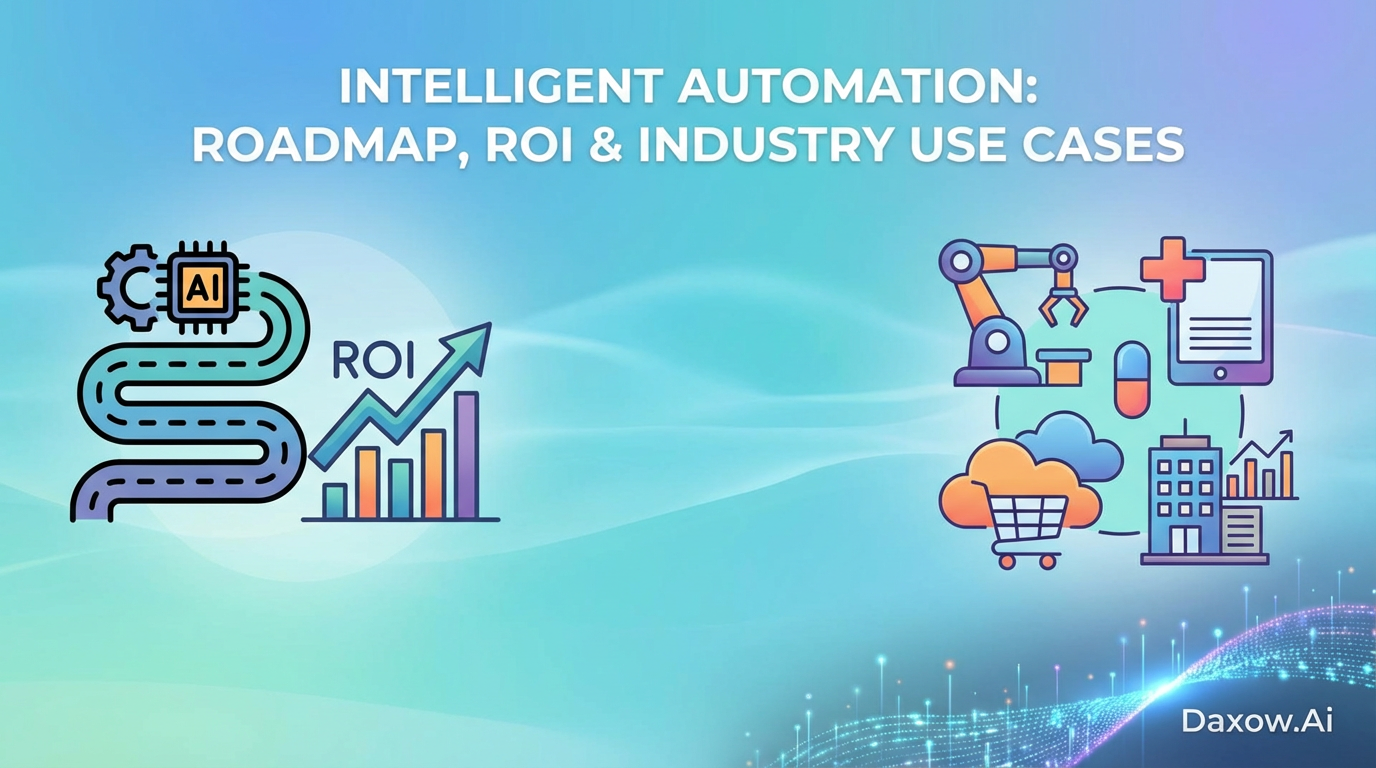
Learn how intelligent automation transforms operations with a 5-step implementation roadmap, ROI examples, industry use cases, and Daxow.ai solutions.
Intelligent Automation: Transforming Business Operations in the AI Era
Estimated reading time: 12 minutes
Key Takeaways
- Intelligent automation integrates AI agents, machine learning, and workflow automation for measurable business outcomes.
- Processes with high volume, rules, and measurability are prime automation candidates.
- Daxow.ai designs custom AI systems that scale enterprise-wide delivering cost reduction, productivity gains, and better customer experiences.
- A structured roadmap minimizes risk and accelerates ROI from pilot to scale.
- Governance, security, and ongoing optimization ensure durable automation success.
Table of Contents
- Intelligent Automation: Transforming Business Operations in the AI Era — What it Is and Why It Matters
- Where Intelligent Automation Delivers the Most Value
- How AI Agents and Workflow Automation Create Operational Leverage
- Implementation Roadmap: From Strategy to Scale
- Measuring ROI and Building a Business Case
- Example Implementations: From Concept to Execution
- Governance, Security, and Ongoing Optimization
- Getting Started: A Practical Checklist for Leaders
- Frequently Asked Questions
Intelligent Automation: Transforming Business Operations in the AI Era — What it Is and Why It Matters
Intelligent automation moves beyond simple scripting and RPA. It embeds decision-making, natural language understanding, and data-driven predictions into end-to-end workflows. The result is not just fewer manual tasks but faster, more accurate outcomes aligned with strategic goals such as lower operating costs, faster scaling, and superior customer support.
Key characteristics:
- AI agents that act with context: Agents are trained on company data, brand voice, and business rules to make consistent decisions.
- Integrated workflows: Automation connects CRM, ERP, support platforms, and databases for seamless end-to-end processes.
- Continuous improvement: Systems are monitored and iterated to adapt to changing needs — not set-and-forget.
- Measurable outcomes: Focus on metrics like processing time, error rate, cost per transaction, and NPS.
Research-backed impact:
- Typical early pilots show productivity gains of 40–60% and ROI often between 200–400% in year one.
- Automated processes can yield 20–50% cost reductions, 30–70% faster execution, and error rates below 1% when properly implemented.
These are the results decision-makers seek — and the outcomes Daxow.ai delivers through tailored solutions.
Where Intelligent Automation Delivers the Most Value
Identify automation candidates by prioritizing processes that are high-volume, rule-based, and measurable. Examples include invoice processing, order-to-cash, lead qualification, and customer inquiries.
High-impact process types
- Repetitive data entry and validation.
- Multi-step approvals (e.g., invoices, contracts).
- Customer support triage and resolution.
- Document extraction and compliance reporting.
- Lead scoring and qualification.
Industry use cases (practical examples)
E-commerce
- Use case: Automate the order-to-cash cycle — order validation, inventory checks, shipment triggers, invoice generation, and exception handling.
- Business impact: Faster fulfillment, reduced cart abandonment, and better inventory planning that increases revenue per customer.
Healthcare
- Use case: Patient scheduling and claims pre-processing using NLP to extract data from forms and EHRs.
- Business impact: Shorter wait times, higher claims accuracy, and compliance support that reduces denials and rework.
Finance
- Use case: Loan application triage using document automation and AI-driven risk signals; fraud alerts automated for rapid response.
- Business impact: Quicker approvals, improved compliance and audit trails, and lower operational risk.
Real Estate
- Use case: Automated lead qualification from multiple channels, property valuation models, and AI agents that book viewings or coordinate virtual tours.
- Business impact: Faster deal cycles, higher conversion rates, and 24/7 client engagement.
HR and Talent
- Use case: Resume screening, interview scheduling, onboarding task orchestration, and employee sentiment analysis.
- Business impact: Faster hiring, reduced administrative overhead, and better retention through proactive insights.
How AI Agents and Workflow Automation Create Operational Leverage
AI agents act as extensions of teams, executing deterministic tasks and context-aware decisions. They can be designed to interact with humans, systems, and external partners to drive end-to-end outcomes.
Core capabilities:
- Process discovery and optimization: Agents help map current-state workflows, revealing bottlenecks and rework loops.
- Decision automation: Predictive models and rule engines handle approvals, routing, and escalations.
- NLP-driven interactions: Chatbots and virtual assistants manage support conversations, freeing human agents for complex cases.
- Data extraction and normalization: Document OCR and structured extraction fuel downstream systems.
How Daxow.ai helps:
- We design AI agents that reflect your operational rules, brand tone, and compliance requirements.
- We implement workflow automation that connects your CRM, ERP, ticketing, and document stores, delivering end-to-end automation — for example, from invoice receipt to payment with automated reconciliations.
- We build shared libraries and templates so successful pilots scale quickly across departments.
Implementation Roadmap: From Strategy to Scale
A structured approach reduces risk and accelerates ROI. Follow these five steps — and see how Daxow supports each phase.
-
Assess needs and define objectives
- Actions: Conduct a bottleneck audit with frontline teams. Prioritize using an impact-effort matrix.
- Deliverables: Clear metrics (e.g., TAT, error rate, cost per transaction), prioritized backlog.
- Daxow role: Facilitate workshops, run process mining analyses, and produce a prioritized automation roadmap.
-
Document and analyze processes
- Actions: Map workflows, capture exceptions and workarounds, and identify data sources.
- Deliverables: Process maps, exception lists, security and compliance constraints.
- Daxow role: Perform field interviews, record “as-is” processes, and model “to-be” automation flows.
-
Select tools and build context
- Actions: Choose platforms that support integrations, model training, and governance.
- Deliverables: Tech stack recommendation, data hygiene plan, agent personality and rule set.
- Daxow role: Recommend platforms, design agent context (brand voice, SOPs), and implement secure integrations with CRMs, ERPs, and other systems.
-
Launch pilot projects
- Actions: Start with a low-risk, high-impact process; measure pre/post performance.
- Deliverables: Pilot performance dashboard, user feedback loop.
- Daxow role: Build and deploy the pilot, provide training, and iterate rapidly based on real usage.
-
Scale and monitor
- Actions: Standardize successful automations, roll out across units, implement governance and monitoring.
- Deliverables: Automation playbook, KPI cadence (quarterly reviews), continuous improvement pipeline.
- Daxow role: Package solutions for scale, centralize monitoring, and run A/B experiments to optimize outcomes.
Best practices to avoid common pitfalls
- Involve cross-functional teams early, including IT and compliance.
- Focus on data quality and labeling for reliable models.
- Limit initial scope to rule-based tasks to avoid scope creep.
- Establish clear KPIs and reporting routines.
- Plan for human-in-the-loop operations where exceptions require human judgement.
Measuring ROI and Building a Business Case
Quantifiable outcomes are essential for approval and sustained funding. Build your business case around time saved, error reduction, and revenue impact.
Key metrics to track:
- Processing time reduction (minutes/days saved).
- Error rate before vs after automation.
- Cost per transaction or support ticket.
- Conversion lift for sales automation.
- Net promoter score (NPS) or customer satisfaction improvements.
ROI illustration (simple model)
- Baseline: 5 FTEs handling 10,000 transactions/month at $4,000 monthly fully-burdened cost per FTE = $20,000.
- Automation impact: 40% productivity gain → effective FTE reduction of 2; recurring monthly savings = $8,000.
- Additional benefits: Faster throughput increases revenue opportunities; error reduction lowers rework and penalty costs.
- Pilot ROI: Many pilots report 200–400% ROI in the first year when downstream benefits and scale are considered.
How Daxow quantifies ROI:
- We run pilot studies with control groups to isolate automation impact.
- We provide transparent dashboards and monthly reports.
- We calculate break-even timelines and projected year-one ROI.
Example Implementations: From Concept to Execution
Example 1: Finance — Automated Invoice-to-Pay
- Problem: Manual invoice entry, frequent mismatches, slow approvals.
- Daxow solution: OCR data extraction, automated matching to POs, rules-based approval routing, and payment orchestration via ERP integration.
- Outcome: Reduced processing time by 60%, error rates <1%, and predictable cash management.
Example 2: Customer Support Automation
- Problem: High ticket volume and long response times for simple queries.
- Daxow solution: Multi-channel chatbot with escalation rules, knowledge base integration, and automated ticket tagging for routing.
- Outcome: 30–70% faster resolution for standard issues, higher CSAT, and fewer escalations to senior agents.
Example 3: Sales Automation and Lead Qualification
- Problem: Sales teams spend time on low-fit leads.
- Daxow solution: AI agent ingests lead sources, enriches data, scores leads, and schedules qualified prospects for sales follow-up via CRM integration.
- Outcome: Higher conversion rates, reduced time-to-contact, and improved quota attainment.
Governance, Security, and Ongoing Optimization
Automation interacts with sensitive data and critical systems. A robust governance model keeps projects secure and compliant.
Essentials:
- Data access controls and encryption.
- Audit trails for automated decisions and approvals.
- Model retraining schedules and performance thresholds.
- Change management and user training.
Daxow capabilities:
- We implement secure integrations and role-based access.
- We build audit logs and explainability features for compliance.
- We run quarterly performance reviews and retrain models as needed.
Getting Started: A Practical Checklist for Leaders
- Conduct a short audit to identify 3 top candidate processes.
- Set measurable targets (time reduction, error rate, cost savings).
- Choose an experienced partner to minimize integration risk.
- Run a focused pilot, collect data, and iterate quickly.
- Plan for scaling successful pilots into a center of excellence.
Daxow support:
- We offer process discovery workshops and pilot deployments.
- We build custom AI agents and end-to-end automation with system integrations.
- We provide ongoing support, monitoring, and a roadmap to scale across the organization.
Conclusion — Turn Automation into Strategic Advantage
Intelligent automation is not a technology trend — it is a strategic lever for modern businesses. When executed with a clear roadmap, proper governance, and domain-specific AI agents, organizations can drastically reduce manual work, improve customer experiences, and scale without proportional headcount growth. Daxow.ai combines deep process analysis, custom AI agent development, and enterprise-grade integrations to convert automation pilots into sustainable, high-ROI systems.
Bold next step
- Book a free consultation with Daxow.ai to discuss your top processes and assess potential gains.
- Request a process analysis for your company to identify quick wins and a prioritized automation roadmap.
- Contact us to build a custom AI system that automates end-to-end workflows, integrates with your core systems, and delivers measurable business value.
Frequently Asked Questions
What is the difference between robotic process automation (RPA) and intelligent automation?
While RPA focuses on automating repetitive, rule-based tasks using simple scripts, intelligent automation combines AI, machine learning, and decision-making capabilities to automate complex workflows with context awareness and predictive insights.
How do AI agents improve customer support?
AI agents, through chatbots and virtual assistants, handle routine inquiries efficiently, provide 24/7 support, and escalate complex issues to humans, resulting in faster resolution times and higher customer satisfaction.
What industries benefit most from intelligent automation?
Industries such as finance, healthcare, e-commerce, real estate, and HR see substantial benefits by automating high-volume, rules-based processes like claims processing, loan triage, order-to-cash, lead qualification, and onboarding.
How does Daxow.ai ensure secure and compliant automation solutions?
We implement role-based access controls, encryption, audit logging, explainability features, and conduct regular performance reviews and model retraining to maintain security, transparency, and regulatory compliance.