
Mastering AI Agent Implementation for Business Leaders
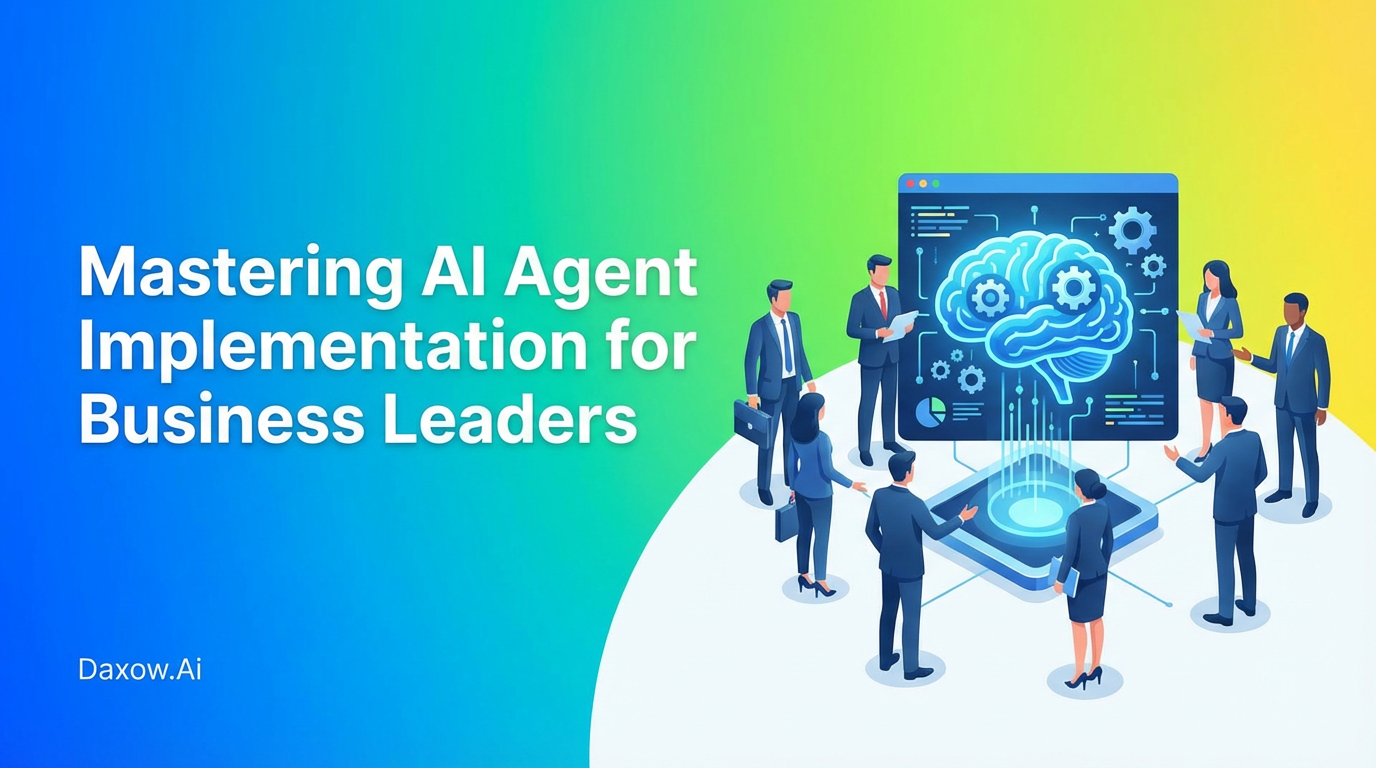
Five-phase guide for business leaders to design, deploy, and scale AI agents. Covers ROI, KPIs, use cases, risks, and Daxow.ai implementation services.
Mastering AI Agent Implementation: A Strategic Guide for Business Leaders
Estimated reading time: 15 minutes
Key Takeaways
- AI agents automate high-volume, repetitive tasks to improve speed and reduce manual effort.
- A structured five-phase roadmap guides successful AI agent implementation.
- Measurable outcomes include cost reduction, productivity gains, revenue uplift, and strong ROI.
- Industry-specific use cases demonstrate AI agents' versatility across e-commerce, healthcare, finance, real estate, and HR.
- Daxow.ai offers tailored AI automation services from discovery to governance and continuous improvement.
- Best practices emphasize data quality, governance, human oversight, and incremental scaling.
Table of Contents
- Mastering AI Agent Implementation: A Strategic Guide for Business Leaders
- Five-phase implementation roadmap for AI agent implementation
- Practical use cases across industries
- How Daxow.ai helps you implement AI agent solutions
- Best practices and risk mitigation
- Measuring success — KPIs and dashboards
- Frequently Asked Questions
- Conclusion and next steps
Mastering AI Agent Implementation: A Strategic Guide for Business Leaders
What AI agent implementation means for businesses
AI agent implementation means deploying autonomous software that performs tasks, interacts with users and systems, and makes decisions on behalf of the business. These agents can:
- Handle repetitive, high-volume tasks with predictable outcomes.
- Integrate with CRMs, ERPs, knowledge bases, and third-party tools to create end-to-end automation.
- Escalate complex cases to humans while resolving routine inquiries autonomously.
- Continuously learn from interactions to improve over time.
When implemented following best practices, AI agents deliver 3–5x faster process execution, reduce manual effort, and enable organizations to scale operations without proportional increases in headcount. The result is improved customer experience, lower costs, and better decision-making across functions.
The business case — measurable outcomes
Adopting AI agents and workflow automation produces clear, measurable benefits:
- Cost reduction: 30–50% reduction in operational costs for support and HR through automation of routine tasks.
- Productivity gains: 3–5x faster handling of repeatable processes such as claims intake, lead qualification, and invoice processing.
- Revenue uplift: 10–20% increase from improved customer retention and faster sales cycles through sales automation.
- ROI: Typical realizations range from 200–500% ROI within 12–18 months for targeted implementations.
These outcomes rely on focusing on high-volume, low-risk tasks first, ensuring data quality, and putting governance frameworks in place to monitor ethical and compliant AI behavior.
Five-phase implementation roadmap for AI agent implementation
Deploying AI agents successfully requires a phased approach that reduces risk and maximizes adoption. Use this five-phase roadmap as an operational framework.
Phase 1 — Strategic assessment and planning (4–8 weeks)
Key actions:
- Define business objectives linked to KPIs (e.g., reduce first-response time by 50%).
- Identify high-volume processes suitable for automation (customer inquiries, invoice processing, lead qualification).
- Conduct a data audit: assess data quality, availability, and compliance requirements.
- Establish initial ROI targets and timelines.
Deliverables:
- Prioritized use-case list
- Success metrics and baseline measurements
- Data readiness report
Phase 2 — Technology selection and vendor evaluation (6–12 weeks)
Key actions:
- Evaluate platforms for scalability, integrations, security, and compliance (HIPAA, finance regulations as relevant).
- Select AI capabilities required: NLP for chatbots, RPA for task orchestration, predictive models for forecasting.
- Consider vendor support, SLAs, and extensibility for future automation.
Deliverables:
- Vendor short-list and proof-of-concept plan
- Integration requirements document
Phase 3 — Preparation and development (4–8 weeks)
Key actions:
- Clean and consolidate data sources; build knowledge bases and decision trees.
- Design workflow automation and agent behavior (including fallbacks and escalation paths).
- Implement governance policies: role definitions, access controls, and audit procedures.
- Create training materials and change-management plans for staff.
Deliverables:
- Working knowledge base and decision models
- Integration connectors and security design
- Governance and training plan
Phase 4 — Pilot deployment and gradual rollout (4–20 weeks)
Key actions:
- Launch a pilot with a single team or channel to validate performance.
- Measure pilot KPIs (resolution rate, CSAT, cost per interaction).
- Iterate on agent responses, integration stability, and edge-case handling.
- Scale incrementally to new channels and use cases once SLA targets are met.
Deliverables:
- Pilot performance report
- Rollout schedule and operational playbooks
Phase 5 — Monitoring and optimization (ongoing)
Key actions:
- Continuously track KPIs and retrain models using production data.
- Conduct scheduled audits for bias, compliance, and performance degradation.
- Optimize workflows and expand automation scope based on measured ROI.
- Maintain a change-log and roadmap for ongoing enhancements.
Deliverables:
- Continuous improvement backlog
- Monthly or quarterly KPI dashboard
Practical use cases across industries
AI agents deliver domain-specific value when tailored to industry workflows. Below are practical examples with concrete business outcomes.
E-commerce — conversational agents and inventory forecasting
Use cases:
- Chatbots that resolve 70–80% of customer inquiries (order status, returns) without human handoff.
- Personalized recommendation agents that increase conversion rates and reduce cart abandonment.
- Inventory forecasting agents that integrate sales data and supplier information to prevent stockouts.
Business impact:
- Higher conversion and average order value.
- Reduced customer service headcount growth and lower cost-per-interaction.
Healthcare — compliant triage and scheduling
Use cases:
- HIPAA-ready virtual agents that triage symptoms, book appointments, and send reminders.
- Monitoring agents that flag anomalies in patient data for clinician review.
Business impact:
- Faster patient routing, fewer missed appointments, and improved capacity utilization.
- Reduced administrative burden on clinical staff.
Finance — fraud detection and compliance automation
Use cases:
- Real-time transaction monitoring agents that flag suspicious activity and automate alerting.
- Automated compliance checks for onboarding and reporting.
Business impact:
- Faster detection and response to fraud, lowering direct losses.
- Reduced manual review time and improved regulatory reporting accuracy.
Real estate — lead qualification and digital tours
Use cases:
- Virtual agents that qualify leads, schedule viewings, and generate automated valuation reports from market data.
- Interactive chat/video tours guided by AI that answer buyer questions.
Business impact:
- Shorter sales cycles and higher lead-to-deal conversion.
- Reduced workload for agents and faster property turnaround.
HR — recruiting and onboarding automation
Use cases:
- Resume screening agents that pre-qualify candidates against job criteria.
- Onboarding chatbots that answer employee questions and automate document collection.
Business impact:
- Recruitment cycle times reduced by up to 50%.
- HR teams freed to focus on retention and culture work.
How Daxow.ai helps you implement AI agent solutions
Discovery and process analysis
- We map your current workflows to identify high-impact automation opportunities.
- Deliverables include a prioritized automation roadmap and ROI projections.
Custom AI agent design and development
- We design agents that execute real tasks: retrieving data, making decisions, integrating with CRMs and ERPs.
- Solutions include chatbots, workflow automation, lead qualification agents, document extraction systems, and RPA integrations.
Systems integration and data connectivity
- We integrate agents with your existing stack — CRM, ticketing systems, databases, and third-party APIs — ensuring seamless end-to-end automation.
- We implement secure data pipelines and transformation rules, maintaining compliance and auditability.
Governance, monitoring, and continuous improvement
- We establish governance frameworks covering ethics, access control, and performance audits.
- We deploy monitoring dashboards and retraining workflows to ensure agents improve over time and sustain ROI.
Outcomes Daxow delivers
- Reduced manual tasks and operational costs.
- Improved productivity across support, sales, HR, and operations.
- Faster ROI by focusing pilots on high-volume, low-risk processes.
- Scalable automation that grows with your business.
Best practices and risk mitigation
To maximize value and minimize risk, follow these proven best practices:
- Start small and measure: Begin with one or two high-volume processes to validate outcomes before scaling.
- Prioritize data quality: Clean, well-structured data is essential for reliable agent behavior.
- Enforce governance: Define roles, access controls, and audit trails to manage ethical and regulatory risks.
- Involve cross-functional teams: Early involvement from IT, legal, compliance, and business owners ensures adoption and realistic scope.
- Plan for scalability: Architect solutions with modular integrations and versioning to support future expansion.
- Maintain human oversight: Keep escalation paths and human-in-the-loop controls for critical decisions.
- Track the right KPIs: Monitor CSAT, resolution rate, cost-per-interaction, time-to-resolution, and model drift indicators.
Measuring success — KPIs and dashboards
Standard KPIs to evaluate AI agent performance and business impact:
- Resolution rate (percentage of issues handled without human intervention)
- First-response time and average handling time
- Customer satisfaction (CSAT) and Net Promoter Score (NPS)
- Cost-per-interaction and total operational cost reduction
- Lead conversion rate and time-to-deal for sales automation
- Recruitment cycle time and time-to-productivity for HR automation
- Model accuracy and false positive/negative rates for fraud/compliance agents
Set baseline metrics before launch, then track improvements monthly. Aim for incremental gains (e.g., 10% month-on-month improvements during optimization) and validate ROI against the targets set during the assessment phase.
Conclusion and next steps
Mastering AI agent implementation is a strategic investment that delivers significant productivity gains, reduces manual tasks, and enables scalable business automation. By following a structured roadmap, prioritizing data quality, and focusing on measurable outcomes, organizations can achieve substantial ROI within 12–18 months while improving customer experience and operational resilience.
Daxow.ai partners with businesses to design, build, and operate custom AI systems that automate workflows end-to-end. From discovery and integration to governance and continuous optimization, we ensure your AI agents execute real tasks, connect with your systems, and deliver measurable value.
Book a free consultation with Daxow.ai to request a process analysis for your company and start building a custom AI system that reduces manual work, improves productivity, and drives business automation. Visit our contact page to begin your automation transformation.
Frequently Asked Questions
What types of tasks are best suited for AI agent automation?
High-volume, repetitive, and predictable tasks are ideal candidates. Examples include customer inquiries, lead qualification, invoice processing, and routine compliance checks.
How long does the AI agent implementation process typically take?
Implementation varies by complexity but generally follows a phased approach lasting from several months to about 12 months, including assessment, development, pilot, and scaling phases.
How does Daxow.ai ensure compliance and ethical use of AI?
We establish governance frameworks with clear roles, access controls, audit trails, and regular bias and compliance audits to maintain ethical AI behavior aligned with industry regulations.
What industries can benefit from AI agent implementation?
E-commerce, healthcare, finance, real estate, and human resources are key industries benefiting from AI automation, among many others with high-volume operational processes.