
Mastering AI Agent Implementation for Business Transformation
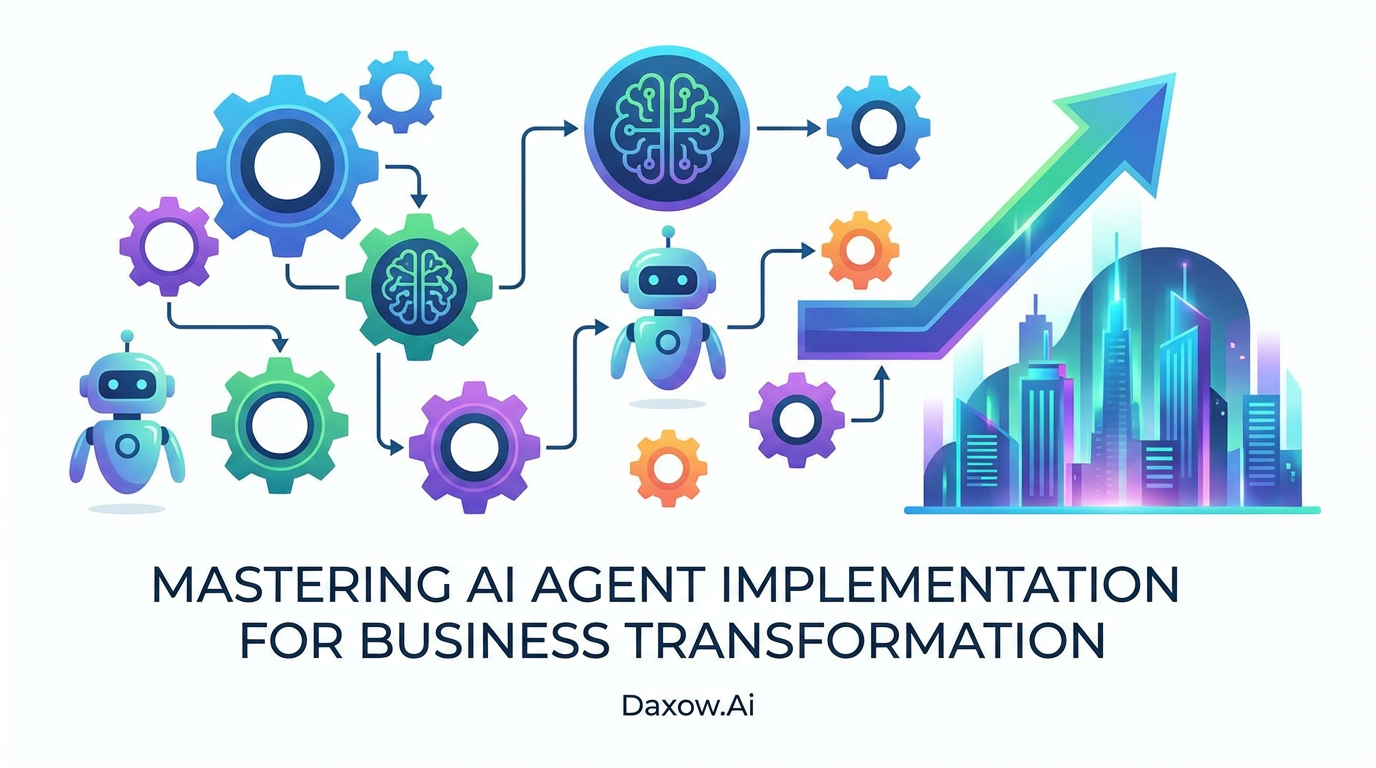
Guide to planning, piloting, and scaling AI agents to reduce costs, boost productivity, and deliver measurable ROI across industries with Daxow.ai
Mastering AI Agent Implementation: A Strategic Guide for Business Transformation
Estimated reading time: 18 minutes
Key Takeaways
- AI agents significantly improve scalability, reduce costs, and boost productivity across industries.
- Daxow.ai enables seamless design, integration, and governance of custom AI agents tailored to business workflows.
- Phased implementation—from strategic assessment to continuous optimization—ensures measurable ROI and risk mitigation.
- Practical use cases span e-commerce, healthcare, finance, real estate, and HR, delivering tangible business impact.
- Strong data quality, human oversight, and governance are critical to successful AI agent deployment.
Table of Contents
- Why AI Agents Matter Now
- How AI Agents and Workflow Automation Drive Business Value
- Practical Use Cases Across Industries
- Implementation Framework — Phased, Measurable, and Governed
- Best Practices and Common Pitfalls
- Measuring ROI — KPIs, Timelines, and Example Calculations
- Technical Considerations — Security, Scalability, and Observability
- Practical Checklist — Ready to Start?
- Frequently Asked Questions
Why AI Agents Matter Now
AI agents represent a leap beyond traditional automation by combining reasoning, real-time data processing, and adaptive learning to orchestrate multi-step processes across systems. The outcome: faster decision-making, higher accuracy, and a dramatic reduction in repetitive manual work.
Key business advantages:
- Scalability: Agents handle increasing volumes without proportional headcount growth.
- Cost reduction: Targeted workflows can see 40–60% cost reductions.
- Productivity gains: Expect 30–70% time savings on automated tasks.
- Improved CX: Personalized, consistent interactions lead to better retention and revenue uplift.
Daxow.ai specializes in translating these advantages into concrete systems: building AI agents that connect CRMs, ERPs, support platforms, and databases to automate end-to-end processes while maintaining governance and human oversight.
How AI Agents and Workflow Automation Drive Business Value
From Rule-Based Automation to Intelligent Agents
Traditional workflow automation executes predefined rules. AI agents add context, reasoning, and adaptive behavior. They can:
- Route exceptions to humans,
- Re-prioritize work when inputs change,
- Call external APIs to execute transactions,
- Learn from outcomes to reduce future errors.
Daxow.ai architects hybrid systems that combine workflow automation for predictable processes and AI agents for dynamic decision-making, ensuring reliability while capturing complexity.
Real Business Outcomes
- Faster resolutions and approvals (up to 3–5x faster in pilot scenarios).
- Reduced support tickets and manual follow-ups (customer support automation can cut tickets by ~50%).
- Revenue improvements via intelligent lead qualification and sales automation.
- Compliance and auditability through structured governance and secure data handling.
Practical Use Cases Across Industries
E-commerce — Personalized Fulfillment and Returns
Use case:
- AI agents analyze orders, inventory, and shipping constraints in real time.
- They update customers proactively, trigger re-routing, and automate returns processing.
Impact:
- Reduce cart abandonment by 20–30%.
- Support tickets fall by ~50%.
- Faster order resolution and fewer manual interventions.
Daxow.ai role:
- Integrate agents with e-commerce platforms, warehouses, and CRM.
- Build monitoring dashboards to trace fulfillment KPIs and escalate exceptions.
Healthcare — Appointment Triage and Records Automation
Use case:
- Agents handle appointment scheduling, triage patient inquiries, extract structured data from records, and escalate urgent cases.
- Built-in compliance checks ensure HIPAA-safe handling.
Impact:
- Administrative time cut by ~30%.
- Improved patient access and reduced no-shows.
Daxow.ai role:
- Design secure data pipelines, implement compliance controls, and integrate with EHR systems.
- Provide human-in-the-loop workflows for critical clinical decisions.
Finance — Fraud Detection and Compliance Checks
Use case:
- Agents monitor transactions, flag anomalies, initiate multi-step investigations, and route high-risk cases to analysts.
- Automate compliance reporting and KYC document verification.
Impact:
- Faster approvals (up to 70% quicker in some workflows).
- Reduced error rates and stronger audit trails.
Daxow.ai role:
- Connect agents to payment systems, CRMs, and compliance tools.
- Implement secure model governance and explainability features.
Real Estate — Lead Qualification and Virtual Tours
Use case:
- Agents qualify inbound leads, schedule virtual tours, generate property reports, and execute basic negotiation steps.
- Integrate market data for automated valuation estimates.
Impact:
- Accelerates deal cycles and autonomously qualifies ~40% more leads.
- Reduces manual follow-ups and improves agent productivity.
Daxow.ai role:
- Build lead qualification pipelines, integrate MLS and CRM systems, and automate follow-up communications.
HR — Resume Screening and Onboarding
Use case:
- AI agents screen resumes, conduct preliminary chat interviews, manage onboarding workflows, and resolve payroll queries.
- Ensure fair screening through bias checks and logged decisions.
Impact:
- Hiring time cut by ~50%.
- Improved candidate experience and consistent onboarding.
Daxow.ai role:
- Implement secure HR integrations, develop transparent screening criteria, and design escalation paths for hiring managers.
Implementation Framework — Phased, Measurable, and Governed
1. Strategic Assessment and Planning (4–8 weeks)
Activities:
- Define business objectives and KPIs (CSAT, resolution time, cost per interaction).
- Map current workflows and identify high-impact, low-complexity candidates for pilots.
- Audit data readiness, governance, and compliance requirements.
Deliverables:
- Prioritized roadmap.
- Business case with expected ROI and payback timeline.
Daxow.ai support:
- Conduct workshops and process audits, producing a prioritized automation backlog and KPI targets.
2. Technology Selection and Preparation (6–12 weeks)
Activities:
- Select integrations and platform architecture with API-first principles.
- Clean and structure data, build knowledge bases, and define logging/monitoring needs.
- Establish roles, governance, and audit processes.
Deliverables:
- Technical architecture and data pipeline plan.
- Security and compliance checklist.
Daxow.ai support:
- Recommend tooling, implement secure connectors to CRMs/ERP/support platforms, and set up data pipelines.
3. Development, Pilot, and Deployment (4–20 weeks)
Activities:
- Build AI agents with clear action interfaces and error handling.
- Run pilots on constrained user groups or channels.
- Iterate fast using real usage data; scale gradually.
Deliverables:
- Pilot reports with KPI tracking.
- Scalable deployment plan.
Daxow.ai support:
- Full-cycle development, QA, pilot management, and phased rollouts across teams and regions.
4. Monitoring, Optimization, and Governance (Ongoing)
Activities:
- Continuous KPI monitoring and model retraining.
- Human-in-the-loop for critical decisions and ongoing change management.
- Regular audits and compliance reporting.
Deliverables:
- Performance dashboards, retraining schedules, and governance logs.
Daxow.ai support:
- Operate monitoring systems, run optimization sprints, and provide governance advisory to ensure ethical, auditable systems.
Best Practices and Common Pitfalls
Best practices to adopt:
- Prioritize data quality: Reliable AI starts with clean, connected data pipelines.
- Start small, scale fast: Pilot low-risk, high-frequency processes to build trust and measurable wins.
- Design for interoperability: Use API-first architecture so agents can interact with CRMs, ERPs, and third-party services.
- Human oversight: Keep humans in the loop for high-impact or ambiguous decisions.
- Measure continuously: Track CSAT, resolution time, cost per interaction, and error rates.
- Governance and compliance: Define roles, audit trails, and data protections from day one.
Common pitfalls to avoid:
- Skipping pilots or change management.
- Over-automating without human fallbacks.
- Ignoring scalability and integration requirements.
- Deploying models on poor-quality data.
Daxow.ai prevents these pitfalls by combining domain expertise, proven integration patterns, and change management support to ensure adoption and ROI.
Measuring ROI — KPIs, Timelines, and Example Calculations
Key Performance Indicators
- Resolution rate and average handling time.
- Cost per interaction.
- CSAT and NPS.
- Percent of tasks fully automated versus human-assisted.
- Compliance and error rates.
Typical Timelines and Returns
- Pilot phase: 3–6 months for initial pilots and measurable outcomes.
- Scaled deployment: 6–18 months to roll out across functions and geographies.
- Payback: Many clients achieve a 4–6 month payback on pilot investments when aligned to core KPIs.
Example ROI Scenario
Scenario:
- Customer support team handles 20,000 monthly interactions.
- Average cost per interaction: $4.
- Daxow.ai implements an agent to automate 40% of interactions, reducing human-handled interactions and decreasing average handling time by 50%.
Calculation:
- Monthly cost before: 20,000 * $4 = $80,000.
- After automation: 12,000 human interactions * $4 * 0.5 time reduction ≈ $24,000; agent handling 8,000 interactions at lower marginal cost.
- Estimated monthly savings: $30k–$40k.
- Annualized savings justify pilot costs within months.
Daxow.ai helps quantify these numbers for your specific workflows during the Strategic Assessment phase.
Technical Considerations — Security, Scalability, and Observability
Security and Compliance
- Implement role-based access and encryption.
- Log all agent decisions for auditability.
- Enforce data residency and privacy controls for regulated industries.
Daxow.ai experience: We build secure connectors and governance layers that meet industry standards including healthcare and finance.
Scalability and Interoperability
- Design API-first agents and event-driven pipelines to enable scale.
- Use modular services to support multi-agent orchestration.
Daxow.ai experience: We integrate with major CRMs and ERPs, and design cross-system orchestration for resilient automation.
Observability and Feedback Loops
- Build monitoring dashboards for business metrics and model performance.
- Embed easy escalation paths and human feedback to improve agent behavior.
Daxow.ai experience: We deliver end-to-end observability and continuous improvement processes that keep agents aligned with business outcomes.
Practical Checklist — Ready to Start?
- Have you identified 1–3 high-volume processes for automation?
- Do you have access to clean transactional and conversational data?
- Are stakeholders aligned on KPIs and timelines?
- Is your infrastructure ready for API integrations and secure data exchange?
- Have you planned for human oversight and change management?
If you answered yes to most items, you’re ready for a pilot. Daxow.ai can run a rapid process analysis to confirm feasibility and a recommended next-step roadmap.
Frequently Asked Questions
What industries benefit the most from AI agent automation?
Industries with high-volume, decision-driven workflows like e-commerce, healthcare, finance, real estate, and HR see the greatest benefits from AI agent automation through increased efficiency and reduced costs.
How does Daxow.ai ensure compliance and data security?
Daxow.ai implements role-based access, encryption, logging for auditability, and compliance controls tailored to industry standards such as HIPAA and financial regulations, ensuring secure and compliant AI deployments.
Can AI agents adapt to changing business processes?
Yes, AI agents built with Daxow.ai incorporate adaptive learning and reasoning capabilities, allowing them to handle dynamic inputs, prioritize exceptions, and improve performance over time based on real-world outcomes.
What level of human oversight is recommended?
Human oversight is critical for high-impact or ambiguous decisions. Daxow.ai designs human-in-the-loop workflows to balance automation with necessary human review to reduce risks and maintain compliance.