
Mastering AI Agents and Automation for Business Transformation
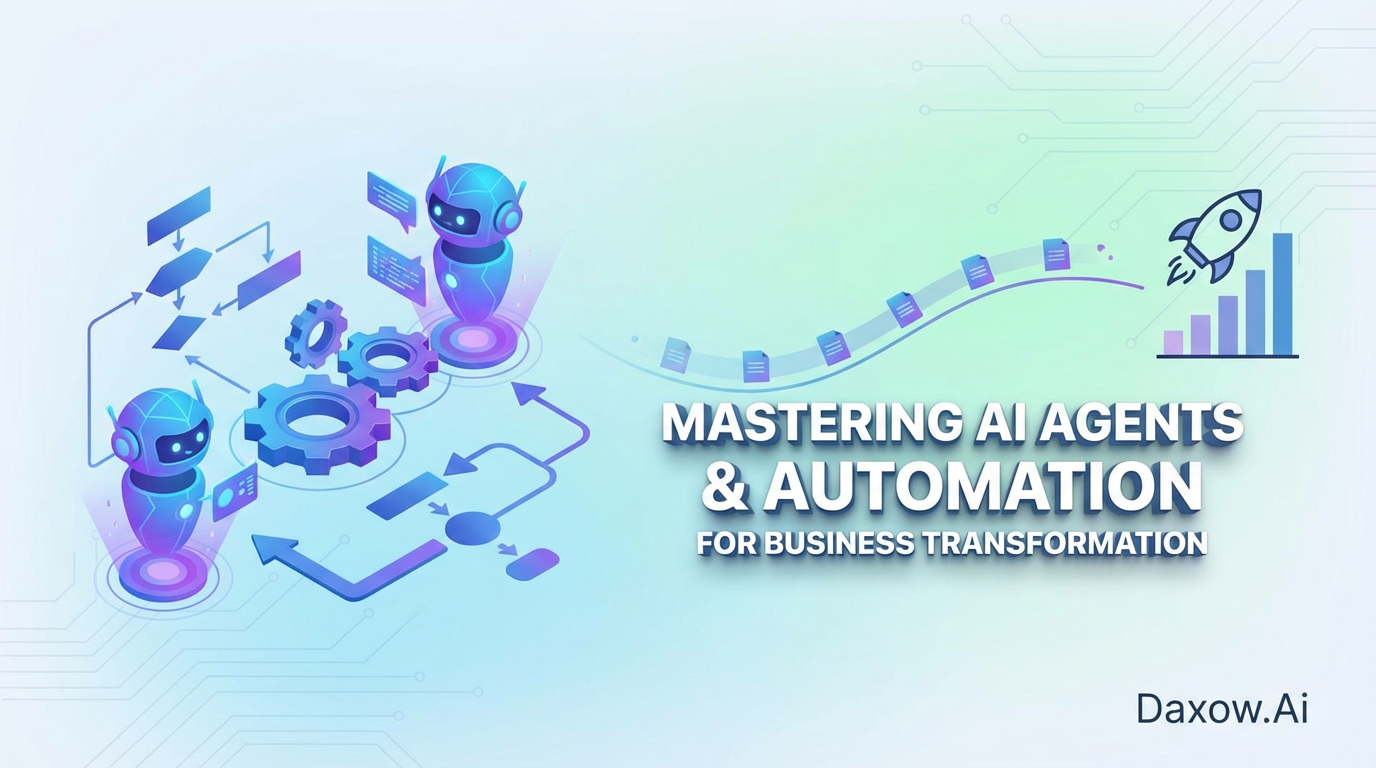
Roadmap for leaders to deploy AI agents and workflow automation: use cases, 90-day plan, ROI metrics, and how Daxow.ai builds production-grade solutions.
Mastering AI Agents and Automation: A Strategic Imperative for Business Transformation
Estimated reading time: 15 minutes
Key Takeaways
- AI agents and workflow automation drive strategic business value through autonomy, integration, and measurable outcomes.
- Implementation follows a disciplined, phased approach from discovery to rollout to maximize ROI and adoption.
- Cross-industry use cases illustrate immediate impact spanning e-commerce, healthcare, finance, real estate, and HR.
- Success depends on quality data, secure integration, governance, and change management.
- Daxow.ai provides tailored AI automation solutions that deliver scalable, production-ready systems with measurable results.
Table of Contents
- Mastering AI Agents and Automation: A Strategic Imperative for Business Transformation
- What AI Agents and Automation Mean for Business
- Practical Use Cases Across Industries
- How AI Agents and Automation Deliver Value
- Implementation Steps and Best Practices
- Measuring ROI and Building the Business Case
- How Daxow.ai Helps — From Strategy to Production
- Practical Roadmap — First 90 Days
- Common Challenges and How to Overcome Them
- Closing — Turning Automation into Competitive Advantage
- Frequently Asked Questions
Mastering AI Agents and Automation: A Strategic Imperative for Business Transformation
What this phrase captures is a structured approach to adopting AI automation across the enterprise. It emphasizes three priorities:
- Autonomy: AI agents that perceive, reason, and act to complete tasks end-to-end.
- Integration: Workflow automation that connects systems, data, and teams.
- Outcomes: Clear metrics and governance that turn technology into strategic value.
Below we unpack the components and provide an actionable blueprint for business leaders.
What AI Agents and Automation Mean for Business
Definitions and capabilities
AI agents are autonomous software entities that observe digital environments, make decisions based on learned models and business rules, and execute tasks without continuous human intervention. Workflow automation coordinates multi-step processes across systems and teams to ensure predictable, repeatable outcomes.
Combined, they deliver:
- Predictive capabilities (e.g., demand forecasting, fraud detection).
- Scale for high-volume work (e.g., document processing, customer inquiries).
- 24/7 operations that reduce response times and manual overhead.
- Data-driven decision support that elevates human judgment.
Business impact summary
Organizations that target AI-first initiatives typically see productivity improvements of 20–50% in prioritized processes. Benefits include fewer errors, faster cycle times, and improved Net Promoter Scores when customer journeys are automated and personalized. The shift to AI-driven workflows also enhances operational resilience by removing single points of failure tied to manual processes.
Practical Use Cases Across Industries
E-commerce — Order-to-cash and personalization
- Use case: An AI agent orchestrates order validation, payment reconciliation, inventory checks, and shipping initiation.
- Outcome: Reduced fulfillment errors, faster order processing, and higher repeat purchase rates.
- Additional automation: Personalization engines that generate product recommendations and automated content (e.g., product descriptions, social captions) to increase conversion rates.
Healthcare — Administrative automation and triage
- Use case: Patient intake, records extraction, and initial triage handled by AI agents and chatbots.
- Outcome: Lower administrative burden, reduced wait times, and improved clinician focus on care delivery.
- Compliance note: Implement with strict privacy controls and audit trails.
Finance — Fraud detection and compliance reporting
- Use case: Continuous transaction monitoring by AI agents that flag anomalies and auto-initiate investigations.
- Outcome: Faster fraud identification, reduced false positives, and accelerated audit cycles.
- Automation benefits: Auto-generation of regulatory reports and invoice processing, cutting manual reconciliation time by up to 70%.
Real estate — Market intelligence and listing automation
- Use case: Agents aggregate market data, price comparables, and sentiment to produce property valuations and update listings.
- Outcome: Shorter deal cycles, more accurate pricing, and freed-up agent time for closing activities.
HR — Recruitment and employee services
- Use case: Resume parsing, candidate scoring, interview scheduling, and employee FAQ automation.
- Outcome: Faster hiring, improved candidate fit, and reduced HR inquiries by enabling self-service.
How AI Agents and Automation Deliver Value
The mechanics of value creation
- Scale repetitive tasks: Automation eliminates manual, rule-based work such as data entry.
- Add intelligence: AI agents summarize, predict, and recommend, extending automation into cognitive tasks.
- Improve accuracy: Machine learning reduces human error in classification and extraction tasks.
- Speed decisions: Real-time insights accelerate business responses to customer needs and market changes.
Integration and data flow
Value depends on connecting AI and automation to the right systems:
- CRM and sales systems for lead qualification and sales automation.
- ERP and inventory systems for supply chain automation.
- Document repositories and email systems for data extraction workflows.
Secure, reliable data pipelines and master data management are prerequisites for stable AI performance.
Implementation Steps and Best Practices
Phase 1 — Discover and prioritize
- Conduct a process audit to identify repetitive, rule-based tasks that are high-volume and high-cost.
- Prioritize workflows with clear KPIs (time saved, cost reduction, improved NPS).
- Tip: Start with non-critical processes to validate models and user acceptance.
Phase 2 — Define objectives and prepare data
- Establish measurable objectives and success criteria.
- Perform a data readiness assessment: quality, format, availability, and governance.
- Ensure data is machine-readable and privacy-compliant.
Phase 3 — Build, integrate, prototype
- Design AI agents to handle decision points and actions within the workflow.
- Integrate with existing systems and set up secure APIs and event streams.
- Deploy prototypes in controlled environments and capture telemetry for iterative improvements.
Phase 4 — Roll out, monitor, iterate
- Use phased rollouts with clear rollback plans.
- Monitor performance via dashboards tied to your business KPIs.
- Retrain models and refine rules based on real-world feedback.
Best practices
- Ensure data quality: Poor input yields poor outcomes.
- Govern and avoid sprawl: Centralize oversight to control shadow automation.
- Cross-functional teams: Combine business, IT, and data science perspectives.
- Security and compliance: Embed privacy and audit capabilities from day one.
- Change management: Communicate goals and train users to ensure adoption.
Measuring ROI and Building the Business Case
Key metrics to track
- Time saved (hours per process per month).
- Error reduction rate (defect or exception rate).
- Cost per transaction before and after automation.
- Revenue impact (conversion uplift, churn reduction).
- Customer satisfaction (NPS, CSAT) improvements.
Typical returns and timelines
- Many organizations recoup investments within 12–18 months.
- Expect 40–60% reductions in manual labor and error rates for well-scoped workflows.
- Long-term benefits include scalability and strategic differentiation (e.g., improved fraud prevention, continuous personalization).
How Daxow.ai Helps — From Strategy to Production
Daxow.ai specializes in turning strategy into operational systems. Our approach is designed for the kinds of outcomes outlined above:
- Discovery and process analysis: We map your current workflows, identify high-impact automation opportunities, and quantify expected gains.
- Custom AI agent design: We build AI agents that execute real tasks — from lead qualification to multi-step invoice processing.
- Workflow automation and orchestration: We design end-to-end automation that connects systems, people, and data.
- System integrations and data connectivity: We integrate with CRMs, ERPs, ticketing systems, and document repositories, ensuring secure data flows.
- Model management and monitoring: We establish pipelines for continuous retraining, monitoring, and remediation.
- Implementation and change management: We roll out phased deployments, provide training, and measure adoption.
Example engagements
- Sales automation: A B2B client automated lead qualification and routing, cutting lead response time from hours to minutes and increasing qualified meetings by 35%.
- Customer support automation: A healthcare provider deployed chatbots and document extraction to triage inquiries and auto-populate records, reducing administrative backlog by 50%.
- Finance automation: A mid-market company automated AP processing end-to-end, reducing invoice processing costs by 60% and processing time from days to hours.
Discover more details within our AI automation solutions and consulting services pages.
Practical Roadmap — First 90 Days
Weeks 1–3: Discovery and prioritization
- Stakeholder interviews and process mapping.
- Identification of 1–3 pilot processes with measurable KPIs.
Weeks 4–8: Prototype and integrate
- Build a minimally viable AI agent and workflow.
- Integrate with core systems and validate data flows.
Weeks 9–12: Pilot, measure, and decide scale
- Run the pilot, collect metrics, and refine.
- Develop a scaling plan and ROI forecast.
Common Challenges and How to Overcome Them
Data quality and siloed systems
- Remedy: Prioritize data cleaning and create shared schemas. Use APIs and middleware to unify data.
Organizational resistance
- Remedy: Use change management, measurable pilot wins, and internal champions to build support.
Model drift and maintenance
- Remedy: Implement continuous monitoring and scheduled retraining. Maintain clear audit trails for model decisions.
Regulatory constraints
- Remedy: Embed compliance checks, encryption, and logging into workflows. Consult legal and compliance teams early.
Closing — Turning Automation into Competitive Advantage
Mastering AI Agents and Automation: A Strategic Imperative for Business Transformation requires more than technology selection — it requires discipline, governance, and a focus on measurable outcomes. Organizations that approach automation as an iterative program rather than a one-off project realize the greatest returns: lower costs, higher productivity, superior customer experiences, and new operational agility.
Daxow.ai partners with businesses to deliver practical, production-grade automation that integrates with existing systems and scales with your needs. We design AI agents that not only suggest actions but execute them, handle exceptions, and learn from outcomes — freeing your teams to focus on strategic priorities.
Bold action today leads to sustained advantage tomorrow. Contact Daxow.ai to book a free consultation, request a process analysis for your company, or start building a custom AI system that reduces manual tasks, boosts productivity, and drives measurable ROI.
Frequently Asked Questions
What are AI agents and how do they differ from traditional automation?
AI agents are autonomous software entities that perceive, reason, and act to complete tasks end-to-end, going beyond rule-based automation by incorporating learning and decision-making capabilities that adapt to changing conditions.
How can businesses start implementing AI automation?
Begin by auditing current processes to identify repetitive, high-volume tasks with clear KPIs, and then proceed through a phased approach including data preparation, prototyping, integration, and iterative rollout while ensuring governance and change management.
What industries benefit most from AI agents and automation?
E-commerce, healthcare, finance, real estate, and human resources are among the sectors seeing immediate benefits by reducing manual tasks, improving accuracy, and enhancing customer and employee experiences.
How does Daxow.ai support organizations in this transformation?
Daxow.ai offers end-to-end consulting, custom AI agent design, workflow automation, system integration, model management, and change management services to deliver tailored automation solutions that generate measurable business outcomes.