
Mastering AI Agents and Automation: A Business Playbook
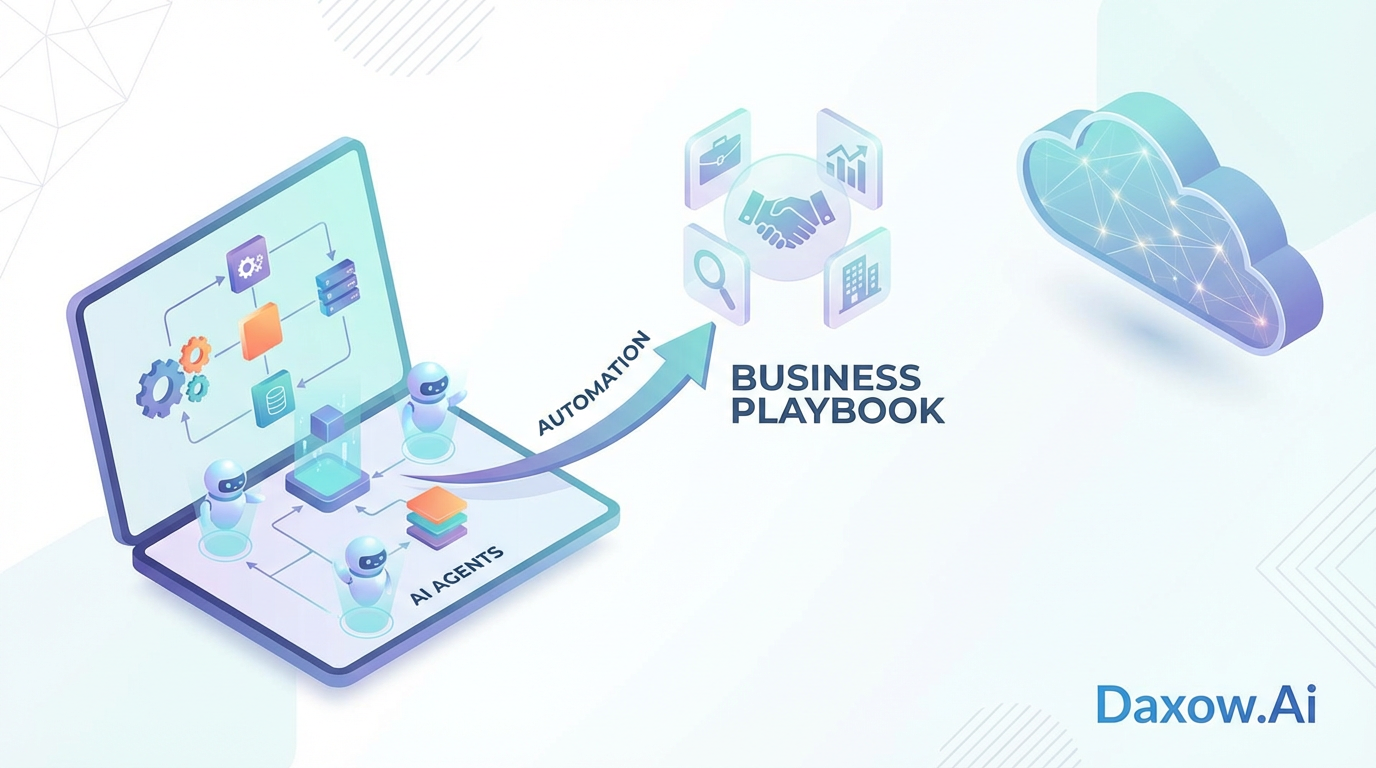
Practical playbook for AI agents and workflow automation: use cases, ROI metrics, phased implementation, and Daxow.ai's end-to-end solutions.
Mastering AI Agents and Automation: A Strategic Imperative for Modern Businesses
Estimated reading time: 15 minutes
Key Takeaways
- Understand what AI agents and workflow automation mean for businesses and their benefits.
- Explore real-world use cases across industries with measurable results.
- Follow a phased implementation approach with best practices for success.
- Learn how Daxow.ai builds and integrates custom AI automation solutions.
- Identify key KPIs to measure ROI and drive strategic automation investments.
Table of Contents
- What AI agents and automation mean for businesses
- Practical Use Cases: AI agents and automation across industries
- Implementation Steps and Best Practices
- Measuring ROI and Business Value
- Overcoming common pitfalls
- How Daxow.ai delivers end-to-end AI automation solutions
- Getting started: next steps with Daxow.ai
- Frequently Asked Questions
What AI agents and automation mean for businesses
Defining AI agents and workflow automation
AI agents are autonomous, software-driven entities that execute tasks, make decisions, and interact with systems and people using machine learning, natural language processing, and rule-based logic. Workflow automation converts repeatable business processes into reliable, auditable sequences executed without manual intervention.
Why this matters:
- Reduce manual tasks across your organization by automating high-volume, rule-based work.
- Boost productivity by reallocating human resources to strategic work.
- Improve customer experience with faster, more accurate responses via customer support automation and AI-driven personalization.
- Enable scale without linear increases in headcount through business automation.
Business outcomes to expect
- Operational cost reduction of 30–50% on automated processes.
- Faster execution and decision-making: companies report 3–5x faster goal achievement.
- Improved accuracy and compliance through automated audit trails and anomaly detection.
- Higher customer satisfaction, e.g., CSAT lifts of 20–30% in automated support channels.
Practical Use Cases: AI agents and automation across industries
E-commerce
Use case: AI agents handle order-to-cash tasks — inventory checks, personalized recommendations, exceptions in returns processing.
Impact: Automate up to 80% of routine support tickets, reduce cart abandonment with timely bot interventions, and increase average order value through personalized upsells.
How Daxow helps: Build omnichannel chatbots that integrate with your CMS and ERP to automate order updates, returns, and personalized product suggestions.
Healthcare
Use case: Patient triage, appointment scheduling, pre-visit documentation extraction, and compliant record handling.
Impact: Reduce administrative load, improve patient throughput, and ensure HIPAA-compliant data handling.
How Daxow helps: Implement secure AI agents that connect to EHRs, enforce compliance policies, and escalate clinical exceptions to human staff.
Finance
Use case: Invoice processing, fraud detection via anomaly analysis, regulatory reporting automation.
Impact: Lower processing errors, accelerate audit readiness, and detect suspicious patterns preemptively.
How Daxow helps: Deploy AI agents that extract invoice data, reconcile accounts, and trigger compliance workflows integrated with core financial systems.
Real Estate
Use case: Lead qualification, virtual property tours via NLP-driven agents, automated property matching.
Impact: Shorten sales cycles by up to 40%, improve lead conversion, and automate routine follow-ups.
How Daxow helps: Create sales automation stacks that qualify leads in CRM, schedule viewings, and surface matched listings to agents.
HR and Recruitment
Use case: Resume screening, candidate scoring, interview scheduling, onboarding automation.
Impact: Reduce time-to-hire, identify top talent via predictive matching, and standardize onboarding processes.
How Daxow helps: Build AI agents that integrate with ATS systems to screen candidates, automate interview logistics, and ensure compliance in hiring workflows.
Customer Support and Sales Automation
Use case: 24/7 customer support automation, lead qualification, follow-up sequencing.
Impact: Drop cost per inquiry by 50%, increase response speed, and raise conversion rates through timely follow-ups.
How Daxow helps: Implement AI-driven support assistants that triage tickets, escalate complex cases, and feed qualified leads into sales automation workflows.
Implementation Steps and Best Practices
Overview of a phased, risk-mitigated approach
Successful automation follows a structured path: assessment, selection, preparation, pilot, deployment, and continuous optimization. Each phase prioritizes measurable goals and strong change management.
Phase 1 — Assessment and Planning (4–8 weeks)
- Set specific targets (e.g., reduce support cost per ticket by 20%).
- Map processes and identify high-volume, low-complexity tasks ideal for initial automation.
- Assemble cross-functional teams: business owners, IT, data engineers, and change managers.
- Daxow role: Lead the process audit, quantify ROI potential, and produce a prioritized automation roadmap.
Phase 2 — Technology and Vendor Selection (6–12 weeks)
- Evaluate platforms for integration capabilities, scalability, compliance, and long-term support.
- Plan for integrations with CRMs, ERPs, knowledge bases, and security tools.
- Daxow role: Recommend best-fit architecture, evaluate AI stacks, and manage vendor proof-of-concepts.
Phase 3 — Preparation (4–8 weeks)
- Data readiness: Cleanse and standardize data, remove duplicates, and prepare datasets for model training.
- Knowledge engineering: Build decision trees, escalation paths, and knowledge bases.
- Integration design: Document APIs, mapping, and error-handling mechanisms.
- Daxow role: Execute data pipelines, set up knowledge stores, and design secure integrations.
Phase 4 — Pilot and Deployment (4–20 weeks)
- Start small: Launch a pilot on a single use case and subset of users.
- Measure core metrics: Resolution rates, time to resolution, error rates, and customer satisfaction.
- Iterate quickly based on real-world feedback and telemetry.
- Daxow role: Deploy pilots, monitor KPIs, and iterate models and workflows to hit targets.
Phase 5 — Monitoring and Optimization (ongoing)
- Continuous learning: Retrain models, correct bias, and expand language and channel coverage.
- Governance: Maintain audit trails, compliance checks, and escalation logs.
- Scale: Expand automation across teams and geographies with an eye to long-term scalability.
- Daxow role: Provide ongoing support, model governance, and a roadmap for hyperautomation.
Best practices to ensure success
- Start with high-impact, low-complexity pilots to build momentum and deliver early ROI.
- Invest in data readiness to avoid common pitfalls and reduce integration friction.
- Embed change management to drive adoption and minimize resistance.
- Monitor for bias and compliance to maintain trust and regulatory alignment.
- Plan for 3–5 year scalability to prevent short-term solutions from becoming technical debt.
Measuring ROI and Business Value
Key metrics to track
- Cost per process (before and after automation)
- Labor hours saved and reallocated to revenue-generating activities
- Resolution times and first-contact resolution (FCR)
- Customer satisfaction (CSAT) and Net Promoter Score (NPS)
- Conversion rates for sales and lead qualification
- Compliance and error rates for regulated processes
Typical ROI profile
- Time to ROI: 6–12 months for most pilots
- Labor savings: 30–60% on automated tasks
- Productivity gains: 20–40% across affected teams
- Strategic uplift: Early adopters achieve 3–5x speed to goals and sustained efficiency gains of 25–50% over time
Example ROI calculation (illustrative)
A customer support team processes 10,000 tickets/month at $3 per ticket = $30,000 monthly.
Automating 50% of tickets reduces cost to $15,000 — saving $15,000/month.
Annualized savings: $180,000. If pilot cost is $60,000 and annual support $30,000, ROI occurs within the first year.
Daxow partners with clients to define these KPIs, instrument dashboards, and provide ongoing reporting to justify and expand automation investments.
Overcoming common pitfalls
Data and integration issues
Pitfall: Poor data quality or siloed systems block automation.
Mitigation: Daxow performs data cleansing, builds ETL pipelines, and designs secure integrations to ensure reliable inputs.
Lack of clear objectives
Pitfall: Projects stall without measurable goals.
Mitigation: Define KPIs upfront, start with a pilot, and tie success to business outcomes like cost reduction and customer satisfaction.
Adoption and change management
Pitfall: Teams resist automation fearing job loss.
Mitigation: Communicate benefits, reskill employees for higher-value work, and demonstrate early wins.
Ethical and compliance risks
Pitfall: Bias in models or non-compliant data handling.
Mitigation: Implement bias monitoring, transparent escalation paths, and privacy-by-design practices. Daxow enforces governance and auditability in every solution.
How Daxow.ai delivers end-to-end AI automation solutions
Discovery and process analysis
Daxow starts by mapping your workflows, identifying automation candidates, and quantifying expected ROI. We provide a clear automation roadmap aligned with strategic goals.
Custom AI agents and workflow automation
We design AI agents that execute real tasks: responding to customers, making routing decisions, extracting data, or triggering finance operations. We implement workflow automation to sequence tasks reliably across systems and teams.
Systems integration and data connectivity
Daxow integrates with CRMs, ERPs, ticketing systems, and document stores to ensure data flows cleanly and securely. Our solutions include connectors, APIs, and middleware to avoid vendor lock-in.
Deployment, governance, and scale
We pilot quickly, measure, and iterate. We establish governance, monitoring, and retraining plans to keep systems accurate and compliant. We plan for scale, building solutions that evolve with your business needs.
Ongoing optimization and managed services
Daxow offers continued support: monitoring, model refinement, expansion of automation, and change management to maximize long-term ROI.
Getting started: next steps with Daxow.ai
If your organization is ready to reduce manual tasks, increase productivity, and turn AI automation into measurable business value, Daxow is positioned to help. Our end-to-end approach—from process analysis to building production-ready AI agents and integrating them into your systems—minimizes risk and accelerates outcomes.
Ready to act?
- Book a free consultation to explore how AI agents and workflow automation can transform your operations.
- Request a process analysis tailored to your company to identify quick wins and build a phased automation roadmap.
- Contact Daxow.ai to design and deploy a custom AI system that reduces costs, improves customer support automation, and drives sales automation.
Book a free consultation or request a process analysis today — let Daxow.ai help you master AI agents and automation to achieve measurable business results.
Frequently Asked Questions
What are AI agents in business automation?
AI agents are software programs that autonomously perform tasks such as decision making, data extraction, and customer interaction using AI technologies like machine learning and natural language processing.
How quickly can companies expect ROI from AI automation?
Most pilots achieve ROI within 6 to 12 months, with labor savings ranging from 30–60% and productivity gains of 20–40% across teams.
How does Daxow.ai ensure compliance and ethical use of AI?
Daxow.ai implements bias monitoring, privacy-by-design, audit trails, and transparent escalation paths to ensure governance and adherence to regulatory standards in all AI automation solutions.
What industries can benefit most from AI agents and automation?
Industries such as e-commerce, healthcare, finance, real estate, HR/recruitment, and customer support can achieve significant gains through AI agents and workflow automation tailored to their specific needs.