
Mastering AI Agents and Automation for Business Transformation
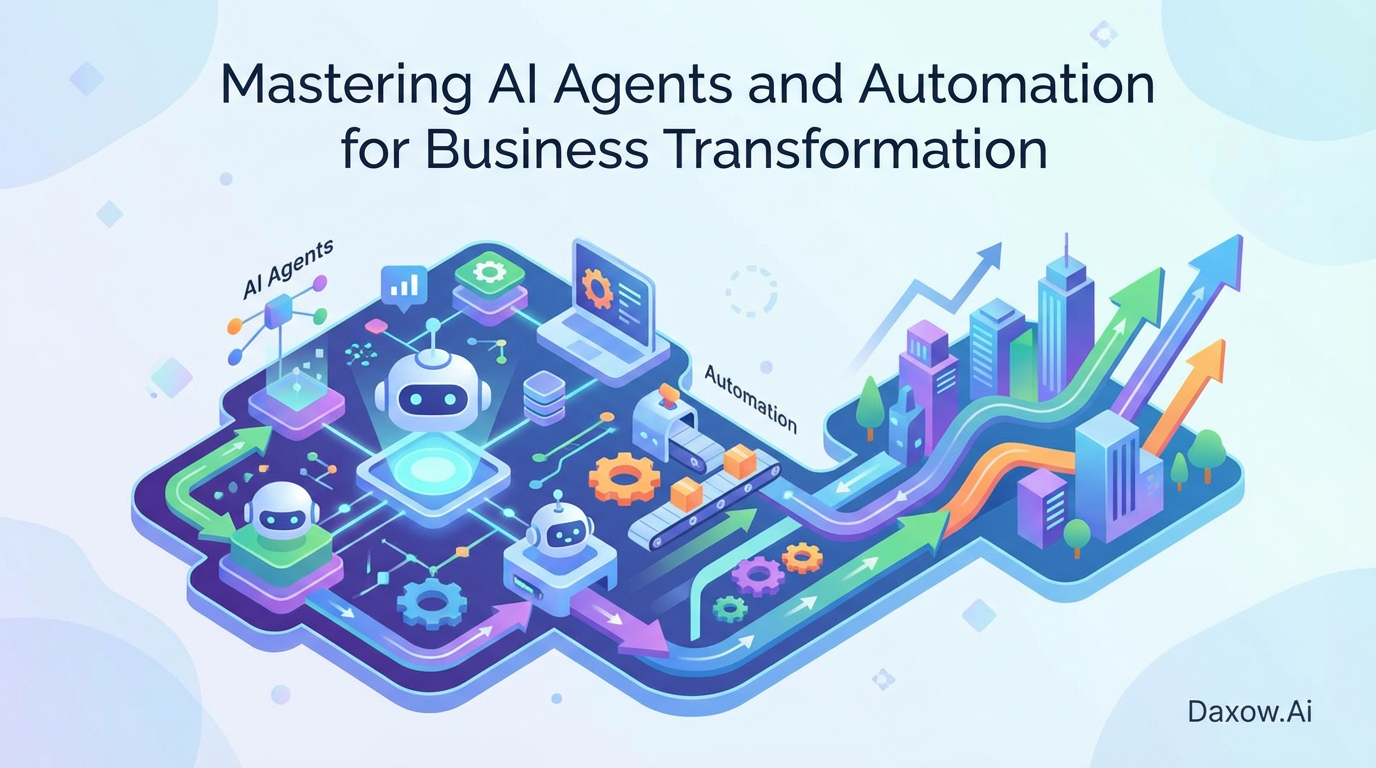
Why AI agents and automation are a business imperative: roadmap, use cases, ROI metrics, and how Daxow.ai builds custom systems to scale automation.
Mastering AI Agents and Automation: A Strategic Imperative for Business Transformation
Estimated reading time: 15 minutes
Key Takeaways
- AI agents and automation significantly reduce manual tasks and improve productivity.
- Successful AI deployment requires clear KPIs, strong data hygiene, and system integration.
- Industries like e-commerce, healthcare, finance, real estate, and HR benefit greatly from tailored AI solutions.
- Daxow.ai provides end-to-end services from process discovery to managed optimization.
- Measuring ROI and ongoing optimization are critical for sustained business impact.
Table of Contents
- Mastering AI Agents and Automation: A Strategic Imperative for Business Transformation
- The strategic value of AI agents and business automation
- Practical use cases across industries
- Implementation roadmap — How to deploy AI automation successfully
- Measuring ROI and business impact
- Risk management and best practices
- How Daxow.ai designs and delivers custom AI agents and workflow automation
- Getting started — a practical checklist for decision-makers
- Frequently Asked Questions
Mastering AI Agents and Automation: A Strategic Imperative for Business Transformation
Why this topic matters now
AI agents and workflow automation enable companies to handle repetitive, high-volume processes autonomously while augmenting human teams for strategic activities. Organizations that adopt these technologies can expect:
- Significant reductions in manual tasks through intelligent routing, data extraction, and automated decisioning.
- Improved productivity as teams focus on high-value work rather than repetitive transactions.
- Faster time-to-outcome, with structured implementations delivering results 3–5x faster than uncoordinated efforts.
- Measurable cost savings and improved customer satisfaction from consistent, reliable automation.
These benefits are realized when automation is implemented with clear objectives, strong data hygiene, and tightly integrated systems — not when treated as isolated experiments.
The strategic value of AI agents and business automation
What AI agents do differently
AI agents go beyond rule-based automation. They combine machine learning, natural language processing (NLP), and integration capabilities to:
- Interpret unstructured inputs (emails, documents, chat messages).
- Make context-aware decisions and route exceptions.
- Learn from feedback and improve over time.
- Integrate with CRMs, ERPs, knowledge bases, and third-party services to execute end-to-end workflows.
This combination supports hyperautomation: RPA for repetitive tasks plus AI for judgment and adaptation. The result is a system that reduces manual oversight and scales with demand.
Business outcomes to prioritize
Decision-makers should frame automation projects around measurable outcomes. Typical priorities include:
- Reduce manual tasks in target processes by 30–70%.
- Increase productivity measured as throughput per staff hour.
- Shorten process times (e.g., invoice processing, response time) by 40% or more.
- Improve customer support automation rates (resolve a higher share of inquiries without agent intervention).
- Lower operational costs and achieve payback within 6–12 months for well-scoped pilots.
Practical use cases across industries
E-commerce — Order-to-cash and CX automation
Problem: High volume of customer inquiries, abandoned carts, and manual inventory reconciliation.
AI solution:
- Deploy AI agents that automate order confirmations, shipment tracking, returns processing, and inventory updates by integrating with your e-commerce platform and warehouse systems.
- Use chatbots with contextual understanding to handle 70–80% of routine customer queries.
- Implement personalization engines to deliver product recommendations and targeted recovery offers.
Impact:
- Reduce manual customer support volume by up to 80%.
- Decrease cart abandonment and increase conversion through timely automated follow-ups.
- Faster order-to-cash cycles and lower fulfillment errors.
Healthcare — Scheduling, triage, and admin automation
Problem: Administrative bottlenecks, long patient wait times, and heavy compliance demands.
AI solution:
- AI agents that handle appointment scheduling, automated reminders, and intelligent triage using symptom inputs.
- Document automation to extract clinical and billing data from forms while maintaining HIPAA-compliant data handling and access controls.
- Integration with EHRs for automated updates and claims processing.
Impact:
- Cut administrative costs and wait times by up to 30%.
- Lower no-show rates via automated reminders and rescheduling workflows.
- Reduced claims denials through consistent data validation.
Finance — Invoicing, compliance, and fraud detection
Problem: Manual invoice processing, time-consuming reconciliation, and exposure to fraudulent transactions.
AI solution:
- Use AI agents to extract invoice data, validate line items, match purchase orders, and trigger payments.
- Deploy anomaly detection models to surface suspicious transactions for review.
- Automate compliance checks and regulatory reporting with rule-based validation augmented by NLP for narrative review.
Impact:
- Reduce invoice processing errors and processing time significantly.
- Faster month-end close cycles and improved forecasting accuracy.
- Lower fraud losses through proactive detection.
Real estate — Lead qualification and contract automation
Problem: High volume of leads with inconsistent qualification and slow contract cycles.
AI solution:
- Implement AI agents that qualify leads automatically from multiple channels, prioritize high-intent prospects, and schedule viewings.
- Use document automation to extract lease or purchase contract terms, standardize clauses, and flag exceptions for legal review.
- Integrate virtual tours, property data, and CRM updates into a single workflow.
Impact:
- Accelerate deal cycles with automated qualification and faster contract turnaround.
- Higher agent efficiency and better client experiences.
HR — Recruitment, onboarding, and employee support
Problem: Lengthy recruitment cycles, inconsistent screenings, and repetitive onboarding tasks.
AI solution:
- AI agents that screen resumes for required skills, schedule interviews, and generate offer letters.
- Automate onboarding tasks (account provisioning, policy acknowledgment) and handle routine HR queries through a conversational agent.
- Use analytics to identify bottlenecks in hiring and retention.
Impact:
- Cut hiring time by up to 50%.
- Better candidate experience and standardized evaluation reducing bias.
Implementation roadmap — How to deploy AI automation successfully
Phase 1 — Assessment and planning (4–8 weeks)
Start with a structured assessment:
- Identify processes with high volume, repetitive steps, and clear rules.
- Set measurable KPIs (e.g., reduce cost per interaction by 20%, achieve 50% automation rate).
- Audit data sources for quality and accessibility.
- Define compliance requirements (e.g., GDPR, HIPAA) and escalation paths.
How Daxow helps:
- We run process audits and opportunity scoring to prioritize quick-win automations aligned to business goals.
- We map integrations and data requirements to ensure feasibility.
Phase 2 — Technology selection and design (6–12 weeks)
Choose platforms that support:
- Scalable integrations with CRMs and ERPs.
- Supervised learning and NLP for unstructured data.
- Monitoring, retraining, and security features.
How Daxow helps:
- Daxow designs solution architectures that combine AI agents, RPA, and workflow automation tools tailored to your environment.
- We recommend vendors and build proof-of-concept prototypes to validate choices.
Phase 3 — Preparation and data work (4–8 weeks)
Critical tasks:
- Clean and label data, create knowledge bases, and define decision trees.
- Prepare APIs and connectors to internal systems.
- Train cross-functional teams and define change management plans.
How Daxow helps:
- We handle data engineering, build the integrations, and create training materials to support adoption.
- We set up governance frameworks to manage bias, performance, and security.
Phase 4 — Pilot and deployment (4–20 weeks)
Best practice:
- Start with one high-volume use case.
- Monitor KPIs, collect user feedback, and iterate rapidly.
- Expand to adjacent processes once performance and adoption metrics are met.
How Daxow helps:
- Daxow delivers pilot builds, manages rollout, and applies continuous improvement based on live metrics.
- We implement human-in-the-loop reviews for safety and compliance during rollout.
Phase 5 — Ongoing optimization
Sustainability requires:
- Continuous monitoring and retraining to accommodate new patterns.
- Regular audits for data quality, drift, and bias.
- Process owners to manage evolution and scale.
How Daxow helps:
- We provide managed services for model retraining, performance monitoring, and feature expansion.
- We implement dashboards that surface operational metrics and ROI.
Measuring ROI and business impact
Key metrics to track
To justify expansion and quantify results, track:
- Resolution rate and percentage of interactions handled by AI agents (automation rate).
- Cost per interaction and operational cost savings.
- Process cycle time reduction and throughput improvements.
- Customer satisfaction (CSAT/NPS) and first contact resolution.
- Error rates and compliance incidents.
Typical ROI outcomes
Well-executed automation projects often deliver:
- Payback within 6–12 months for targeted pilots.
- Operational cost reductions of 30–50% on automated processes.
- Process speed improvements of 40% or more.
- Noticeable gains in customer satisfaction and reduced employee churn due to decreased manual workloads.
Daxow’s role: We help define KPIs, implement tracking infrastructure, and translate performance into financial terms for executive reporting.
Risk management and best practices
Common pitfalls to avoid
- Launching broad initiatives without clear KPIs.
- Neglecting data quality and integration planning.
- Failing to involve IT and security teams early.
- Skipping user training and change management.
- Over-automating without human oversight for exceptions.
Proven safeguards
- Start small with high-volume, low-complexity tasks to build trust and momentum.
- Implement human-in-the-loop reviews for critical decisions.
- Define clear escalation processes and audit trails.
- Regularly retrain models and monitor for bias and drift.
- Ensure end-to-end integration for reliable data flows.
Daxow’s approach: We combine technical delivery with organizational change management. Our projects include governance, security checks, and training to ensure sustainable adoption.
How Daxow.ai designs and delivers custom AI agents and workflow automation
End-to-end automation services
Daxow offers a full lifecycle service:
- Process discovery and opportunity analysis to identify the most valuable automation candidates.
- Custom AI agent development that executes real tasks, integrates with your systems, and learns over time.
- Workflow automation and RPA to stitch together front-end interactions and backend processing.
- System integrations with CRMs, ERPs, databases, and knowledge bases for seamless data flow.
Technical capabilities and integrations
We specialize in:
- Natural language processing for customer support automation and document extraction.
- Predictive models for lead scoring and fraud detection.
- Robotic process automation for repetitive, rule-based tasks.
- Secure APIs and connectors to mainstream business tools and custom systems.
Measuring value and scaling
Daxow emphasizes measurable outcomes:
- We define KPIs during planning and deliver dashboards for executive visibility.
- We prioritize scalable architectures so that successful pilots can be expanded across teams and regions.
- Our managed services ensure long-term optimization and cost-effectiveness.
Getting started — a practical checklist for decision-makers
- Identify 2–3 high-volume processes where automation can immediately reduce manual tasks.
- Define tangible KPIs (cost, time, satisfaction).
- Allocate cross-functional ownership including IT, business stakeholders, and a change lead.
- Request a process analysis to evaluate data readiness and integration points.
- Pilot a single use case, measure results, then scale.
Why engage Daxow.ai
- Tailored solutions: We don’t sell one-size-fits-all products; we design AI agents to your workflows.
- End-to-end delivery: From discovery to deployment and managed services, we cover the full lifecycle.
- Business-first approach: We focus on measurable ROI, governance, and user adoption, ensuring automation projects deliver sustainable value.
Mastering AI Agents and Automation: A Strategic Imperative for Business Transformation is achievable with the right approach: focused process selection, robust data and integrations, iterative pilots, and governance. If your organization wants to reduce manual work, boost productivity, and accelerate growth with tailored AI automation, Daxow.ai can help. Book a free consultation or request a process analysis for your company today to begin building a custom AI system that delivers measurable business value.
Frequently Asked Questions
What are AI agents and how do they differ from traditional automation?
AI agents combine machine learning, natural language processing, and integration to handle unstructured inputs, make context-aware decisions, and learn over time, going beyond rule-based automation that relies on fixed scripts.
How can my business measure the success of AI automation projects?
Success metrics include reduction in manual tasks, productivity increases, process time reduction, improved customer satisfaction scores, and operational cost savings. Establishing KPIs during planning ensures clear measurement.
Is AI automation suitable for all industries?
While AI automation delivers value across many sectors like e-commerce, healthcare, finance, real estate, and HR, the best results come from tailored solutions that fit specific industry challenges and workflows.
What makes Daxow.ai's approach to AI automation unique?
Daxow.ai provides end-to-end services from process discovery to managed optimization, focusing on tailored solutions, strong governance, measurable ROI, and sustainable adoption, supported by deep technical and industry expertise.