
Mastering AI Agents and Automation for Business Transformation
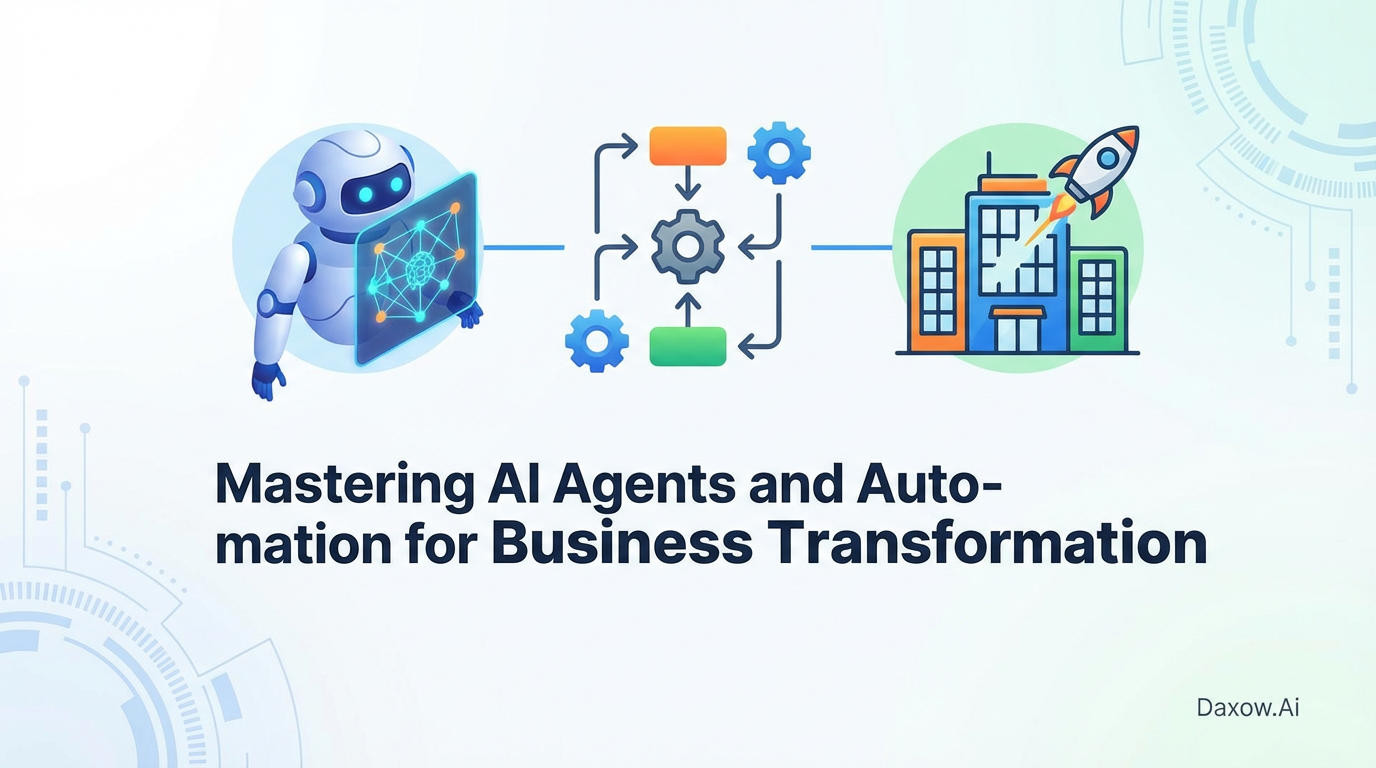
Learn a phased roadmap to deploy AI agents and workflow automation, with industry use cases, best practices, and ROI-driven solutions from Daxow.ai.
Mastering AI Agents and Automation: A Strategic Imperative for Business Transformation
Estimated reading time: 15 minutes
Key Takeaways
- AI agents and automation improve productivity, reduce manual tasks, and deliver personalized experiences.
- A phased roadmap ensures risk-managed AI adoption with measurable KPIs and business outcomes.
- Industry-specific use cases demonstrate practical AI and workflow automation benefits.
- Daxow.ai provides end-to-end solutions from discovery to optimization driving significant ROI.
- Continuous monitoring, governance, and human oversight are essential for sustainable AI success.
Table of Contents
- Mastering AI Agents and Automation: A Strategic Imperative for Business Transformation
- What AI Agents and Workflow Automation Deliver
- Practical Use Cases Across Industries
- Implementation Roadmap — A Phased, Risk-Managed Approach
- Best Practices and Risk Management
- How Daxow.ai Delivers End-to-End Business Automation
- Measuring ROI — KPIs That Matter
- Technical and Organizational Considerations
- Realistic Timeline and Investment Expectations
- Example Outcomes — Hypothetical Case Summaries
- Next Steps — How to Start Mastering AI Agents and Automation
- Frequently Asked Questions
Mastering AI Agents and Automation: A Strategic Imperative for Business Transformation
Mastering AI Agents and Automation: A Strategic Imperative for Business Transformation is no longer a theoretical ambition — it is a pressing commercial requirement. Decision-makers face intensified competition, rising customer expectations, and constrained operational budgets. Deploying AI automation and AI agents enables organizations to reduce manual tasks, accelerate decision cycles, and deliver consistent, personalized customer experiences. This article explains what mastering AI agents and automation looks like in practice, presents actionable implementation steps, offers industry-specific use cases, and shows how Daxow.ai designs and delivers custom AI systems that drive measurable business value.
What this strategic imperative means for your organization
- AI agents are autonomous digital workers that execute tasks, make decisions within defined boundaries, and escalate exceptions.
- Automation — particularly workflow automation — orchestrates end-to-end processes across systems and teams.
- Together they enable businesses to scale operations, improve productivity, and reduce human error when dealing with high-volume, repeatable work.
Why now
- Proven deployments achieve faster time-to-value by prioritizing high-volume, low-complexity processes.
- Organizations that implement AI automation report substantial reductions in operational cost and improvements in customer satisfaction.
- AI agents add the ability to interpret unstructured data, communicate in natural language, and integrate context-aware decisions into workflows.
What AI Agents and Workflow Automation Deliver
Core capabilities
- 24/7 task execution: Agents handle routine tasks outside business hours.
- Data-driven decisions: Models analyze patterns and surface predictive insights.
- System-to-system integrations: Automation connects CRM, ERP, ticketing, and other systems.
- Human-in-the-loop escalation: Agents defer complex exceptions to humans with context.
Primary business outcomes
- Reduce manual tasks across departments, freeing staff for strategic work.
- Improve productivity by eliminating bottlenecks and accelerating cycle times.
- Boost customer experience through rapid, consistent responses and personalized interactions.
- Lower operational costs through process consolidation and error reduction.
Practical Use Cases Across Industries
E-commerce — order processing to personalization
- Use cases: Automated order routing, inventory reconciliation, returns handling, dynamic pricing, and chatbot-driven customer support.
- Business outcomes: Faster fulfillment, reduced cancellations, higher average order value through personalized recommendations.
- How AI agents help: Conversational agents qualify returns and refunds, while workflow automation updates stock across marketplaces and triggers fulfillment centers.
Healthcare — scheduling to compliance
- Use cases: Automated patient scheduling, symptom triage via NLP agents, claims validation, and compliance monitoring.
- Business outcomes: Reduced no-shows, optimized clinician time, fewer billing errors, and stronger audit trails.
- How AI agents help: Intelligent triage agents gather symptoms and recommend next steps, handing off to clinicians for complex cases while maintaining HIPAA-compliant data handling.
Finance — invoicing to fraud detection
- Use cases: Invoice extraction and validation, risk scoring, AML/compliance checks, and anomaly detection in transactions.
- Business outcomes: Faster invoice-to-pay cycles, improved regulatory compliance, and earlier fraud detection.
- How AI agents help: Document automation extracts invoice fields and posts them to ERP; anomaly detection agents flag suspicious patterns and trigger investigations.
Real Estate — lead qualification to portfolio analytics
- Use cases: Automated property listings ingestion, virtual valuations, lead qualification, and scheduling viewings.
- Business outcomes: Shorter sales cycles, higher lead-to-view conversion, and more accurate market insights.
- How AI agents help: Agents qualify leads via chat, schedule viewings, and populate CRM records with owner and property data.
HR — recruitment to employee lifecycle
- Use cases: Resume screening, interview scheduling, onboarding workflows, payroll automation, and retention risk modeling.
- Business outcomes: Faster hiring, improved candidate experience, and reduced administrative overhead.
- How AI agents help: Screening agents score candidates against role criteria and schedule interviews, while workflow automation enrolls new hires into systems and training programs.
Customer Support and Sales Automation
- Use cases: Customer support automation with multi-channel chatbots, automated ticket routing, knowledge-base recommendation, and sales lead qualification and nurturing.
- Business outcomes: Reduced response times, lower cost per interaction, increased conversion from qualified leads.
- How AI agents help: Conversational agents handle tier-1 support, escalate complex tickets with context, and qualify leads before routing to sales teams.
Implementation Roadmap — A Phased, Risk-Managed Approach
Phase 1 — Define Goals and Assess Readiness (4–8 weeks)
- Activities:
- Identify high-impact processes where automation will reduce manual tasks.
- Set clear, measurable objectives (e.g., 30% cost reduction, 20% faster response).
- Conduct a data audit: availability, quality, security and compliance considerations.
- Deliverables:
- Process priority matrix.
- Baseline KPIs and a success measurement plan.
Phase 2 — Select Tools and Build Team (6–12 weeks)
- Activities:
- Evaluate platforms for integration, security, and scale.
- Choose models and automation tools suited to the use case (NLP for chatbots, supervised models for scoring).
- Put together cross-functional teams: IT, operations, domain experts, and vendor partners.
- Deliverables:
- Technology stack recommendation.
- Roles and responsibility matrix.
Phase 3 — Prepare Data, Design Workflows, and Pilot (4–8 weeks)
- Activities:
- Clean and normalize data, build knowledge bases and templates.
- Design human-in-the-loop escalation paths and compliance controls.
- Run a time-boxed pilot with clear monitoring.
- Deliverables:
- Pilot deployment with measurable KPIs and a feedback loop for iterative improvements.
Phase 4 — Scale and Optimize (Ongoing)
- Activities:
- Gradual expansion across teams and systems.
- Continuous monitoring, model retraining, and performance tuning.
- Establish governance and reporting for long-term sustainability.
- Deliverables:
- Production-grade automation, documented ROI metrics, and a roadmap for additional use cases.
Best Practices and Risk Management
Best practices
- Start small with high-volume tasks: Early wins build momentum and reduce risk.
- Involve leadership and IT early: Secure sponsorship and ensure integration feasibility.
- Maintain human oversight: Retain escalation paths and transparent decision logs.
- Measure continuously: Track resolution rates, cost per interaction, and customer satisfaction.
- Iterate quickly: Use pilot feedback to refine models and workflows.
Risk mitigation
- Data privacy and compliance: Implement encryption, role-based access, and audit trails.
- Model drift and performance: Schedule retraining and establish thresholds for human review.
- Change management: Communicate the role shifts to staff and invest in upskilling.
How Daxow.ai Delivers End-to-End Business Automation
Discovery and process analysis
We map your existing workflows, identify automation candidates, and quantify potential ROI.
Deliverable: A prioritized automation plan with estimated resource and time savings.
Custom AI agents and workflow automation
We design AI agents that execute real tasks—extracting data, interacting with customers, updating CRMs, and making conditional decisions.
We build workflow automation that integrates with your business stack (CRM, ERP, ticketing, databases).
Deliverable: Production-ready AI agents and automated workflows tailored to your operations.
Integration and data connectivity
We connect systems and normalize data to ensure agents have the context they need.
We handle secure API integrations, data pipelines, and identity/access controls.
Deliverable: Reliable integrations and accessible single sources of truth for automation.
Monitoring, optimization, and governance
We implement performance dashboards, alerting, and retraining pipelines.
We set governance around escalation, compliance, and auditing.
Deliverable: Continuous improvement processes ensuring long-term ROI.
Outcomes Daxow.ai targets
- Reduce manual tasks by up to 50–70% in targeted processes.
- Improve productivity through faster cycle times and fewer errors.
- Increase revenue by improving conversion rates via sales automation and personalization.
- Reduce operational costs and accelerate time-to-value with phased rollouts.
Learn more about our solutions on the Daxow.ai Solutions page or explore case studies detailing our client successes.
Measuring ROI — KPIs That Matter
Operational KPIs
- Process cycle time reduction (hours/days saved).
- Percentage reduction in manual tasks.
- Cost per transaction or interaction.
Customer KPIs
- First response time and resolution rate.
- Net Promoter Score (NPS) and CSAT improvements.
Business KPIs
- Conversion rate uplift from sales automation.
- Error reduction and compliance incident decreases.
Track these metrics before, during, and after pilots to quantify the impact and justify scaling.
Technical and Organizational Considerations
System integration and data architecture
- Plan for API-first integrations and data normalization.
- Use secure, auditable data stores and event logs to maintain traceability.
Scalability and reliability
- Deploy agents using modular, containerized architectures to scale horizontally.
- Include fallback mechanisms and circuit-breakers for dependent systems.
Talent and change management
- Upskill staff to work alongside AI agents.
- Communicate role changes and focus on value redistribution, not headcount reduction.
Realistic Timeline and Investment Expectations
Typical engagements follow the phased timeline described earlier:
- Assessment & planning: 4–8 weeks
- Technology selection & initial build: 6–12 weeks
- Pilot: 4–8 weeks
- Rollout & optimization: ongoing
Investment varies with scope. Many clients see measurable ROI within months for focused pilots and achieve full payback within 12–24 months as automation scales across processes.
Example Outcomes — Hypothetical Case Summaries
Case A — E-commerce retailer
- Problem: High volume of returns and manual refund processing.
- Solution: Automated return intake agent, document extraction, and a workflow automating approvals.
- Outcome: 40% reduction in manual processing time, 25% faster refunds, improved customer satisfaction.
Case B — Mid-size bank
- Problem: Time-consuming KYC checks and fraud alerts.
- Solution: AI agents for document verification and anomaly detection integrated into the CRM.
- Outcome: 30% faster onboarding, earlier fraud detection, and reduced AML compliance workload.
Case C — Healthcare provider
- Problem: Scheduling inefficiencies and high no-show rates.
- Solution: Patient triage agent and automated scheduling/rescheduling workflow with reminders.
- Outcome: 20% fewer no-shows, improved clinician utilization, and better patient satisfaction.
Next Steps — How to Start Mastering AI Agents and Automation
Daxow.ai offers a structured way to move from concept to production:
- We begin with a process analysis to identify automation winners.
- We deliver pilots that prove value quickly, then scale proven systems across your organization.
- We provide full lifecycle support: design, build, integrate, monitor, and optimize.
Bold, decisive action captures the strategic advantage. Organizations that prioritize AI agents and workflow automation now will outperform peers in cost structure, speed, and customer experience.
Frequently Asked Questions
What are AI agents and how do they differ from traditional automation?
AI agents are autonomous digital workers capable of interpreting unstructured data, making context-aware decisions, and communicating in natural language. Unlike traditional automation focused on rule-based tasks, AI agents can handle more complex workflows requiring adaptability and learning.
How quickly can my organization expect to see ROI from AI automation?
Many organizations achieve measurable ROI within months of piloting focused automation on high-impact processes. Full payback and broader benefits typically materialize within 12–24 months as solutions scale and optimize.
What are the main risks in implementing AI agents and how can they be mitigated?
Key risks include data privacy issues, model drift, and organizational resistance. Mitigation involves strong security and compliance controls, continuous model retraining, clear communication, and involving stakeholders early.