
Mastering AI Agents and Automation for Modern Enterprises
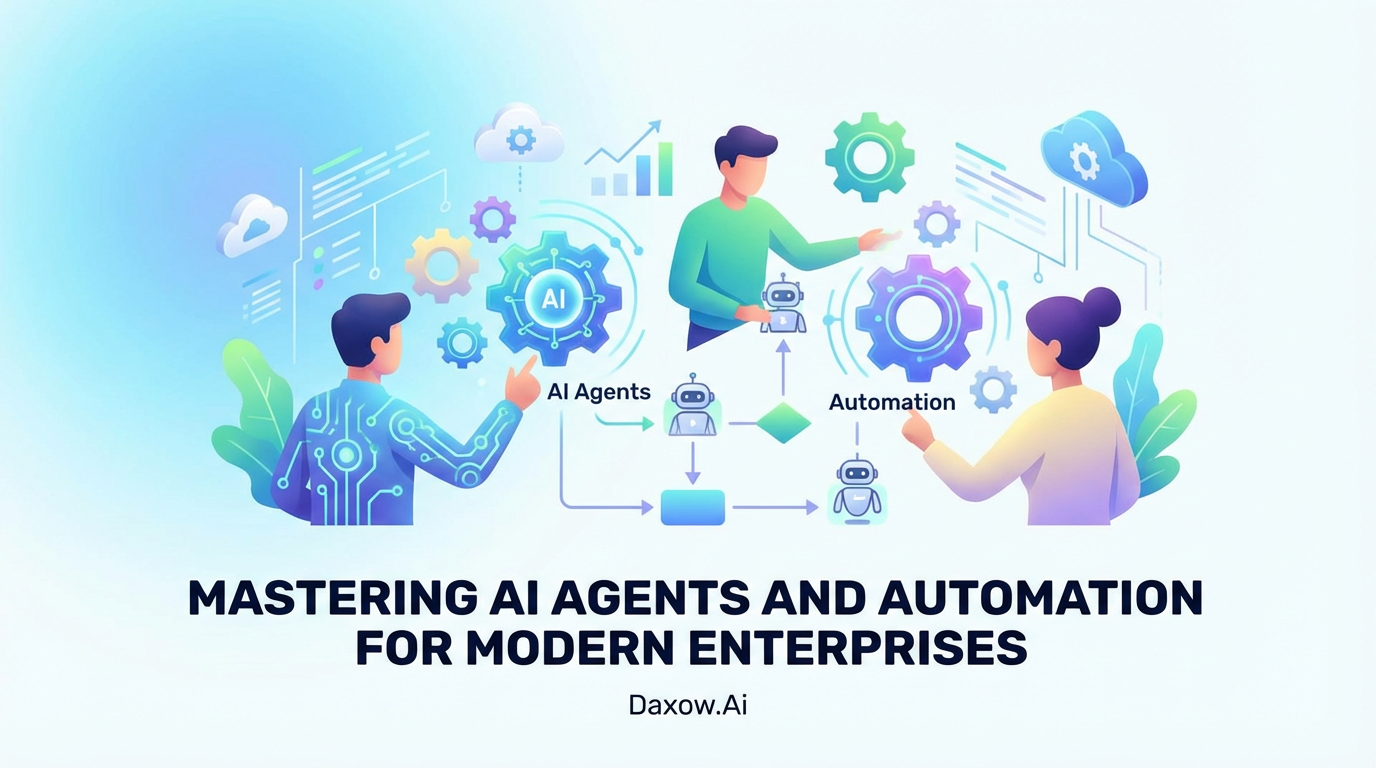
Practical guide to AI agents and workflow automation for enterprises: use cases, phased implementation, ROI expectations, and Daxow.ai services.
Mastering AI Agents and Automation: Transforming Business Operations for the Modern Enterprise
Estimated reading time: 15 minutes
Key Takeaways
- AI agents combined with workflow automation enable scalable, efficient operations while reducing manual tasks across multiple industries.
- Structured implementations accelerate business objectives 3–5x faster with clear ROI and measurable impact.
- Daxow.ai offers end-to-end solutions from discovery to deployment, focusing on compliance, governance, and scalability.
- Phased implementation reduces risk and promotes successful adoption through data quality, continuous improvement, and leadership engagement.
- Industry-specific AI use cases enhance productivity, customer experience, and cost efficiency in finance, healthcare, e-commerce, HR, and more.
Table of Contents
- Mastering AI Agents and Automation: What It Means for Your Business
- Practical Use Cases: How AI Agents and Automation Deliver Value Across Industries
- Implementation Framework: A Phased Approach to Successful AI Automation
- Measuring ROI and Operational Impact
- Governance, Risk Management, and Compliance
- Integration and Scalability: Connecting AI Agents to Your Tech Stack
- How Daxow.ai Helps You Build and Scale AI Agents and Workflow Automation
- Frequently Asked Questions
Mastering AI Agents and Automation: What It Means for Your Business
AI agents are autonomous software systems that perform tasks, make decisions, and interact with people or systems with minimal oversight. When combined with workflow automation, they allow organizations to scale operations without linear increases in headcount.
- Core capabilities: natural language processing, decision logic, API integrations, predictive analytics, and continuous learning loops.
- Business outcomes: 24/7 operations, faster throughput, reduced error rates, and personalized customer interactions.
- Why it matters now: organizations that adopt structured AI implementations achieve objectives 3–5x faster, while high-volume, low-complexity tasks deliver the fastest wins.
Benefits at a glance
- Reduce manual tasks across finance, HR, sales, and support.
- Improve productivity by reallocating human effort to strategic work.
- Enhance customer experience through consistent, rapid responses and personalization.
- Cut operating costs with automated processing, monitoring, and compliance controls.
Practical Use Cases: How AI Agents and Automation Deliver Value Across Industries
E-commerce: Order-to-fulfillment automation
Use case: Automate order validation, fulfillment orchestration, inventory updates, and returns processing.
Practical workflow:
- AI agent receives order via API or webhook.
- Validate payment, check inventory, and reserve stock.
- Trigger fulfillment provider and update shipment tracking.
- Handle returns automatically and adjust inventory.
Business impact:
- Reduce manual tasks in order management by up to 70%.
- Shorten fulfillment times and lower fulfillment costs.
- Improve customer satisfaction with timely status updates via chatbots (customer support automation).
Healthcare: Scheduling, triage, and records automation
Use case: Streamline appointment scheduling, symptom triage, and intake form processing while maintaining compliance.
Practical workflow:
- Patient interacts with an AI agent to describe symptoms.
- Agent triages urgency, suggests next steps, and schedules appointments.
- Automate medical record updates and billing codes.
Business impact:
- Reduce administrative workload for staff, freeing clinicians for care.
- Cut wait times and no-show rates.
- Maintain audit trails for compliance and HIPAA-safe data handling.
Finance: Invoice processing and fraud detection
Use case: Automate invoice capture, validation, approval routing, and anomaly detection.
Practical workflow:
- AI extracts invoice data using document automation.
- Cross-checks against purchase orders and payment terms.
- Flags anomalies and routes exceptions for human review.
Business impact:
- Reduce manual tasks in AP by 50–70%.
- Decrease payment errors and detect fraud earlier.
- Shorten cycle time from invoice to payment, improving supplier relationships.
Real Estate: Lead qualification and property operations
Use case: Qualify leads, schedule viewings, and generate pricing guidance.
Practical workflow:
- AI agent engages leads from web forms or listings.
- Ask qualifying questions and score leads based on defined criteria.
- Schedule viewings, send reminders, and feed CRM with enriched data.
Business impact:
- Faster lead response times and higher conversion rates.
- Sales automation reduces time-to-contact and qualifies leads before human handoff.
HR: Resume screening and onboarding automation
Use case: Screen resumes, schedule interviews, and automate onboarding tasks.
Practical workflow:
- AI parses resumes and scores candidates against role requirements.
- Auto-schedule interviews and send onboarding documentation.
- Manage approvals for equipment, training, and access rights.
Business impact:
- Accelerate hiring timelines (up to 40% faster).
- Reduce bias from manual screening with standardized scoring criteria.
- Free HR teams to focus on culture and retention.
Customer Support and Sales: End-to-end conversational automation
Use case: Provide instant support, triage complex tickets, and hand off to agents when needed.
Practical workflow:
- Customer interacts with a chatbot (24/7).
- Agent resolves simple queries or collects context and escalates complex cases.
- Integrate with CRM for personalized follow-up and sales qualification.
Business impact:
- Customer support automation reduces first-response times and handling costs.
- Improve NPS and retention with consistent experiences across channels.
Implementation Framework: A Phased Approach to Successful AI Automation
Phase 1 — Assessment and Planning (4–8 weeks)
Actions:
- Map existing workflows and identify bottlenecks.
- Choose measurable goals: cost reduction, FCR (first contact resolution), throughput, or NPS.
- Evaluate integration points (CRM, ERP, messaging, databases).
- Assess data quality and regulatory requirements (GDPR, HIPAA where applicable).
Daxow role:
- Conduct process discovery workshops.
- Deliver a prioritized roadmap and ROI-backed business case.
Phase 2 — Technology Selection and Team Building (6–12 weeks)
Actions:
- Select platforms that integrate with your stack and meet scale requirements.
- Build a cross-functional team: product owner, engineers, SMEs, and change leads.
- Define KPIs and success criteria for pilots.
Daxow role:
- Recommend architecture and vendor-neutral options.
- Provide expert resources for rapid prototyping and integration.
Phase 3 — Preparation and Data Readiness (4–8 weeks)
Actions:
- Cleanse and structure data; build knowledge bases and decision trees.
- Define escalation logic and audit trail requirements.
- Establish training sets for NLP models and rules engines.
Daxow role:
- Implement secure data pipelines and transform legacy data.
- Build knowledge graphs and document automation templates.
Phase 4 — Pilot Deployment and Rollout (4–20 weeks)
Actions:
- Launch small, measurable pilots with tight feedback loops.
- Monitor KPIs, iterate on dialogues, retrain models, and expand scope.
- Plan phased rollout across teams and geographies.
Daxow role:
- Deliver pilot AI agents and integrations.
- Run performance monitoring, continuous improvement, and handover training.
Best practices to follow
- Start small with high-impact, low-complexity workflows.
- Invest in data quality—AI is only as good as the data it consumes.
- Build continuous improvement loops for monitoring and retraining.
- Engage leadership early for alignment and governance.
- Plan for change management to ensure adoption and ROI realization.
Measuring ROI and Operational Impact
Quantifying value is essential to justify investment and drive further automation.
Key metrics to track
- Cost per transaction and overall operational cost.
- Time-to-resolution and throughput volumes.
- Error rates and exception frequency.
- Customer satisfaction (CSAT/NPS) and employee productivity.
- Time-to-hire, hiring funnel conversion rates (HR use cases).
Expected outcomes (realistic ranges)
- Operational cost reduction: 30–70% in automated areas.
- Error reduction: up to 90% for data-entry and document tasks.
- Time to value: pilots pay back in 6–12 months with disciplined execution.
- Productivity gains: human agents focused on exceptions and high-value decisions.
How Daxow helps measure impact
- We define baseline metrics during assessment.
- We build dashboards to monitor KPIs in real time.
- We run A/B pilots to isolate the effect of automation on key outcomes.
Governance, Risk Management, and Compliance
Automation introduces new governance responsibilities. Addressing them proactively reduces legal and reputational risk.
Focus areas
- Data privacy and compliance: define policies for GDPR, HIPAA, and local regulations.
- Auditability: maintain immutable logs for decisions and transactions.
- Model governance: version control, performance monitoring, and human-in-the-loop escalation.
- Security: secure APIs, authentication, and least-privilege access to systems.
Daxow approach
- Implement compliance by design with secure data handling and encrypted pipelines.
- Deliver transparent decision logs and role-based access controls.
- Provide change management and training to ensure ethical AI use and adoption.
Integration and Scalability: Connecting AI Agents to Your Tech Stack
AI agents deliver value only when they're properly connected to backend systems.
Common integrations
- CRM and sales systems for context and follow-up.
- ERP and finance systems for invoice and payment automation.
- Ticketing and knowledge bases for support automation.
- Document stores and identity systems for secure data access.
Scalability considerations
- Stateless, containerized services for elastic scaling.
- Message-driven architectures for decoupled components.
- Monitoring, rate limiting, and retry logic for robust operations.
Daxow capabilities
- End-to-end integrations across cloud and on-prem systems.
- API-first designs that support phased rollouts and multi-channel delivery.
- Ongoing maintenance and scalability planning so automation grows with your business.
How Daxow.ai Helps You Build and Scale AI Agents and Workflow Automation
Daxow.ai provides a full-service approach tailored to your business objectives.
What we deliver
- Custom AI agents that execute real tasks—handling chats, automating approvals, extracting documents, and orchestrating workflows.
- Workflow automation to remove manual steps and link systems with business rules.
- Customer support automation and chatbots that improve response times and resolution rates.
- Sales automation including lead qualification and CRM enrichment.
- System integrations connecting CRMs, ERPs, ticketing, and third-party services.
- End-to-end project management, from discovery to long-term support.
Typical engagement phases
- Discovery and process analysis to identify high-value automation candidates.
- Rapid prototyping to demonstrate feasibility and measure early wins.
- Full implementation with secure system integrations and user training.
- Continuous optimization with monitoring, retraining, and feature expansion.
Why partner with Daxow
- Business-first approach: we prioritize measurable outcomes and fast payback.
- Technology agnostic: we choose the right tools for your environment.
- Enterprise-grade delivery: security, compliance, and scalability built-in.
- Proven methodology: structured phases that reduce risk and accelerate adoption.
Mastering AI agents and automation is a strategic imperative for modern enterprises. When done correctly, AI-driven automation reduces manual tasks, increases productivity, and creates measurable business automation value across support, sales, finance, HR, and operations. Daxow.ai combines process expertise, engineering capability, and governance discipline to design and deploy AI agents that deliver real outcomes.
Frequently Asked Questions
What industries benefit most from AI agent automation?
Industries with high-volume, rule-based workflows such as e-commerce, healthcare, finance, real estate, HR, and customer support are ideal candidates for AI-driven automation.
How long does it take to implement AI automation with Daxow.ai?
Implementation timelines vary by project complexity, but a phased approach typically spans 4 to 20 weeks for pilot deployments, with ongoing rollouts aligned to your business goals.
How does Daxow.ai ensure data privacy and compliance?
We implement compliance by design, including secure data pipelines, encrypted communication, audit logs, and adherence to GDPR, HIPAA, and relevant regulations specific to your industry.
What is the expected ROI from AI agent automation?
Typical ROI includes 30–70% operational cost reduction, up to 90% error reduction, and payback periods of 6–12 months when executed with discipline and proper change management.