
Mastering AI Agents & Automation: A Business Roadmap
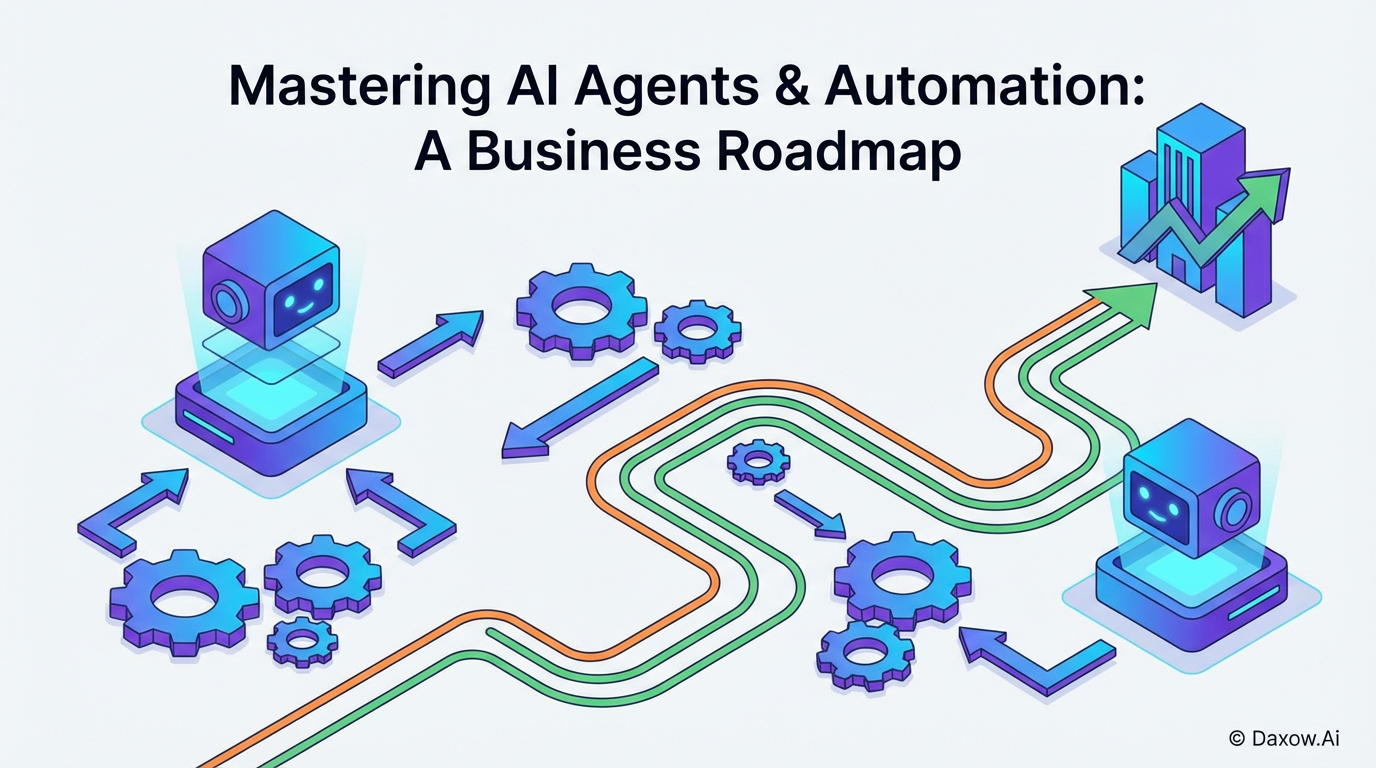
Practical guide to AI agents and workflow automation: industry use cases, phased implementation roadmap, KPIs and ROI examples — how Daxow.ai builds pilots to scale.
Mastering AI Agents and Automation: A Strategic Imperative for Business Transformation
Estimated reading time: 15 minutes
Key Takeaways
- AI agents and automation accelerate business transformation by improving speed, reducing costs, and enhancing scalability.
- Core AI capabilities include autonomous execution, natural language interaction, system orchestration, and continuous learning.
- Practical use cases span industries such as e-commerce, healthcare, finance, real estate, and HR, delivering measurable ROI.
- A structured implementation roadmap ensures successful deployments from strategy through scale and continuous optimization.
- Adopting best practices and avoiding common pitfalls maximizes automation benefits and stakeholder trust.
- Daxow.ai specializes in custom AI system design, integration, and ongoing optimization for sustained business value.
Table of Contents
- Introduction
- Why this is strategic
- What AI Agents and Automation Mean for Your Business
- Practical Use Cases Across Industries
- Implementation Roadmap: From Strategy to Scale
- Best Practices and Common Pitfalls
- Measuring ROI and Business Value
- How Daxow.ai Helps: From Assessment to Autonomous Execution
- Quick Checklist for Decision-Makers
- Next Steps
- Conclusion and CTA
- Frequently Asked Questions
Introduction
Mastering AI Agents and Automation: A Strategic Imperative for Business Transformation is no longer a theoretical advantage — it is a practical requirement for organizations that want to compete, scale, and reduce operational friction. For business owners, CTOs, operations leaders and decision-makers, adopting AI automation and AI agents shifts repetitive, error-prone work into reliable, measurable systems that operate around the clock. This article explains what that shift looks like in practice, demonstrates concrete use cases across industries, outlines a proven implementation roadmap, and shows how Daxow.ai designs and delivers custom AI systems that drive measurable ROI.
Why this is strategic
- Speed and efficiency: Organizations that structure AI initiatives achieve objectives 3–5x faster through focused implementations.
- Cost reduction: Targeted automation can reduce operational expenses in specific functions by 30–50%.
- Scalability and availability: AI agents run 24/7, increasing throughput without proportional headcount growth.
These outcomes make AI agents and automation a strategic lever for reallocating resources to innovation, improving customer experience, and ensuring compliance in regulated sectors.
What AI Agents and Automation Mean for Your Business
Core capabilities
- Autonomous task execution: AI agents perform structured, rule-based work and make bounded decisions with minimal human oversight.
- Natural language interaction: NLP-driven chatbots and agents manage customer and employee conversations across channels.
- System orchestration: Workflow automation coordinates actions across CRM, ERP, ticketing systems and databases.
- Continuous learning: Agents collect feedback and retrain models to improve accuracy over time.
Business outcomes
- Reduced manual tasks across support, sales, finance, and HR, freeing staff for higher-value activities.
- Improved productivity with measurable boosts (pilot programs commonly deliver 20–30% productivity gains).
- Faster decisions and processing, enabling real-time fraud detection, automated approvals, and instant customer responses.
- Better customer satisfaction through faster response times and personalized experiences, driving conversion and retention.
Practical Use Cases Across Industries
AI agents and workflow automation produce the greatest value in high-volume, rule-based processes with decision elements. Below are practical examples with measurable outcomes and how Daxow.ai helps implement them.
E-commerce
Use case: Conversational commerce and fulfillment orchestration
- What happens: AI agents handle pre-sale inquiries, product recommendations, and post-sale support. Workflow automation connects order systems, inventory, and shipping partners.
- Impact: Response times fall from hours to seconds; conversions improve by 20–30% through personalized recommendations.
- Daxow.ai role: Build customer support automation and AI agents integrated with your e-commerce platform and CRM, automate order routing, and optimize upsell flows driven by predictive models.
Healthcare
- Use case: Appointment scheduling, triage, and administrative automation
- What happens: AI agents triage patient queries, schedule appointments, and check eligibility while preserving privacy and compliance.
- Impact: Administrative burdens drop, clinicians gain time for care, and patient satisfaction improves.
- Daxow.ai role: Design HIPAA-aware AI systems that connect EHRs, automate intake forms, and escalate clinical issues to human staff when appropriate.
Finance
- Use case: Real-time fraud detection and automated compliance checks
- What happens: AI agents analyze transactions for anomalies, automate KYC and AML checks, and route exceptions for human review.
- Impact: Risk is reduced, approvals accelerate, and potential losses are minimized.
- Daxow.ai role: Implement anomaly detection pipelines, integrate with core banking systems, and create audit trails for regulatory reporting.
Real Estate
- Use case: Lead qualification and virtual showings
- What happens: AI agents qualify inquiries, schedule virtual tours, and generate market valuations using external data and CRM history.
- Impact: Sales cycles shorten by up to 40%, and agents spend more time closing deals.
- Daxow.ai role: Build lead qualification agents, calendar integrations, and valuation models connected to property databases and CRM workflows.
HR and Talent
- Use case: Resume screening, onboarding automation, and employee support
- What happens: Agents screen resumes, run preliminary interviews via chat, automate onboarding checklists, and answer employee policy questions.
- Impact: Time-to-hire improves by 50% and HR teams focus on candidate experience and strategic initiatives.
- Daxow.ai role: Create unbiased screening rules, conversational HR assistants, and secure integrations with HRIS systems.
Implementation Roadmap: From Strategy to Scale
Successful deployments follow a phased, cyclical framework that mitigates risk and drives adoption. Daxow.ai applies a pragmatic process proven to deliver results.
1. Strategic Assessment and Planning (4–8 weeks)
- Objectives: Define business goals (e.g., reduce support cost by 20%, achieve 90% issue resolution via automation).
- Activities: Process mapping, volume analysis, KPI definition, identification of high-impact, low-complexity processes.
- Daxow.ai deliverable: A prioritized automation roadmap with target KPIs and a ROI projection.
2. Technology Selection and Vendor Evaluation (6–12 weeks)
- Objectives: Choose platforms for orchestration, model deployment, and integrations.
- Activities: Evaluate AI capabilities (NLP, ML), connectors to CRM/ERP, compliance features (GDPR, HIPAA), and governance controls.
- Daxow.ai deliverable: Platform selection recommendations and integration architecture tailored to your tech stack.
3. Preparation and Data Readiness (4–8 weeks)
- Objectives: Ensure data quality and prepare knowledge assets.
- Activities: Clean and label data, construct decision trees and knowledge bases, document escalation paths, set access controls.
- Daxow.ai deliverable: Data pipelines, annotated datasets, and secure connectivity to source systems.
4. Pilot Deployment and Testing (2–6 weeks)
- Objectives: Validate the solution with a controlled audience and measurable metrics.
- Activities: Deploy a single use case (e.g., chatbot for FAQ), monitor performance, collect user feedback, iterate.
- Daxow.ai deliverable: Working pilot, performance dashboard, and optimization plan.
5. Gradual Rollout and Change Management (ongoing)
- Objectives: Expand coverage while maintaining quality and adoption.
- Activities: Multi-channel deployment, staff training, communications, defined human-in-the-loop workflows.
- Daxow.ai deliverable: Rollout playbook, training materials, and governance processes.
6. Monitor, Optimize, and Scale (continuous)
- Objectives: Sustain improvements and adapt to new needs.
- Activities: Retrain models, onboard new integrations, measure KPIs and ROI, conduct periodic audits.
- Daxow.ai deliverable: Continuous improvement services, model retraining, and performance reporting.
Key success metrics to track:
- Cost per interaction
- Resolution rate and escalation rate
- Time-to-resolution
- CSAT / NPS
- Time-to-value and payback period
Best Practices and Common Pitfalls
Best practices
- Start small: Focus on high-impact, low-complexity processes to deliver quick wins and build organizational confidence.
- Invest in data quality: Clean, well-structured data is the foundation of effective AI agents.
- Define escalation paths: Clear human-in-the-loop procedures prevent risk and maintain customer trust.
- Align business and IT: Cross-functional teams ensure technical feasibility and business relevance.
- Monitor continuously: Use dashboards and KPIs to catch drift and drive improvements.
Common pitfalls to avoid
- Deploying complex, enterprise-wide automation without a pilot.
- Underestimating integration complexity with legacy systems.
- Lacking governance and auditability — crucial in regulated industries.
- Ignoring user experience — poorly designed agents damage trust and adoption.
- Expecting AI to be a set-and-forget solution — models need ongoing maintenance.
Measuring ROI and Business Value
Quantifying the value of AI automation requires choosing the right metrics and a realistic timeline. Typical outcomes seen across pilots and early rollouts include:
- Support automation: 40–60% reduction in ticket volume for repetitive issues.
- Process efficiency: 3–5x faster cycle times for structured approvals and document processing.
- Productivity: 20–30% improvement in throughput for pilot functions.
- Payback: High-impact use cases often return investment within 6–12 months.
To measure ROI, track leading indicators (automation rate, resolution rate, time saved) and lagging indicators (cost savings, revenue uplift, CSAT). Daxow.ai builds reporting frameworks that map automation outcomes to financial KPIs so stakeholders can evaluate impact and prioritize further investment.
How Daxow.ai Helps: From Assessment to Autonomous Execution
- Strategic discovery: We analyze current workflows and data to identify the highest-value automation candidates.
- Custom AI agents: We design and build agents that perform real tasks — from lead qualification and sales automation to customer support automation and HR assistants.
- Workflow automation: We orchestrate cross-system processes, ensuring reliable data flow between CRM, ERP, ticketing, and document systems.
- Integrations and data connectivity: We connect legacy systems and cloud platforms, building secure, auditable integrations that preserve data integrity.
- Compliance and governance: We implement role-based access, audit trails, and policy controls for regulated environments.
- Continuous optimization: From pilot to scale, we monitor performance, retrain models, and adapt automations to evolving business needs.
Example engagement model
- Discovery sprint: 2–4 weeks to identify quick wins and build a pilot plan.
- Pilot build: 4–8 weeks to implement a working automation and measure impact.
- Scale and operate: Ongoing partnership for rollout, maintenance, and continuous improvement.
Quick Checklist for Decision-Makers
- Do you have repetitive processes with high volume and clear rules?
- Can you quantify desired outcomes (cost reduction, resolution rate, time savings)?
- Are your key systems (CRM, ERP, ticketing) accessible for integration?
- Do you have data and subject-matter experts available to help build knowledge bases?
If you answered yes to most items, you are well-positioned to realize immediate benefits from AI automation.
Next Steps
- Identify one high-impact use case for a pilot.
- Set clear KPIs and a 3–6 month timeline for measurable results.
- Secure executive sponsorship and cross-functional participation.
- Engage an implementation partner to manage integrations, governance, and continuous optimization.
Conclusion and CTA
AI agents and workflow automation are strategic imperatives that deliver measurable cost savings, productivity gains, and improved customer experiences. Daxow.ai specializes in designing custom AI systems that integrate with your business, automate end-to-end processes, and deliver rapid, scalable ROI. Book a free consultation or request a process analysis for your company to identify the highest-value automation opportunities and begin a focused pilot that delivers results. Contact Daxow.ai today to build a custom AI system that reduces manual tasks, improves productivity, and transforms your operations.
Frequently Asked Questions
What industries benefit most from AI agents and automation?
Industries with high-volume, rule-based processes such as e-commerce, healthcare, finance, real estate, and HR see the greatest value and measurable ROI from AI automation initiatives.
How quickly can my organization expect to see ROI?
High-impact use cases often deliver a payback within 6 to 12 months, especially when starting with focused pilots and measurable KPIs.
What are the key challenges in AI automation deployments?
Common challenges include data quality, integration complexity with legacy systems, governance and compliance, user experience design, and ensuring continuous maintenance and monitoring of AI models.
How does Daxow.ai support compliance in regulated industries?
Daxow.ai implements role-based access controls, audit trails, policy enforcement, and designs systems compliant with regulations such as HIPAA and GDPR to safeguard sensitive data and maintain compliance.