
Mastering AI Agents and Automation for Business Transformation
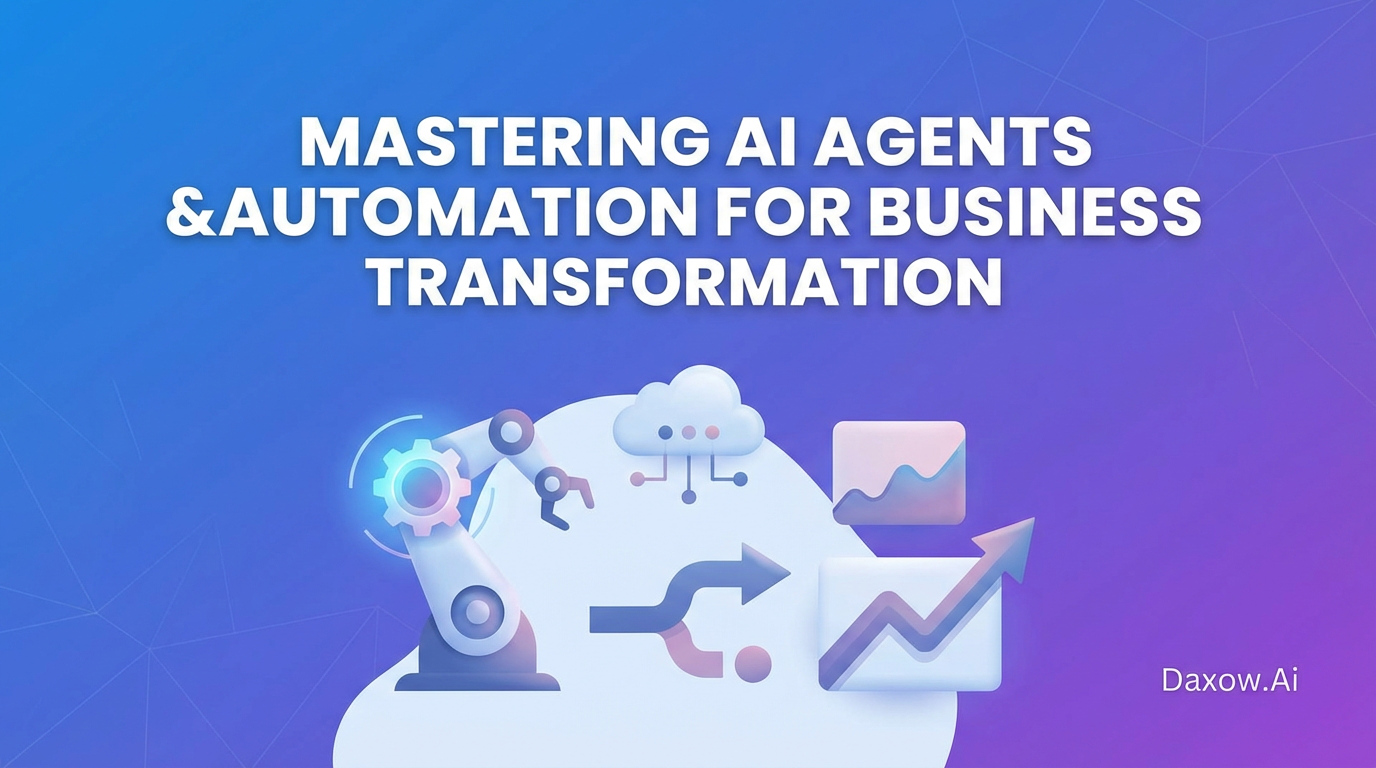
Practical guide to deploying AI agents and workflow automation to cut costs, speed operations, and deliver measurable ROI. Includes Daxow.ai's five-phase framework and industry use cases.
Mastering AI Agents and Automation: A Strategic Imperative for Business Transformation
Estimated reading time: 15 minutes
Key Takeaways
- AI agents and workflow automation drive significant cost savings and productivity gains.
- Strategic implementation of AI enables hyperautomation and operational scale.
- Industry-specific use cases demonstrate measurable ROI across e-commerce, healthcare, finance, real estate, and HR.
- Daxow.ai offers end-to-end AI automation solutions tailored to business needs.
- Following a structured five-phase framework ensures successful adoption and scaling of AI systems.
Table of Contents
- Mastering AI Agents and Automation: A Strategic Imperative for Business Transformation
- Why Mastering AI Agents and Automation Matters Now
- Practical Use Cases Across Industries
- A Five-Phase Implementation Framework (Actionable, Proven)
- Technical Considerations and Best Practices
- Measuring ROI and Scaling Successfully
- How Daxow.ai Helps You Master AI Agents and Automation
- Getting Started — Practical First Steps
- Frequently Asked Questions
Mastering AI Agents and Automation: A Strategic Imperative for Business Transformation
Mastering AI Agents and Automation: A Strategic Imperative for Business Transformation is no longer a theoretical advantage — it is a practical requirement for businesses that want to reduce manual work, increase productivity, and remain competitive. Organizations that adopt AI automation and AI agents can cut operational costs, speed decision-making, and scale services without proportional increases in headcount. This article synthesizes proven research, practical implementation steps, and industry use cases to help business leaders evaluate, plan, and deploy AI-driven workflow automation. It also explains how Daxow.ai partners with companies to design and implement custom AI systems that deliver measurable ROI.
What do we mean by AI agents and automation? In practice:
- AI agents are autonomous software entities that perceive context, reason with data, and take actions through APIs and integrated tools. They go beyond rule-based bots by handling unstructured input and multi-step decisioning.
- Automation streamlines repetitive, high-volume tasks through workflow automation, RPA, and orchestration.
- Together they enable hyperautomation — an integrated stack of RPA, machine learning, and agentic AI that automates end-to-end processes.
The business impact is clear:
- Targeted process cost reductions of 30–50% in many scenarios.
- 3–5x faster execution for automated workflows.
- Revenue and retention uplifts through personalization and faster response times.
- 24/7 operational scale, freeing humans for strategic work that requires judgment and creativity.
Why Mastering AI Agents and Automation Matters Now
Operational and strategic drivers
- Rising customer expectations demand faster, context-aware responses that static automation struggles to provide.
- Data volume and complexity require systems that can reason across sources and act autonomously.
- Labor cost pressures and skills shortages make it essential to reduce manual tasks and redeploy talent to higher-value activities.
Tangible business outcomes
- Productivity gains: Automating routine tasks increases employee productivity and shortens cycle times.
- Cost savings: Process automation and agent-driven exception handling drive 20–40% cost reductions on average, and up to 50% in selected administrative areas.
- Improved CX: Customer support automation and intelligent agents reduce response times and improve Net Promoter Score (NPS).
- Risk reduction: Agents can enforce compliance through automated checks, audit trails, and anomaly detection.
Practical Use Cases Across Industries
E-commerce — personalization, inventory, support
Use case:
- Agents analyze browsing and transaction data to power personalized recommendations and dynamic pricing.
- Support agents handle returns, refunds, and fraud detection conversationally.
Business value:
- Conversion rate improvements of 15–25% from better recommendations.
- Reduced manual customer service work and faster resolution times.
Daxow implementation:
- Build AI agents integrated with your e-commerce platform, CRM, and inventory system.
- Deploy workflow automation for returns and refunds, with escalation to humans for exceptions.
- Monitor conversion and retention KPIs and iterate models monthly.
Healthcare — triage, scheduling, records management
Use case:
- Conversational agents triage patient inquiries and schedule appointments.
- Automation extracts data from forms and updates EHRs while enforcing HIPAA controls.
Business value:
- Administrative burden reduced by ~40%, with faster patient access to care.
Daxow implementation:
- Implement secure, HIPAA-compliant agent pipelines with encrypted data stores and audit logs.
- Integrate with scheduling systems and EHRs via API-first connectors.
- Use supervised learning and human-in-the-loop reviews during rollout to ensure safety.
Finance — invoicing, anomaly detection, compliance
Use case:
- Autonomous agents process invoices, match payments, and flag anomalies.
- Agents run compliance checks and prepare audit-ready summaries.
Business value:
- Faster close cycles, fewer errors, and improved regulatory readiness.
Daxow implementation:
- Build document extraction pipelines and integrate agents with accounting and ERP systems.
- Use anomaly detection models to surface exceptions and automate case routing.
- Provide dashboards with real-time KPIs for finance teams.
Real estate — lead qualification, valuations, contract automation
Use case:
- Agents qualify leads by analyzing inquiries, market data, and CRM history.
- Automated valuation models and contract review workflows speed transactions.
Business value:
- Shorter sales cycles and higher-quality leads routed to agents.
Daxow implementation:
- Connect MLS APIs, CRM, and document systems.
- Automate lead scoring, property valuations, and contract generation with conditional approval flows.
HR — recruitment and onboarding
Use case:
- Agents screen resumes, conduct initial conversational interviews, and trigger tailored onboarding workflows.
Business value:
- Recruitment time cut by up to 50%, improved candidate experience.
Daxow implementation:
- Integrate ATS systems and calendar tools with conversational AI.
- Automate background verification steps and create employee-specific onboarding journeys.
A Five-Phase Implementation Framework (Actionable, Proven)
Phase 1 — Strategic Assessment and Planning
- Focus: Identify high-impact processes with clear KPIs (cost, time, error rates).
- Actions: Map workflows, quantify baseline metrics, and choose 1–2 pilot candidates.
- Pitfall: Avoid vague goals that lead to scope creep.
- Daxow role: We run a rapid process analysis to identify targets and ROI estimates.
Phase 2 — Technology Architecture and Design
- Focus: Design cloud-native, API-first architecture with data pipelines and security.
- Actions: Select agent types (autonomous vs. scripted), define integrations, and plan observability.
- Pitfall: Poor integration design that creates silos.
- Daxow role: We design secure, scalable architectures and select tools that meet compliance and performance needs.
Phase 3 — Development and Integration
- Focus: Build agents, connectors, and user interfaces with robust error handling.
- Actions: Develop test suites for edge cases, set up CI/CD, and enable human-in-the-loop controls.
- Pitfall: Ignoring edge cases that undermine reliability.
- Daxow role: We implement engineering standards, build integrations, and run comprehensive QA.
Phase 4 — Deployment and Change Management
- Focus: Pilot with oversight, gather feedback, and train staff.
- Actions: Run phased rollouts, provide training, and set governance checkpoints.
- Pitfall: Skipping change management and losing adoption.
- Daxow role: We manage pilots, stakeholder communications, and adoption programs.
Phase 5 — Monitoring and Optimization
- Focus: Continuous improvement through monitoring, retraining, and iteration.
- Actions: Track KPIs, retrain models quarterly, update workflows, and formalize governance.
- Pitfall: "Set it and forget it" mentality that degrades performance.
- Daxow role: We provide ongoing managed services, model maintenance, and performance analytics.
Technical Considerations and Best Practices
API-first, modular architecture
- Best practice: Use standardized APIs and connectors so agents can access real-time data and tools.
- Why: Ensures interoperability and reduces integration debt.
Data quality and governance
- Best practice: Invest early in data cleaning, lineage, and labeling processes.
- Why: Agent performance depends on high-quality training and operational data.
Security, compliance, and ethical controls
- Best practice: Apply role-based access, encryption, and audit trails. Establish bias detection and explainability checkpoints.
- Why: Protects customer data and maintains regulatory compliance.
Testing and resilience
- Best practice: Test agents across real-world scenarios, including edge cases and failure modes.
- Why: Reliable automation reduces manual interventions and builds stakeholder trust.
Observability and feedback loops
- Best practice: Implement dashboards and alerts for KPIs and anomalies.
- Why: Enables continuous optimization and rapid incident response.
Measuring ROI and Scaling Successfully
Pick measurable KPIs
- Common KPIs:
- Time saved per transaction
- Error reduction rates
- Cost per case
- Conversion and retention uplift
- NPS and customer satisfaction
- Tip: Define success thresholds for pilots that validate scaling decisions.
Typical ROI expectations
- Research-based outcomes:
- 20–40% cost savings across automated processes.
- 3–5x faster task completion in many workflows.
- Daxow client baseline: we guide clients to 200–300% ROI within 12 months by aligning agents with core workflows and measurable KPIs.
Scale with governance
- Scale only after pilots show consistent gains.
- Establish AI governance for model updates, risk management, and compliance as you expand.
How Daxow.ai Helps You Master AI Agents and Automation
Daxow is an end-to-end AI automation partner founded to help businesses move from concept to production quickly and safely. We combine strategic analysis, engineering, and managed services to deliver production-grade AI agents and workflow automation.
Our core capabilities:
- Strategy & process analysis: Rapid discovery workshops to identify high-impact automation candidates and quantify ROI.
- Custom AI agent development: Design and build autonomous agents that interact with your systems, reason with your data, and perform real tasks.
- Workflow automation & integrations: Connect enterprise tools, CRMs, ERPs, and third-party APIs for seamless end-to-end automation.
- Customer support automation & sales automation: Deploy conversational agents that qualify leads, resolve customer issues, and route complex cases to humans.
- Document automation & data extraction: Automate invoices, contracts, and forms with secure extraction and validation pipelines.
- Managed operations & optimization: Ongoing model retraining, monitoring, and process improvement to sustain ROI.
What a typical Daxow engagement looks like:
- Discovery and ROI scoping (2–4 weeks): Process mapping and KPI definition.
- Pilot build (4–8 weeks): Develop an agent and integrated workflows for a targeted process.
- Pilot validation (4 weeks): Measure KPIs, refine models, and prepare for scale.
- Scale and operate: Roll out across departments with governance and managed support.
Learn more about our services and how we can help your business accelerate AI adoption.
Getting Started — Practical First Steps
- Start with a short process audit to find quick wins.
- Run a focused pilot with clear success metrics.
- Require cross-functional ownership: business, IT, and operations.
- Build for integration from day one; don’t bolt automation onto legacy silos.
- Plan for continuous improvement: retrain, refine, and expand incrementally.
Frequently Asked Questions
What distinguishes AI agents from traditional automation?
AI agents are autonomous software entities capable of perceiving context, making complex decisions, and interacting with APIs and tools beyond simple rule-based automation. They handle unstructured data and multi-step workflows, unlike traditional static automation.
How can businesses measure the ROI of AI automation?
ROI measurement focuses on KPIs such as time saved per transaction, error reduction, cost per case, conversion uplift, and customer satisfaction scores (NPS). Pilots with clearly defined metrics help validate these outcomes before scaling.
Is AI automation applicable across all industries?
Yes, AI automation can be applied across industries such as e-commerce, healthcare, finance, real estate, and HR, with tailored solutions addressing their unique workflows and regulatory requirements.
What role does Daxow.ai play in AI automation projects?
Daxow.ai acts as an end-to-end partner, providing strategic process analysis, custom AI agent development, workflow automation, integration services, and managed operations to ensure successful deployment and measurable ROI.