

Mastering AI Agents and Automation: Strategic Roadmap
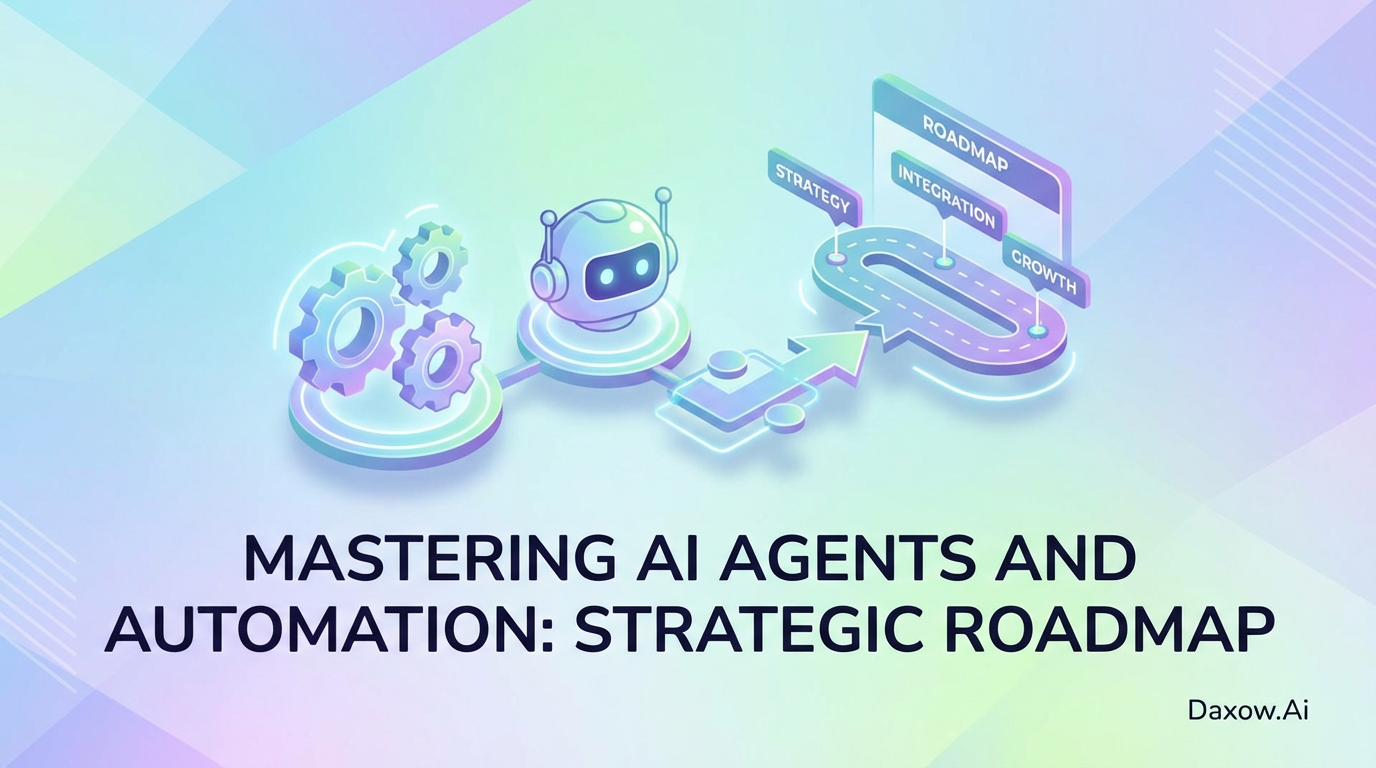
Practical roadmap to deploy AI agents and automation that cut costs, boost efficiency, and improve CX - with industry use cases, KPIs, and governance.
Mastering AI Agents and Automation: A Strategic Guide for Business Transformation
Estimated reading time: 18 minutes
Key Takeaways
- AI agents and automation significantly improve efficiency, scalability, and customer experience.
- Structured implementation roadmaps ensure measurable outcomes and quick deployments.
- Industry-specific use cases highlight automation benefits in e-commerce, healthcare, finance, real estate, and HR.
- Strong governance, data quality, and human oversight mitigate risks and ensure compliance.
- Daxow.ai offers end-to-end AI automation services aligned with business goals to maximize ROI.
Table of Contents
- Mastering AI Agents and Automation — Why it Matters for Your Business
- How AI Agents and Automation Drive Business Outcomes
- Implementation Roadmap — From Strategy to Scale
- Practical Use Cases Across Industries
- Common Risks and How to Avoid Them
- Quantifying ROI — Expected Results and Timeline
- How Daxow.ai Helps You Master AI Agents and Automation
- Practical Playbook — First 90 Days
- Final Recommendations for Decision-Makers
- Frequently Asked Questions
Mastering AI Agents and Automation — Why it Matters for Your Business
AI agents and workflow automation transform manual, error-prone processes into scalable, reliable systems. These intelligent systems combine machine learning, natural language processing, and real-time data integration to execute tasks autonomously, escalate complex cases to humans, and continuously learn.
- Business outcomes: Faster resolution times, lower operational costs, and a better customer experience.
- Operational advantages: Convert fixed labor costs into on-demand capacity that scales with demand.
- Risk management: Embed governance and audit trails for compliance-sensitive industries.
For CTOs and operations leaders, mastering AI agents and automation means aligning technology with measurable KPIs — such as cost-per-ticket, time-to-resolution, lead-to-conversion rates, and compliance error rates — and delivering 3–5x faster deployments when following a structured plan.
How AI Agents and Automation Drive Business Outcomes
Core capabilities and integration
AI agents act as proactive orchestrators that connect to CRM, ERP, and knowledge bases via API-first integrations. When combined with robust data pipelines and standardized protocols (e.g., Model Context Protocol-like coordination), agents deliver context-aware, multi-channel responses across chat, email, and voice.
- Efficiency gains: Automate 70–80% of routine tasks to cut processing times and manual bottlenecks.
- Scalability: Handle peak volumes without a proportional increase in headcount.
- Enhanced customer experience: Provide 24/7 personalized support and faster response times.
- Risk mitigation: Implement governance frameworks for compliance and auditability.
Measurable KPIs to track
Establish KPIs before deployment and measure continuously:
- Cost savings (absolute and percentage)
- Time-to-resolution and average handle time
- First contact resolution rate
- Lead qualification speed and conversion rate
- Volume of tasks automated vs. manual
- User satisfaction and NPS
Implementation Roadmap — From Strategy to Scale
1. Strategic Assessment and Planning (4–8 weeks)
- Define strategic goals and target KPIs (ROI, resolution rates, efficiency).
- Map current workflows and identify high-volume, repetitive tasks to prioritize.
- Assess data quality, integration needs (CRM, billing, EHR), and regulatory constraints.
- Produce a roadmap with pilot targets and success criteria.
2. Technology Selection and Vendor Evaluation (6–12 weeks)
- Choose platforms that offer API integrations, real-time data pipelines, and vendor support.
- Evaluate ease of integration, customization, and compatibility for agent orchestration.
- Decide on hosted vs. managed vs. hybrid deployments based on data residency and compliance requirements.
3. Preparation and Data Readiness (4–8 weeks)
- Clean and structure data sources; build curated knowledge bases.
- Define decision trees, escalation paths, and guardrails for agent actions.
- Document end-to-end workflows and integration points.
4. Pilot Deployment and Gradual Rollout (4–20 weeks)
- Start with low-risk, high-impact use cases (e.g., FAQ automation, invoice routing).
- Monitor performance vs. KPIs, collect user feedback, and refine.
- Expand channel coverage, user groups, and capabilities in controlled waves.
5. Monitoring, Optimization, and Governance
- Implement dashboards for real-time monitoring and alerts.
- Maintain cyclical improvement through retraining, content updates, and A/B testing.
- Establish governance with roles, policies, and audit logging to ensure compliance.
Practical Use Cases Across Industries
E-commerce
Use cases:
- Automated customer support for order tracking, returns, and refunds.
- Personalized product recommendations during chat sessions.
- Inventory reconciliation and low-stock alerts to purchasing systems.
Business impact:
- Reduce manual tickets by routing 60–80% of inquiries to automated agents.
- Improve conversion by reducing cart abandonment with proactive messages and offers.
- Lower operational cost in support and operations.
Healthcare
Use cases:
- Patient triage via conversational agents that collect symptoms and recommend next steps.
- Appointment scheduling and reminders integrated with EHR systems.
- Document automation for intake forms and insurance verification.
Business impact:
- Shorter wait times and fewer manual scheduling errors.
- Improved compliance by embedding HIPAA-aligned workflows and audit trails.
- Better clinician efficiency by automating administrative burdens.
Finance
Use cases:
- Real-time transaction monitoring and fraud alerts.
- Automated KYC and onboarding workflows.
- Compliance reporting and routine audit preparation.
Business impact:
- Faster onboarding and reduced manual review times.
- Lower compliance risk with automated checks and traceable logs.
- Scalable monitoring during transaction spikes.
Real Estate
Use cases:
- Lead qualification via chat, scheduling viewings, and virtual tour coordination.
- Automated property listing management and price benchmarking.
- Document extraction for contracts and lease agreements.
Business impact:
- Faster lead-to-viewing times, increasing conversion rates.
- Reduced manual admin for agents and property managers.
HR and Administration
Use cases:
- Resume parsing and initial candidate screening.
- Onboarding checklists, benefits enrollment automation, and employee FAQs.
- Automating repetitive payroll and compliance checks.
Business impact:
- Shortened recruitment cycles and improved candidate experience.
- Reduced HR admin time, enabling focus on strategic initiatives.
Common Risks and How to Avoid Them
Pitfalls to avoid
- Skipping pilots and rushing full-scale rollouts.
- Neglecting data quality—poor inputs degrade agent performance.
- Weak governance—no audit logs, unclear escalation rules, or compliance blind spots.
- Over-automation—removing human oversight from decisions that require judgment.
Mitigation strategies
- Start small with well-defined pilots and success criteria.
- Invest in data hygiene, canonical sources, and knowledge curation.
- Build governance that includes legal, compliance, and domain experts.
- Keep humans-in-the-loop for exception handling and continuous improvement.
Quantifying ROI — Expected Results and Timeline
Short-term (0–12 months)
- Implement pilots that deliver immediate benefits: 20–40% efficiency gains in Year 1 for many processes.
- Reduce support costs by up to 50% in highly automated contact centers.
- Accelerate onboarding and lead qualification timelines, improving revenue velocity.
Mid- to long-term (12–36 months)
- Scale agents across departments to achieve broader productivity gains.
- Convert manual fixed costs into variable services during peak demand.
- Realize ongoing improvements through model retraining and process refinement.
How to measure value
- Baseline current metrics before deployment.
- Use a balanced scorecard: cost, speed, quality, compliance, and customer satisfaction.
- Re-assess and reforecast ROI after each phase to support expansion decisions.
How Daxow.ai Helps You Master AI Agents and Automation
Daxow.ai is an end-to-end AI automation partner founded in Estonia in 2024. We help organizations from assessment to scale by designing, building, and operating custom AI systems that align with business goals.
Our approach
- Discovery and process analysis: We map workflows to identify high-impact automation opportunities and target KPIs.
- Custom agent design: We build AI agents tailored to your domain, with curated knowledge bases and escalation paths.
- Workflow automation: We implement workflow automation that integrates with your CRM, ERP, and other back-office systems.
- Integrations and data connectivity: API-first integration strategies connect agents to real-time data sources, ensuring reliability and context-awareness.
- Governance and compliance: We implement role-based access, audit trails, and compliance controls suitable for regulated industries.
- Operational support: Ongoing monitoring, model refinement, and performance optimization to sustain value and improve ROI.
Typical engagement flow with Daxow.ai
- Phase 1 — Process analysis and pilot scoping (4–8 weeks)
- Phase 2 — Data preparation, integrations, and agent build (6–12 weeks)
- Phase 3 — Pilot launch, measurement, and iteration (4–20 weeks)
- Phase 4 — Scale and governance (ongoing)
Examples of what we build
- AI-driven customer support automation that reduces manual tickets and boosts CSAT.
- Sales automation and lead qualification agents that improve conversion and shorten sales cycles.
- Document automation pipelines for invoice processing, contracts, and compliance reporting.
- Multi-agent orchestration to handle complex workflows across systems.
Practical Playbook — First 90 Days
Week 1–4: Assess and prioritize
- Conduct stakeholder interviews and map top 5 workflows.
- Define 2–3 pilot use cases with measurable success criteria.
Week 5–8: Prepare data and integrations
- Cleanse datasets and set up API connections to CRM/ERP.
- Develop knowledge base content and escalation rules.
Week 9–12: Launch pilot and measure
- Deploy agent in a controlled environment.
- Monitor KPIs and collect qualitative feedback from users.
- Iterate quickly and prepare scaling plan.
Final Recommendations for Decision-Makers
- Prioritize short, measurable pilots in low-risk, high-volume areas.
- Invest in data quality and integration architecture upfront.
- Design governance and human oversight to manage exceptions and regulatory needs.
- Adopt an API-first strategy to ensure interoperability and future-proofing.
- Measure, iterate, and scale using KPI-driven expansion criteria.
Mastering AI agents and automation delivers measurable cost savings, productivity gains, and improved customer experiences when executed with a clear plan, data readiness, and strong governance. Daxow.ai specializes in guiding organizations through that transformation — from process analysis and custom AI agent design to full workflow automation and integration. Learn more about our services and how we can help your business achieve sustainable transformation.
Frequently Asked Questions
What industries benefit most from AI agents and automation?
Industries with high-volume repetitive tasks such as e-commerce, healthcare, finance, real estate, and HR gain significant efficiency and compliance advantages from AI automation.
How long does it take to deploy AI agent automation?
Deployment timelines vary by complexity but typically follow a phased approach from 4 weeks for initial pilots to 20 weeks or more for gradual rollout and scaling.
How does Daxow.ai ensure compliance with regulations?
We implement governance frameworks, role-based access, audit trails, and align workflows with industry-specific compliance standards such as HIPAA and GDPR.
Can AI automation replace all human tasks?
AI automation excels at routine, rule-based tasks but complex decisions and judgment calls require human oversight; we design systems that keep humans in the loop for exceptions and continuous improvement.