
Mastering AI Automation: Roadmap, Use Cases & ROI
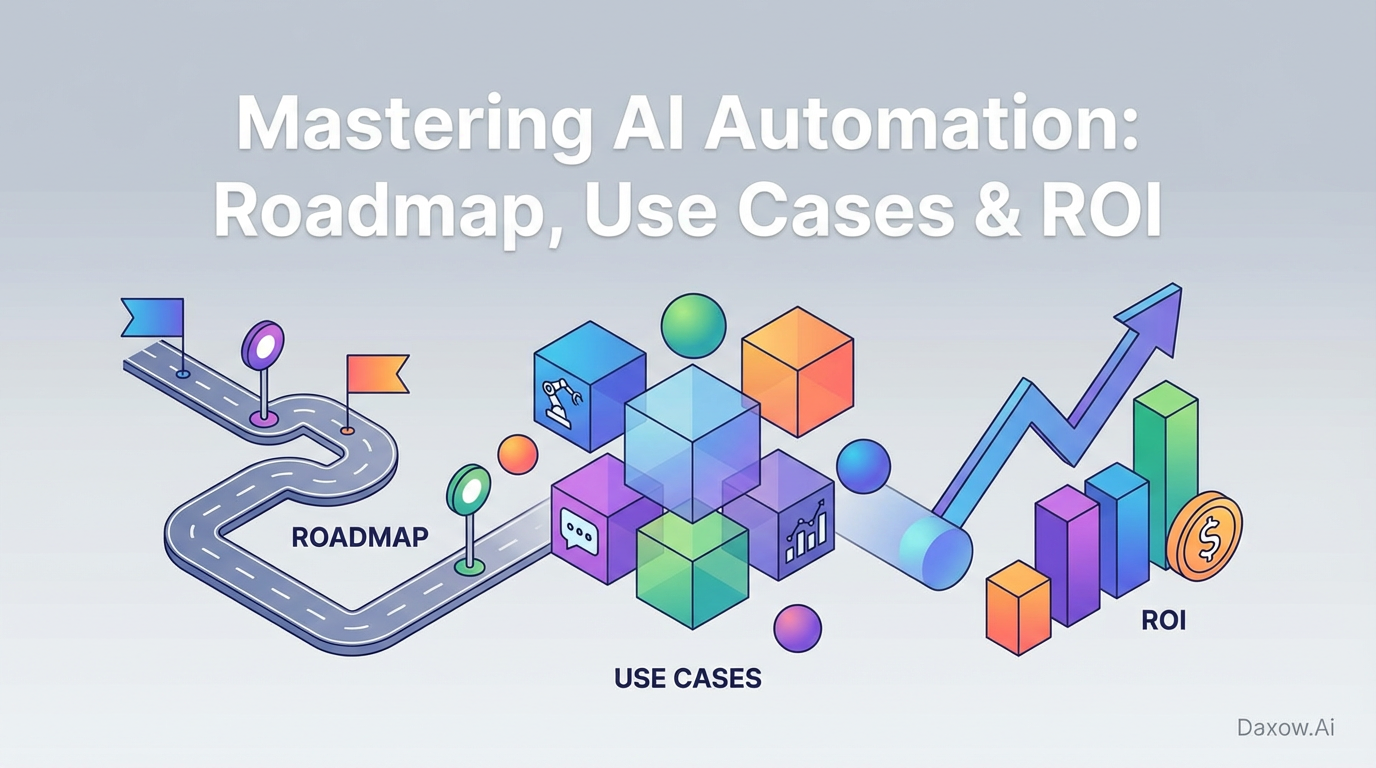
Practical guide to AI automation with roadmap, industry use cases, and ROI — how Daxow.ai builds custom AI agents and integrations to boost efficiency.
Mastering AI Automation: Transforming Business Operations for Competitive Advantage
Estimated reading time: 15 minutes
Key Takeaways
- AI automation integrates AI, workflow automation, and RPA to significantly reduce costs and boost productivity.
- AI agents execute multi-step, autonomous workflows that interact with multiple business systems.
- Industry-specific automation use cases demonstrate measurable business impacts across e-commerce, healthcare, finance, real estate, HR, and customer support.
- A clear, step-by-step implementation roadmap helps business leaders align initiatives with objectives and data governance.
- Daxow.ai offers custom AI agents, system integrations, and governance frameworks to deliver secure, scalable automation with fast ROI.
Table of Contents
- Mastering AI Automation: Transforming Business Operations for Competitive Advantage
- High-impact Use Cases by Industry: Practical and Actionable Examples
- How AI Agents and Workflow Automation Drive Results
- Implementation Roadmap: Step-by-Step to Successful Business Automation
- Measuring ROI and Sustaining Value
- Why Partner with Daxow.ai for Business Automation
- Practical Next Steps for Decision-Makers
- Frequently Asked Questions
Mastering AI Automation: Transforming Business Operations for Competitive Advantage
Why this matters now
AI automation integrates artificial intelligence with workflow automation and Robotic Process Automation (RPA) to handle repetitive, data-intensive, and decision-making tasks. Organizations that adopt these capabilities report dramatic improvements: targeted processes can see cost reductions of 40–60%, productivity gains of 30–50%, and error reductions up to 90%. These gains translate into faster throughput, improved customer experiences, and the ability to scale operations without proportional headcount growth.
Strategic implications for decision-makers
- Operational resilience: Automated workflows and AI agents deliver consistency and speed, reducing variability and manual errors that compromise service delivery.
- Predictive advantage: AI-driven insights anticipate demand shifts, detect fraud, and surface compliance risks before they escalate.
- Customer differentiation: Personalized, automated interactions increase satisfaction and Net Promoter Scores by delivering timely, context-aware responses.
- Cost and ROI: With measurable KPIs and phased rollouts, organizations often see ROI within 6–12 months for high-volume processes.
Key facts from research
- AI automation frees human teams for strategic work by taking on rule-based and cognitive tasks.
- Hyperautomation scales capacity—handling multiple times the data volume without directly increasing labor costs.
- Success depends on aligning AI projects with business objectives, ensuring data quality, and maintaining strong cross-functional governance.
High-impact Use Cases by Industry: Practical and Actionable Examples
E-commerce: End-to-end order-to-cash and personalized experiences
What to automate:
- Order validation, fraud screening, payment reconciliation.
- Inventory prediction and restocking triggers.
- Personalized product recommendations and dynamic pricing.
Business impact:
- Reduced cart abandonment and fraud losses.
- Faster order processing and fewer returns.
- Increased average order value through targeted recommendations.
How Daxow.ai helps:
- Build AI agents that orchestrate order processing across your CMS, ERP, and payment gateway.
- Deploy workflow automation to reduce manual reconciliations and integrate inventory telemetry with predictive models.
Healthcare: Administrative efficiency and better care coordination
What to automate:
- Patient intake, data extraction from documents, automated triage via chatbots.
- Predictive readmission alerts and resource scheduling.
Business impact:
- Reduced administrative burden on clinicians.
- Faster patient throughput and improved compliance with privacy standards.
How Daxow.ai helps:
- Implement secure document automation to extract structured data from EHRs and referrals.
- Design clinical triage AI agents that escalate cases to clinicians with context and supporting evidence.
Finance: Fraud detection, document processing, and compliance
What to automate:
- Transaction surveillance, automated KYC/AML screening.
- Invoice processing and accounts payable workflows.
- Risk scoring and audit trail generation.
Business impact:
- Lower fraud losses and audit time.
- Faster month-end close and reduced manual reconciliation.
How Daxow.ai helps:
- Integrate AI models with your ledger and transaction streams to provide real-time risk signals.
- Build end-to-end automation pipelines that extract invoice data, validate line items, and auto-route exceptions.
Real Estate: Accelerating leads and valuations
What to automate:
- Property valuation models, automated listing creation, and lead qualification via conversational analysis.
Business impact:
- Faster deal cycles and higher lead conversion.
- Reduced time on manual property research and document assembly.
How Daxow.ai helps:
- Create AI agents that pull market data, produce valuations, and generate listing content automatically.
- Integrate with CRM systems to qualify and route leads based on intent and readiness.
HR and Recruitment: Screening and employee lifecycle automation
What to automate:
- Resume parsing, candidate shortlisting, interview scheduling.
- Employee onboarding tasks and sentiment analysis from surveys.
Business impact:
- Reduced hiring time by up to 50% and better retention through predictive turnover insights.
How Daxow.ai helps:
- Deploy workflow automation for candidate screening and onboarding checklists.
- Train models to surface retention risk and recommend targeted interventions.
Customer Support and Sales Automation: Faster responses, higher conversion
What to automate:
- Customer support automation via chatbots and AI agents handling multi-step troubleshooting.
- Sales automation for lead qualification, meeting scheduling, and proposal drafting.
Business impact:
- Higher first-response rates and reduced resolution times.
- Improved lead qualification accuracy and faster deal progression.
How Daxow.ai helps:
- Build AI agents that operate within support channels to resolve common issues and create tickets for complex cases.
- Integrate chat-based qualification with CRM to auto-create qualified opportunities and trigger sales workflows.
How AI Agents and Workflow Automation Drive Results
What makes AI agents different
AI agents are autonomous systems that execute multi-step workflows across tools. Unlike single-purpose bots, they:
- Orchestrate tasks end-to-end.
- Interact with multiple systems (ERP, CRM, document stores).
- Make decisions based on rules and learned patterns.
Complementarity: AI + Automation
- Workflow automation handles deterministic, rule-based tasks (e.g., moving data, routing approvals).
- AI models add judgment, anomaly detection, and natural language understanding.
Together they enable hyperautomation and reduce manual tasks while maintaining human oversight.
Practical architecture patterns
- Event-driven triggers (new invoice uploaded → extraction → verification → approval).
- Human-in-the-loop checkpoints for exceptions.
- Continuous feedback loops for retraining and performance improvement.
Implementation Roadmap: Step-by-Step to Successful Business Automation
1. Define clear objectives
- Align automation initiatives with strategic goals (cost reduction, faster response, improved NPS).
- Create success criteria and a scorecard for prioritization.
Action steps:
- Set measurable targets (e.g., reduce invoice processing time by 60%).
- Identify the owners and KPIs.
2. Identify high-impact processes
- Audit operations to find repetitive, high-volume tasks ripe for automation.
- Prioritize based on ROI potential and data accessibility.
Action steps:
- Map current process flows and cycle times.
- Score processes by frequency, time spent, and error rates.
3. Assess and prepare data
- Evaluate data quality, completeness, and privacy constraints.
- Standardize formats and create governance rules.
Action steps:
- Build a data catalog and remediation plan.
- Ensure compliance with local regulations and security standards.
4. Select tools and design integrations
- Choose scalable platforms with connectors to your ERP, CRM, and messaging systems.
- Favor modular architectures to support iterative rollouts.
Action steps:
- Prototype integrations with a sandbox environment.
- Define APIs and data contracts for system interoperability.
5. Build teams and governance
- Assemble cross-functional squads (business, IT, data science) with clear roles.
- Define ethical frameworks and monitoring protocols to prevent bias and drift.
Action steps:
- Establish training programs and change management plans.
- Centralize oversight to avoid fragmented “shadow AI” projects.
6. Deploy, monitor, and iterate
- Start with pilots, measure impact, and scale successful automations.
- Continuously retrain models and refine rules based on new data.
Action steps:
- Track leading indicators (response time, error rate) and outcome KPIs (cost savings, NPS).
- Implement alerting for performance degradation and scheduled retraining.
Measuring ROI and Sustaining Value
Quantifiable metrics to track
- Cost savings per process and total operational cost reduction.
- Productivity uplift (workload handled per employee).
- Error reduction and exception rates.
- Time-to-resolution for customer issues and transaction cycle times.
- Customer satisfaction (CSAT/NPS) and revenue impact from improved conversion.
Example ROI scenarios
- Finance: Automating invoice processing reduces headcount effort by 70%, achieving payback in 6 months and lowering processing costs by 40%.
- E-commerce: AI-driven inventory prediction reduces stockouts and overstock, cutting inventory waste by 20–30% and improving fulfillment rates.
- Support: Customer support automation reduces average handling time, increases self-service rates, and improves NPS within three quarters.
Sustaining gains
- Use continuous monitoring to detect performance drift.
- Re-align priorities as business needs evolve and scale automation where return is highest.
- Reinvest savings into higher-value automation projects to compound benefits.
Why Partner with Daxow.ai for Business Automation
End-to-end design and delivery
Daxow.ai was founded in Estonia in 2024 to help businesses move from manual, fragmented processes to fully automated systems. Our approach covers the entire lifecycle: process discovery, solution design, model training, integration, deployment, and ongoing optimization.
Custom AI agents that execute real tasks
We build AI agents tailored to your workflows—agents that can converse with customers, extract and validate documents, or orchestrate multi-system transactions. Our solutions are designed to reduce manual tasks and increase productivity while preserving human oversight for exceptions.
System integrations and data connectivity
Daxow.ai specializes in connecting AI and automation to your core systems: CRMs, ERPs, support platforms, and document repositories. Our integration-first mindset ensures secure data flow and durable automation that fits your enterprise architecture.
Business value and measurable ROI
We prioritize high-impact use cases to deliver early wins and fast ROI. By tracking KPIs such as process cycle time, error rates, and customer satisfaction, we demonstrate value and create a roadmap for scaling automation across the organization.
Compliance, security, and governance
We implement enterprise-grade security measures and ethical AI practices to mitigate bias and ensure compliance with industry regulations. Our governance frameworks enable safe, auditable automation.
Practical Next Steps for Decision-Makers
- Conduct a short, focused process audit to identify 3–5 high-impact automation candidates.
- Define measurable success criteria and expected ROI for each candidate.
- Pilot one AI agent or workflow automation project with clear owners and escalation paths.
- Establish cross-functional governance and a roadmap for scaling based on outcomes.
Mastering AI Automation: Transforming Business Operations for Competitive Advantage is an achievable, strategic priority that delivers measurable cost savings, increases productivity, and enhances customer experience. Daxow.ai helps organizations design and deliver custom AI agents and workflow automation solutions that reduce manual tasks, improve operational efficiency, and integrate seamlessly with existing systems.
Book a free consultation with Daxow.ai to assess your processes and request a tailored process analysis for your company. Contact us to build a custom AI system that drives measurable ROI and positions your business for sustained competitive advantage.
Frequently Asked Questions
What is AI automation and how does it differ from traditional automation?
AI automation combines artificial intelligence technologies such as machine learning and natural language processing with traditional workflow automation and robotic process automation (RPA) to handle not only rule-based tasks but also cognitive tasks that require judgment and decision-making.
How quickly can organizations expect to see ROI from AI automation?
With well-targeted use cases and phased rollouts, organizations often achieve measurable ROI within 6 to 12 months, particularly in high-volume, repetitive processes.
What role do AI agents play in business automation?
AI agents autonomously execute multi-step workflows that orchestrate tasks across multiple systems, make data-driven decisions, and manage exceptions, extending the capabilities of traditional single-purpose bots.
How does Daxow.ai ensure security and compliance in AI automation projects?
Daxow.ai implements enterprise-grade security measures, ethical AI frameworks, and governance protocols that ensure data privacy, mitigate bias, and maintain compliance with applicable industry regulations throughout the automation lifecycle.