
Mastering AI Automation for Modern Enterprises
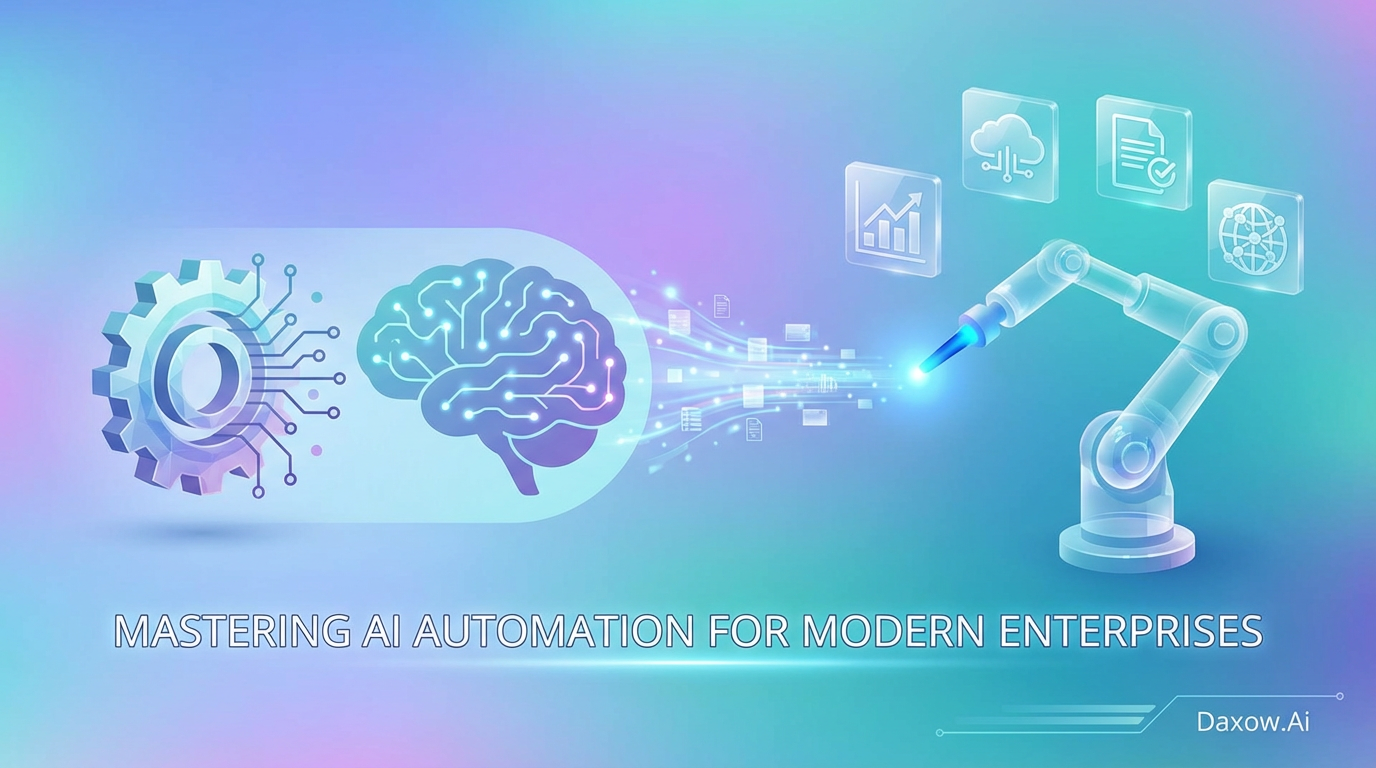
Enterprise guide to AI automation: use cases, implementation steps, ROI metrics, and how Daxow.ai builds custom AI agents and workflows.
Mastering AI Automation: Transforming Business Operations for the Modern Enterprise
Estimated reading time: 15 minutes
Key Takeaways
- AI automation combines AI, ML, NLP, and RPA to automate repetitive tasks and improve decision-making.
- Mastering AI automation delivers 20–50% productivity gains and faster, more efficient business processes.
- Industry-specific use cases demonstrate measurable ROI in e-commerce, healthcare, finance, real estate, and HR.
- Successful deployment requires clear goals, cross-functional teams, iterative testing, and continuous monitoring.
- Daxow.ai provides end-to-end custom AI agent design, integration, and governance for impactful automation.
Table of Contents
- Mastering AI Automation: Transforming Business Operations for the Modern Enterprise
- What AI Automation Means for Businesses
- Practical Use Cases Across Industries
- How AI Agents and Automation Deliver Impact
- Implementation Steps and Best Practices
- Measuring ROI and Business Value
- How Daxow.ai Helps You Master AI Automation
- Frequently Asked Questions
Mastering AI Automation: Transforming Business Operations for the Modern Enterprise
AI automation reshapes operations by shifting labor away from routine, high-volume tasks toward strategic work. Organizations that master AI automation can expect 20–50% productivity gains in targeted processes, faster response times, and improved customer satisfaction. The most effective programs combine workflow automation with intelligent agents that learn from data and human feedback, enabling end-to-end automation rather than isolated point solutions.
What “mastering” means in practice
- Align automation to business outcomes: Start with specific objectives (e.g., reduce invoice processing costs by 30%, cut average support response time in half).
- Treat automation as product development: Iterate quickly, measure impact, and scale winners.
- Combine technology and process design: Successful automation requires both sound ML/NLP models and efficient, auditable workflows.
What AI Automation Means for Businesses
AI automation is not merely a technology upgrade — it is an operational transformation. It blends RPA-like task execution with AI-driven decisioning to automate processes that were previously considered too complex.
Core capabilities and business effects
- Automate repetitive tasks: Data entry, invoice matching, form population, and routine customer queries can be automated to reduce errors and free staff for higher-value activities.
- Intelligent decision support: Predictive analytics and anomaly detection improve forecasting, risk management, and fraud detection.
- Conversational automation: NLP-powered chatbots and virtual agents handle nuanced customer interactions and triage requests.
- Knowledge extraction: Document automation and data extraction turn unstructured documents into structured records for downstream systems.
Tangible benefits
- Reduce manual tasks and operational costs by automating high-volume workflows.
- Boost productivity across teams by enabling human workers to focus on strategic decisions.
- Improve customer experience through faster responses and personalized interactions.
- Increase resilience and scalability: Agents scale with volume without proportional headcount increases.
Practical Use Cases Across Industries
E‑commerce
- Customer support automation: AI agents respond to order status queries, process returns, and escalate complex cases. Result: reduce first-response time and improve NPS.
- Demand forecasting and inventory: Predictive models forecast SKU-level demand to minimize stockouts and overstock. Result: reduced carrying costs and increased availability.
- Content generation: Automated generation of personalized product descriptions and social content to increase conversion rates.
How Daxow.ai helps: We build chatbots integrated with CRMs and order systems, and deploy forecasting models that sync to inventory and replenishment workflows.
Healthcare
- Document automation: Extract critical fields from medical forms and referral letters to populate EHRs automatically.
- Patient triage agents: AI-driven intake that assesses symptoms, schedules appointments, and routes urgent cases to clinicians.
- Billing and compliance: Automated checks for billing anomalies and pre-submission compliance validation.
How Daxow.ai helps: We design secure, HIPAA-aware pipelines that extract and validate data, integrate with clinical systems, and automate repetitive administrative workflows to reduce processing time and errors.
Finance
- Fraud detection and monitoring: Real-time surveillance of transactions with automated flagging and case creation for review.
- Regulatory reporting: Automate data collection, validation, and submission for compliance reports.
- Investment analytics: NLP analysis of market news and sentiment to augment forecasting models.
How Daxow.ai helps: We implement agents that monitor transactions, execute predefined workflows on alerts, and integrate with core banking and risk systems to reduce false positives and accelerate investigations.
Real Estate
- Listing automation: Extract property details from documents and auto-publish consistent listings across channels.
- Lead qualification: AI agents qualify inbound leads, schedule viewings, and provide market data to clients.
- Market trend prediction: Pattern recognition to forecast neighborhood-level pricing and demand.
How Daxow.ai helps: We connect listing platforms, CRMs, and marketing tools, building agents that automate repetitive sales tasks and accelerate deal velocity.
HR and Recruitment
- Resume screening: Automate initial candidate evaluation and shortlisting based on role-specific criteria.
- Onboarding automation: Auto-populate HR systems, schedule training, and monitor completion.
- Attrition prediction: Identify flight risk and trigger retention workflows.
How Daxow.ai helps: We craft recruitment pipelines that integrate ATS systems, automate communications, and surface the highest-probability hires to recruiters.
How AI Agents and Automation Deliver Impact
AI agents are autonomous processes that combine generative AI, machine learning, and RPA to perform multi-step tasks without constant human intervention.
Typical agent capabilities
- Execute multi-step workflows: Retrieve data, validate inputs, update systems, notify stakeholders.
- Adapt to new data: Learn from interactions and improve over time.
- Integrate across tools: Connect to CRMs, ERPs, ticketing systems, and databases.
- Provide explainability and audit trails: Log decisions and actions for compliance and governance.
Example—Customer support automation flow
- Inbound message received via chat or email.
- NLP agent classifies intent, extracts key entities (order ID, product).
- Agent queries order system and delivers a response or opens a support ticket.
- If escalation is required, the agent compiles context and hands off to an agent with suggested next steps.
Outcome: Faster resolutions, fewer manual steps, and higher agent throughput.
Implementation Steps and Best Practices
1. Define clear goals and assess readiness
- Map automation to concrete KPIs (cost savings, handling time reductions, error rates).
- Use an AI-readiness scorecard: data quality, system integration feasibility, and team readiness.
- Prioritize high-volume, rule-based processes for early wins.
2. Identify processes and select appropriate tools
- Evaluate tools for NLP, RPA, ML lifecycle management, and integration capabilities.
- Favor platforms that support monitoring and retraining pipelines.
- Plan for security, data governance, and compliance.
3. Build a cross-functional team
- Include domain experts, data scientists, ML engineers, product managers, and compliance leads.
- Co-create solutions with operations teams to ensure adoption.
- Train staff on new workflows to avoid "shadow AI" and ensure consistent usage.
4. Develop, test, and deploy
- Develop minimum viable automations and run pilots with clear acceptance criteria.
- Test models for precision, recall, and business impact.
- Use phased rollouts to reduce operational risk.
5. Monitor, retrain, and iterate
- Implement dashboards that track performance, error rates, and user feedback.
- Schedule retraining and prompt refinement based on drift and new business rules.
- Document outcomes and scale successful automations.
Best practices and common pitfalls
- Start small and scale: Demonstrate measurable wins before broad rollouts.
- Data hygiene is critical: Poor data quality undermines results.
- Avoid scope creep: Focus on discrete, measurable processes.
- Prioritize explainability: Maintain logs and human-readable decision rationales for audits.
- Partner strategically: Vendors should provide integration support and customization.
Measuring ROI and Business Value
Key metrics to track
- Operational metrics: Cycle time, throughput, error rate reduction.
- Financial metrics: Cost per transaction, headcount hours saved, process cost reductions.
- Customer metrics: Response times, resolution rates, NPS changes.
- Strategic metrics: Time to decision, scalability of services, and rate of innovation adoption.
Expected returns
- Organizations frequently report 20–40% productivity gains and 30–50% cost reductions in automated processes.
- Savings are amplified when automations allow teams to reallocate capacity toward revenue-generating activities.
- Long-term value comes from scalability: agents handle increased volumes without linear increases in staffing costs.
How Daxow.ai Helps You Master AI Automation
Discovery and process analysis
- We map your workflows, identify automation opportunities, and quantify expected ROI.
- Deliverable: A prioritized roadmap that targets low-risk, high-impact processes for immediate automation.
Custom AI system design and build
- We design AI agents and workflow automation that integrate with CRMs, ERPs, support platforms, and data lakes.
- We select tools and models suited to your stack and compliance needs, including secure data handling for regulated industries.
End-to-end implementation and integration
- Our engineers implement integrations, build robust error handling, and create monitoring dashboards.
- We automate orchestration so agents can execute multi-step processes and update systems of record.
Monitoring, governance, and continuous improvement
- We set up retraining pipelines, performance dashboards, and governance frameworks to ensure long-term accuracy.
- We partner with your teams to refine automations and scale successful agents across the organization.
Tangible benefits of working with Daxow.ai
- Reduce manual tasks across departments.
- Improve productivity through intelligent automation and workforce augmentation.
- Lower operational costs and accelerate ROI via targeted pilots and scalable deployments.
- Integrate systems with minimal disruption and maintain compliance through auditable workflows.
- Deploy AI agents that execute real tasks, not prototypes — with measurable business impact.
Learn more about our services on the Daxow.ai Services page or explore how our custom AI solutions can transform your operations.
Frequently Asked Questions
What is AI automation and how does it differ from traditional automation?
AI automation integrates artificial intelligence, machine learning, natural language processing, and robotic process automation to handle complex tasks and decisioning, whereas traditional automation typically involves simple rule-based task execution.
Which industries benefit most from AI automation?
Industries such as e-commerce, healthcare, finance, real estate, and HR see significant gains from AI automation by streamlining workflows, enhancing customer interactions, and improving compliance.
How should businesses start implementing AI automation?
Begin with clear goals aligned to business outcomes, prioritize high-volume rule-based processes, assemble cross-functional teams, develop pilot projects, and continuously monitor and iterate based on performance data.
What role does Daxow.ai play in AI automation projects?
Daxow.ai partners with organizations to deliver end-to-end AI automation solutions, from discovery and design through to integration, governance, and continuous improvement, ensuring measurable business value.