
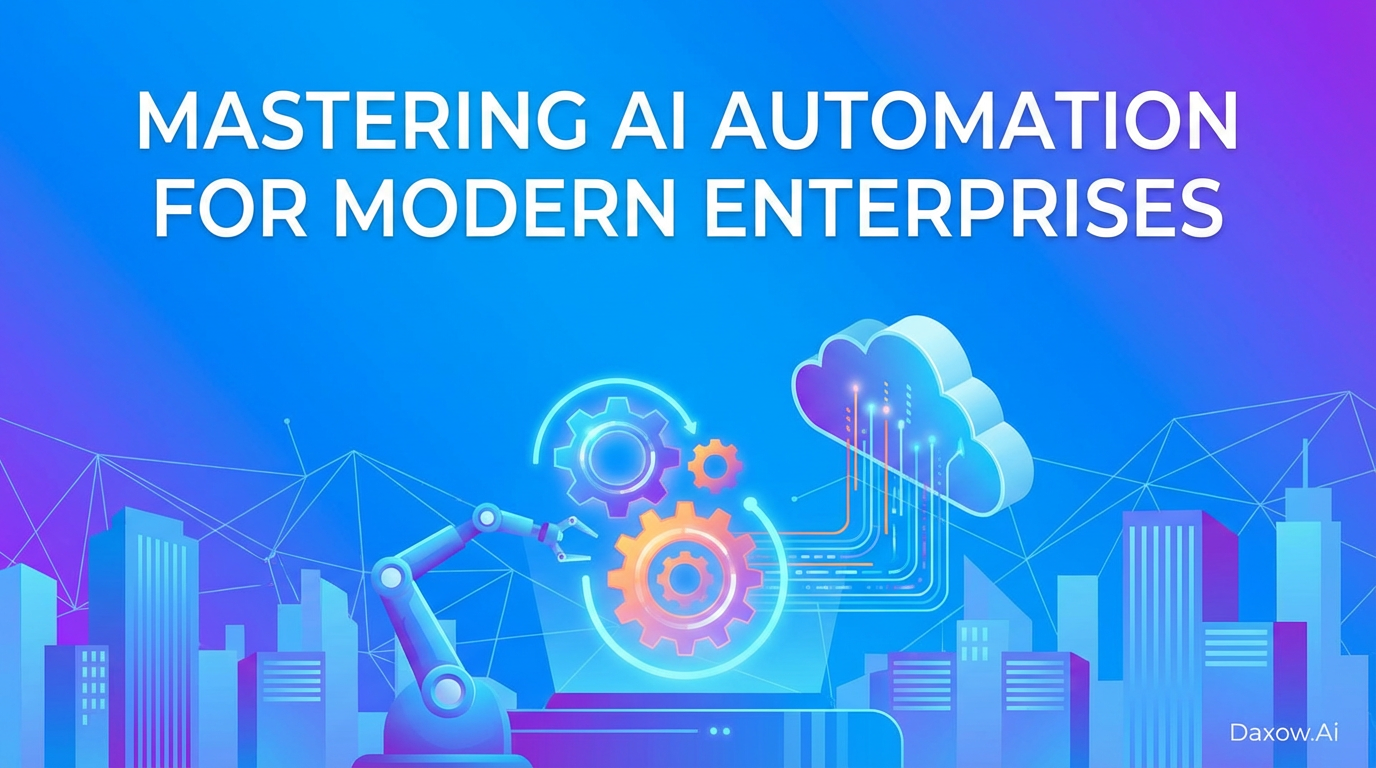
Mastering AI Automation for Modern Enterprises
Learn how AI automation and agents transform enterprise operations with a practical roadmap, industry use cases, and Daxow.ai's deployment approach.
Mastering AI Automation: Transforming Business Operations for the Modern Enterprise
Estimated reading time: 15 minutes
Key Takeaways
- AI automation leverages machine learning, NLP, and expert systems to automate repetitive tasks and enhance decision-making.
- AI agents enable autonomous workflows, improving speed, accuracy, and scalability across industries like e-commerce, healthcare, finance, real estate, and HR.
- Daxow.ai specializes in custom AI automation solutions that reduce operational costs, increase productivity, and deliver rapid ROI.
- Practical AI automation implementation requires phased planning, technology selection, pilot deployment, and continuous optimization.
- Measuring KPIs such as cost per transaction, resolution time, and customer satisfaction is critical to justify and scale AI investments.
- Embedding security, ethics, and change management are key best practices to ensure successful AI adoption.
Table of Contents
- Mastering AI Automation: Transforming Business Operations for the Modern Enterprise
- Why AI Agents and Workflow Automation Matter
- Practical Use Cases Across Industries
- How to Implement AI Automation — A Practical Roadmap
- Best Practices and Common Pitfalls
- Measuring ROI and Scaling Automation
- How Daxow.ai Helps You Master AI Automation
- Frequently Asked Questions
Mastering AI Automation: Transforming Business Operations for the Modern Enterprise
AI automation combines technologies such as machine learning, natural language processing (NLP), computer vision, and expert systems to automate repetitive tasks, enhance decision-making, and unlock scalable efficiency. For business leaders, the outcome is clear: fewer manual tasks, faster cycle times, and better customer outcomes. Successful deployments convert routine work — data entry, invoice processing, lead qualification, support triage — into intelligent, self-improving workflows that free teams to focus on strategic initiatives.
Strategic implications for businesses
- Operational resilience and growth: AI automation streamlines core processes to handle volume while maintaining consistency.
- Talent leverage: By shifting transactional work to AI, human teams focus on high-value activities.
- Competitive differentiation: Early, structured adoption yields sustained ROI and positions organizations to compete in a data-driven market.
Why AI Agents and Workflow Automation Matter
AI agents are autonomous systems that perceive, reason, and act on data to execute tasks end-to-end. Paired with workflow automation, they create processes that route, resolve, and optimize without constant human intervention.
The business outcomes you can expect
- Faster delivery: Structured implementation can yield 3–5x faster project and process completion.
- Cost reduction: Automated processes often reduce operational costs by 20–50% depending on scope.
- Improved accuracy: Continuous learning lowers error rates in processes such as reconciliations and compliance checks.
- Scalability: Agents handle peak demand — for example, seasonal e-commerce spikes — without proportional increases in staff.
How AI agents deliver value in practice
AI agents integrate with CRMs, ERPs, document stores, and communication platforms to perform tasks such as:
- Data cleansing and extraction from documents.
- Dynamic routing of customer queries and escalations.
- Predictive forecasting and inventory planning.
- Automated fraud detection and compliance checks.
At Daxow.ai we focus on building AI agents that connect to existing systems, orchestrate workflows, and continuously optimize performance so companies can achieve hyperautomation without ripping out legacy infrastructure.
Practical Use Cases Across Industries
E-commerce — Order-to-cash and customer support automation
Use case:
Implement AI agents to manage order validation, inventory forecasting via machine learning, personalized product recommendations via NLP, and post-purchase support using chatbots.
Business impact:
Reduce manual order reconciliation by up to 70%.
Chatbots resolve 70–80% of routine queries, reducing support cost per ticket and improving conversion rates through timely recommendations.
Example action:
Deploy a conversational AI agent connected to your commerce platform and CRM to handle returns, shipping notifications, and cross-sell messages.
Healthcare — Scheduling, triage, and document automation
Use case:
Use NLP agents to triage patient inquiries, schedule appointments, and extract structured data from clinical documents. Use computer vision for preliminary diagnostic workflows where appropriate and compliant.
Business impact:
Administrative burden reduced by up to 40%, faster patient access, and better compliance via automated audit trails.
Example action:
Integrate an appointment-scheduling AI with EHR workflows and a secure document automation layer to populate intake forms and route complex cases to clinicians.
Finance — Fraud detection, compliance, and invoice processing
Use case:
Deploy anomaly-detection models to flag suspicious transactions and expert systems to automate compliance checks. Use document automation to process invoices and reconcile accounts.
Business impact:
Processing times drop from days to minutes; error rates fall and fraud prevention yields material savings.
Example action:
Introduce an AI agent that automatically validates incoming invoices against purchase orders and routes exceptions to finance staff with contextual summaries.
Real Estate — Lead qualification and property valuation
Use case:
Conversational AI qualifies leads, captures preferences, and schedules tours. Machine learning models provide automated valuations using market data.
Business impact:
Faster deal cycles, higher lead conversion rates, and improved agent productivity.
Example action:
Combine a lead-qualification bot with MLS and CRM integrations to automatically prioritize leads and trigger personalized outreach.
HR — Recruitment automation and employee self-service
Use case:
NLP screens resumes, automates interview scheduling and onboarding workflows, and a virtual assistant answers routine HR queries.
Business impact:
Faster time-to-hire, improved candidate experience, and predictive analytics to reduce turnover.
Example action:
Implement a hiring pipeline agent that scores candidates, schedules interviews, and populates ATS fields automatically.
How to Implement AI Automation — A Practical Roadmap
1. Assess and plan (4–8 weeks)
- Map end-to-end processes and identify high-volume, rule-based tasks with measurable ROI.
- Define KPIs: cost per transaction, resolution time, error rate, or customer satisfaction.
- Audit data quality and compliance requirements.
Daxow role: We conduct workshops and process analysis to prioritize automation candidates and quantify expected gains.
2. Select technology and partners (6–12 weeks)
- Choose scalable tools that integrate with your stack and meet regulatory needs (e.g., HIPAA).
- Prefer platforms that support rapid prototyping and no-code paths for early validation.
Daxow role: We recommend architectures, select vendors as needed, and build proof-of-concept AI agents to validate value quickly.
3. Prepare infrastructure (4–8 weeks)
- Cleanse and label data, create knowledge bases, and map decision rules.
- Define security, governance, and rollout plans.
Daxow role: Our engineers establish secure integrations, build data pipelines, and create documentation to speed deployment.
4. Pilot and deploy (4–20 weeks)
- Start with a targeted pilot, measure against KPIs, and iterate.
- Expand in waves, learning from each deployment.
Daxow role: We run pilots, provide model tuning and monitoring dashboards, and train your teams on operation and exceptions handling.
5. Optimize and scale
- Use continuous monitoring and A/B testing to improve outcomes.
- Implement change management and upskilling programs for staff.
Daxow role: We provide ongoing optimization, governance, and support to ensure systems evolve with your business needs.
Best Practices and Common Pitfalls
Best practices:
- Start small with high-impact pilots and expand after measurable wins.
- Embed security and ethics into design decisions from day one.
- Involve cross-functional teams — IT, Ops, Compliance, and end-users — early.
- Measure continuously and implement a cadence for model and process audits.
Pitfalls to avoid:
- Skipping change management and user training.
- Ignoring data quality issues; poor data derails 70% of projects.
- Over-automating complex decisions without human-in-the-loop escalation.
Measuring ROI and Scaling Automation
To justify investment, tie automation to concrete financial and operational metrics.
Key KPIs:
- Cost per transaction or ticket.
- Time to resolution or processing cycle time.
- First-contact resolution and customer satisfaction scores.
- Revenue uplift from improved conversion or reduced churn.
Realistic timelines and returns:
- Many organizations realize ROI within 6–12 months for e-commerce and customer-facing automation.
- Finance and compliance automations can deliver multi-million-dollar savings through fraud reduction and faster close cycles.
- At Daxow, clients commonly achieve 4–6x ROI in the first year when AI projects are aligned with core KPIs and governance practices.
How Daxow.ai Helps You Master AI Automation
Daxow.ai, founded in Estonia in 2024, offers end-to-end AI automation services tailored to enterprise needs. Our approach focuses on measurable business value and sustainable scaling.
What we deliver:
- Process analysis and prioritization: We map workflows, quantify automation opportunity, and define KPIs.
- Custom AI agents and workflow automation: We build agents that execute real tasks—lead qualification, customer support automation, sales automation, document automation, and more.
- System integrations and data connectivity: We connect AI capabilities to CRMs, ERPs, ticketing systems, and data lakes.
- Compliance-first engineering: We embed security and regulatory controls from design through deployment.
- Change management and training: We ensure teams adopt new workflows and maintain performance after rollout.
- Ongoing optimization and support: Continuous monitoring, retraining, and feature expansion to keep systems aligned with evolving business goals.
Why partner with Daxow:
- We prioritize business outcomes, not technology for its own sake.
- We deploy iteratively, delivering quick wins and scaling reliably.
- We build self-improving systems: AI agents that learn from feedback and reduce manual tasks over time.
- We integrate with your existing stack, avoiding disruptive rip-and-replace projects.
Example engagements
- Sales automation: We built a lead-qualification agent that reduced sales qualification time by 60% and increased pipeline conversion.
- Customer support automation: We deployed a multi-channel chatbot and routing agent that resolved 75% of routine tickets and improved CSAT by 12 points.
- Finance automation: We automated invoice processing and exception handling to cut close time by 40% and reduce manual approvals.
Frequently Asked Questions
What industries benefit most from AI automation?
AI automation delivers significant value across e-commerce, healthcare, finance, real estate, and HR, though its flexible nature enables benefits in nearly all sectors.
How quickly can my organization see ROI from AI automation?
Many clients realize measurable ROI within 6–12 months, especially for customer-facing and e-commerce automation, with finance and compliance solutions often providing rapid cost savings.
Does AI automation require replacing existing systems?
No, Daxow.ai specializes in integrating AI agents with your existing CRMs, ERPs, and platforms to enhance workflows without disruptive replacements.
What role does change management play in AI automation?
Change management and user training are critical for adoption; skipping these steps is a common pitfall that limits AI automation success and impact.