
Mastering AI Automation: Strategy, Use Cases & ROI
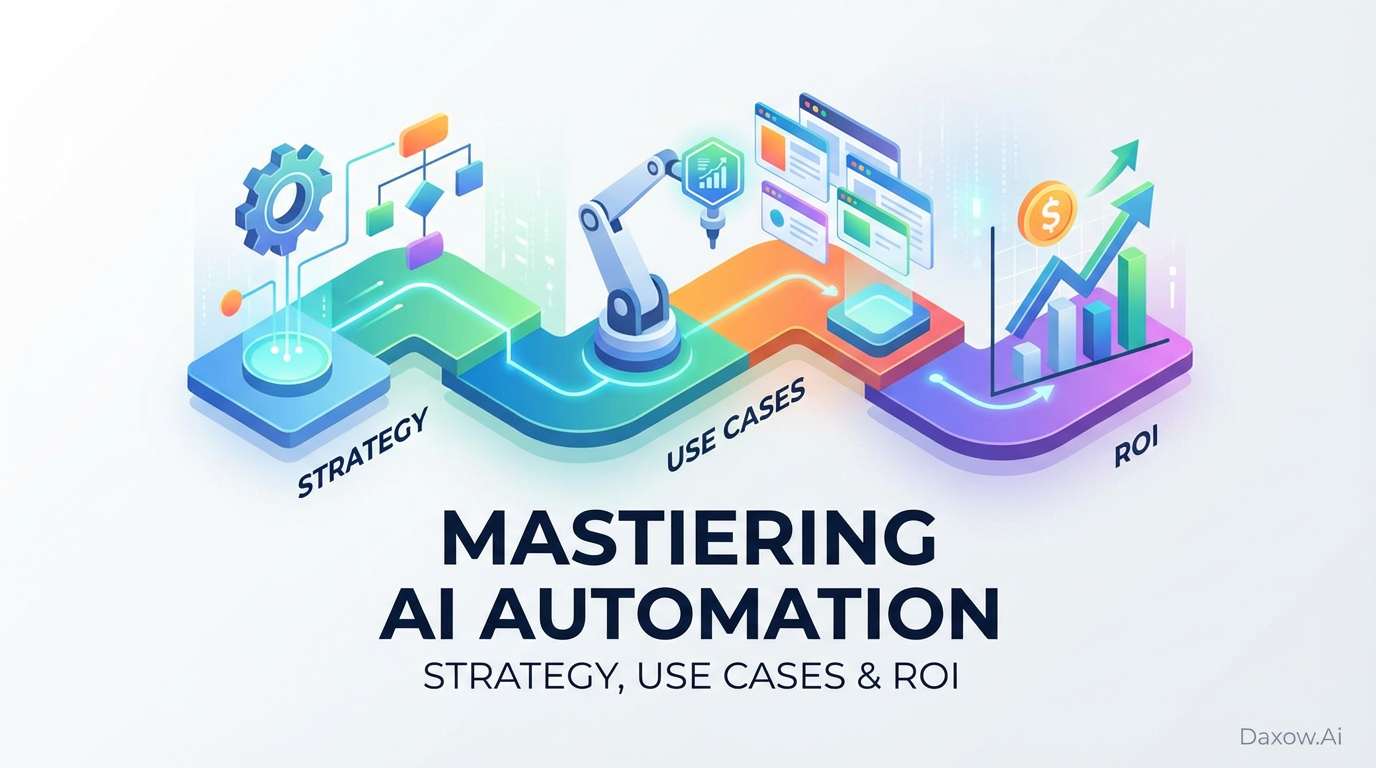
Learn how to implement AI automation for measurable ROI with practical use cases, phased steps, and how Daxow.ai builds custom AI agents to scale operations.
Mastering AI Automation: A Strategic Imperative for Modern Businesses
Estimated reading time: 15 minutes
Key Takeaways
- AI automation integrates AI technologies with workflow automation to transform business operations.
- Structured AI strategies can reduce costs by up to 60% and accelerate outcomes by 3–5 times.
- Industry use cases include e-commerce, healthcare, finance, real estate, and HR for rapid, measurable impact.
- A phased, risk-aware approach with governance ensures successful AI automation implementation.
- Daxow.ai specializes in building custom AI agents and automated workflows with strong compliance and ROI focus.
Table of Contents
- Mastering AI Automation: What It Means for Your Business
- Practical Use Cases — Industry Examples and Actionable Workflows
- How AI Agents and Workflow Automation Scale Operations
- Implementing AI Automation — A Phased, Risk-Aware Approach
- Calculating ROI and Measuring Success
- How Daxow.ai Helps You Master AI Automation
- Next Steps — Start Mastering AI Automation Today
- Frequently Asked Questions
Mastering AI Automation: What It Means for Your Business
AI automation is the integration of machine learning, natural language processing, and rule-based automation into business workflows. Unlike traditional automation that follows fixed scripts, AI automation adapts, learns, and handles ambiguous inputs — moving teams from manual processing to oversight and strategy.
- Core capabilities: AI agents that execute multi-step workflows, NLP for customer conversations and document understanding, machine learning for predictive decisions, and integrations that connect CRMs, ERPs, and other systems.
- Primary business outcomes: reduced manual tasks, faster decision cycles, improved accuracy, enhanced customer experience, and scalable 24/7 operations.
- Quantifiable benefits: cost reductions in targeted processes (up to 40–60%), support operation savings (30–50%), and process acceleration often delivering 3–5x improvements.
How AI Automation Differs from Traditional Automation
- Traditional automation: deterministic, rule-based, rigid. Best for structured processes with little variance.
- AI automation: probabilistic, learns from data, handles unstructured inputs (emails, contracts, conversations), and adapts over time.
- Business impact: AI automation reduces exceptions and manual escalations, enabling teams to focus on high-value tasks rather than repetitive handling.
Practical Use Cases — Industry Examples and Actionable Workflows
E‑commerce — Intelligent Order and Support Automation
Use case: Automate inventory updates, predictive restocking, personalized product recommendations, and customer support via chatbots.
Business impact:
- Reduce cart abandonment by resolving customer queries instantly.
- Maintain optimal stock levels through demand forecasting.
Workflow example:
- AI agent reads order and inventory feeds.
- Predictive model flags low-stock SKUs and automatically creates restock requests in the ERP.
- Chatbot fields shipping and return queries, escalating only complex issues to agents.
Daxow role: Build and integrate AI agents with your e-commerce platform and CRM, configure recommendation models, and orchestrate automated workflows to reduce manual inventory checks and support tickets.
Healthcare — Streamlined Scheduling and Records Processing
Use case: Automate patient scheduling, triage intake, and document extraction from medical records.
Business impact: Cut administrative time by 30–50% and reduce appointment no-shows through automated reminders and triaging.
Workflow example:
- Patient submits symptoms via a portal.
- AI triage agent analyzes inputs and schedules the appropriate appointment type.
- Document automation extracts and classifies patient records, updating EHRs automatically.
Daxow role: Design compliant data pipelines, deploy triage agents, and integrate with EHR systems while ensuring privacy and auditability.
Finance — Invoice Handling and Fraud Detection
Use case: End-to-end invoice automation: capture, validate, route for approval, and trigger payments; detect anomalous transactions in real time.
Business impact: Reduce invoice processing time and human errors; accelerate approvals and cash flow management.
Workflow example:
- Document OCR extracts invoice fields.
- AI validation checks vendor details, PO matches, and flags exceptions.
- Approved invoices flow automatically to payment systems.
Daxow role: Implement AI-driven document extraction, rules engines, and integrations to ERP and accounting systems to reduce manual reconciliations.
Real Estate — Lead Qualification and Contract Automation
Use case: Automate lead qualification, property matching, virtual tour scheduling, and contract generation/review.
Business impact: Increase salesperson productivity by focusing on qualified leads and reduce time-to-contract.
Workflow example:
- Inbound lead is scored by an AI model.
- Qualified leads receive personalized property matches and scheduled viewings.
- Contract clauses are pre-populated and reviewed by AI for compliance before human sign-off.
Daxow role: Configure lead-scoring models, connect listing databases, and create AI agents that manage the end-to-end buyer journey.
HR — Recruitment, Onboarding, and Employee Support
Use case: Automate resume screening, interview scheduling, onboarding workflows, and internal HR support via chatbots.
Business impact: Shorten hiring cycles and lower administrative overhead while improving candidate experience.
Workflow example:
- AI screens resumes and ranks candidates against role criteria.
- Top candidates get automated interview invites; new hires receive step-by-step onboarding checklists.
- HR chatbots answer benefits and policy questions on demand.
Daxow role: Deploy secure recruitment pipelines, integrate applicant tracking systems, and build HR chatbots that reduce routine queries.
How AI Agents and Workflow Automation Scale Operations
AI agents function as autonomous digital workers that coordinate multi-step processes across systems. They reduce friction by connecting siloed data, executing business logic, and improving themselves through feedback.
- Example: end-to-end invoice processing
- Ingest invoice (email, portal, or scan).
- Extract fields using document AI.
- Validate against purchase orders and vendor records.
- Auto-approve low-risk invoices; route exceptions for review.
- Trigger payment or schedule follow-up.
- Why it scales: AI agents operate 24/7, handle volume spikes without staffing changes, and reduce error rates that cause rework.
Continuous Learning and Feedback Loops
- Agents collect human corrections and outcome data.
- Models retrain periodically to decrease exceptions.
- Monitoring dashboards track KPIs and surface drifts early.
Implementing AI Automation — A Phased, Risk-Aware Approach
Successful implementations follow a disciplined, phased approach. Start small, measure rigorously, and scale with governance.
Step 1 — Assess and Prioritize Processes
- Identify high-volume, rule-based tasks that deliver quick ROI.
- Evaluate data quality, compliance needs, and integration complexity.
- Prioritize processes with measurable KPIs (resolution time, error rate, cost/hour).
Step 2 — Assemble Cross‑Functional Teams
- Include business owners, IT, data engineers, and frontline users.
- Consider external partners like Daxow.ai when internal expertise is limited.
Step 3 — Select Tools and Prepare Infrastructure
- Choose platforms that balance speed (pre-built connectors) and customization.
- Clean and structure data; build integration layers to CRMs, ERPs, and cloud storage.
Step 4 — Develop and Pilot
- Launch a limited-scope pilot with clear success metrics.
- Measure impact on cost, time-to-resolution, and customer satisfaction.
- Iterate rapidly based on user feedback.
Step 5 — Integrate, Train, and Roll Out Gradually
- Provide role-based training and clear runbooks.
- Expand scope in waves, maintaining monitoring and rollback plans.
Step 6 — Scale with Governance
- Implement model governance, bias audits, and compliance checks.
- Create a center of excellence (CoE) or appoint champions to drive continuous improvement.
Best practices summary:
- Start with high-impact, low-complexity use cases.
- Invest in data quality.
- Define clear metrics and timelines.
- Prioritize change management to ensure adoption.
Avoid common pitfalls such as over-automation, ignoring user feedback, and skipping pilots; these mistakes derail many projects.
Governance, Compliance, and Ethical Considerations
- Enforce audit trails for decisions and data access.
- Conduct bias testing and maintain human-in-the-loop controls for sensitive decisions.
- Document processes and create escalation paths for exceptions.
Calculating ROI and Measuring Success
Quantify returns early and use metrics to guide expansion.
Key KPIs:
- Resolution time and average handling time.
- Error rates and exception counts.
- Cost per transaction and total cost savings.
- Customer metrics: NPS and satisfaction scores.
- Velocity metrics: throughput and time-to-completion.
Typical ROI outcomes:
- Support operations: 30–50% reduction in costs.
- Process acceleration: 3–5x faster for selected workflows.
- Pilot payback: 6–12 months, with full rollout delivering 3–5x returns as automation scales.
How Daxow.ai Helps You Master AI Automation
Daxow.ai designs and delivers custom AI automation solutions from discovery to scale. Our approach aligns with the phased best practices above and focuses on measurable business value.
What Daxow.ai offers:
- Process discovery and prioritization: We map workflows, quantify ROI potential, and identify quick-win automation targets.
- Custom AI agents: We build agents that execute real tasks — from lead qualification and chatbots to document automation and predictive workflows.
- End-to-end workflow automation: We connect systems, orchestrate logic, and automate approvals and escalations.
- System integrations and data connectivity: We integrate with CRMs, ERPs, ticketing systems, and cloud storage to eliminate silos.
- Compliance and governance: We implement audit trails, bias checks, and secure data handling practices.
- Pilot-to-scale delivery: We run pilots with defined KPIs, iterate based on results, and deploy enterprise-grade automation at scale.
- Training and change management: We provide role-based training and documentation to ensure adoption and sustained performance.
Typical Engagement Flow with Daxow.ai
- Discovery workshop and process analysis.
- Pilot design with clear success metrics.
- Rapid development and integration of AI agents.
- Pilot execution, monitoring, and iteration.
- Gradual rollout and CoE enablement.
- Continuous monitoring, retraining, and optimization.
Next Steps — Start Mastering AI Automation Today
Mastering AI automation delivers measurable reductions in manual tasks, higher productivity, and improved customer experiences. Whether you need a single AI agent to manage invoices or a portfolio of automated workflows that transform operations, Daxow.ai provides the expertise to design, build, and scale custom solutions that deliver ROI.
Bold next actions:
- Book a free consultation to assess automation opportunities.
- Request a process analysis for your company to identify quick wins.
- Contact us to build a custom AI system tailored to your workflows.
Contact Daxow.ai today and begin your journey to mastering AI automation — reduce manual tasks, boost productivity, and realize sustainable business automation that scales.
Frequently Asked Questions
What is AI automation, and how does it differ from traditional automation?
AI automation integrates AI technologies like machine learning and natural language processing into workflows to adapt and learn from data, handling unstructured inputs. Traditional automation is rule-based and deterministic, best suited for repetitive, structured tasks.
How quickly can businesses expect ROI from AI automation?
Companies often realize payback on pilot investments within 6–12 months and can see cost reductions of up to 40–60%, accelerated processes by 3–5x, and sustained ROI as automation scales.
What industries benefit most from AI automation?
E-commerce, healthcare, finance, real estate, and HR are among key industries where AI automation drives significant productivity gains and cost savings through tailored workflows and AI agents.
How does Daxow.ai ensure compliance and ethical AI use?
Daxow.ai implements audit trails, bias testing, human-in-the-loop controls, secure data handling, and continuous governance to maintain ethical standards and regulatory compliance throughout AI automation projects.