
Mastering AI Implementation for Business Transformation
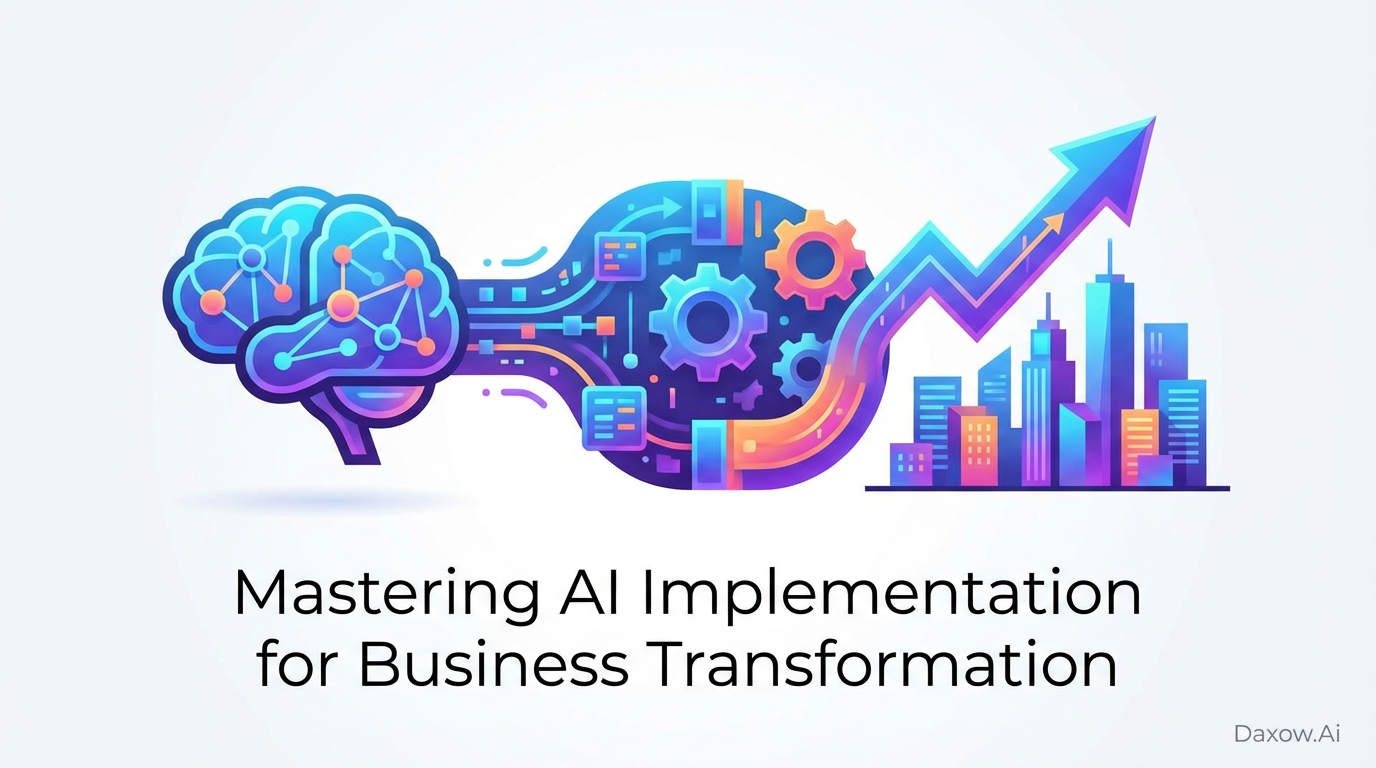
Actionable framework to implement AI agents and workflow automation, with industry use cases, phased rollout, governance, and ROI guidance from Daxow.ai.
Mastering AI Implementation: Unlocking Business Transformation Through Automation
Estimated reading time: 15 minutes
Key Takeaways
- AI automation drives cost reduction, faster decision-making, and increased productivity.
- Implement AI as a business transformation program, not a one-off experiment.
- Start with high-volume, low-complexity processes for quick wins across industries.
- Combine AI agents with workflow automation for orchestration and contextual decisions.
- Follow a phased, measurable framework with governance and continuous optimization.
- Measure impact using KPIs like cost per transaction, CSAT, and time-to-ROI.
- Daxow.ai offers end-to-end AI automation consulting, design, and managed services.
Table of Contents
- Why This Matters Now
- Strategic Value of AI Automation for Business
- Practical Use Cases: Where to Start with AI Automation
- How AI Agents and Workflow Automation Deliver Business Value
- Implementation Framework — Phased, Measurable, Low-Risk
- Governance, Ethics, and Risk Management
- Measuring ROI and Scaling Impact
- Real-World Examples and Outcomes
- How Daxow.ai Partners With You End-to-End
- Practical Checklist to Get Started This Quarter
- Final Recommendations for Decision-Makers
Why This Matters Now
- Speed and scale: Automation enables your teams to execute at scale without linear increases in headcount.
- Cost and quality: Expect cost reductions of 20–50% in high-volume processes when automation is applied correctly.
- Customer expectations: 24/7 intelligent service and faster resolutions increase CSAT and retention.
- Competitive advantage: Structured AI implementation delivers results 3–5x faster than ad-hoc approaches.
These outcomes only occur when AI automation is implemented as a business transformation program — not a one-off experiment.
Strategic Value of AI Automation for Business
Core benefits
- Reduce manual tasks: Automate repetitive, rule-based activities (data entry, invoice processing, lead qualification) to free staff for strategic work.
- Improve productivity: Offload up to 70% of routine work to AI agents and automated workflows.
- Business automation with intelligence: Combine workflow automation with machine learning for contextual decisions (e.g., prioritizing high-value leads).
- Faster, data-driven decisions: Predictive models and real-time analytics turn operational data into actionable insight.
Metrics to prioritize
Focus KPIs that connect to business value:
- Cost per transaction or case
- Time to resolution / cycle time
- First-contact resolution and CSAT
- Lead-to-opportunity conversion rate
- Model accuracy and error rates
- Time-to-ROI for pilot projects
Practical Use Cases: Where to Start with AI Automation
Start with high-volume, low-complexity processes to get quick wins. Here are targeted examples across industries, with practical actions you can take today.
E-commerce
- Use case: Order processing, returns handling, inventory reconciliation, personalized recommendations.
- Action: Deploy AI agents to read order messages, check inventory via ERP integration, and trigger fulfillment workflows. Use customer support automation (chatbots) to handle common order queries and escalate exceptions.
- Impact: Reduced manual order handling, faster delivery onboarding, lower cart abandonment through contextual recommendations.
Healthcare
- Use case: Patient scheduling, triage, claims pre-check, compliance monitoring.
- Action: Implement workflow automation to route referrals and schedule appointments; use AI to pre-fill forms and flag anomalies for clinician review. Ensure HIPAA-compliant data handling and audit trails.
- Impact: Lower administrative overhead, 30% reduction in time spent on routine paperwork, improved patient access.
Finance and Accounting
- Use case: Invoice processing, reconciliation, fraud detection, compliance reporting.
- Action: Combine data extraction (OCR + NLP) with rule-based validation and robotic process automation (RPA) to automate order-to-cash and procure-to-pay cycles. Add real-time anomaly detection models for fraud signals.
- Impact: Fewer payment errors, faster close cycles, improved audit readiness.
Real Estate
- Use case: Lead qualification, property valuation, document generation.
- Action: Deploy AI agents to parse inquiries, score leads, and schedule viewings. Integrate MLS and CRM data for automated valuations and market alerts.
- Impact: Faster lead-to-deal conversion and reduced time-to-sale.
HR and People Operations
- Use case: Resume screening, interview scheduling, onboarding workflows, churn prediction.
- Action: Use NLP to extract candidate attributes, automatically rank applicants against job criteria, and automate interview calendar coordination. Implement churn prediction models to trigger retention interventions.
- Impact: 40% reduction in time-to-hire and better employee retention interventions.
How AI Agents and Workflow Automation Deliver Business Value
What are AI agents?
AI agents are autonomous systems that perceive input (text, files, events), make decisions using models and rules, and take action across systems — for example, creating tickets, updating CRMs, or initiating payments. They orchestrate multi-step processes and can escalate to humans when required.
Why combine agents with workflow automation?
- Orchestration: Agents coordinate tasks across CRM, ERP, support tools, and custom systems.
- Contextual decisions: Machine learning improves routing and prioritization beyond static rules.
- Continuous improvement: Retraining and monitoring prevent performance drift and adapt behavior as business changes.
- End-to-end automation: From detection to resolution, automated flows reduce manual handoffs and average handling time.
Implementation Framework — Phased, Measurable, Low-Risk
1. Assessment and planning (4–8 weeks)
- Objectives: Define business goals, map current processes, identify quick wins, and establish KPIs.
- Deliverables: Process inventory, opportunity ranking (impact vs. complexity), data readiness report, governance plan.
- Daxow role: Conduct process workshops, stakeholder interviews, and technical discovery to design a pragmatic roadmap.
2. Technology selection (6–12 weeks)
- Objectives: Choose platforms and integration approach (cloud vs. on-premises, model providers, RPA tools).
- Deliverables: Architecture blueprint, vendor shortlist, compliance checklist (GDPR, HIPAA), total cost estimate.
- Daxow role: Evaluate vendors for integration readiness, scalability, and data security; recommend the optimal tech stack for your environment.
3. Preparation and data work (4–8 weeks)
- Objectives: Clean and label data, build knowledge bases, and create API connectors.
- Deliverables: Data pipelines, training datasets, decision trees, proof of integration.
- Daxow role: Implement ETL, set up secure data stores, design knowledge graphs and taxonomy for consistent automation.
4. Pilot deployment (4–12 weeks)
- Objectives: Validate the model and workflow at scale within a controlled scope.
- Deliverables: Live pilot, performance dashboard, user feedback logs, escalation paths.
- Daxow role: Build and deploy AI agents, integrate with target systems, monitor metrics, and iterate based on frontline feedback.
5. Gradual rollout and optimization
- Objectives: Expand across teams and channels while maintaining performance standards.
- Deliverables: Training programs, monitoring and retraining schedules, ROI dashboard.
- Daxow role: Provide managed services for continuous improvement, retrain models with new data, and implement feature enhancements.
Governance, Ethics, and Risk Management
Embed governance from day one
- Data privacy: Define data access, retention, and anonymization rules.
- Bias and fairness: Implement tests for model bias and corrective measures.
- Auditability: Log decisions and actions for regulatory and business audits.
- Human-in-the-loop: Set clear escalation rules for complex or high-risk cases.
Daxow ensures governance controls are built into both design and deployment phases, not retrofitted later.
Measuring ROI and Scaling Impact
Typical business outcomes
- Cost savings: 20–50% reduction in process costs for automated tasks.
- Speed: 30–40% faster workflows and shorter cycle times.
- Productivity: Staff reallocated from routine work to higher-value activities.
- Conversion uplift: Sales automation and lead qualification increase close rates by focusing human effort where it matters most.
How to measure success
Use a simple dashboard with leading and lagging indicators:
- Volume automated (cases, invoices, tickets)
- Time saved (hours/month)
- Cost per transaction before/after
- Accuracy/error rate of automated tasks
- Customer satisfaction (CSAT/NPS)
Real-World Examples and Outcomes
Example 1 — Retail: Order-to-fulfillment automation
- Challenge: High manual touch for order exceptions causing shipment delays.
- Solution: Daxow built AI agents to reconcile orders, auto-resolve common exceptions, and surface only complex cases to operations. Integrated with ERP, WMS, and CRM.
- Result: 45% reduction in manual exception handling, 25% faster fulfillment, and improved CSAT.
Example 2 — Finserv: Invoice processing and fraud detection
- Challenge: Slow invoice matching and manual fraud reviews in high-volume accounts payable.
- Solution: Implemented OCR + NLP for invoice extraction, rule-based matching, and anomaly detection models to flag suspicious transactions. End-to-end automation from receipt to payment authorization.
- Result: 50% reduction in invoice processing costs and a 60% drop in false positive fraud alerts.
Example 3 — SaaS: Customer support automation
- Challenge: Growing support volume and slow first response times.
- Solution: Deployed customer support automation with chatbots for Tier-1 inquiries and AI agents that create and triage tickets, enrich them with customer context, and route to the right team.
- Result: 30% improvement in first response time and 20% increase in first-contact resolution.
How Daxow.ai Partners With You End-to-End
From process analysis to production operations
- Discovery and process analysis: We map workflows and quantify opportunity.
- Custom solution design: We build AI agents and workflow automation tailored to your systems and objectives.
- Integration and security: We connect CRMs, ERPs, and other business tools using secure APIs and enterprise-grade controls.
- Deployment and managed services: We run pilots, support rollout, and provide ongoing monitoring and retraining to sustain gains.
- ROI accountability: We set measurable targets and report outcomes that align to your financial and operational goals.
Practical Checklist to Get Started This Quarter
- Identify 1–3 high-volume processes with clear KPIs.
- Confirm data availability and quality for those processes.
- Appoint an internal sponsor and a change lead.
- Request a process analysis to quantify impact and timeline.
- Plan a 3-month pilot with measurable success criteria.
Final Recommendations for Decision-Makers
- Start small, scale fast: Begin with pilots that deliver clear ROI and expand once success is proven.
- Prioritize integration: End-to-end automation depends on clean system connectivity.
- Measure continuously: Use dashboards to track performance and identify drift.
- Govern responsibly: Embed privacy, fairness, and auditability into every phase.
Conclusion and Call to Action
Mastering AI Implementation: Unlocking Business Transformation Through Automation is achievable with the right strategy, technology, and partner. Daxow.ai combines domain experience, custom AI engineering, and operational rigor to design AI agents and workflow automation that reduce manual tasks, boost productivity, and deliver measurable ROI.
Book a free consultation with Daxow.ai or request a process analysis for your company to identify the highest-impact automation opportunities and begin building your custom AI system. Contact us to build a tailored plan and start transforming operations today.
Frequently Asked Questions
What industries benefit most from AI automation?
High-volume, rule-based industries such as e-commerce, healthcare, finance, real estate, and HR gain immediate advantages by reducing manual tasks and improving decision accuracy through AI automation.
How long does it take to see ROI from AI automation?
With a structured approach and starting with quick-win processes, measurable ROI can be observed typically within 3 to 6 months after deployment, depending on scale and process complexity.
How does Daxow.ai ensure data privacy and compliance?
We embed governance from day one by defining data access rules, implementing anonymization, and ensuring compliance with regulations such as GDPR and HIPAA through secure architecture and audit logging.
Can existing systems be integrated with AI agents and automation?
Yes, Daxow.ai specializes in connecting CRMs, ERPs, and custom business tools via secure APIs and workflows to create seamless end-to-end automation solutions tailored to your environment.