
Mastering AI Implementation: Strategic Guide for Business
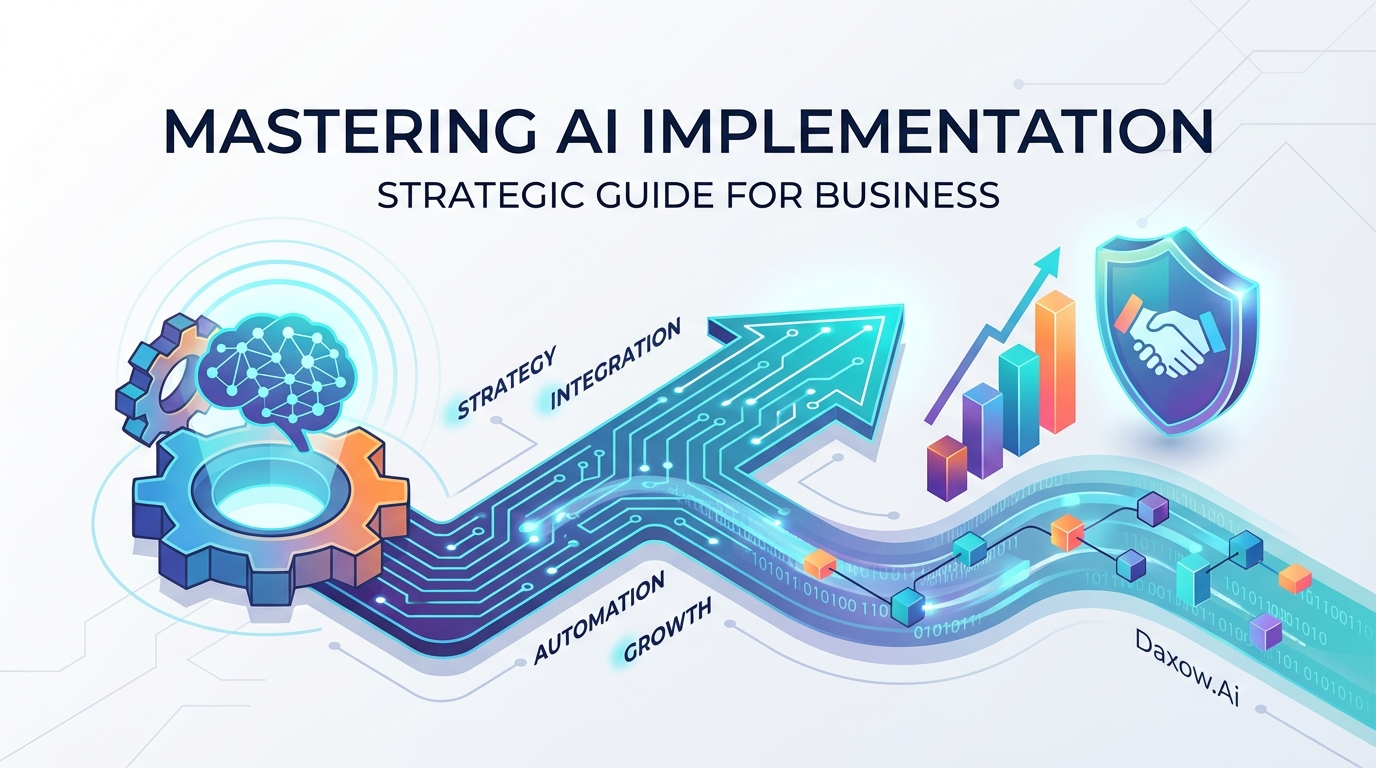
Strategic guide to implement AI automation and agents with a phased roadmap, KPIs, industry use cases, and how Daxow.ai delivers measurable ROI.
Mastering AI Implementation: A Strategic Guide for Business Transformation
Estimated reading time: 20 minutes
Key Takeaways
- AI implementation transforms businesses by automating workflows, improving productivity, and reducing costs.
- Successful AI requires aligning goals to business outcomes, focusing on measurable KPIs and scalable use cases.
- Industries like e-commerce, healthcare, finance, real estate, and HR benefit from AI agents, RPA, and predictive analytics.
- A phased approach from assessment to continuous optimization mitigates risk and accelerates ROI.
- Daxow.ai provides end-to-end AI automation services including process analysis, custom AI design, integration, and governance.
Table of Contents
- Mastering AI Implementation: A Strategic Guide for Business Transformation
- Practical Use Cases Across Industries
- How AI Agents and Automation Help — From Rules to Reasoning
- Implementation Steps and Best Practices
- ROI and Business Value — How to Track Success
- How Daxow.ai Designs and Delivers End-to-End AI Automation
- Start Mastering AI Implementation Today
- Frequently Asked Questions
Mastering AI Implementation: A Strategic Guide for Business Transformation
From ad-hoc pilots to operational impact
AI implementation is the systematic integration of AI capabilities into business processes to automate repetitive work, improve decision-making, and create new value streams. Organizations that follow a structured approach typically realize outcomes that are multiple times faster and more accurate than ad-hoc efforts. Key outcomes include:
- Faster response times and improved customer satisfaction.
- Reduced operational costs through automation of routine tasks.
- Improved accuracy and compliance via audit trails and model governance.
- Scalable operations able to adapt to market shifts.
Business-level objectives to define up front
Before any technical work begins, align AI goals to business outcomes. Typical objectives:
- Reduce handling time for customer inquiries by 40%.
- Cut invoice-processing costs in finance by 30–50%.
- Shorten hiring time by 50% via automated screening and onboarding.
- Increase qualified sales leads by 20% through automated lead qualification.
Practical Use Cases Across Industries
Each use case below pairs an AI pattern (agents, NLP, predictive analytics, RPA) with measurable KPIs and an actionable implementation hint.
E‑commerce — Personalized experiences and efficient operations
- Personalized product recommendations driven by AI agents that analyze behavioral and transactional data to increase AOV and conversion rates.
- Dynamic pricing and inventory forecasting using predictive models to reduce stockouts and markdowns.
- Customer support automation with chatbots that resolve common queries and escalate complex issues.
KPIs & actions:
- Measure conversion lift, cart abandonment reduction, and inventory turnover.
- Start with a limited product category and a single channel (site or chat) for a pilot.
Healthcare — Administrative efficiency and patient triage
- Patient triage agents that classify urgency and schedule appointments.
- Document automation for medical records, claims, and compliance workflows.
- Predictive analytics for patient risk stratification.
KPIs & actions:
- Track time saved per appointment booking and reduction in administrative errors.
- Prioritize HIPAA-compliant integrations and robust audit trails.
Finance — Fraud detection and accounts automation
- Real-time fraud detection with anomaly detection models scanning transactions.
- Invoice and expense processing via document extraction and workflow automation.
- Regulatory compliance automation through rule-based monitoring and reporting.
KPIs & actions:
- Monitor false positive/negative rates, processing time, and audit readiness.
- Begin with high-volume, low-complexity documents for rapid ROI.
Real estate — Faster deals and better lead qualification
- Virtual valuation agents that estimate property values using market and listing data.
- Lead qualification and nurturing through automated outreach and appointment scheduling.
- Lease and contract automation for faster closings.
KPIs & actions:
- Measure lead-to-viewing conversion and time-to-contract.
- Integrate with CRM and listing platforms for end-to-end automation.
HR — Smarter hiring and onboarding
- Resume screening agents using NLP to rank candidates against role profiles.
- Automated onboarding workflows that trigger documents, training, and access rights.
- Retention prediction to identify high-risk employees and plan interventions.
KPIs & actions:
- Track time-to-hire, hiring quality metrics, and onboarding completion rates.
- Use structured interviews and validated assessments to mitigate bias.
How AI Agents and Automation Help — From Rules to Reasoning
Complementary capabilities
- RPA and workflow automation eliminate manual data entry and enforce process steps.
- AI agents add reasoning, context-awareness, and the ability to manage multi-step tasks over time.
- Combined, they create systems that can both execute routine tasks and adapt when exceptions arise.
Typical architecture patterns
- Front-line chatbots or agents handle intent recognition (NLP) and route or resolve queries.
- Middleware orchestrates workflow automation and triggers RPA bots or API calls.
- Back-end predictive models inform decisions (fraud scoring, lead likelihood).
- Monitoring and governance layers capture metrics, drift, and audit logs.
Integration and data readiness
- Data quality and connectivity are prerequisites. Clean, accessible data enables reliable models.
- APIs and connectors to CRMs, ERPs, support platforms, and document stores are required for end-to-end automation.
- Include guardrails: human-in-the-loop for high-risk decisions, logging for compliance, and bias detection routines.
Implementation Steps and Best Practices
Follow a structured, phased approach to minimize risk and speed value realization.
Phase 1 — Assess and ideate (4–8 weeks)
Activities:
- Map current workflows and identify repetitive, high-volume tasks.
- Set measurable goals and success criteria (e.g., 20% cost reduction).
- Run a data readiness audit and identify integration endpoints.
Deliverables:
- Prioritized use-case backlog.
- ROI scoping for each use case.
Phase 2 — Select technology and build the team (6–12 weeks)
Activities:
- Choose scalable platforms with strong integration capabilities.
- Assemble cross-functional teams: product, engineering, SMEs, and external AI specialists.
- Decide on model types (NLP for chat, supervised models for predictions).
Deliverables:
- Technology stack decision.
- Resourcing and governance plan.
Phase 3 — Prepare data and plan integrations
Activities:
- Cleanse datasets, build knowledge bases, and document decision trees.
- Design API integrations and RPA flows for legacy systems.
- Develop compliance and risk mitigation plans.
Deliverables:
- Cleaned datasets and training/validation splits.
- Integration design and security architecture.
Phase 4 — Pilot and test
Activities:
- Deploy a pilot in a limited scope (single channel, single department).
- Use real-world validation sets and iterative testing.
- Implement monitoring, KPIs, and escalation paths.
Deliverables:
- Pilot results and improvement backlog.
- Go/no-go decision paper.
Phase 5 — Rollout and continuous optimisation
Activities:
- Incrementally expand to new processes, teams, and channels.
- Retrain models with fresh data and iterate on workflows.
- Monitor for model drift, bias, and changing business conditions.
Deliverables:
- Production deployments with SLAs.
- Ongoing retraining and governance schedule.
Best practices and common pitfalls
- Start with high-impact, low-complexity workflows for early wins.
- Invest in data readiness and system integrations early.
- Ensure leadership sponsorship and workforce training.
- Implement monitoring, KPIs, and escalation routes to maintain trust.
- Avoid scope creep by tying initiatives to defined metrics.
ROI and Business Value — How to Track Success
Metrics that matter
- Operational efficiency: processing time, throughput, error rates.
- Financial: cost-per-transaction, reduction in FTE hours, payback period.
- Customer: CSAT, Net Promoter Score, response time.
- Adoption: percentage of tasks automated, agent deflection rates.
Typical ROI and timelines
- Many organizations see 30–50% reductions in operational costs on automated processes.
- Payback within 6–12 months is common for finance and HR automation.
- Productivity gains and faster decision cycles lead to 3–5x faster project outcomes in optimized environments.
Example ROI calculation (simplified)
- Current monthly cost to process invoices: $50,000.
- Target reduction: 40% via document automation and workflow automation.
- Projected monthly savings: $20,000 — annualized $240,000.
- Subtract implementation and operating costs to compute payback period.
How Daxow.ai Designs and Delivers End-to-End AI Automation
Daxow.ai specializes in building custom AI systems that convert strategic goals into operational reality. We combine diagnostic rigor, technical expertise, and implementation discipline to deliver measurable outcomes.
Discovery and process analysis
- We begin with a process assessment to map workflows, quantify manual tasks, and identify highest-impact automation opportunities.
- Deliverable: a prioritized automation roadmap with clear KPIs.
Custom AI design and prototyping
- Daxow.ai designs AI agents and workflow automation tailored to your systems and data.
- We build quick prototypes to validate assumptions and deliver pilot value fast.
Integrations and data connectivity
- Our team connects AI systems to CRMs, ERPs, support platforms, and document stores.
- We ensure secure data flows, auditability, and compliance-ready architectures.
End-to-end automation and deployment
- From chatbots and customer support automation to sales automation and end-to-end workflows, we deliver production-ready systems.
- We combine RPA, API orchestration, and AI agents to eliminate repetitive tasks and reduce manual intervention.
Monitoring, governance, and continuous improvement
- Daxow.ai sets up monitoring dashboards, guardrails, and retraining pipelines.
- We implement human-in-the-loop controls for high-risk decisions and routine audits to keep models reliable and fair.
Measurable outcomes and ROI tracking
- We align each implementation with business KPIs and provide transparent dashboards to track performance and ROI.
- Our focus is on converting AI from a cost center into a growth engine.
Concrete examples of Daxow.ai implementations (illustrative)
Customer Support Automation for a SaaS company
- Challenge: High ticket volumes and long resolution times.
- Solution: Deploy a multi-channel chatbot using NLP to handle 70% of routine queries and orchestrate escalation to human agents for complex cases.
- Outcome: 50% reduction in average response time, improved NPS, and reallocation of support staff to strategic tasks.
Invoice automation for a mid-sized finance department
- Challenge: Manual invoice processing with frequent errors and long cycle times.
- Solution: Document extraction, validation rules, and workflow automation connected to ERP.
- Outcome: 40% reduction in processing costs, payback within 9 months.
Lead qualification for a real estate broker
- Challenge: High volume of inbound leads with inconsistent qualification.
- Solution: AI agents score leads, schedule viewings, and nurture warm prospects automatically.
- Outcome: 20% increase in qualified leads and shorter sales cycles.
Start Mastering AI Implementation Today
Implementing AI is a strategic journey that requires clear goals, data readiness, and disciplined execution. Daxow.ai helps companies across industries move from concept to production with end-to-end services: from discovery and prototyping to integrations, deployment, and continuous optimization.
If you want to transform repetitive work into strategic outcomes, improve customer experiences through customer support automation, or scale sales with sales automation and intelligent lead qualification, take the next step.
Bold next steps:
- Book a free consultation with Daxow.ai to map your automation opportunities.
- Request a process analysis for your company and receive a prioritized roadmap.
- Contact us to build a custom AI system or pilot that reduces manual tasks and delivers measurable ROI.
Make the shift from experimentation to operational excellence — contact Daxow.ai to start your AI automation journey.
Frequently Asked Questions
What is the typical timeframe for implementing AI in business workflows?
Typical AI implementation projects follow a phased approach lasting from 4 to 12 weeks for initial assessment, technology selection, and piloting, with ongoing continuous optimization over months or years to ensure sustained value.
How does Daxow.ai ensure AI compliance and governance?
Daxow.ai builds systems with audit trails, human-in-the-loop controls for high-risk decisions, bias detection routines, and monitoring dashboards to ensure compliance with industry standards and regulatory requirements.
Which industries benefit the most from AI agents and automation?
Industries such as e-commerce, healthcare, finance, real estate, and HR have demonstrated strong value from AI implementation by automating customer support, fraud detection, lead qualification, and operational workflows.
What role does data readiness play in AI project success?
Data quality and connectivity are critical prerequisites. Clean, accessible data enables reliable AI models, seamless integrations, and overall automation performance. Early data audits and preparation are essential steps.