
Mastering AI Implementation: Strategic Guide for Leaders
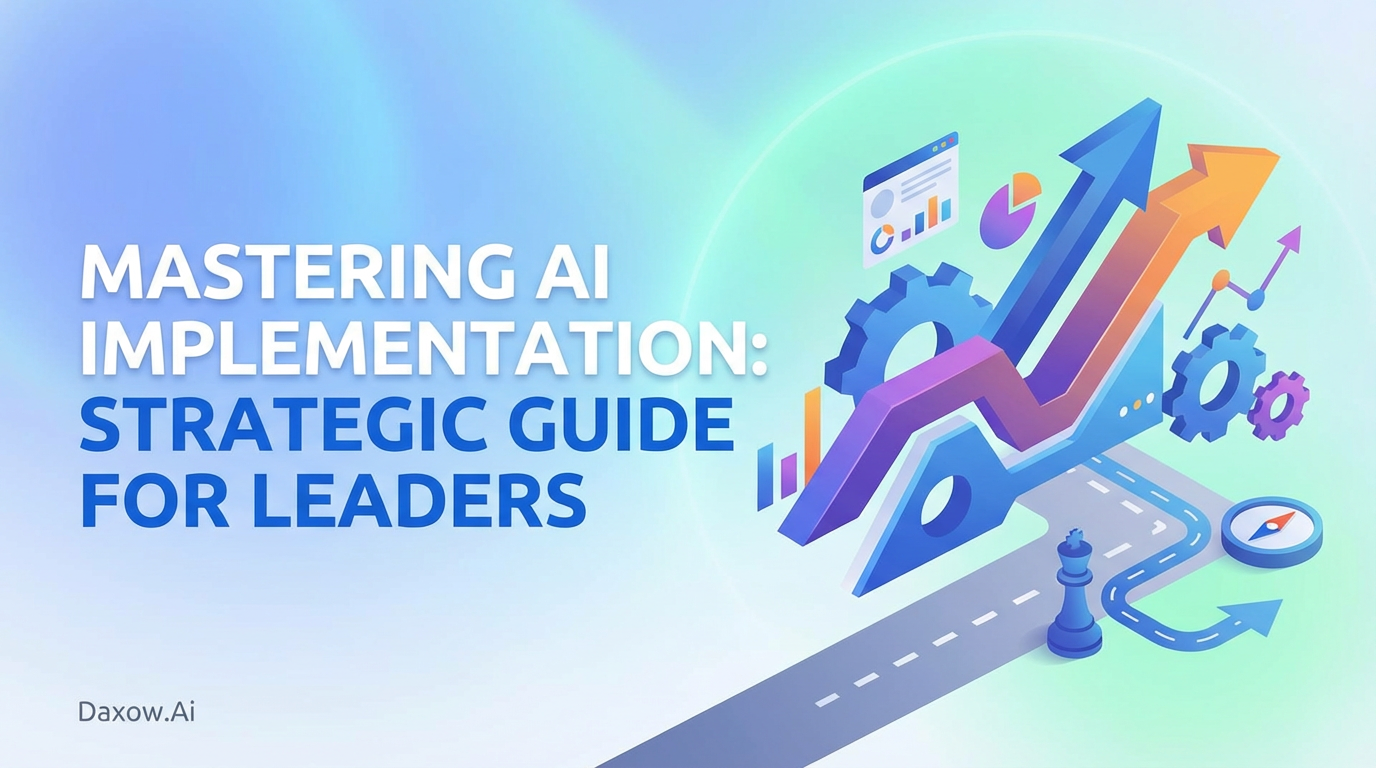
A practical roadmap for business leaders to deploy AI agents and workflow automation, cut costs, boost productivity, and achieve measurable ROI.
Mastering AI Implementation: A Strategic Guide for Business Leaders
Estimated reading time: 15 minutes
Key Takeaways
- AI implementation requires a strategic, phased approach aligned with business goals.
- Automation boosts productivity, reduces operational costs, and improves customer satisfaction.
- Daxow.ai offers custom AI agents and workflow automation across multiple industries.
- Measuring ROI and monitoring model performance ensures sustained AI value.
- Best practices include prioritizing data readiness, compliance, and effective change management.
Table of Contents
- Mastering AI Implementation: A Strategic Guide for Business Leaders
- Why AI Implementation Matters for Business Outcomes
- A Phased Roadmap to Implement AI Successfully
- Practical Use Cases Across Industries
- How AI Agents and Workflow Automation Drive Continuous Value
- Measuring ROI and Operational Value
- Best Practices and Common Pitfalls
- Quick Implementation Checklist for Decision-Makers
- How Daxow.ai Accelerates Your AI Journey
- Frequently Asked Questions
Mastering AI Implementation: A Strategic Guide for Business Leaders
What does successful AI implementation look like? It is not a single pilot or a one-off model. It is a structured transformation that aligns technology with business objectives, prioritizes data quality, builds compliance and governance into the design, and scales automation where it delivers the greatest return. High-performing organizations that adopt this approach move 3–5x faster toward outcomes, achieve 30–50% reductions in operational costs in targeted areas, and realize significant improvements in customer satisfaction and accuracy.
This section outlines the strategic framework for leaders who want to adopt AI in a controlled, measurable way.
Why AI Implementation Matters for Business Outcomes
From manual work to strategic advantage
- Reduce manual tasks: Automate routine data entry, ticket triage, and reconciliation to free teams for higher-value work.
- Increase productivity: AI-driven workflows enable teams to handle more volume without proportional staffing increases.
- Improve customer experience: Customer support automation reduces response times and raises first-contact resolution.
- Enable data-driven decisions: Predictive models and analytics unlock insights that drive revenue and reduce risk.
Business impact you can expect
- Operational efficiency: Typical efficiency gains range from 20–50% for automated workflows.
- Cost reduction: Organizations see 30–50% reductions in operational costs on routine tasks when automation is applied strategically.
- Faster time-to-value: Pilot projects often pay back investment within 3–6 months when scoped to high-frequency processes.
A Phased Roadmap to Implement AI Successfully
A repeatable, phased approach minimizes disruption and aligns implementation with measurable KPIs. Below is a practical timeline and what to focus on at each stage.
Phase 1 — Assessment & Planning (4–8 weeks)
- Objectives: Define clear business goals (for example, reduce ticket handling cost by 30% or cut onboarding time by 50%).
- Activities: Conduct a process audit, identify high-volume, repetitive tasks, and perform a data quality assessment.
- Deliverables: Prioritized use-case list, baseline metrics, and a business case.
- How Daxow helps: We run targeted process diagnostics to identify automation candidates and quantify potential ROI using real operational data.
Phase 2 — Technology Selection & Vendor Evaluation (6–12 weeks)
- Objectives: Choose the right models and platforms—NLP for customer support, supervised models for forecasting, or rule-based automation for predictable tasks.
- Activities: Evaluate vendor capabilities for integration, compliance, scalability, and support. Define architecture and data flow maps.
- Deliverables: Selected stack, integration plan, and compliance checklist (HIPAA, financial standards as applicable).
- How Daxow helps: We architect custom AI solutions and evaluate third-party tools against your systems (CRM, ERP, ticketing, document management) to ensure seamless connectivity.
Phase 3 — Preparation & Build (4–8 weeks)
- Objectives: Prepare data, knowledge bases, and teams.
- Activities: Clean and label data, build or enrich knowledge bases, design process automations and human handoffs, and set up monitoring and audit trails.
- Deliverables: Train/test datasets, prototype models, and integration proofs-of-concept.
- How Daxow helps: Our engineers handle data engineering, build secure integrations, and create explainable AI agents tailored to your workflows.
Phase 4 — Pilot Deployment & Gradual Rollout (4–20 weeks)
- Objectives: Validate the approach in production, then scale.
- Activities: Deploy pilot for a single use case or customer segment. Monitor KPI performance (automation rate, cost per resolution, CSAT). Iterate and expand scope.
- Deliverables: Pilot results, refined models, expanded rollout plan, training materials for staff.
- How Daxow helps: We run pilots end-to-end—monitoring performance, training staff, and implementing continuous improvement loops to maintain model accuracy and ROI.
Practical Use Cases Across Industries
E-commerce — Customer support automation & inventory forecasting
- What to automate: Ticket triage, returns and refund processing, personalized product recommendations, and demand forecasting.
- Impact: Handle 70–80% of routine customer inquiries via AI agents, cut response times from hours to seconds, and reduce stockouts through better forecasts.
- Daxow approach: We integrate AI agents with e-commerce platforms and CRMs to automate conversations, trigger returns workflows, and surface recommendations in checkout flows.
Healthcare — Scheduling, triage, and compliant record handling
- What to automate: Appointment scheduling, symptom triage via chatbots, prior authorization document extraction.
- Impact: Reduce wait times by up to 40% while maintaining audit trails and HIPAA-compliant data handling.
- Daxow approach: We design HIPAA-compliant AI agents and automated document workflows that log every action and support clinician oversight for escalations.
Finance — Invoice reconciliation and fraud detection
- What to automate: Invoice capture and reconciliation, payment exception handling, real-time fraud alerts.
- Impact: Improve forecast accuracy, reduce errors in high-stakes transactions, and accelerate month-end close.
- Daxow approach: We build pipelines that extract and validate financial documents, reconcile with ledgers, and integrate predictive models for anomaly detection.
Real Estate — Lead qualification & property automation
- What to automate: Lead triage, property data extraction, virtual tour generation, and CRM enrichment.
- Impact: Qualify buyers faster and prioritize high-value prospects, reducing time-to-contract.
- Daxow approach: We deploy AI agents that parse leads from multiple channels, enrich CRM records, and trigger nurturing campaigns aligned with agent capacity.
HR — Resume screening & onboarding automation
- What to automate: Resume parsing, candidate matching, interview scheduling, and onboarding document processing.
- Impact: Reduce hiring time by up to 50% and improve candidate experience.
- Daxow approach: We implement bias-aware NLP models, automated interview scheduling integrations, and onboarding workflows that ensure consistent new-hire experiences.
Manufacturing & Operations — Predictive maintenance
- What to automate: Sensor data monitoring, anomaly detection, and maintenance ticket creation.
- Impact: Reduce downtime with predictive alerts and schedule maintenance before failures occur.
- Daxow approach: We connect edge data, build anomaly-detection models, and automate work-order creation in CMMS systems.
How AI Agents and Workflow Automation Drive Continuous Value
Autonomous agents that act, escalate, and learn
- AI agents are designed to perceive inputs, reason about intent, and take actions—like creating tickets, updating records, or sending follow-up messages.
- They deliver 24/7 reliability across chat, email, and apps and are configured to escalate complex issues to humans using clear decision rules.
Predictive insights & adaptive workflows
- Use automated models for demand forecasting, risk scoring, and lead prioritization.
- Build seamless handoffs where the agent solves routine cases and routes exceptions to a human agent with context and suggested actions.
- Daxow implements monitoring that tracks model drift and triggers retraining or rule updates automatically, maintaining high accuracy and low false-positive rates.
System integrations and data connectivity
- Effective business automation requires deep integration with CRMs, ticketing systems, ERPs, and document stores.
- Daxow.ai specializes in connecting disparate systems, ensuring data flows securely and automations execute reliably across the stack.
Measuring ROI and Operational Value
Key metrics to track
- Automation rate: Percentage of tasks fully handled by AI without human intervention.
- Cost per resolution: Total cost divided by number of completed workflows.
- Time-to-resolution: Average time from request to completion.
- Customer satisfaction (CSAT/NPS): Measure changes in customer perception.
- Model performance: Precision, recall, and drift indicators.
Expected financial outcomes
- Efficiency gains of 20–50% for automated processes.
- Routine task cost reductions of 30–70% depending on labor intensity.
- Revenue uplift of 15–25% from improved lead qualification and customer experience.
- Rapid payback: Many pilot projects recover investment in 3–6 months when scoped to high-volume processes.
Best Practices and Common Pitfalls
Best practices
- Start with the highest-impact, lowest-risk use cases: Ticket triage, data extraction, and lead qualification are proven starting points.
- Prioritize data readiness: Clean, labeled data and consistent knowledge bases are essential.
- Design for compliance and ethics: Embed regulatory controls and human oversight from day one.
- Adopt a maturity approach: Move from PoC to pilot to scaled rollout with clear gating criteria.
- Invest in change management: Train staff, communicate benefits, and create clear escalation pathways.
Pitfalls to avoid
- Ignoring integration complexity: Automation fails if systems are siloed or APIs are unreliable.
- Over-automating without human oversight: Some decisions require human judgment; ensure smooth handoffs.
- Scope creep: Tie every feature to a measurable KPI to avoid unbounded projects.
- Poor governance: Lack of monitoring leads to model drift and compliance exposure.
Quick Implementation Checklist for Decision-Makers
- Define three measurable goals for AI automation (efficiency, cost, CX).
- Identify top 3 high-volume workflows to automate.
- Audit data sources and prioritize data cleanup tasks.
- Select pilot use case with clear KPIs and timeline (3–6 months).
- Plan integrations with CRM, ticketing, and document systems.
- Establish governance: compliance, monitoring, retraining thresholds.
- Budget for change management and staff training.
- Prepare for scaling once KPIs are met.
How Daxow.ai Accelerates Your AI Journey
Daxow.ai brings end-to-end expertise to implement AI automation, build AI agents, and integrate systems so your teams can focus on strategy rather than routine work. Our offerings include:
- Process analysis and ROI estimation: We measure automation potential and prioritize use cases.
- Custom AI agent development: Agents that handle chat, email, document workflows, and CRM actions.
- Workflow automation and integrations: Seamless connections to your business tools for reliable execution.
- Compliance and governance: Built-in audit trails, access controls, and regulatory alignment.
- Continuous improvement: Monitoring, retraining, and operational support that ensure sustained performance.
We partner with businesses across technology, e-commerce, finance, healthcare, real estate, and manufacturing to reduce operational costs, increase throughput, and improve customer and employee experience.
Learn more about our solutions and company approach to accelerate AI adoption in your organization.
Frequently Asked Questions
What are the first steps for AI implementation in a business?
Begin with a thorough assessment and planning phase to identify high-volume, repetitive tasks and align AI goals with business objectives.
How does Daxow.ai ensure compliance in AI deployments?
Daxow.ai integrates compliance and governance processes from the outset, including audit trails, regulatory checklists, and human oversight controls to meet standards such as HIPAA and financial regulations.
What types of AI agents can Daxow.ai build?
We develop AI agents capable of chat and email automation, document processing, CRM integration, predictive analytics, and adaptive workflows designed for your unique business needs.
What kind of ROI can businesses expect from AI automation?
Businesses often see efficiency gains of 20–50%, task cost reductions between 30–70%, and revenue uplifts up to 25%, with many pilots recovering investment within 3–6 months.