
Mastering AI Implementation: Strategic Guide for Leaders
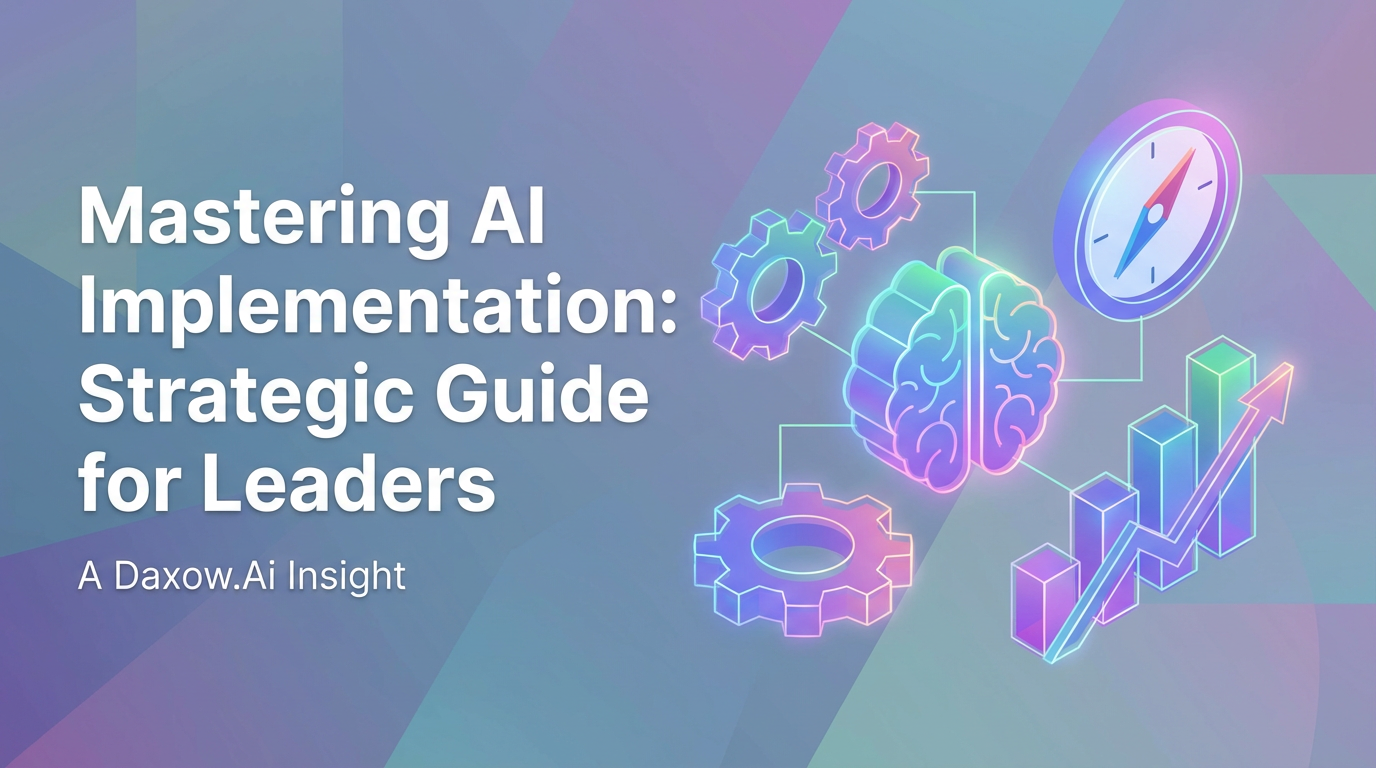
Practical guide for business leaders to implement AI agents and workflow automation, align tech to KPIs, and achieve measurable ROI with phased roadmaps.
Mastering AI Implementation: A Strategic Guide for Business Leaders
Estimated reading time: 15 minutes
Key Takeaways
- AI implementation transforms workflows to reduce manual tasks, boost productivity, and improve outcomes.
- Structured, phased approaches accelerate business impact and minimize risks.
- AI agents combined with workflow automation create end-to-end, scalable solutions.
- Daxow.ai delivers custom AI systems integrated with existing enterprise platforms.
- Governance, ethics, and compliance are crucial for sustainable AI adoption.
Table of Contents
- Mastering AI Implementation: A Strategic Guide for Business Leaders
- The Business Value of AI Implementation
- Practical Use Cases Across Industries
- How AI Agents and Workflow Automation Drive Results
- A Phased Roadmap to Implement AI
- Best Practices and Common Pitfalls
- Measuring ROI and Business Impact
- How Daxow.ai Helps You Master AI Implementation
- Governance, Ethics, and Risk Management
- Getting Started — Practical Checklist
- Frequently Asked Questions
Mastering AI Implementation: A Strategic Guide for Business Leaders
AI implementation involves systematically embedding machine learning, natural language processing, and automation into operations to solve inefficiencies and scale high-value processes. Done well, it creates operational resilience, enables customer-centric innovation, and drives cost optimization. Organizations that follow structured approaches deliver results 3–5x faster and realize quick wins by automating high-volume, low-complexity workflows.
This section summarizes what stakeholders must consider before, during, and after deployment, and how to align technical choices with business outcomes.
The Business Value of AI Implementation
Key benefits
- Cost reduction: Automating routine tasks can cut operational expenses by up to 50% in targeted areas.
- Productivity gains: Project throughput and task completion rates can improve 3–5x when repetitive manual work is removed.
- Customer impact: Customer support automation reduces response times and improves satisfaction, with many businesses handling the majority of routine queries via chatbots.
- Scalability: AI systems operate 24/7, enabling businesses to handle peak loads without proportional headcount increases.
Common business goals to target
- Reduce time-to-resolution for support tickets by X%.
- Cut processing costs for invoices and compliance checks by Y%.
- Improve lead-to-opportunity conversion through sales automation.
Practical Use Cases Across Industries
E-commerce
- Use case: AI-powered chatbots for order inquiries and returns.
- Impact: Customer support automation handles routine questions, reduces response times, and frees agents for complex escalations.
- ROI example: Handling 60–80% of standard queries through bots can reduce support costs by up to 40% and increase conversion via personalized recommendations.
- Daxow offer: We build integrated chatbots that connect to your inventory, CRM, and order systems to provide real-time answers and upsell suggestions.
Healthcare
- Use case: Automated appointment scheduling and symptom triage using NLP.
- Impact: Reduces administrative burden, decreases no-shows, and speeds triage for urgent cases.
- Compliance focus: Systems are configured for HIPAA-ready workflows and secure data handling.
- Daxow offer: We design compliant AI pipelines that integrate EHRs and telehealth platforms to automate administrative workflows while preserving patient privacy.
Finance
- Use case: Real-time fraud detection and automated compliance checks.
- Impact: Minimize financial loss and reduce manual review time for suspicious transactions.
- Daxow offer: We deploy hybrid rule-based and ML models integrated with transaction systems to automate screening and escalation, maintaining audit trails for regulators.
Real Estate
- Use case: Lead qualification bots and predictive pricing models.
- Impact: Accelerate sales cycles by automatically qualifying leads and recommending price adjustments based on market signals.
- Daxow offer: We build AI agents that connect listings, CRM data, and external market feeds to automate lead routing and pricing recommendations.
HR and Admin
- Use case: Resume screening, candidate shortlisting, and onboarding automation.
- Impact: Cut time-to-hire by up to 50% and improve candidate experience through automated communications.
- Daxow offer: We implement bias-aware screening workflows that integrate with ATS systems and automate onboarding task lists.
How AI Agents and Workflow Automation Drive Results
What AI agents can do
- Ingest and extract data from documents.
- Make decisions based on rules and model outputs.
- Execute actions in CRMs, ERPs, ticketing systems, and communication channels.
- Escalate to humans when confidence thresholds are low.
Benefits of combining AI agents with workflow automation
- End-to-end execution: Agents manage tasks from data ingestion to final action, replacing manual handoffs.
- Reduced manual tasks: Routine approvals, data entry, and routing are automated, freeing staff for high-value work.
- Improved accuracy: Machine-assisted validation reduces human error in repetitive processing.
- 24/7 operations: Agents handle after-hours workloads and spikes without added staffing.
Example: Invoice processing flow
- Step 1: AI agent extracts data from invoices using OCR and NLP.
- Step 2: Workflow automation validates vendor and purchase order data against ERP.
- Step 3: Automatic approvals route to finance; exceptions are flagged for human review.
- Business outcome: Faster cycle times, fewer errors, and reduced invoice processing costs.
A Phased Roadmap to Implement AI
Phase 1 — Assessment and Planning (4–8 weeks)
- Define measurable objectives (e.g., reduce support costs by 20%).
- Audit data sources, availability, and quality.
- Prioritize high-volume, low-complexity use cases.
- Deliverable: A prioritized roadmap and success metrics.
Phase 2 — Technology and Vendor Selection (6–12 weeks)
- Evaluate tool compatibility with CRM, ERP, and data stores.
- Consider scalability and compliance needs (GDPR, HIPAA).
- Choose vendors that enable integrations and provide support.
- Deliverable: Technology stack and integration plan.
Phase 3 — Preparation and Build (4–8 weeks)
- Assemble a cross-functional team: IT, business owners, compliance, and change management.
- Clean and structure data, build or enrich knowledge bases.
- Prototype connectors and data pipelines.
- Deliverable: Working prototypes and documented workflows.
Phase 4 — Pilot and Deployment (4–20 weeks)
- Run limited pilots on selected user groups and channels.
- Measure KPIs (resolution rate, handling time, conversion).
- Iterate models and refine automation rules.
- Gradual expansion to new teams and geographies.
- Deliverable: Production-ready systems and rollout plan.
Phase 5 — Monitoring and Optimization (Ongoing)
- Retrain models using fresh data.
- Monitor for bias and drift; apply governance controls.
- Collect user feedback and continuously improve processes.
- Deliverable: Continuous improvement program and governance dashboard.
Best Practices and Common Pitfalls
Best practices
- Start small: Focus on a single, high-impact workflow.
- Ensure data readiness: Invest in data cleaning and mapping before modeling.
- Apply governance: Set policies for model use, monitoring, and explainability.
- Manage change: Prepare teams with training and clear communication plans.
- Measure early and often: Define KPIs and instrument systems to track performance.
Pitfalls to avoid
- Vague objectives that make outcomes unmeasurable.
- Ignoring integration complexity with legacy systems.
- Rushing full-scale rollouts without pilots.
- Neglecting ethical and compliance requirements, leading to operational risk.
Measuring ROI and Business Impact
Metrics to track
- Cost reduction per process (support cost per ticket, processing cost per invoice).
- Throughput and cycle time improvements.
- Error rate changes and exception volume.
- Customer satisfaction and NPS improvements.
- Time-to-hire reductions and retention metrics.
Typical timelines to ROI
- Quick wins (3–6 months): Support automation, lead qualification, invoice processing.
- Mid-term gains (6–12 months): Predictive analytics and deeper process automation.
- Long-term value (12+ months): Strategic transformation with broad AI-driven decisioning.
Research indicates businesses with disciplined pilots and data focus realize full ROI in 6–12 months and report 2–3x higher success rates.
How Daxow.ai Helps You Master AI Implementation
Discovery and process design
- We map your current workflows and identify automation candidates that will reduce manual tasks and increase productivity.
- Deliverable: A prioritized automation roadmap aligned to business KPIs.
Custom AI solution development
- We design and build AI agents, chatbots, and workflow automation tailored to your systems.
- Integrations cover CRMs, ERPs, support platforms, and document repositories.
- Result: Fully automated processes that execute real tasks and escalate intelligently.
Integration and data connectivity
- We implement secure connectors and data pipelines to ensure robust, compliant data flow across systems.
- Daxow configures logging, audit trails, and access controls for governance.
Deployment and scaling
- From pilot to enterprise-grade rollouts, we manage deployments, monitoring, and continuous improvement.
- We set up retraining schedules, performance dashboards, and governance processes to minimize model drift and bias.
Outcomes Daxow delivers
- Reduced operational costs through targeted automation.
- Improved productivity by removing repetitive manual work and enabling staff to focus on value-added tasks.
- Better customer experiences via faster, more accurate responses and personalized interactions.
- Measurable ROI using clear KPIs and phased scaling.
Governance, Ethics, and Risk Management
Governance essentials
- Define ownership for data, models, and decisions.
- Establish monitoring for performance, bias, and security.
- Maintain documentation for model development, objectives, and decision thresholds.
Compliance and privacy
- Map data flows and apply controls for GDPR, HIPAA, and industry-specific regulations.
- Use encryption, role-based access, and anonymization where required.
Getting Started — Practical Checklist
- Conduct a process audit to identify high-volume, repetitive tasks.
- Define clear KPIs tied to cost, time, and customer impact.
- Secure executive sponsorship and allocate cross-functional resources.
- Prepare a small pilot with realistic success metrics.
- Plan for integrations and data pipeline development.
Mastering AI implementation requires strategic planning, disciplined pilots, and a partner who can translate business needs into reliable, integrated systems. Daxow.ai combines domain expertise in AI agents, workflow automation, and system integrations to reduce manual tasks, increase productivity, and deliver measurable business automation outcomes.
Book a free consultation with Daxow.ai to request a process analysis for your company and begin building a custom AI system tailored to your goals. Contact us to start automating with purpose and achieve faster, sustainable ROI.
Frequently Asked Questions
What industries benefit most from AI implementation?
AI benefits a wide range of industries, including e-commerce, healthcare, finance, real estate, and HR. Each vertical can leverage AI to automate routine workflows, improve customer experiences, and increase operational efficiency.
How long does it take to see ROI from AI projects?
Typical timelines range from quick wins within 3–6 months for automation of simple tasks, to full ROI within 6–12 months when following disciplined pilots with adequate data preparation and governance.
What is the role of governance in AI?
Governance ensures AI systems remain auditable, fair, and secure by establishing ownership, monitoring for bias and performance, and maintaining documentation of models and decisions.
How does Daxow.ai integrate with existing systems?
Daxow.ai builds AI agents and automation workflows that seamlessly connect with CRMs, ERPs, support platforms, and other enterprise systems via secure data connectors and APIs, ensuring data flow and compliance across the technology stack.