
Mastering AI Workflow Automation for Business Transformation
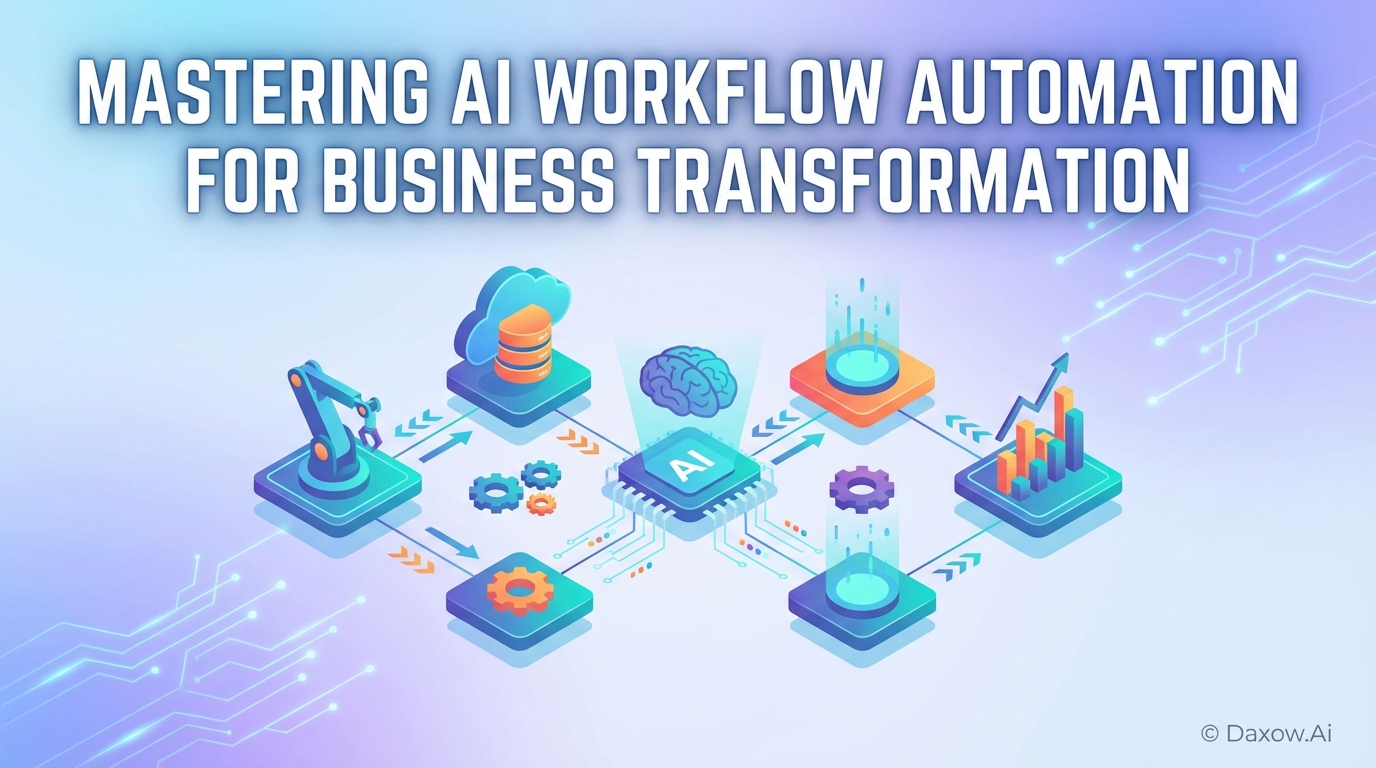
Practical roadmap to design, deploy, and scale AI workflow automation with use cases, implementation steps, ROI metrics, governance, and Daxow.ai services.
Mastering AI Workflow Automation: A Strategic Imperative for Business Transformation
Estimated reading time: 15 minutes
Key Takeaways
- AI workflow automation converts repetitive tasks into intelligent, adaptive systems that boost productivity and accuracy.
- Targeted automation can reduce costs by up to 40% and deliver 3-5x ROI within the first year.
- Practical use cases span e-commerce, healthcare, finance, real estate, and HR with measurable business impact.
- Effective automation relies on robust AI agents, modular integrations, and human-in-the-loop governance.
- Daxow.ai specializes in end-to-end custom AI system design, from process discovery to deployment and monitoring.
Table of Contents
- Mastering AI Workflow Automation: A Strategic Imperative for Business Transformation — Why It Matters
- Practical Use Cases: Where AI Automation Delivers Immediate Value
- How AI Agents and Automation Drive Results
- Implementation Steps and Best Practices
- Architecture and Integrations — Making Automation Work in Real Systems
- Measuring ROI and Business Value
- Change Management and Adoption
- Real-World Example: End-to-End Sales Automation (Practical Walkthrough)
- Frequently Asked Questions
Mastering AI Workflow Automation: A Strategic Imperative for Business Transformation — Why It Matters
AI workflow automation transforms static, manual procedures into intelligent, adaptive systems. Rather than being a one-off tool, automation becomes an engine for continuous improvement.
- Reduce manual tasks: Automate rule-based, repetitive work such as data entry, document processing, and ticket triage.
- Boost productivity: Reallocate 20–50% of employee time from low-value tasks to strategic activities.
- Improve accuracy and speed: Cut error rates substantially in processes like invoice matching and lead qualification.
- Scale without linear headcount growth: Handle volume spikes and 24/7 operations with agentic systems.
- Generate strategic insights: Real-time analytics uncover bottlenecks and opportunities for revenue improvement.
Research shows targeted workflow automation can reduce costs by up to 40% in specific areas and deliver 3–5x ROI within the first year for mid-sized companies that adopt a disciplined approach. The business case is clear: prioritize high-ROI processes and iterate.
Practical Use Cases: Where AI Automation Delivers Immediate Value
E-commerce — Faster Fulfillment and Fewer Stockouts
Use case: Automate order processing, invoice reconciliation, and returns handling with AI agents that read order receipts, update inventory, and create shipment labels.
Impact: Reduced fulfillment time by 30%, fewer stockouts due to automated inventory forecasting, and lower manual reconciliation errors.
How Daxow helps: Build AI agents that integrate with your ERP and CRM, extract order data, reconcile invoices, and post exceptions to a human review queue.
Healthcare — Streamlined Scheduling and Better Administrative Efficiency
Use case: Intelligent triage chatbots handle appointment requests, pre-visit intake forms are auto-extracted, and scheduling conflicts are resolved automatically.
Impact: Lower administrative burden, faster patient response times, and more clinician time for care delivery.
How Daxow helps: Deploy secure, HIPAA-aware automation that connects clinical systems, extracts patient data from documents, and ensures audit trails for compliance.
Finance — Real-Time Fraud Detection and Faster Approvals
Use case: Automate transaction monitoring, AML checks, and loan application scoring using predictive models and rule-based agents.
Impact: Lower error rates and faster decisioning, improved regulatory compliance, and reduced manual investigation workloads.
How Daxow helps: Implement model orchestration and API-based actions to flag suspicious activity, initiate holds, and route cases to investigators with enriched context.
Real Estate — Lead Qualification and Contract Automation
Use case: AI agents qualify inbound leads, estimate property valuations, generate draft contracts, and schedule viewings.
Impact: Shortened sales cycles, higher lead-to-conversion rates, and reduced administrative overhead for brokers.
How Daxow helps: Create agent workflows that pull market data, score leads using custom models, and integrate with calendar and CRM systems to automate follow-ups.
HR — Faster Hiring and Better Onboarding
Use case: Resume screening, interview scheduling, and onboarding checklist automation, plus predictive analytics on turnover risk.
Impact: Faster hiring cycles, higher onboarding accuracy, and actionable retention insights.
How Daxow helps: Deliver end-to-end HR automation that integrates ATS, payroll, and learning platforms, while enforcing privacy controls and consent management.
How AI Agents and Automation Drive Results
AI agents are autonomous software entities that ingest data, apply models, execute actions through APIs, and learn from outcomes. In practice, they orchestrate multi-step workflows across tools and systems.
Core capabilities:
- Data extraction and normalization (OCR, NLP)
- Decision-making models (classification, ranking, anomaly detection)
- Action execution (API calls, ticket creation, emails)
- Human-in-the-loop routing for exceptions
- Continuous learning and retraining to prevent model drift
Key business outcomes:
- Efficiency gains: Automate rule-based tasks and free 20–50% of employee time.
- Accuracy and speed: Reduce manual errors in processes such as sales automation and invoice matching.
- Scalability: Support 24/7 operations and volume surges without proportional hiring.
- Insights: Use analytics to refine processes and improve customer outcomes.
How Daxow helps: We design agentic systems that orchestrate across CRMs, ERPs, support platforms, and proprietary systems. Our approach avoids heavy custom code where possible, using APIs and modular components for faster deployment and easier maintenance.
Implementation Steps and Best Practices
Successful AI workflow automation follows a disciplined, phased approach. Below is an 8-step framework that Daxow applies with clients to move from pilot to scale.
1. Define Clear Goals
- Identify measurable outcomes (e.g., 25% faster response times, 15% cost reduction).
- Prioritize processes using an AI-first scorecard that considers ROI, complexity, and compliance risk.
2. Assess Data Quality
- Inventory data sources, evaluate completeness and accessibility.
- Create pipelines for data cleansing, normalization, and secure storage.
- Ensure privacy and regulatory compliance from the outset.
3. Select the Right Technology
- Match automation types to business needs: NLP for customer queries, ML for predictions, RPA for structured workflows.
- Favor modular, API-first architectures and low-code/no-code platforms for faster iteration.
4. Build a Cross-Functional Team
- Include data scientists, engineers, domain experts, operations and legal.
- Establish communication channels and training to support adoption.
5. Prototype and Test
- Start with a narrow, non-critical workflow to demonstrate value.
- Use validation datasets and track metrics (accuracy, recall, SLA improvements).
- Iterate based on user feedback.
6. Deploy with Monitoring and Observability
- Implement alerts for performance degradation and automated retraining triggers.
- Maintain versioning for models and rollback paths for rapid mitigation.
7. Ensure Governance and Ethics
- Embed security, compliance, and bias mitigation practices.
- Maintain audit logs and human oversight for high-risk decisions.
8. Scale and Optimize
- Expand successful pilots to adjacent workflows.
- Use KPIs and dashboards to measure continuous improvement.
Best practices summary:
- Prioritize high-ROI use cases first.
- Foster a culture of experimentation with quick wins.
- Monitor continuously for bias and performance drift.
How Daxow helps: We run process discovery workshops, build prototypes, and provide full lifecycle services — from data engineering and model development to deployment and ongoing monitoring. Our engagements include governance templates and change management plans so automation scales safely.
Architecture and Integrations — Making Automation Work in Real Systems
A practical automation architecture balances reliability, security, and maintainability.
Typical components:
- Data ingestion layer (APIs, connectors, document ingest)
- Processing layer (ETL, feature store, model runtime)
- Orchestration layer (workflow engine, AI agents)
- Integration layer (CRM, ERP, ticketing systems, calendars)
- Monitoring and observability (metrics, retraining pipelines)
- Security and compliance (encryption, access controls, audit trails)
Integration patterns:
- Event-driven triggers for near-real-time workflows.
- Batch processing for high-throughput tasks like reconciliation.
- Hybrid human-in-the-loop where critical decisions require review.
How Daxow helps: We map existing tool stacks, build connectors to CRMs/ERPs/support platforms, and implement resilient orchestration so AI agents execute tasks reliably and transparently. Explore more integration solutions on Daxow.ai Platform.
Measuring ROI and Business Value
Quantify automation impact with clear metrics tied to business outcomes.
Example metrics and typical impact:
- Cost reduction: 25–40% in targeted workflows (e.g., $500K annual savings on invoice processing).
- Efficiency: 30% faster cycle times (e.g., order fulfillment from days to hours).
- Revenue growth: 15–25% via personalization and better lead qualification.
- Error rates: Reduced 50–90% in tasks like onboarding or compliance checks.
How to calculate ROI:
- Baseline current process costs (FTEs, error remediation, cycle time).
- Model automation costs (build, run, integration, licenses).
- Project savings from headcount reallocation, error reduction, and revenue uplift.
- Include recurring benefits from continuous improvement and scale.
How Daxow helps: We create a tailored ROI model during the discovery phase and track KPIs post-deployment to prove value and guide expansion. Visit our solutions page to learn about our ROI frameworks.
Change Management and Adoption
Automation succeeds when people adopt it. Plan for user acceptance and continuous training.
Key actions:
- Communicate benefits clearly to teams and stakeholders.
- Provide training and simple interfaces for humans to interact with agents.
- Set up feedback channels to refine workflows based on frontline experience.
How Daxow helps: Our engagements include user training, UI/UX design for human-agent handoffs, and governance playbooks to ensure lasting adoption.
Real-World Example: End-to-End Sales Automation (Practical Walkthrough)
Scenario: A sales organization wants to improve lead qualification and shorten sales cycles.
Automated workflow:
- Inbound lead arrives via web form or email.
- AI agent extracts and normalizes contact and company data.
- Predictive model scores lead based on intent signals and firmographics.
- High-scoring leads are pushed to CRM and routed to SDR with an automated meeting link.
- Low-scoring leads enter a nurture sequence with personalized content.
- All actions logged and metrics captured for continuous model retraining.
Business outcomes: Faster lead routing, improved SDR productivity, higher conversion rates, and measurable uplift in pipeline velocity.
How Daxow helps: We design and implement the full stack: extraction, scoring models, CRM integrations, and monitoring dashboards. We also iterate on the scoring logic based on conversion feedback to continuously improve results.
Frequently Asked Questions
What types of tasks are best suited for AI workflow automation?
Tasks that are rule-based, repetitive, and data-intensive such as document processing, data entry, transaction monitoring, and lead qualification are ideal candidates. Automation enables these tasks to be executed faster, with higher accuracy, and at scale.
How can businesses ensure trust and governance in automated workflows?
Implementing human-in-the-loop processes for exceptions, maintaining audit trails, embedding compliance controls, and continuously monitoring for bias and model drift are key practices that promote trust and governance.
What is the typical ROI timeline for AI workflow automation?
Mid-sized companies adopting disciplined AI workflow automation can expect a 3–5x ROI within the first year, particularly by focusing on high-impact processes that reduce costs and improve productivity.
How does Daxow.ai support the implementation journey?
Daxow.ai provides end-to-end services that include process discovery, prototype development, system design, integration, deployment, monitoring, user training, and governance. This holistic approach ensures automation is scalable, secure, and delivers measurable business value.