
Mastering AI Workflow Automation: Roadmap, Use Cases & ROI
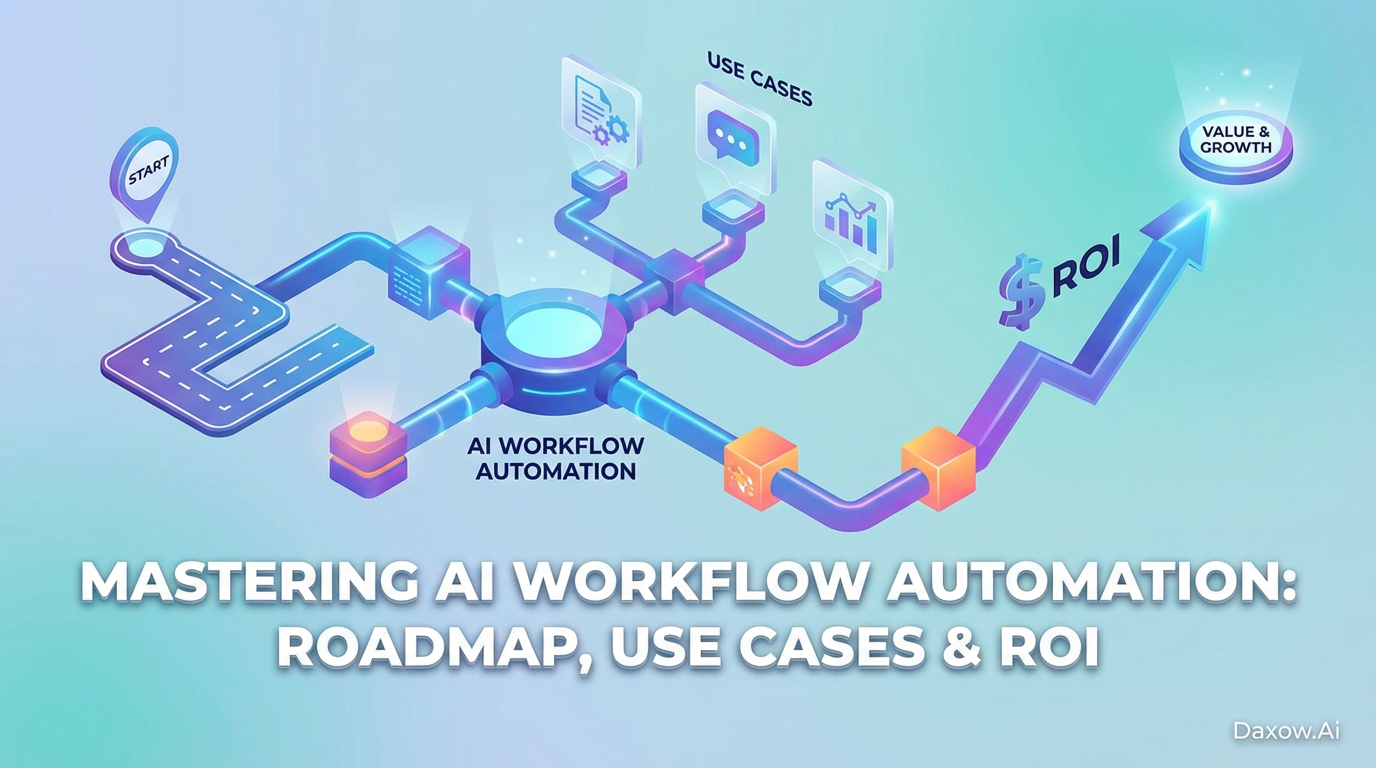
A pragmatic guide to AI workflow automation: phased roadmap, cross-industry use cases, governance, and how Daxow.ai builds AI agents to cut costs and boost ROI.
Mastering AI Workflow Automation: Transforming Business Operations for the AI Era
Estimated reading time: 12 minutes
Key Takeaways
- AI workflow automation dramatically improves operational efficiency and decision-making across industries.
- Disciplined implementation delivers 3–5x ROI within 12–18 months by reducing manual tasks and costs.
- Daxow.ai provides tailored AI agents and end-to-end automation systems integrated with enterprise platforms.
- Governance and clear KPIs are essential to avoid complexity and ensure scalable, sustainable automation.
- Phased deployment from audit to continuous improvement enables practical, measurable business impact.
Table of Contents
- Mastering AI Workflow Automation: Transforming Business Operations for the AI Era
- Why AI Workflow Automation Matters for Your Business
- Practical Use Cases: How AI Workflow Automation Delivers Industry Value
- How AI Agents and Automation Work Together
- Implementation Roadmap: From Audit to Continuous Improvement
- Best Practices and Common Challenges (and How to Fix Them)
- Measuring ROI and Business Impact
- Concrete Project Examples: What Daxow.ai Builds
- How Daxow.ai Delivers Value
- Getting Started: A Practical First Step
- Frequently Asked Questions
Mastering AI Workflow Automation: Transforming Business Operations for the AI Era
AI workflow automation integrates artificial intelligence into routine business processes to automate repetitive tasks, enhance decision-making, and enable scalable, intelligent operations. For business leaders, the benefits are tangible: faster cycle times, fewer errors, improved customer experience, and the ability to redeploy human talent to high-value work. Early adopters report 30–50% reductions in processing time and cost savings on automated tasks of 20–50%, with disciplined programs often achieving 3–5x ROI within 12–18 months.
Below we present a structured analysis and actionable guidance you can apply in your company today.
Why AI Workflow Automation Matters for Your Business
Business value and measurable outcomes
- Operational efficiency: Automate high-volume, repetitive tasks such as data entry, invoice reconciliation, and ticket routing to cut processing time and error rates.
- Faster customer response: Customer support automation and intelligent routing reduce first-response time and increase customer satisfaction.
- Better decisions: AI agents generate real-time insights and proactive alerts that enable faster, more accurate decisions.
- Scalable processes: Automations scale with demand without proportional headcount growth, improving margins and enabling growth.
Risks and governance to avoid “agentic sprawl”
- Unchecked automation can multiply complexity and increase costs rather than reduce them.
- Governance, monitoring, and clear KPIs are essential to ensure automation aligns with strategic objectives and delivers predictable ROI.
Practical Use Cases: How AI Workflow Automation Delivers Industry Value
E-commerce
- Use case: Automate order-to-cash workflows — inventory forecasting, order validation, fraud detection, returns processing, and dynamic pricing.
- Business outcome: Reduced order processing time, lower cart abandonment, higher conversion rates.
- How Daxow.ai helps: We build AI agents that integrate with your e-commerce platform and ERP to automate order validation, perform real-time fraud scoring, and trigger fulfillment workflows — reducing manual exceptions and improving throughput.
Healthcare
- Use case: Patient scheduling, symptom triage, and administrative reconciliation (billing and claims).
- Business outcome: Shorter wait times, fewer administrative errors, improved compliance.
- How Daxow.ai helps: We deploy secure, privacy-first AI workflows that extract and normalize clinical and billing data, triage patient requests via conversational agents, and automate claim reconciliation while maintaining audit trails.
Finance and Accounting
- Use case: Invoice processing, compliance checks, risk scoring, and account reconciliation.
- Business outcome: Faster month-end close, fewer compliance fines, improved fraud detection.
- How Daxow.ai helps: Our solutions combine document automation, OCR, and predictive models to automatically route invoices, reconcile accounts, and flag anomalies for human review — cutting manual processing by up to 50%.
Real Estate
- Use case: Lead qualification, property listing automation, image recognition for virtual tours, and contract generation.
- Business outcome: Faster time-to-offer, higher lead conversion, and streamlined transaction cycles.
- How Daxow.ai helps: We create AI-driven lead qualification engines and automated document generation systems integrated with CRMs to move leads efficiently through the funnel.
HR and Talent
- Use case: Resume screening, interview scheduling, onboarding automation, and employee sentiment analysis.
- Business outcome: Reduced hiring time, better candidate fit, and lower turnover risk.
- How Daxow.ai helps: We implement applicant screening models backed by structured workflows that schedule interviews, automate background checks, and personalize onboarding, improving HR productivity and retention.
How AI Agents and Automation Work Together
What AI agents do
- Autonomous task execution: AI agents perform routine decision-making tasks using machine learning and natural language processing.
- Adaptation: They learn from data and feedback, improving accuracy over time.
- Integration: Agents connect to enterprise systems (CRMs, ERPs, ticketing systems) to execute end-to-end workflows.
Complementary automation
- Rule-based automation handles deterministic steps (e.g., routing invoices).
- AI agents handle ambiguous, data-driven processes (e.g., classifying support tickets, predicting churn).
- Combined, they enable hyper-personalization and proactive decision-making across sales, support, finance, and operations.
Implementation Roadmap: From Audit to Continuous Improvement
Phase 1 — Align and Audit
- Identify high-impact workflows with an operational audit.
- Define KPIs (e.g., reduce invoice processing time by 40%; improve support first-response time by 60%).
- Map data sources and ownership.
Deliverable: Prioritized automation roadmap with estimated ROI.
Phase 2 — Data Readiness
- Audit data quality and accessibility.
- Build data pipelines and standardize formats.
- Put compliance and security controls in place.
Deliverable: Clean, connected datasets ready for modelling and automation.
Phase 3 — Prototype and Validate
- Build small pilots using low-code/no-code tools and lightweight AI agents.
- Validate models with real-world data and track metrics (precision, recall, time savings).
- Run A/B tests against manual processes.
Deliverable: Production-ready prototype with performance benchmarks.
Phase 4 — Integrate and Roll Out
- Integrate with internal systems (CRMs, ERPs, ticketing).
- Implement phased rollouts and shadow-mode deployments to compare performance.
- Train staff and define escalation paths.
Deliverable: Live automation with governance, monitoring dashboards, and user training.
Phase 5 — Monitor and Iterate
- Set up continuous monitoring and retraining pipelines.
- Implement alerting for drift, bias, and performance degradation.
- Iterate based on stakeholder feedback and business changes.
Deliverable: Sustainable automation with continuous improvement cycles.
Best Practices and Common Challenges (and How to Fix Them)
- Prioritize rule-based, high-volume tasks first: These deliver quick wins and build stakeholder confidence.
- Cross-functional teams: Combine domain experts, data scientists, engineers, and compliance leads to avoid blind spots.
- Governance and KPIs: Define success metrics up-front to avoid agentic sprawl.
- Data quality: Early audits and automated cleaning pipelines prevent poor outcomes.
- Integration strategy: Use phased approaches and existing system connectors to reduce implementation friction.
- Skill gaps: Provide targeted training and operate with blended teams to accelerate adoption.
- Ethics and compliance: Incorporate bias testing, explainability, and privacy-by-design into every stage.
Measuring ROI and Business Impact
To justify and optimize investment, focus on quantifiable metrics:
- Time savings: Measure reductions in cycle time and manual hours.
- Error rates: Track decline in exceptions and rework.
- Cost reduction: Calculate labor and operational cost savings from automation.
- Customer metrics: Monitor NPS, first-response time, and resolution time.
- Revenue impact: Attribute increases in conversion, retention, or upsell to automation where possible.
Example KPI targets:
- Reduce manual processing time by 40%.
- Decrease invoice exceptions by 60%.
- Cut first-response time for customer support in half.
- Achieve 3–5x ROI within 12–18 months for prioritized use cases.
Concrete Project Examples: What Daxow.ai Builds
- AI agents that autonomously qualify leads by integrating CRM data, website behavior, and email signals, then trigger tailored nurturing campaigns — improving sales automation and conversion rates.
- Document automation systems that extract data from invoices and contracts, reconcile with ERP entries, and automatically post transactions — drastically reducing month-end close time.
- Customer support automation setups that classify tickets, route priority issues to human agents, and provide conversational self-service for common queries — increasing customer satisfaction while lowering support costs.
- End-to-end automation for healthcare providers that schedules patients, pre-fills forms, and manages billing workflows while enforcing data privacy and auditability.
In every project, Daxow.ai focuses on measurable outcomes, robust integrations, and long-term maintainability. Discover more about our tailored solutions on our solutions and services pages.
How Daxow.ai Delivers Value
- Custom AI solutions: We design systems tailored to your workflows, not one-size-fits-all products.
- End-to-end process automation: From discovery and data engineering to model deployment and system integration.
- System integrations and data connectivity: We connect AI agents to your CRM, ERP, ticketing, and analytics stacks for seamless execution.
- Operational cost reduction: By automating manual work and improving accuracy, we deliver predictable cost savings and faster cycle times.
- ROI-focused delivery: Our implementations prioritize KPIs with clear measurement and iterative improvement.
- Security and compliance: Built-in controls to meet regulatory and privacy requirements across industries.
Getting Started: A Practical First Step
- Pick one high-volume, high-cost workflow.
- Conduct a 2-week audit to map tasks, measure current state metrics, and estimate automation potential.
- Prototype a minimal viable automation that handles the most repetitive steps.
This approach yields fast insights and de-risks larger rollouts.
Learn how to begin your AI automation journey with Daxow.ai by visiting our contact page.
Frequently Asked Questions
What industries benefit most from AI workflow automation?
AI workflow automation provides value across multiple industries including e-commerce, healthcare, finance, real estate, and HR by automating repetitive tasks and improving decision-making.
How quickly can businesses expect to see ROI from AI automation?
Disciplined AI workflow automation programs typically achieve 3–5x ROI within 12–18 months, depending on scope and organizational readiness.
What role does governance play in AI automation?
Governance is crucial to prevent uncontrolled complexity (“agentic sprawl”), ensuring that automation aligns with business goals, follows compliance standards, and delivers measurable results.
How does Daxow.ai customize AI automation solutions?
Daxow.ai designs custom AI agents and automation workflows tailored to your company’s specific processes and integrates them with existing enterprise systems to maximize value and ROI.