
Mastering AI Workflow Automation: A Practical Business Guide
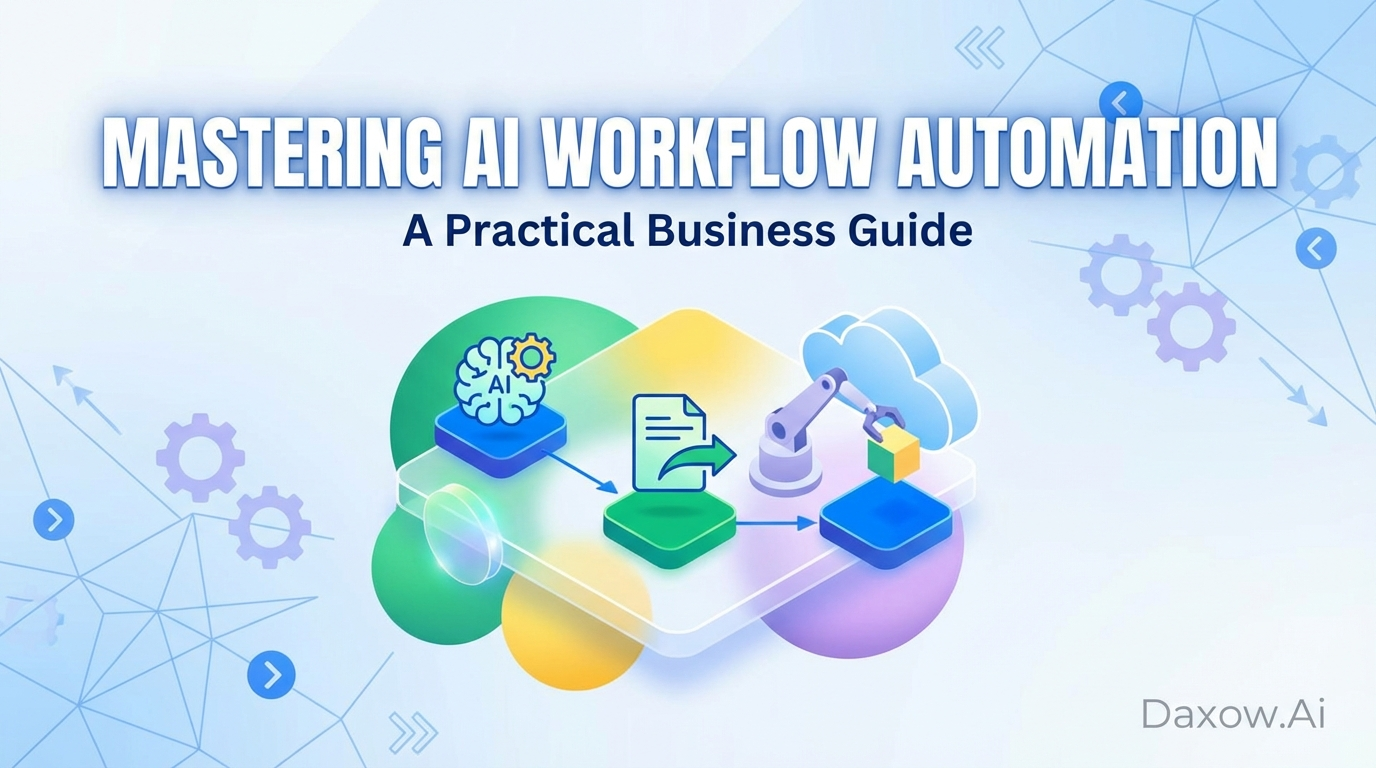
Practical guide to implementing AI workflow automation with use cases, ROI expectations, governance, and a step-by-step roadmap—plus how Daxow.ai scales pilots.
Mastering AI Workflow Automation: Transforming Business Operations for the AI Era
Estimated reading time: 15 minutes
Key Takeaways
- AI workflow automation reduces manual tasks and improves productivity across departments.
- Business drivers like customer expectations and competitive pressure make automation urgent.
- Industry use cases include e-commerce, healthcare, finance, real estate, and HR.
- AI agents and workflow automation enable adaptive, scalable business processes.
- Successful implementation follows a phased, data-driven roadmap with governance and monitoring.
- Daxow.ai delivers custom AI agent solutions with integration, governance, and measurable ROI.
Table of Contents
- Mastering AI Workflow Automation: Transforming Business Operations for the AI Era
- Why Now? Business Forces Making Automation Urgent
- Practical Use Cases: AI Automation Across Industries
- How AI Agents and Workflow Automation Work Together
- Implementation Roadmap — Practical Steps to Minimize Risk and Maximize Value
- How Daxow.ai Helps Enterprises Master AI Automation
- Measuring Success — KPIs and ROI
- Practical Roadmap: A Sample Project Plan (8–12 Weeks Pilot)
- Governance, Ethics, and Risk Management
- Getting Started with Daxow.ai — A Recommended First Move
- Frequently Asked Questions
Mastering AI Workflow Automation: Transforming Business Operations for the AI Era
What “AI workflow automation” means for your business
AI workflow automation integrates machine learning and automation to perform routine, repetitive tasks autonomously. Typical targets include data entry, invoice processing, ticket sorting, lead qualification, and document review. The result is faster processing, fewer errors, and more capacity for strategic work.
- Primary benefits: lower operational costs, faster decision-making, improved accuracy, and enhanced customer experience.
- Operational shift: from manually intensive processes to scalable, intelligent systems that can adapt over time.
- Key requirement: robust data management to ensure models are accurate and reliable.
Why Now? Business Forces Making Automation Urgent
Market and operational drivers
- Rising customer expectations for speed and personalization demand faster, more consistent responses.
- High-volume, repetitive work creates ongoing cost and error exposure that automation eliminates.
- Availability of proven AI models and integration platforms reduces the time and risk of deployment.
- Competitive pressure: early adopters gain measurable efficiency and revenue advantages.
Quantifiable outcomes you can expect
- Target improvements typically reported: 30–50% productivity gains in targeted workflows.
- Cost reductions for manual processing can reach ~40%, with pilot returns often realized in 6–12 months.
- Long-term outcomes include higher customer satisfaction, faster sales cycles, and workforce shifts toward higher-value tasks.
- Daxow clients commonly see 3–5x ROI when automation is designed for scale and governed ethically.
Practical Use Cases: AI Automation Across Industries
E-commerce — accelerate order-to-cash and personalization
Use case examples:
- Automate order validation, inventory updates, and shipment notifications to reduce fulfillment times.
- Use AI agents to process returns and detect fraudulent orders.
- Deploy personalized recommendation engines to increase average order value.
Business value:
- Fewer manual interventions, faster shipping, and improved conversion through personalization.
- Sales teams receive qualified leads from automated lead scoring.
Healthcare — streamline administration and triage
Use case examples:
- Automate patient scheduling and insurance pre-authorization.
- Triage incoming medical records and extract structured data from unstructured notes.
- Support preliminary diagnostics in imaging workflows using assisted detection models.
Business value:
- Reduced administrative burden on staff, faster patient throughput, and improved compliance with privacy controls.
Finance — secure, accurate transaction workflows
Use case examples:
- Automate invoice processing, account reconciliation, and fraud detection via supervised models.
- Use AI agents to flag anomalies and initiate follow-up workflows.
- Integrate predictive cash-flow models into treasury operations.
Business value:
- Lower error rates, faster month-end close, and reduced fraud exposure.
Real estate — speed deals and contract workflows
Use case examples:
- Automate property listing enrichment and lead nurturing.
- Use NLP to analyze contracts and extract key clauses for legal review.
- Automate scheduling and document handoffs for closing.
Business value:
- Faster deal cycles, fewer bottlenecks in document-heavy processes, and better lead-to-close ratios.
HR and recruitment — reduce time-to-hire
Use case examples:
- Automate resume screening and candidate shortlisting using trained models.
- Deploy chatbots to answer onboarding queries and guide new hires.
- Automate background checks and document verification.
Business value:
- Reduced time-to-hire, improved candidate experience, and freed HR capacity for strategic initiatives.
How AI Agents and Workflow Automation Work Together
What are AI agents?
AI agents are autonomous software entities that make decisions, execute tasks, and learn from interactions. They act on behalf of users or processes — routing tickets, initiating approvals, or orchestrating multi-step operations across systems.
Complementary roles
- Workflow automation orchestrates rule-based processes and handoffs.
- AI agents provide intelligence for ambiguous or data-driven decisions (e.g., classifying support tickets, clustering leads, predicting churn).
Together they enable continuous, adaptive automation that scales beyond fixed-rule bots.
Implementation Roadmap — Practical Steps to Minimize Risk and Maximize Value
Phase 1 — Define goals and select pilots
- Start with measurable outcomes: reduce manual processing time by X%, improve CSAT by Y points, or cut invoice errors by Z%.
- Prioritize high-volume, repeatable processes with clear metrics.
- Create an AI-first scorecard to rank candidate workflows.
Phase 2 — Data readiness and governance
- Audit data for completeness, accuracy, and accessibility.
- Standardize formats and build pipelines that preserve privacy and compliance.
- Establish governance rules for model ownership, auditing, and bias monitoring.
Phase 3 — Build cross-functional capability
- Assemble teams including domain experts, ML engineers, integration specialists, and process owners.
- Provide training for both technical and business participants.
- Involve IT and legal early to avoid integration and compliance bottlenecks.
Phase 4 — Technology selection and pilot deployment
- Choose models aligned to tasks (NLP for documents, supervised models for predictions).
- Integrate with existing systems via APIs or low-code platforms to avoid wholesale replacement.
- Run non-critical pilots, validate with real data, and iterate.
Phase 5 — Monitor, retrain, and scale
- Establish dashboards with precision, recall, throughput, and business KPIs.
- Retrain models based on drift and feedback loops.
- Phase rollouts to new departments after pilot success and governance sign-off.
Common pitfalls and how to avoid them
- Avoid vague objectives; tie outcomes to defined KPIs.
- Don’t ignore data quality — it is the foundation of reliable AI.
- Avoid tool proliferation; prefer integration with existing stacks.
- Implement monitoring from day one to detect drift and regressions.
How Daxow.ai Helps Enterprises Master AI Automation
End-to-end process automation design
Daxow.ai conducts a structured process audit to map current workflows, identify automation candidates, and design end-to-end solutions that combine workflow automation with AI agents. We prioritize high-impact workflows and deliver MVP pilots that demonstrate measurable outcomes.
Custom AI agents that execute real tasks
We build AI agents configured to interact with your systems, execute tasks, and trigger downstream workflows. Examples:
- Support agents that classify and route tickets, draft responses, and escalate complex cases.
- Sales agents that qualify leads, enrich records in your CRM, and schedule next steps.
- Finance agents that extract invoice data, reconcile accounts, and flag anomalies.
Systems integration and data connectivity
Daxow connects AI solutions to CRMs, ERPs, helpdesk platforms, and document repositories to ensure seamless data flow and operational reliability. Our integrations use secure APIs and follow enterprise-grade security and compliance standards.
Reduce operational costs and improve ROI
We focus on rapid, measurable returns. Our engagements include KPI definition, pilot implementation, and scaling plans that deliver 3–5x ROI, shorter cycle times, and sustained cost savings.
Governance, monitoring, and continuous improvement
Daxow implements monitoring dashboards, retraining pipelines, and governance frameworks so that models remain safe, compliant, and effective as business conditions change.
Measuring Success — KPIs and ROI
Recommended KPIs
- Time saved per process (hours reduced).
- Error rate reduction (pre- and post-automation).
- Throughput increase (cases handled per day).
- Customer satisfaction (CSAT, NPS) improvements.
- Cost per transaction and total cost of ownership.
Typical ROI timelines and expectations
- Well-scoped pilots often show returns within 6–12 months.
- Scaled implementations deliver 3–5x ROI for clients focused on high-volume processes and strong governance.
- Long-term advantages include competitive differentiation from personalization, faster time-to-market, and resilient operations.
Practical Roadmap: A Sample Project Plan (8–12 Weeks Pilot)
Weeks 1–2 — Discovery and goal setting
- Process mapping and KPI definition.
- Data scoping and access planning.
Weeks 3–4 — Prototype and data pipeline
- Build data pipelines and small-scale models.
- Integrate with one production system for testing.
Weeks 5–8 — Pilot rollout and validation
- Deploy agent in controlled environment.
- Collect metrics, refine models, and gather user feedback.
Weeks 9–12 — Scale and governance
- Implement retraining pipelines and monitoring dashboards.
- Plan phased rollout across teams and regions.
Governance, Ethics, and Risk Management
Design for compliance and bias mitigation
- Incorporate privacy-by-design and secure data handling.
- Validate models for biased outcomes and ensure explainability where required.
Operational monitoring
- Implement real-time alerts for performance drift.
- Maintain human-in-the-loop checkpoints for exceptions and continuous learning.
Getting Started with Daxow.ai — A Recommended First Move
Quick assessment offer
Begin with a targeted process analysis to identify the highest-value automation opportunities in your organization. The assessment includes:
- Process mapping of 3–5 candidate workflows.
- Estimated ROI and implementation roadmap.
- A proposed pilot scope with measurable KPIs.
Why choose Daxow.ai
- Practical, measurable outcomes: we focus on real business value over technology for its own sake.
- End-to-end delivery: from data pipelines to AI agents and integrations.
- Enterprise-grade governance: security, compliance, and monitoring built-in.
- Industry experience: solutions tailored to finance, healthcare, e-commerce, real estate, HR, and more.
Frequently Asked Questions
What is AI workflow automation?
AI workflow automation combines machine learning with automation tools to perform routine tasks autonomously, increasing efficiency and reducing errors.
Which industries benefit most from AI automation?
Industries such as e-commerce, healthcare, finance, real estate, and HR see significant benefits through faster workflows, cost reductions, and improved customer experiences.
How does Daxow.ai ensure AI solutions are compliant and ethical?
Daxow.ai incorporates privacy-by-design, bias mitigation, and continuous monitoring frameworks to ensure solutions are safe, transparent, and aligned with regulatory standards.
How quickly can businesses see ROI from AI automation?
Pilot projects often demonstrate returns within 6 to 12 months, with scaled implementations achieving 3–5x ROI depending on process volume and governance quality.