
Master AI Workflow Automation: Roadmap, Use Cases & ROI
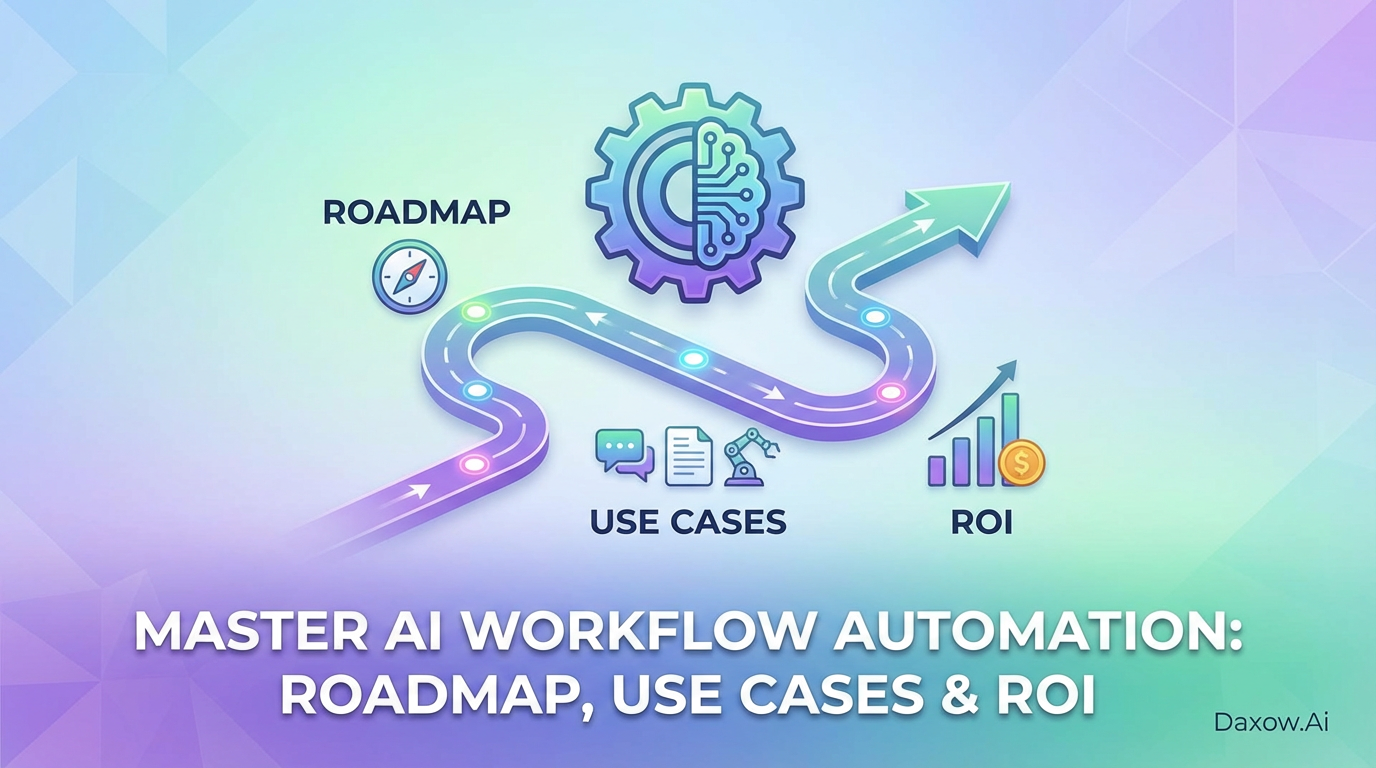
Practical guide to AI workflow automation: roadmap, KPIs, industry use cases, and ROI. See how Daxow.ai builds AI agents to cut costs and boost productivity.
Mastering AI Workflow Automation: A Strategic Imperative for Business Transformation
Estimated reading time: 15 minutes
Key Takeaways
- AI workflow automation significantly reduces operational costs by 30–50% and improves accuracy up to 90%.
- AI agents differ from basic automation through learning capabilities and contextual decision-making, reducing human involvement by up to 80%.
- Industries like e-commerce, healthcare, finance, real estate, and HR benefit from tailored AI automation systems.
- A structured six-step implementation roadmap ensures successful AI workflow automation deployment and governance.
- Daxow.ai offers end-to-end services from discovery to continuous optimization to deliver rapid ROI and lasting business transformation.
Table of Contents
- Mastering AI Workflow Automation: A Strategic Imperative for Business Transformation
- How AI agents and workflow automation drive measurable results
- Practical use cases across industries (actionable examples)
- Implementation roadmap — proven steps to deploy AI workflow automation
- Best practices and risk mitigation (practical steps)
- Realistic ROI expectations and business value
- How Daxow.ai helps you master AI workflow automation
- Practical example: end-to-end automation for a mid-size finance team
- Preparing your organization to succeed
- Frequently Asked Questions
Mastering AI Workflow Automation: A Strategic Imperative for Business Transformation
Mastering AI Workflow Automation: A Strategic Imperative for Business Transformation is no longer a theoretical advantage — it is a practical necessity for organizations that want to reduce manual tasks, increase productivity, and sustain competitive advantages. Companies face pressure from rising customer expectations, talent shortages, and the need to scale operations without proportional headcount growth. AI automation and AI agents deliver measurable outcomes: faster processing, fewer errors, and actionable insights that convert into improved profitability and customer experience.
This article presents a structured, actionable guide for decision-makers. It synthesizes proven research and real-world use cases, provides a clear implementation roadmap, and shows how Daxow.ai builds custom AI systems that automate end-to-end workflows, cut costs, and deliver rapid ROI.
What mastering AI workflow automation means for your business
AI workflow automation integrates machine learning, natural language processing, and robotic process automation into existing processes to handle high-volume, rule-based tasks and to augment decision-making. The practical implications are:
- Operational cost reduction: Targeted automation can reduce repetitive process costs by 30–50%.
- Faster cycle times: Tasks such as invoice processing or ticket routing complete far faster, improving throughput and customer experience.
- Higher accuracy: Automation reduces human error with potential error reductions of up to 90% in specific processes.
- Scalability without headcount growth: AI scales processing volume without a linear increase in staff, helping businesses manage demand spikes economically.
- Proactive decision-making: Predictive analytics deliver real-time insights that let leaders act before issues escalate.
These outcomes translate directly to business value: improved margins, higher customer satisfaction, and the flexibility to reallocate human talent toward strategic work.
How AI agents and workflow automation drive measurable results
What separates AI agents from basic automation
- Basic automation executes defined scripts or rules.
- AI agents learn patterns, make contextual decisions, and iterate via feedback loops.
- Agents integrate with CRMs, ERPs, chat systems, and databases to orchestrate end-to-end workflows: routing tickets, qualifying leads, reconciling accounts, or triggering cross-system processes.
- In targeted areas, AI agents can reduce human intervention by 70–80%, freeing teams to focus on escalation and strategy.
Key performance levers and metrics to track
When deploying AI automation, track metrics that tie directly to business objectives:
- Throughput and cycle time (orders processed per hour, invoice turnaround time).
- Error rate and rework percentage.
- Cost per transaction and labor hours saved.
- Customer satisfaction (CSAT) and first-contact resolution.
- Lead-to-conversion time and qualified-lead volume.
Setting KPIs upfront creates a clear path to ROI and aligns stakeholders to measurable outcomes.
Practical use cases across industries (actionable examples)
AI workflow automation and AI agents are versatile. Below are concrete use cases and the business outcomes they enable.
E-commerce
- Use case: End-to-end order-to-cash automation that combines inventory checks, fraud scoring, dynamic routing to warehouses, and automated returns processing.
- Outcomes: Fulfillment times reduced by ~40%, fewer stockouts, and higher repeat purchase rates through personalized recommendations.
- How Daxow helps: Build AI agents that connect storefronts, WMS, payment processors, and CRM to automate exceptions and personalize customer journeys.
Healthcare
- Use case: Automated patient intake, triage chatbots, scheduling, and pre-visit documentation extraction from forms and records.
- Outcomes: Reduced administrative burden, faster patient throughput, and improved clinician time allocation.
- How Daxow helps: Deploy secure, compliant automation that integrates EHR systems, triage logic, and human escalation paths to ensure safety and governance.
Finance and Accounting
- Use case: Invoice capture, intelligent matching, exception routing, and real-time fraud detection across payments.
- Outcomes: Cost reductions of 30%+ in invoicing operations, faster closing cycles, and lower compliance risk.
- How Daxow helps: Implement data extraction, reconciliation agents, and audit-ready logging that integrate with ERPs and banking systems.
Real Estate
- Use case: Automated listing ingestion, lead qualification, scheduling virtual tours, and automated contract review via document intelligence.
- Outcomes: Shortened sales cycles, better lead-to-agent matching, and improved conversion rates.
- How Daxow helps: Create AI agents that qualify leads by intent and budget, automate follow-ups, and sync listings across platforms.
HR and Talent Acquisition
- Use case: Resume screening, initial candidate outreach, interview scheduling, and onboarding workflow automation.
- Outcomes: Recruitment cycle times cut by up to 50%, improved candidate experience, and faster time-to-productivity.
- How Daxow helps: Design systems that score candidates against role-specific criteria and automate onboarding tasks while preserving human oversight.
Implementation roadmap — proven steps to deploy AI workflow automation
1. Define clear objectives
- Identify high-impact processes with measurable KPIs (e.g., reduce invoice processing time by 30%, or increase qualified leads by 25%).
- Map current workflow to reveal bottlenecks and exception rates.
- Involve business owners and decision-makers to ensure alignment.
2. Assess and prepare your data
- Audit data sources for accuracy, completeness, and accessibility.
- Clean and standardize data to prevent model drift and flawed outputs.
- Establish data governance and security controls up front.
3. Select the right technology mix
- Choose scalable platforms that integrate with existing CRMs, ERPs, and communication tools.
- Consider no-code or low-code options for rapid prototyping, combined with custom models where needed.
- Prioritize security and compliance, particularly in regulated industries.
4. Build a cross-functional team
- Combine product owners, data engineers, ML engineers, IT, and domain experts.
- Define roles for model maintenance, monitoring, and human-in-the-loop escalation.
5. Pilot, measure, iterate
- Start small with a pilot on a non-critical, high-impact workflow.
- Track KPIs, collect feedback, and iterate rapidly.
- Use pilot learnings to build a repeatable playbook for scaling.
6. Scale with governance
- Expand automation modules in phases, reusing components and integration patterns.
- Implement audit trails, compliance checks, and formal change control.
- Continuously retrain models and refine decision logic.
Best practices and risk mitigation (practical steps)
- Start small and prove value quickly: Early wins build stakeholder momentum.
- Embed security and privacy from day one: Apply role-based access, encryption, and audit logs.
- Design for human oversight: Define escalation rules and transparent decision trails.
- Focus on modular, scalable architectures: Build reusable components to accelerate future automation.
- Foster organizational change: Train teams, communicate benefits, and set realistic timelines.
- Monitor performance continuously: Automate alerts for model drift and process deviations.
Realistic ROI expectations and business value
- Typical ROI window: 6–12 months.
- Labor impact: 20–40% reduction in headcount required for automatable tasks; reallocation of staff to higher-value work.
- Productivity gains: 2–3x output per employee in automated areas.
- Customer impact: Up to 25% improvement in satisfaction through faster, consistent responses.
- Long-term gains: sustained annual efficiency lifts of 15–25% for well-governed deployments.
Daxow.ai’s approach prioritizes quantifiable outcomes. We help clients measure baseline metrics, define realistic targets, and track returns to ensure automation pays back quickly and compounds over time.
How Daxow.ai helps you master AI workflow automation
Daxow.ai is an AI automation agency founded in Estonia in 2024 focused on designing and deploying custom automation systems that deliver business outcomes. Our services address the full lifecycle of automation:
Discovery and process analysis
- We map existing workflows, quantify time and cost, and recommend priority areas that deliver the fastest ROI.
- Outputs: process maps, baseline metrics, and a prioritized automation roadmap.
Custom AI agent development
- We build AI agents that execute real tasks: lead qualification, ticket resolution, invoice reconciliation, and more.
- Agents are trained on your data and integrated with your business tools to act autonomously while preserving oversight.
End-to-end workflow automation
- From data extraction and document automation to multi-system orchestration, we implement full-stack automation that eliminates manual handoffs.
- We ensure robust error handling, auditability, and exception management.
System integrations and data connectivity
- Whether your stack includes CRMs, ERPs, proprietary databases, or SaaS platforms, we design secure connectors and synchronization strategies.
- Our integrations reduce data silos and make insights actionable across teams.
Change management and training
- Adoption is vital. We provide training, documentation, and change management support to ensure teams embrace new workflows.
- We establish governance models and support structures for ongoing optimization.
Continuous monitoring and optimization
- Post-deployment, we monitor performance, retrain models, and implement incremental improvements.
- Our service model aligns incentives: we focus on measurable efficiency and cost reductions.
Practical example: end-to-end automation for a mid-size finance team
Scenario:
- Pain points: Manual invoice entry, long approval times, frequent mismatches, and delayed payments.
Daxow.ai solution: Implemented a document automation pipeline that extracts invoice data, matches invoices to purchase orders, routes exceptions to a human reviewer, and posts approved entries into the ERP.
Outcomes:
- Invoice processing costs reduced by >30%.
- Approval cycle shortened by 60%.
- Audit trails automated, reducing compliance overhead.
This shows how a targeted project yields immediate savings while creating a foundation for further automation.
Preparing your organization to succeed
- Appoint an automation sponsor with budget and decision authority.
- Create a cross-functional steering committee for prioritization.
- Invest in data quality initiatives before scaling automation.
- Treat the first phase as a learning engagement — iterate fast and share wins.
Frequently Asked Questions
What is the difference between AI agents and traditional automation?
Traditional automation follows fixed rules and scripts, whereas AI agents learn patterns, adapt to context, and improve via feedback loops, enabling higher flexibility and decision-making capabilities.
How quickly can businesses expect to see ROI from AI workflow automation?
Typical ROI windows range from 6 to 12 months depending on implementation scope and industry, with early wins often realized through pilot projects.
Is AI workflow automation suitable for regulated industries?
Yes. With proper governance, security, and compliance measures, AI workflow automation can be tailored to meet strict regulatory requirements.
How does Daxow.ai ensure continuous optimization after deployment?
We monitor system performance, retrain AI models regularly, collect user feedback, and implement improvements iteratively to maximize long-term value.