
Mastering AI Workflow Automation for Business Transformation
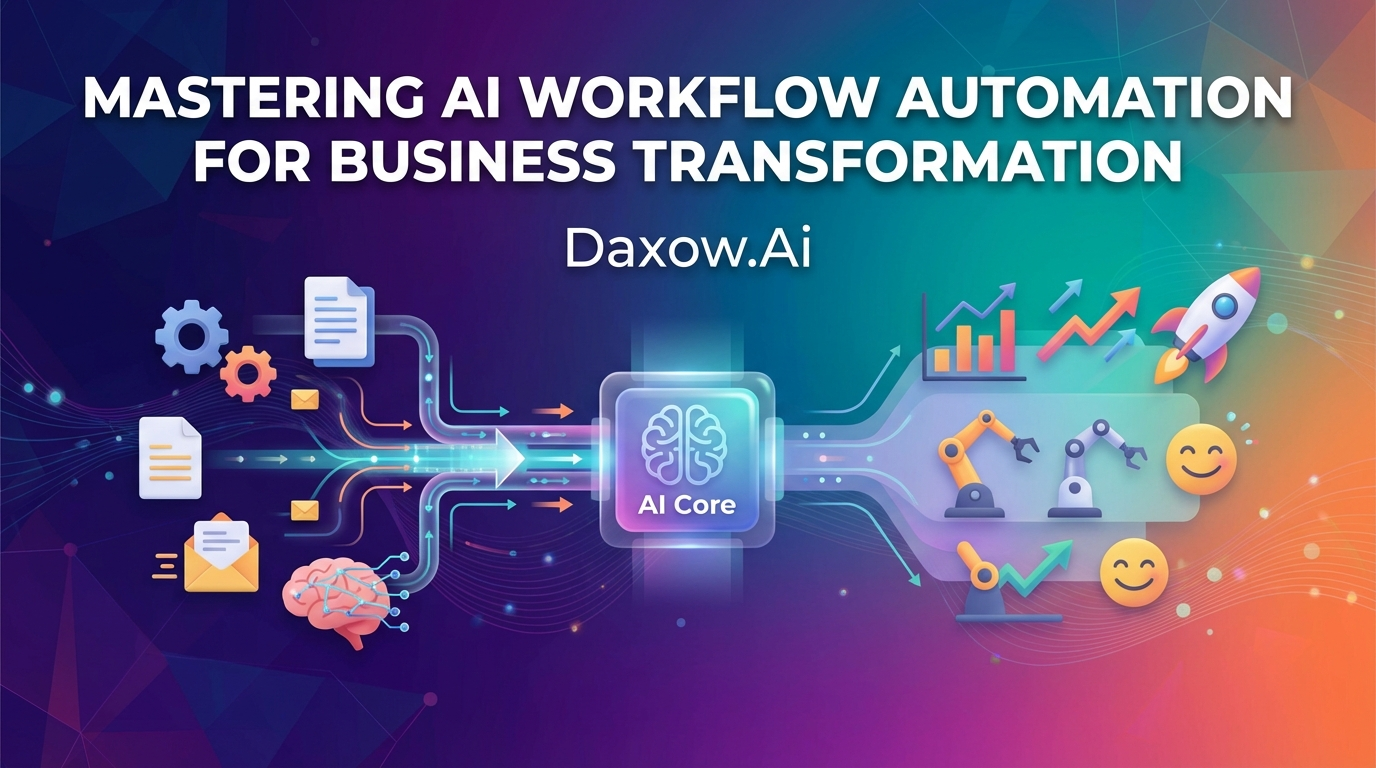
How Daxow.ai designs AI agents and workflow automation to cut costs, speed processes, and deliver rapid ROI across e-commerce, healthcare, finance, and HR.
Mastering AI Workflow Automation: A Strategic Imperative for Business Transformation
Estimated reading time: 15 minutes
Key Takeaways
- AI workflow automation reduces manual tasks, cuts costs, and improves customer experience.
- Targeted automation can save 40–60% of time on workflows and reduce administrative burdens by 40%.
- Industries like e-commerce, healthcare, finance, real estate, HR, and customer support benefit from tailored AI agents.
- Successful implementation involves clear goals, data preparation, piloting tools, team building, and continuous iteration.
- ROI is achievable within 6-12 months with potential gains of 3–5x when scaling automation.
- Daxow.ai offers end-to-end AI automation solutions integrating with your existing systems for measurable impact.
Table of Contents
- Mastering AI Workflow Automation: A Strategic Imperative for Business Transformation
- Practical Use Cases of AI Workflow Automation
- How AI Agents and Automation Drive Impact
- Implementation Steps and Best Practices
- Calculating ROI and Business Value
- Getting Started with Daxow.ai
- Frequently Asked Questions
Mastering AI Workflow Automation: A Strategic Imperative for Business Transformation
AI workflow automation integrates machine learning, natural language processing, and rule-based orchestration into business processes to reduce manual tasks, cut errors, and unlock capacity for high-value work. Companies piloting these systems report substantial gains: targeted workflows can save 40–60% of time, transactional efficiencies rise by 20–50%, and administrative burdens can fall by 40% in areas like scheduling and records processing.
Why this is strategic
- It is a scalability lever: automation scales without linear headcount increases.
- It is a quality lever: AI reduces human error in high-volume data processes.
- It is a customer-experience lever: faster, consistent responses increase satisfaction and retention.
- It is a strategic asset: data and models create predictive capabilities that support better decisions.
At Daxow.ai, we emphasize that AI workflow automation must be treated as a foundational technology. That requires initial investment in data quality, integration, and governance — investments that typically pay back within 6–12 months through labor savings and faster cycles.
Practical Use Cases of AI Workflow Automation
E‑commerce — Order-to-Cash, Inventory, and Personalization
- What to automate: order validation, inventory reconciliation, returns processing, dynamic pricing signals, and customer ticket triage.
- Impact: fulfillment times reduced by 30–50%, higher conversion via personalized recommendations, and fewer stockouts.
- Practical workflow: an AI agent validates orders, updates inventory, flags anomalies, and routes exceptions to a human for review.
- Daxow.ai role: build AI agents that integrate with e-commerce platforms, connect inventory systems, and automate order-to-cash flows to reduce manual interventions and accelerate time-to-cash.
Healthcare — Scheduling, Records, and Triage
- What to automate: patient scheduling, medical record extraction, pre-visit triage, and claims pre-checks.
- Impact: administrative workload reduced by 40%, faster appointment fulfillment, and improved clinician time allocation.
- Practical workflow: an NLP pipeline extracts structured data from clinical notes and a scheduling agent optimizes bookings based on clinician availability and urgency.
- Daxow.ai role: implement secure, compliant data extraction and scheduling agents, integrate with EHR systems, and deploy patient-facing chatbots for 24/7 support.
Finance — Reconciliation, Fraud Detection, and Compliance
- What to automate: invoice reconciliation, exception handling, AML screening, and regulatory reporting pre-processing.
- Impact: faster audit cycles, fewer reconciliation errors, and improved fraud detection with predictive analytics.
- Practical workflow: an automated reconciliation pipeline matches invoices to payments and escalates mismatches while a fraud model scores anomalous transactions.
- Daxow.ai role: create ML models for anomaly detection, integrate with accounting and payment systems, and automate reporting to reduce manual reconciliation load.
Real Estate — Lead Qualification and Contract Automation
- What to automate: inbound lead triage, property listing updates, contract drafting and review, and closing workflow orchestration.
- Impact: shorter sales cycles, better lead-to-deal conversion, and streamlined document processing.
- Practical workflow: an AI agent scores leads, schedules viewings, populates contract templates, and tracks milestones until closing.
- Daxow.ai role: implement lead qualification agents and document automation that connect MLS, CRM, and contract-signature tools, reducing time-to-close.
HR — Recruitment and Onboarding
- What to automate: resume screening, interview scheduling, onboarding checklists, and employee FAQs via chatbots.
- Impact: hiring time reduced by up to 50%, consistent candidate experience, and lower operational overhead.
- Practical workflow: a recruitment agent parses resumes, ranks candidates against role criteria, and manages scheduling and communications.
- Daxow.ai role: deploy recruitment automation and employee support bots that integrate with HRIS and ATS systems to accelerate hiring and onboarding.
Customer Support and Sales — 24/7 Service and Lead Nurturing
- What to automate: triage and routing of support tickets, first-level resolution via chatbots, and automated follow-ups for leads.
- Impact: 24/7 availability, reduced handle times, and improved lead qualification rates.
- Practical workflow: a customer support agent responds to FAQs, escalates complex requests, and captures sentiment for continuous improvement.
- Daxow.ai role: build customer support automation and sales automation that integrate with CRMs, helpdesks, and knowledge bases to reduce manual tasks and increase throughput.
How AI Agents and Automation Drive Impact
AI agents are autonomous components that execute multi-step processes. When combined with orchestration platforms, they deliver end-to-end automation that replicates and improves human workflows.
Capabilities of AI Agents
- Execute multi-step tasks across systems (e.g., read an email, extract invoice data, create an accounting entry).
- Make decisions using predictive models (e.g., approve low-risk transactions automatically).
- Interact with users through chat interfaces and trigger human handoffs where needed.
- Continuously learn from new data to improve accuracy and reduce exceptions.
Representative AI Agent Examples
- Lead Qualification Agent: reads inbound inquiries, enriches leads with firmographic data, scores them, and creates CRM tasks for qualified leads. Result: faster sales follow-up and higher-quality pipeline.
- Invoice Automation Agent: extracts line-item data from invoices, reconciles amounts against POs, posts matching entries to accounting, and flags exceptions. Result: fewer reconciliation errors and faster month-end close.
- Support Automation Agent: handles tier-1 requests using knowledge base search and NLP, creates tickets for unresolved issues, and summarizes interactions for agents. Result: reduced first-response time and increased customer satisfaction.
Daxow.ai builds these agents end-to-end — from model selection and training to system integrations and operational monitoring. Our approach ensures AI agents not only automate tasks but also produce auditable, compliant outcomes.
Implementation Steps and Best Practices
1. Define Clear Goals and Metrics
- Actions: set measurable KPIs (e.g., reduce processing time by 30%, decrease error rate to <1%).
- Stakeholders: involve business owners, IT, compliance, and frontline teams.
- Pitfalls to avoid: vague objectives and scope creep.
2. Assess and Prepare Data
- Actions: audit data sources, clean datasets, establish governance, and map integrations.
- Emphasis: prioritize high-volume, structured data workflows for early wins.
- Pitfalls to avoid: poor data quality leading to misleading AI outputs.
3. Select and Pilot Tools
- Actions: choose NLP, OCR, or ML components matched to the use case; run small-scale pilots; collect user feedback.
- Metrics: accuracy, throughput, exception rate, user satisfaction.
- Pitfalls to avoid: rushing to enterprise-wide rollout without validating pilots.
4. Build Teams and Integrate Infrastructure
- Team composition: product owner, data engineer, ML engineer, IT/security lead, and business SME.
- Technical focus: scalable cloud infrastructure, API-based integrations, role-based access, and security controls.
- Pitfalls to avoid: insufficient IT readiness and siloed ownership.
5. Train, Monitor, and Iterate
- Actions: deliver training for users, set up monitoring dashboards, implement retraining schedules for models.
- Continuous improvement: establish feedback loops to capture exceptions and improve models.
- Pitfalls to avoid: neglecting model drift and failing to measure long-term outcomes.
At Daxow.ai we run a phased program: discovery and process mapping, rapid pilot implementation, iterative improvement, and scaled rollout. This approach reduces risk and accelerates ROI.
Calculating ROI and Business Value
AI workflow automation delivers quantifiable returns. Typical outcomes reported by businesses include 20–50% efficiency gains, rapid payback within 6–12 months, and the potential to achieve 3–5x ROI when automation is scaled across high-impact processes.
How to estimate ROI (practical model)
- Baseline current costs — identify manual FTE hours spent, average fully loaded hourly rate.
- Estimate time savings — apply expected automation efficiency (e.g., 40% reduction).
- Calculate annual savings — time saved × hourly rate × frequency.
- Include implementation costs — platform licensing, development, and integration.
- Compute payback period and multi-year ROI.
Example: Automating invoice processing
- Baseline: 2 full-time employees spending 3,000 hours/year at $30/hour = $90,000.
- Expected reduction: 50% time saved → $45,000 annual labor savings.
- Implementation and Ongoing cost: $25,000 first year.
- Payback: under 12 months; ongoing annual net savings $20,000+ and reduced error costs.
Daxow.ai helps organizations build these financial models during our discovery phase, ensuring automation efforts target high-ROI processes and producing measurable business cases to secure stakeholder support.
Getting Started with Daxow.ai
Daxow.ai offers an end-to-end service model that turns process inefficiencies into automated, measurable outcomes. Our approach is designed for business leaders who need practical, low-risk transformation.
How we engage
- Discovery & Process Analysis: map workflows, quantify manual effort, and prioritize high-value use cases.
- Pilot Design & Build: deliver a working pilot with clear success criteria and integration points.
- Scale & Integrate: extend automation across systems and departments, build robust integrations with CRMs and business tools.
- Run & Optimize: monitor performance, retrain models, and maintain the automation as business needs evolve.
Our capabilities
- Custom AI agents that execute real tasks across multiple systems.
- Workflow automation that reduces manual tasks and improves throughput.
- Customer support automation and chatbots for 24/7 service.
- Sales automation and lead qualification to accelerate pipeline conversion.
- Data extraction and document automation for faster processing.
- Secure integrations with CRMs, ERPs, and industry tools to ensure data continuity and governance.
Why partner with Daxow.ai
- We combine technical expertise with business process experience.
- We focus on measurable outcomes and faster ROI.
- We design systems that work with your existing stack and scale with your business.
- We provide ongoing support to ensure models remain accurate and aligned with changing processes.
Frequently Asked Questions
What types of processes are best suited for AI workflow automation?
Processes that are high-volume, repetitive, rule-based, and involve data extraction or decision-making are ideal candidates for AI workflow automation.
How quickly can organizations expect to see ROI from AI automation?
Most organizations realize payback within 6–12 months, depending on the scale and complexity of the automation implemented.
How does Daxow.ai ensure compliance and data security in AI deployments?
We implement secure, governance-driven integrations, adhere to industry standards, and include audit trails to ensure compliance and data security across all AI systems.
Can AI agents integrate with existing CRM and ERP systems?
Yes. Daxow.ai specializes in integrating AI agents seamlessly with CRMs, ERPs, and other business platforms to leverage existing infrastructure and data sources.