
Mastering AI Workflow Automation: Strategy & Use Cases
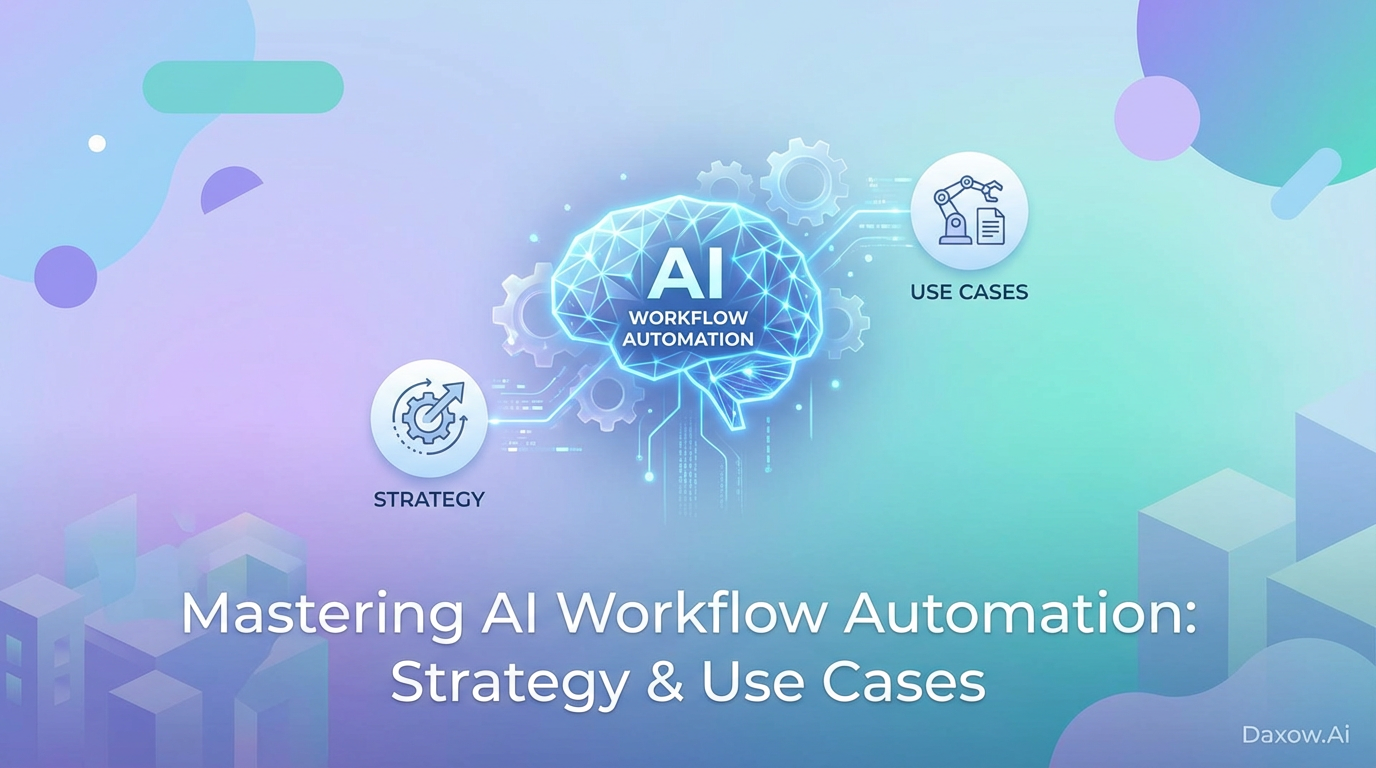
Learn how AI workflow automation and AI agents reduce costs, speed processes, and deliver ROI with a practical implementation framework and industry use cases.
Mastering AI Workflow Automation: A Strategic Imperative for Modern Businesses
Estimated reading time: 12 minutes
Key Takeaways
- AI workflow automation drives operational efficiency, scalability, and better customer experiences.
- Intelligent automation extends traditional RPA with machine learning and natural language processing.
- Industry-specific use cases demonstrate measurable ROI and rapid payback periods under 12 months.
- Phased implementation and strong governance are essential for sustainable success.
- Daxow.ai delivers custom AI agents and end-to-end automation integrated with enterprise systems.
Table of Contents
- Mastering AI Workflow Automation: A Strategic Imperative for Modern Businesses
- What AI Workflow Automation Means for Businesses
- Practical Use Cases Across Industries
- How AI Agents and Automation Drive Transformation
- Implementation Steps and Best Practices
- Measuring ROI and Business Value
- How Daxow.ai Helps You Master AI Workflow Automation
- Getting Started — Practical Checklist
- Frequently Asked Questions
Mastering AI Workflow Automation: A Strategic Imperative for Modern Businesses
Mastering AI Workflow Automation: A Strategic Imperative for Modern Businesses is not just a technological aspiration — it is a competitive necessity. Organizations across industries face mounting pressure to deliver faster service, reduce costs, and scale operations without proportionally increasing headcount. AI automation and intelligent workflow automation enable businesses to reduce manual tasks, accelerate decision-making, and unlock new productivity gains by deploying AI agents and integrated systems that execute real work.
This article explains what AI workflow automation means for business leaders, presents a practical implementation framework, and delivers industry-specific use cases and metrics you can act on immediately. Throughout, we show how Daxow.ai helps design and deploy custom AI systems that automate end-to-end processes, integrate with existing tools, and deliver measurable ROI.
Why this is strategic
- Operational efficiency drives profitability. Automating repetitive, rule-based tasks such as data entry, invoice processing, and routine customer inquiries immediately reduces labor costs and error rates.
- Scalability without headcount growth. AI systems process large volumes and adapt to variability, enabling companies to handle spikes in demand without hiring equivalent personnel.
- Better customer experiences. Faster response times, personalized interactions, and fewer mistakes translate into higher satisfaction and retention.
- Insight-driven decisions. Machine learning models and analytics convert process data into predictive signals that prevent disruptions and reveal growth opportunities.
Key outcomes to expect
- 30–50% reductions in process times for targeted workflows.
- Error rates dropping below 1% in automated data and document processing.
- Payback periods often under 12 months for focused implementations with clear KPIs.
What AI Workflow Automation Means for Businesses
From RPA to intelligent automation
Traditional robotic process automation (RPA) follows deterministic rules. AI workflow automation extends RPA with machine learning, natural language processing, and predictive analytics. The result is systems that:
- Interpret unstructured data (invoices, emails, contracts).
- Make context-aware decisions (triage, escalation).
- Learn from feedback and improve autonomously.
Core capabilities to prioritize
- Data extraction and document automation — auto-populate records and reduce manual reconciliation.
- AI agents — autonomous assistants that execute multi-step tasks across systems.
- Customer support automation — chatbots and support workflows that resolve common issues and escalate when needed.
- Sales automation — lead qualification, follow-up sequencing, and CRM enrichment.
- Workflow orchestration — integrating systems to create end-to-end process flows with monitoring and audit trails.
Practical Use Cases Across Industries
E-commerce
Use case: Order-to-cash and returns automation
- AI agents validate orders, reconcile payments, and trigger fulfillment workflows.
- Predictive analytics forecast stockouts and adjust procurement signals.
- Automated returns processing extracts fault codes, updates inventory, and issues refunds without manual review.
Business impact:
- Faster order fulfillment, fewer shipment errors, improved conversion through personalized recommendations.
- Reduced working capital tied to inventory via better forecasting.
Healthcare
Use case: Patient intake and document processing
- Natural language processing extracts information from referrals and clinical notes to populate EHR fields.
- Chatbots handle appointment triage and reminders, reducing no-shows.
- Predictive models flag anomalies for early intervention.
Business impact:
- Lower administrative overhead, faster patient throughput, and improved care coordination while maintaining compliance.
Finance
Use case: Invoice automation and fraud surveillance
- AI agents extract invoice data, match to purchase orders, and route exceptions.
- Machine learning models analyze transaction patterns to surface fraud risks in real time.
Business impact:
- Faster AP cycles, fewer payment errors, and reduced fraud losses.
Real Estate
Use case: Lead qualification and contract automation
- Automated research enriches leads with market signals and demographics.
- AI drafts contracts from templates, extracting clauses and populating terms automatically.
Business impact:
- Quicker deal cycles, higher agent productivity, and fewer administrative bottlenecks.
Human Resources
Use case: Applicant screening and onboarding
- Resume parsing and skill matching filters candidates for hiring managers.
- Automated onboarding workflows provision accounts, schedule training, and collect documents.
Business impact:
- Reduced time-to-hire and improved employee experience from day one.
How AI Agents and Automation Drive Transformation
What AI agents do differently
AI agents are autonomous systems designed to perform complex, multi-step tasks with minimal human intervention. They:
- Execute tasks across web apps and APIs.
- Understand and synthesize unstructured information.
- Take decisions within defined guardrails and escalate ambiguous cases.
Orchestration and integration
Automation succeeds when tools are connected. Orchestration layers integrate AI agents with CRMs, ERPs, ticketing systems, and data warehouses to create frictionless workflows. Key integration principles:
- Use APIs and middleware for secure, auditable connectivity.
- Preserve human-in-the-loop for exceptions and governance.
- Implement real-time monitoring and observability for performance and compliance.
Implementation Steps and Best Practices
A phased, risk-aware approach delivers the most reliable business value. Follow these steps:
1. Define objectives and prioritize processes
- Align automation with measurable business goals (cost reduction, NPS improvement, SLA adherence).
- Use process mining and stakeholder interviews to identify high-volume, repetitive tasks that yield quick ROI.
2. Assess data readiness
- Audit data quality, completeness, and compliance constraints.
- Build data pipelines and normalize formats before model training or rule configuration.
3. Choose tools and assemble the right team
- Opt for scalable platforms with strong integration capabilities and security features.
- Create a cross-functional team: business owners, data engineers, ML specialists, and compliance leads.
4. Prototype and pilot
- Start with a small, non-critical workflow to validate assumptions.
- Measure error rates, cycle time improvements, and user satisfaction.
5. Scale and govern
- Roll out incrementally, applying lessons learned to adjacent processes.
- Establish governance: model performance monitoring, bias checks, and audit trails.
- Provide training and change management to drive adoption and prevent shadow AI.
Best practice checklist
- Start small and show value quickly.
- Invest in data quality as the foundation.
- Design human oversight for edge cases.
- Measure continuously and iterate.
- Ensure privacy and compliance by design.
Measuring ROI and Business Value
Metrics to track
- Process cycle time reduction (baseline vs. automated).
- Error rate improvement and exception volume.
- FTE hours saved and redeployment impact.
- Customer experience indicators (response time, NPS).
- Financial outcomes: cost savings, avoided losses, revenue lift from faster lead conversion.
Typical ROI scenarios
- Invoice processing automation: immediate labor savings and faster discounts captured, with payback often under 12 months.
- Customer support automation: reduced average handle time and improved SLA compliance, enabling headcount reduction or redeployment to higher-value tasks.
- Predictive maintenance or stock forecasting: prevented downtime and reduced out-of-stock losses, delivering significant topline protection.
How Daxow.ai Helps You Master AI Workflow Automation
Daxow.ai specializes in designing and implementing custom AI systems that convert operational complexity into automated, measurable outcomes.
What we deliver
- Process discovery and analysis. We map your workflows, identify automation candidates, and quantify expected gains.
- Custom AI agents and workflows. We build AI agents that execute real tasks—data extraction, multi-step orchestration, decisioning, and escalation.
- End-to-end automation. From integration with CRMs and ERPs to user-facing chatbots and backend pipelines, we automate processes across the stack.
- System integrations and data connectivity. Secure connectors and APIs unify data silos and make automation resilient and auditable.
- Governance, monitoring, and iteration. We deploy model monitoring, bias mitigation, and continuous improvement processes so automation remains reliable over time.
How we approach projects
- Business-first: All solutions start with measurable objectives aligned to KPIs.
- Rapid validation: We prototype quickly to demonstrate value before large-scale rollout.
- Cross-functional delivery: Teams combine domain experts, engineers, and change managers.
- Security and compliance: We embed privacy and regulatory controls into every implementation.
Example engagements
- Automating invoice-to-pay workflows for a mid-size finance firm, delivering a 40% reduction in cycle time and sub-1% exception rates.
- Building AI-powered lead qualification and CRM enrichment for a real estate enterprise, doubling the effective pipeline conversion rate.
- Deploying a patient intake automation suite for a healthcare provider, lowering administrative costs and improving appointment throughput.
Getting Started — Practical Checklist
If you are ready to move from exploration to value capture, begin with these steps:
- Identify 2–3 high-volume processes where automation will immediately reduce manual tasks.
- Gather sample data and process documentation for scoping.
- Define target KPIs and success criteria for a 3–6 month pilot.
- Engage a partner to run a process analysis and prototype.
Frequently Asked Questions
What is AI workflow automation?
AI workflow automation uses artificial intelligence to automate complex business processes by integrating AI agents, machine learning, and analytics to reduce manual tasks and accelerate decision making.
How quickly can businesses expect ROI from AI automation?
Focused AI workflow automation implementations often deliver payback periods under 12 months, driven by process efficiency improvements and error reduction.
What industries benefit most from AI workflow automation?
Industries such as finance, healthcare, e-commerce, real estate, and human resources have demonstrated immediate and measurable gains from AI-enabled automation tailored to their unique processes.
How does Daxow.ai support AI automation projects?
Daxow.ai provides end-to-end AI workflow automation solutions including process analysis, AI agent development, system integration, governance, and ongoing monitoring to ensure sustainable business value.