
Mastering AI Workflow Automation: Practical Guide & Use Cases
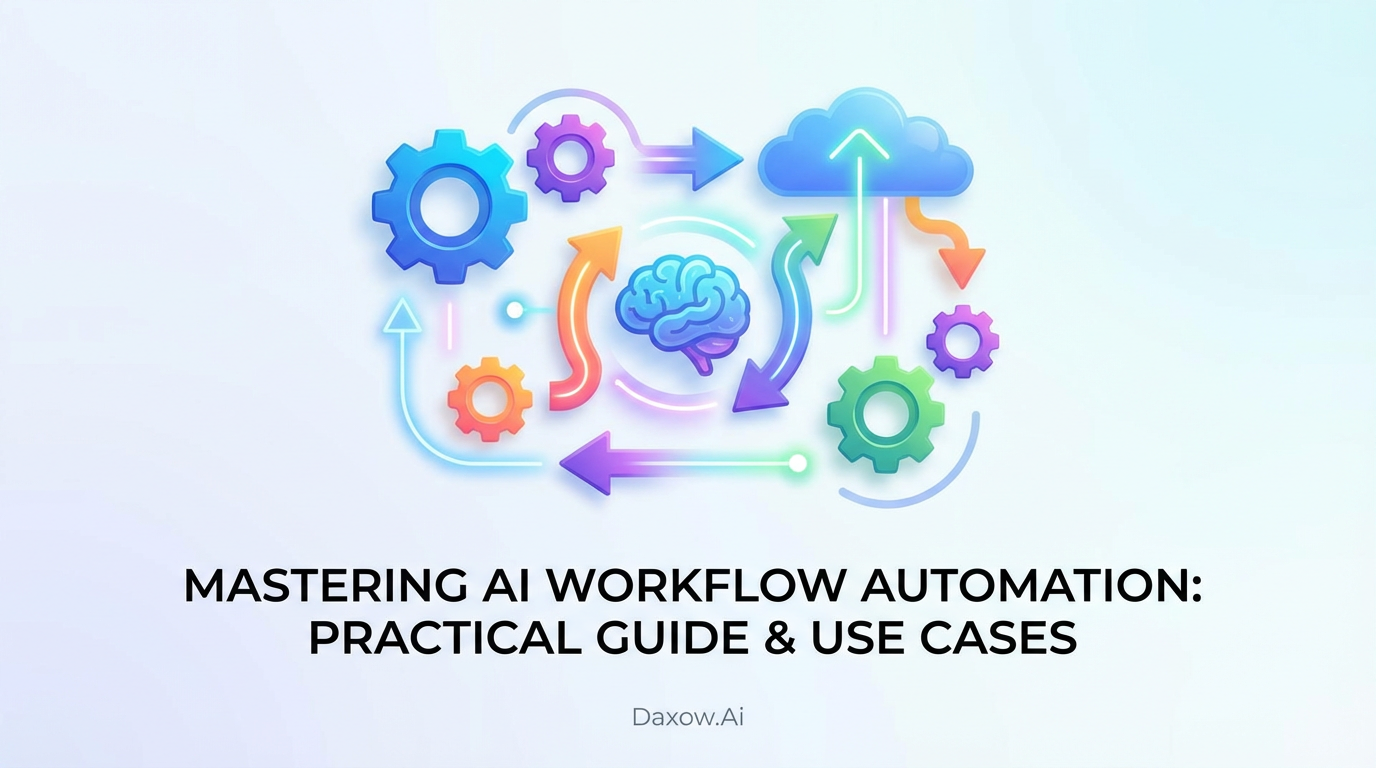
Discover how AI workflow automation cuts manual work, speeds decisions, and drives ROI. Practical steps, industry use cases, and Daxow.ai solutions.
Mastering AI Workflow Automation: Transforming Business Operations for the AI Era
Estimated reading time: 15 minutes
Key Takeaways
- AI workflow automation integrates ML, NLP, and RPA to reduce manual tasks and increase operational efficiency.
- Businesses gain faster decision cycles, improved accuracy, cost savings, and better customer experiences.
- Industry use cases range from e-commerce order processing to healthcare patient triage and finance fraud detection.
- Daxow.ai offers tailored AI automation solutions including custom agents, system integration, and governance.
- Phased implementation and continuous monitoring ensure sustainable ROI and operational resilience.
Table of Contents
- Mastering AI Workflow Automation: Transforming Business Operations for the AI Era
- What AI Workflow Automation Means for Businesses
- Practical Use Cases Across Industries
- How AI Agents and Automation Deliver Results
- Implementation Steps and Best Practices
- Measuring ROI and Business Value
- How Daxow.ai Designs and Delivers Custom AI Automation
- Frequently Asked Questions
Mastering AI Workflow Automation: Transforming Business Operations for the AI Era
AI workflow automation integrates machine learning, natural language processing, and robotic process automation to convert repeating, rule-based, and data-heavy tasks into autonomous or semi-autonomous workflows. The shift replaces manual data entry, ad-hoc document handling, and fragmented systems with intelligent pipelines that execute tasks, trigger decisions, and surface exceptions for human review.
Why this matters now
- Scale without proportional headcount: Mature implementations reduce routine work by up to 80% and free teams to focus on strategy.
- Faster, more accurate operations: Automation removes human fatigue from high-volume tasks and reduces processing errors.
- Actionable insights in real time: AI agents analyze data continuously, flagging anomalies like fraud or supply disruption before they escalate.
- Customer experience uplift: Personalized interactions and faster resolutions improve retention and revenue.
What AI Workflow Automation Means for Businesses
From rule-based tasks to intelligent agents
AI workflow automation moves beyond static RPA scripts. Modern solutions combine:
- Pre-trained models and custom ML for classification, extraction, and prediction.
- AI agents that orchestrate multi-step processes across systems.
- Continuous monitoring and retraining to prevent performance drift.
Business outcomes to expect
- Operational resilience: Automated surveillance of transactions and systems reduces risk and increases uptime.
- Efficiency gains: Typical reductions in manual effort range from 20–50% on targeted processes; time-to-completion often falls by 30–40%.
- Cost savings and ROI: Organizations can expect payback within 12–18 months for prioritized use cases; mature adopters report 3–5x returns.
- Compliance and auditability: Automated trails and standardized processing improve regulatory adherence.
Practical Use Cases Across Industries
E-commerce — Order-to-cash and personalization
Use case:
- Automate order validation, invoice generation, returns processing, and personalized post-purchase outreach.
Implementation steps:
- Integrate order management and CRM via APIs.
- Deploy an AI agent to reconcile orders, flag mismatches, and auto-generate invoices.
- Add personalization models to tailor recommendations and retention offers.
Impact:
- Reduce order processing time by 60–80%, improve conversion and repeat purchase rates.
Healthcare — Patient intake and triage
Use case:
- Automate patient data extraction, appointment triage, and clinical documentation summarization.
Implementation steps:
- Use secure OCR and NLP to extract structured data from forms and EHR notes.
- Route urgent cases with AI triage rules and set human-in-the-loop review for complex situations.
Impact:
- Faster response times, improved compliance, and lower administrative overhead for clinicians.
Finance — Fraud surveillance and document automation
Use case:
- Continuous transaction monitoring for fraud patterns and automated reporting from invoices and contracts.
Implementation steps:
- Feed real-time transaction streams into anomaly detection models.
- Use document automation to extract fields from invoices and map to accounting systems.
Impact:
- Reduced fraud losses, faster reconciliation, and lower cost per transaction processing.
Real Estate — Lead qualification and listing automation
Use case:
- Auto-qualify leads from multiple channels and generate property listings with optimized descriptions and imagery.
Implementation steps:
- Connect lead sources (website, portals, social) to an AI qualification agent.
- Build templates and an image-processing agent to enrich listings.
Impact:
- Accelerated conversion cycles, higher agent productivity, and improved lead-to-deal ratios.
HR — Resume screening and onboarding
Use case:
- Automate CV parsing, candidate shortlisting, and personalized onboarding workflows.
Implementation steps:
- Use NLP models for resume parsing and skill matching.
- Automate offer paperwork, training enrollments, and equipment provisioning pipelines.
Impact:
- Reduce time-to-hire by up to 50%, improve candidate experience, and standardize onboarding compliance.
How AI Agents and Automation Deliver Results
What an AI agent does
AI agents are designed to act on behalf of teams by:
- Executing multi-step workflows across applications.
- Making decisions from predictive models with confidence thresholds.
- Escalating exceptions to humans and learning from feedback.
Example agent workflows (actionable)
- Invoice automation agent:
- Retrieve invoices from email or upload.
- OCR and parse line items.
- Validate against purchase orders and GL codes.
- Post to accounting or route exceptions to AP clerk.
- Notify stakeholders and log audit details.
- Customer support automation agent:
- Classify incoming tickets by urgency and topic.
- Provide automated responses for known issues.
- Escalate complex tickets to human agents with summarized context and suggested actions.
- Sales automation agent:
- Qualify leads based on behavior and CRM history.
- Schedule discovery calls and prepare a lead brief for the salesperson.
Key technical considerations
- Use enterprise-grade security and encryption for data in transit and at rest.
- Ensure robust API connectivity with CRMs, ERPs, and collaboration tools.
- Implement continuous monitoring and automated retraining pipelines to avoid performance drift.
Implementation Steps and Best Practices
Phase 1 — Discovery and prioritization
- Conduct a process audit to identify high-volume, low-value tasks.
- Set measurable objectives (e.g., reduce invoice processing time by 70% or improve NPS by 10 points).
- Prioritize quick wins that demonstrate ROI and build momentum.
Phase 2 — Data readiness and integration
- Assess data quality, completeness, and compliance needs.
- Standardize formats and build ingestion pipelines.
- Map integrations to key systems (CRM, ERP, ticketing, document repositories).
Phase 3 — Prototype and pilot
- Build a minimal viable AI agent for a single process.
- Run a controlled pilot with KPIs and human oversight for exceptions.
- Capture qualitative feedback from users for refinement.
Phase 4 — Scale and govern
- Roll out in phases with stakeholder training and change management.
- Implement governance for model versioning, access controls, and ethical use.
- Establish dashboards to monitor accuracy, throughput, cost savings, and SLA compliance.
Organizational best practices
- Form a cross-functional team with IT, business owners, and data specialists.
- Communicate ROI and time-savings early to reduce resistance.
- Avoid shadow AI by centralizing procurement and standards.
Measuring ROI and Business Value
Metrics that matter
- Operational: cycle time, throughput, error rate.
- Financial: cost per transaction, labor hours saved, reduction in penalties or losses.
- Customer: response time, NPS, retention.
- Model health: precision, recall, drift indicators.
Sample ROI calculation
- Example: Invoice processing automation
- Baseline cost: $6 per invoice manual processing.
- Post-automation cost: $1.50 per invoice.
- Volume: 50,000 invoices/year.
- Annual savings: (6 - 1.5) * 50,000 = $225,000.
- Payback period: less than 12 months for typical implementation budgets.
How Daxow.ai Designs and Delivers Custom AI Automation
Daxow.ai builds end-to-end AI automation solutions tailored to your workflows and strategic goals. Our methodology focuses on value, security, and seamless integration.
Discovery and process mapping
- We start with a structured process analysis to identify automation candidates and quantify impact.
- Deliverable: prioritized roadmap with expected KPIs and rollout plan.
Custom AI agents and workflow automation
- We design AI agents that execute real tasks: document extraction, lead qualification, customer triage, and more.
- We combine ML, RPA, and orchestration to create resilient, maintainable automation pipelines.
System integration and data connectivity
- Daxow integrates with CRMs, ERPs, support platforms, and databases using secure APIs.
- We ensure data lineage, logging, and compliance for auditability.
Implementation, monitoring, and governance
- Our teams prototype quickly, run pilots, and scale with governance frameworks to prevent sprawl.
- We establish dashboards, automated retraining, and alerting to maintain performance and ROI.
Operational benefits delivered
- Reduced manual tasks across departments.
- Improved productivity and faster throughput.
- Lower operational costs and predictable savings.
- Better customer experiences through intelligent support automation and personalization.
Learn more about how Daxow.ai can help you by exploring our custom AI automation services and industry solutions.
Frequently Asked Questions
What is AI workflow automation?
AI workflow automation uses machine learning, natural language processing, and robotic process automation to streamline repetitive and data-intensive business tasks into automated workflows.
How quickly can businesses expect ROI from AI automation?
Typical payback periods for prioritized use cases range from 12 to 18 months, with mature adopters reporting returns of 3 to 5 times their investment.
Which industries benefit most from AI workflow automation?
Industries such as e-commerce, healthcare, finance, real estate, and HR see significant improvements in operational efficiency, accuracy, and customer experience through AI workflow automation.
How does Daxow.ai ensure data security in automation implementations?
Daxow.ai applies enterprise-grade encryption and security measures for data in transit and at rest, ensures strict API connectivity controls, and implements governance frameworks to maintain compliance and auditability.