
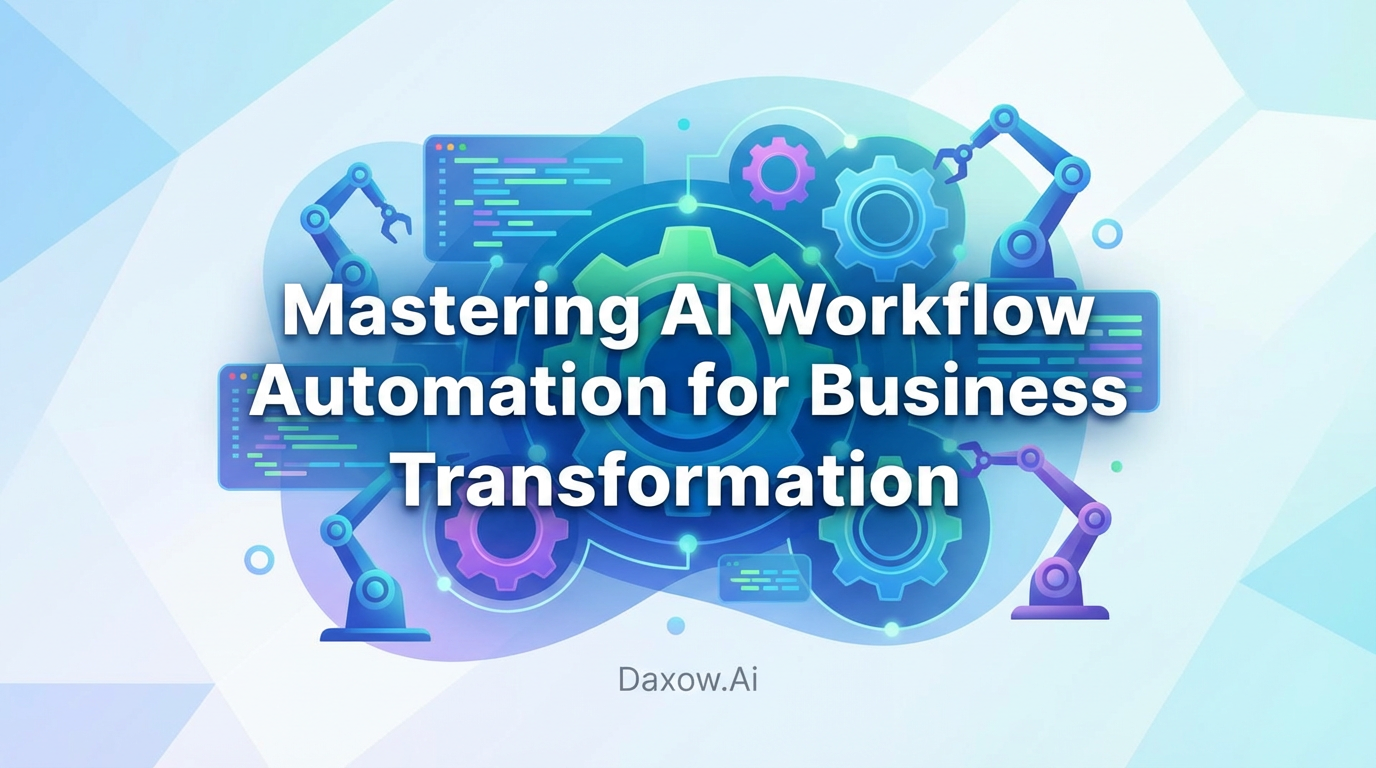
Mastering AI Workflow Automation for Business Transformation
Practical guide to AI workflow automation: industry use cases, an implementation roadmap, ROI examples, and how Daxow.ai builds AI agents to automate enterprise workflows.
Mastering AI Workflow Automation: A Strategic Imperative for Business Transformation
Estimated reading time: 15 minutes
Key Takeaways
- AI workflow automation reduces manual tasks, accelerates processes, and improves accuracy across industries.
- Companies using AI agents and automation can achieve 20–50% efficiency gains and rapid ROI.
- Daxow.ai provides custom AI systems and integrations to automate end-to-end workflows securely and scalably.
- Successful implementation requires clear objectives, data quality, cross-functional teams, and governance.
- Tracking KPIs such as cycle time, costs, and customer satisfaction is essential for scaling automation impact.
Table of Contents
- Mastering AI Workflow Automation: A Strategic Imperative for Business Transformation
- Practical Use Cases Across Industries
- How AI Agents and Automation Deliver Value
- Implementation Roadmap and Best Practices
- Technical Considerations
- Measuring ROI and Expected Impact
- How Daxow.ai Helps You Master AI Workflow Automation
- Next Steps: From Strategy to Action
- Frequently Asked Questions
Mastering AI Workflow Automation: A Strategic Imperative for Business Transformation
Mastering AI Workflow Automation: A Strategic Imperative for Business Transformation is no longer a theoretical advantage — it is a commercial necessity. Organizations that adopt AI automation and AI agents for workflow automation can dramatically reduce manual tasks, accelerate decision-making, and reclaim time for strategic work. For business owners, operations leaders, and executives, the question is no longer whether to transform, but how to do it in a way that delivers measurable productivity gains, cost savings, and improved customer outcomes. This article lays out a practical, action-oriented guide for decision-makers and explains how Daxow.ai designs custom AI systems to automate end-to-end processes and deliver ROI.
AI workflow automation integrates artificial intelligence into business processes to automate repetitive, predictable tasks and enable context-aware decisions. The result is a shift away from error-prone, manual workflows toward scalable systems that operate in real time. Organizations that implement these systems realize several strategic benefits:
- Reduced manual tasks: Rule-based tasks such as data entry, invoice reconciliation, and ticket routing often consume 20–30% of employee time. Automating these tasks frees teams for higher-value work.
- Faster, more accurate processes: AI agents and automation can accelerate cycle times, reduce errors, and ensure consistent compliance and audit trails.
- Scalability and agility: Automated systems scale without linear headcount increases and adapt to changing business demands.
- Measurable ROI: Typical deployments show 20–50% efficiency gains and often recoup investment within 6–12 months.
This transformation is achieved through a combination of AI agents (autonomous, learning software that makes context-aware decisions) and workflow automation (repeatable execution of rules and integrations across systems). For enterprise-grade results, these solutions must be built around secure integrations, clean data pipelines, and continuous monitoring.
Practical Use Cases Across Industries
AI workflow automation delivers tangible value across sectors by targeting high-volume, repetitive, and decision-heavy processes. Below are actionable use cases with practical implementation notes.
E-commerce
Use case:
- Automate order processing, inventory reconciliation, returns handling, and personalized customer messaging.
Business impact:
- Faster fulfillment and fewer stockouts via real-time inventory reconciliation.
- Reduced manual support: AI agents resolve common customer queries and escalate exceptions.
- Improved conversion through automated personalized recommendations and abandoned-cart recovery.
How Daxow helps:
We map order-to-delivery workflows, connect e-commerce platforms to back-office systems, build AI agents for query resolution and returns classification, and implement monitoring to reduce fulfillment times by up to 50%.
Healthcare
Use case:
- Automate patient scheduling, intake forms processing, preliminary triage, and medical record updates.
Business impact:
- Lower administrative burden — clinics can reduce non-clinical workload by ~40%.
- Improved patient experience: faster scheduling and pre-visit communications.
- Compliance by design: data flows engineered to meet privacy and audit requirements.
How Daxow helps:
We design secure data pipelines, extract and normalize patient data from documents, and create AI agents that route urgent cases to clinicians while maintaining HIPAA-aligned processes.
Finance and Accounting
Use case:
- Automate invoice matching, reconciliations, fraud detection, and regulatory reporting.
Business impact:
- Faster close cycles and fewer reconciliation errors.
- Continuous compliance with automated audit trails and anomaly detection.
- Cost reduction from fewer manual validations.
How Daxow helps:
We implement document automation, build AI models for anomaly detection, integrate with ERP/CRM systems, and deliver dashboards that track accuracy and cycle time.
Real Estate
Use case:
- Automate lead qualification, property listing enrichment, contract review, and tenant onboarding.
Business impact:
- Higher agent productivity by removing paperwork from the agent workflow.
- Faster deal cycles through automated document review and e-signature integrations.
How Daxow helps:
We build AI agents that score leads, extract contract clauses, and automate tenant checks, enabling agents to prioritize showings and negotiations.
Human Resources
Use case:
- Automate resume parsing, interview scheduling, onboarding workflows, and routine employee inquiries.
Business impact:
- Shorter hiring cycles and improved candidate experience.
- Higher retention from prompt, consistent onboarding.
How Daxow helps:
We create recruitment automation that screens candidates against job criteria, schedules interviews, and automates onboarding tasks across HRIS systems.
Customer Support and Sales Automation
Use case:
- AI-powered triage and routing of support tickets, automated knowledge retrieval, and lead qualification bots that enrich CRM records.
Business impact:
- Faster response times and higher first-contact resolution.
- Higher pipeline quality through automated lead scoring and qualification.
How Daxow helps:
We build customer support automation and AI agents that interact with customers, resolve common issues, escalate complex cases, and update CRM records in real time.
How AI Agents and Automation Deliver Value
AI agents are the orchestration layer that combine decision-making, integrations, and learning. They are distinct from basic automation because they:
- Make context-aware decisions using ML and NLP.
- Integrate across CRM, ERP, document stores, and communication platforms.
- Learn from feedback and improve over time.
- Provide human-AI handoff points where complex judgment is required.
Key elements that produce value:
- End-to-end orchestration: Automate the entire workflow rather than isolated tasks to minimize manual touchpoints.
- Data connectivity: Reliable data pipelines and APIs are essential for accurate, timely AI-driven actions.
- Observability: Continuous monitoring, logging, and metrics enable rapid iteration and trust.
- Human-in-the-loop: Design for seamless escalation to humans where AI confidence is low.
Daxow.ai builds AI agents that execute real business tasks — from qualifying sales leads to performing contract reviews — and ties these agents into existing systems to maintain a single source of truth and consistent auditability.
Implementation Roadmap and Best Practices
Successful AI workflow automation requires a structured, iterative approach. The following roadmap reflects proven best practices.
1. Define Clear Business Objectives
- Set measurable goals (e.g., reduce response time by 25%, cut processing costs by 15%).
- Prioritize processes based on volume, variability, and current cost.
2. Assess Data Quality and Accessibility
- Audit data sources for completeness and accuracy.
- Standardize formats and build ETL pipelines.
- Ensure compliance and access controls are in place.
3. Identify High-Impact Workflows
- Start with high-frequency, rule-based processes that are customer-facing or costly.
- Use process mining or manual audits to quantify time and error rates.
4. Select Tools and Architecture
- Choose platforms that integrate with your CRM/ERP and provide secure APIs.
- Favor modular architectures that enable incremental rollout and reuse.
5. Build a Cross-Functional Team
- Include process owners, data engineers, ML engineers, and compliance stakeholders.
- Invest in training and change management.
6. Prototype, Deploy, and Monitor
- Run pilots with real data and users.
- Track KPIs: cycle time, accuracy, cost per transaction, and customer satisfaction.
- Iterate rapidly based on monitoring insights.
7. Scale with Governance
- Establish governance for model updates, data access, and ethical use.
- Standardize deployment and monitoring practices to prevent sprawl.
Best practices summary:
- Start small, scale smart: Pilot one process, prove ROI, then expand.
- Prioritize data quality: Clean inputs = reliable outputs.
- Embed security and compliance early.
- Measure and iterate continuously.
- Invest in people to drive adoption.
Technical Considerations
Integrations and APIs
- Ensure bi-directional integrations with core systems for real-time data.
- Use robust middleware where direct integrations are impractical.
Security and Compliance
- Enforce role-based access and encryption at rest/in transit.
- Maintain audit logs for regulatory requirements.
Observability and Retraining
- Implement model performance dashboards and alerting.
- Retrain models using new labeled data and feedback loops.
Measuring ROI and Expected Impact
To justify and guide investment, track a compact set of KPIs:
- Process cycle time (before vs. after automation).
- Cost per transaction or cost per customer interaction.
- Error rate or exception volume.
- Employee time reclaimed (hours/month).
- Customer satisfaction (CSAT) and Net Promoter Score (NPS).
Example ROI scenario:
A mid-size company processes 10,000 invoices per month. Each invoice costs $5 in manual processing and takes 10 minutes. Automating invoice matching reduces manual processing by 60%. Monthly savings: 10,000 invoices * $5 * 60% = $30,000. If automation costs $150,000 to implement and $3,000/month to operate, breakeven is under 6 months.
These calculations are conservative; many organizations report 20–50% efficiency gains and significant reductions in error rates. Tracking the right KPIs allows you to scale automation where it drives the most value.
How Daxow.ai Helps You Master AI Workflow Automation
Daxow.ai offers end-to-end services tailored to enterprise needs:
- Discovery & Process Mapping: We analyze current workflows to identify high-impact automation candidates.
- Custom AI Systems: We design AI agents and automation tailored to your use cases, from lead qualification to document automation.
- Integrations & Data Engineering: We build secure, reliable integrations with CRM, ERP, support platforms, and data stores.
- Prototype-to-Scale Delivery: We run pilots, measure ROI, optimize models, and scale successful automations across the organization.
- Governance & Monitoring: We implement governance frameworks, observability, and retraining pipelines to sustain long-term performance.
- Training & Change Management: We train teams, provide adoption playbooks, and align stakeholders for smooth rollouts.
Why partner with Daxow.ai:
- Experience in cross-industry deployments ensures fast time to value.
- Focus on business outcomes means every automation ties back to measurable KPIs.
- Modular, secure architectures support enterprise compliance and scale.
- Practical AI agents that execute real tasks and integrate seamlessly with human workflows.
Next Steps: From Strategy to Action
If you are evaluating AI automation, begin with a structured, risk-managed approach:
- Conduct an automation readiness assessment.
- Identify one customer-facing or high-volume internal process to pilot.
- Set clear KPIs and success criteria.
- Establish a cross-functional team and governance plan.
Daxow.ai can lead or accelerate every step — from process analysis and prototyping to full-scale automation and ongoing optimization.
Conclusion and Call to Action
Mastering AI workflow automation is a strategic imperative for organizations seeking to reduce manual tasks, boost productivity, and transform operations into a competitive advantage. With the right priorities, governance, and partners, businesses can achieve rapid ROI and sustainable performance improvement.
Frequently Asked Questions
What is AI workflow automation and why is it important?
AI workflow automation uses artificial intelligence to automate repetitive and decision-intensive business tasks, improving efficiency, accuracy, and scalability while reducing manual effort.
How does Daxow.ai approach AI automation projects?
Daxow.ai follows a structured approach including discovery, custom AI system design, secure integrations, prototype-to-scale deployment, governance, and change management to deliver measurable business outcomes.
What industries benefit most from AI workflow automation?
Industries such as e-commerce, healthcare, finance, real estate, human resources, and customer support can realize significant efficiency and service improvements from AI workflow automation.
What KPIs should organizations track to measure automation impact?
Key KPIs include process cycle time, cost per transaction, error rates, employee time reclaimed, and customer satisfaction metrics like CSAT and NPS.