
Mastering AI Workflow Automation: Roadmap & ROI
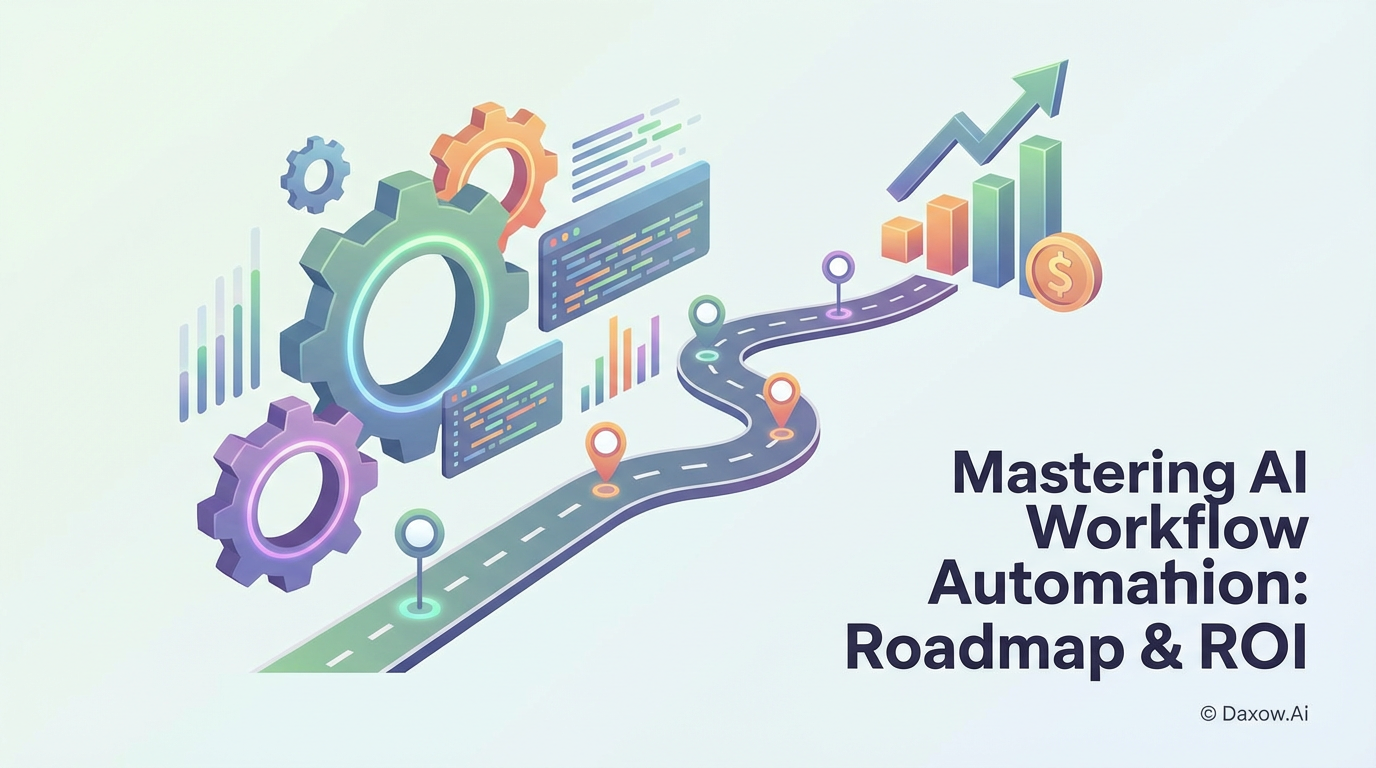
Practical guide to AI workflow automation: steps, industry use cases, ROI metrics, and how Daxow.ai builds custom AI agents for end-to-end automation.
Mastering AI Workflow Automation: A Strategic Imperative for Business Transformation
Estimated reading time: 15 minutes
Key Takeaways
- AI workflow automation is essential for scaling, cost reduction, and enhancing customer and employee experiences.
- Industries such as e-commerce, healthcare, finance, and HR benefit significantly from AI agents and automated workflows.
- Implementing AI workflow automation requires a structured approach including objective definition, data preparation, tool selection, and continuous optimization.
- Measurable ROI includes labor cost reductions of 20–40%, error reductions up to 90%, and faster business cycles.
- Daxow.ai delivers end-to-end AI automation solutions with custom AI agents, integrations, and ongoing support.
Table of Contents
- Mastering AI Workflow Automation: A Strategic Imperative for Business Transformation
- Practical Use Cases — How AI Workflow Automation Creates Immediate Business Value
- How AI Agents and Workflow Automation Drive Results
- Implementation Steps and Best Practices for Mastering AI Workflow Automation
- Measuring ROI and Business Value
- How Daxow.ai Delivers End-to-End AI Workflow Automation
- Practical Roadmap — From Pilot to Enterprise-Scale Automation
- Final Considerations — Governance, Ethics, and Long-Term Success
- Frequently Asked Questions
Mastering AI Workflow Automation: A Strategic Imperative for Business Transformation
Mastering AI Workflow Automation: A Strategic Imperative for Business Transformation is no longer a theoretical advantage — it is a practical requirement for organizations that want to scale, reduce costs, and improve customer and employee experiences. AI automation transforms repetitive, error-prone tasks into intelligent, self-optimizing processes, allowing businesses to reallocate human talent to strategic work.
This article explains what mastering AI workflow automation looks like in practice, presents actionable steps and use cases across industries, and shows how Daxow.ai builds custom AI agents and end-to-end business automation to deliver measurable ROI.
Why this topic matters now
- Competitive pressure: Rapid market shifts require faster response times and personalized customer interactions.
- Labor and cost constraints: Companies need to reduce manual tasks and control headcount growth without sacrificing throughput.
- Data abundance: Organizations have more data than ever — the challenge is turning it into automated decision-making and operational improvement.
- Technology maturity: AI agents, NLP, and integration platforms have reached the point where reliable, secure workflow automation is attainable for mid-market and enterprise organizations.
What mastering AI workflow automation delivers
- Higher productivity through automation of repetitive work and intelligent decision-making.
- Reduced operational costs — many industries report potential cost cuts of 30–50% on targeted processes.
- Faster cycles and better customer outcomes, including reduced resolution times and improved satisfaction.
- Scalability without proportional headcount increases, enabling growth with predictable operating margins.
Practical Use Cases — How AI Workflow Automation Creates Immediate Business Value
E-commerce and Retail
- Automate order processing, returns handling, and inventory reconciliation.
- Use AI agents to classify customer inquiries, route them to the appropriate channel, and trigger fulfillment workflows.
- Expected outcomes: up to 40% reduction in fulfillment times, fewer stockouts through predictive replenishment, and improved customer retention through faster responses.
- Example: an AI agent inspects incoming messages, extracts order IDs and issues, triggers a refund or exchange workflow, updates the CRM, and notifies the warehouse — all without human intervention.
Customer Support and Service (Customer Support Automation)
- Implement AI-powered triage to prioritize urgent tickets and route complex issues to specialists.
- Use conversational AI chatbots to resolve common questions and escalate appropriately.
- Expected outcomes: significant reduction in average handling time and the ability to focus agents on high-value interactions.
- Example: a hybrid AI agent resolves tier-1 queries, opens a support case for tier-2, populates case notes with structured data, and schedules follow-ups automatically.
Healthcare
- Automate patient intake, scheduling, and document updates while extracting structured data from clinical notes.
- AI agents can perform triage, surface urgent cases, and ensure documentation compliance.
- Expected outcomes: 25–35% reduction in administrative burden, freeing clinicians for patient care.
- Example: an AI workflow extracts medication lists from unstructured records, reconciles them with pharmacy systems, and creates tasks for care coordinators.
Finance and Accounting (Sales Automation & Finance Automation)
- Automate invoice processing, reconciliation, fraud detection, and compliance checks.
- Use AI to qualify leads and route qualified opportunities directly into CRM pipelines.
- Expected outcomes: faster close cycles, fewer reconciliation errors, and faster audits.
- Example: an AI agent validates invoices, matches them to purchase orders, flags anomalies, and initiates payments or investigations.
Real Estate
- Automate property listing creation, lead qualification, and contract review.
- AI agents extract terms from contracts, compare them to standard templates, and escalate deviations.
- Expected outcomes: shorter sales cycles, higher conversion rates, and reduced legal review time.
- Example: incoming buyer inquiries are scored and nurtured by automated sequences; qualified leads are assigned to agents with pre-populated dossiers.
HR and People Operations
- Automate resume screening, interview scheduling, onboarding, and performance tracking.
- AI models predict turnover risk and identify skills gaps.
- Expected outcomes: up to 50% reduction in hiring time and higher quality hires through better screening.
- Example: an AI assistant parses applications, ranks candidates by fit, schedules interviews, and creates onboarding checklists integrated with HRIS.
How AI Agents and Workflow Automation Drive Results
What AI agents do differently
- Context-aware processing: Beyond rule-based workflows, AI agents use machine learning and NLP to make decisions based on context and historical patterns.
- End-to-end execution: Agents can ingest data, take actions across CRM/ERP systems, communicate with customers, and close tasks autonomously.
- Continuous improvement: With monitoring and retraining, agents self-optimize and maintain performance over time.
Key impact metrics
- Reduction in manual tasks: many implementations reduce human intervention in routine processes by 70–80%.
- Error reduction: automation can cut repetitive task errors by as much as 90%.
- Payback period: typical early ROI windows range between 6–12 months, with ongoing efficiency gains thereafter.
- Annual efficiency gains: early movers often see sustained 15–25% annual improvements after scale.
Implementation Steps and Best Practices for Mastering AI Workflow Automation
1. Define Clear Objectives
- Conduct process audits and task mining to identify high-impact automation opportunities.
- Set measurable goals (e.g., reduce processing time by 30%, decrease manual FTEs by 2).
- Align objectives with business priorities to avoid scope creep.
2. Assess and Prepare Data
- Audit data quality and accessibility across systems.
- Standardize and pipeline data into structured formats suitable for AI ingestion.
- Ensure privacy and compliance are embedded from day one.
3. Select Tools and Architecture
- Prioritize platforms with enterprise-grade security, legacy compatibility, and scalability.
- Choose solutions that facilitate integrations with CRM, ERP, ticketing systems, and document stores.
- Use modular designs so you can automate small processes quickly and scale later.
4. Build a Cross-Functional Team
- Include process owners, IT/infrastructure, data scientists, and end-users.
- Provide training and change management to reduce resistance.
- Establish governance to manage models, data lineage, and bias monitoring.
5. Pilot, Test, and Iterate
- Start with a focused pilot on a single high-value workflow.
- Validate accuracy, speed, and user experience before broad rollout.
- Use A/B testing and staged releases to measure impact.
6. Monitor, Optimize, and Scale
- Track KPIs: accuracy, cycle time, cost per transaction, and customer satisfaction.
- Implement feedback loops and retrain models periodically.
- Plan infrastructure scaling to avoid bottlenecks.
Common challenges and mitigation
- Data quality issues: perform thorough audits and data cleaning before model deployment.
- Integration hurdles: adopt phased integrations and middleware to bridge legacy systems.
- Resistance to change: demonstrate quick wins via pilots and invest in training.
- Scalability limits: choose retrainable models and enterprise-grade platforms.
Measuring ROI and Business Value
How to quantify impact
- Define baseline metrics before automation (e.g., average handling time, error rate, headcount cost).
- Use direct cost savings (labor reduction, fewer errors), indirect value (higher conversion, improved NPS), and opportunity gains (redeployment of staff to revenue-generating work).
- Typical returns: labor cost reductions in the 20–40% range for automated processes, and shorter cycle times that increase throughput and customer lifetime value.
Designing success metrics
- Operational KPIs: processing time, SLA compliance, error rate.
- Financial KPIs: cost per transaction, cost savings, payback period.
- Customer KPIs: NPS, CSAT, first-contact resolution.
- People KPIs: time saved, employee satisfaction, redeployed FTEs.
How Daxow.ai Delivers End-to-End AI Workflow Automation
Discovery and Process Analysis
- We map your current workflows, identify bottlenecks, and quantify automation potential.
- Our process audits use task mining and stakeholder interviews to prioritize high-ROI use cases.
Custom AI Design and Build
- We design custom AI agents tailored to your operational context: document extraction models, conversational agents for customer support automation, lead qualification systems, and intelligent routing agents.
- Our solutions combine machine learning, NLP, and rule-based logic to maximize reliability and explainability.
Integrations and Data Connectivity
- We integrate AI agents with CRMs, ERPs, ticketing systems, and data warehouses to ensure end-to-end automation.
- Our architecture emphasizes secure data flows, audit trails, and compliance-ready practices.
Implementation, Testing, and Change Management
- We run pilots, iteratively refine models, and scale through phased rollouts.
- We train end-users and establish governance frameworks to sustain performance and prevent sprawl.
Ongoing Optimization and Support
- Daxow.ai sets up KPI monitoring and retraining pipelines to keep agents performing as business conditions change.
- Our managed services reduce maintenance burden and ensure you realize continual improvements.
Practical Roadmap — From Pilot to Enterprise-Scale Automation
A clear path to scale:
- Opportunity discovery: identify 3–5 processes for quick automation.
- Pilot: deploy an AI agent on one workflow, measure outcomes, and iterate.
- Scale: standardize successful patterns and replicate across departments.
- Institutionalize: embed governance, training, and continuous optimization.
Example Project Timeline (12 weeks pilot)
- Weeks 1–2: Discovery and data assessment.
- Weeks 3–6: Model development and integrations.
- Weeks 7–9: Pilot testing and user validation.
- Weeks 10–12: Go-live and initial optimization.
Final Considerations — Governance, Ethics, and Long-Term Success
- Embed governance early to manage bias, explainability, and compliance.
- Monitor models for drift, and schedule regular retraining.
- Treat automation as continuous transformation rather than a one-off project.
- Prioritize stakeholder alignment and transparent communication to maintain trust.
Mastering AI workflow automation is a strategic imperative for businesses seeking to reduce manual tasks, improve productivity, and unlock scalable growth. Across e-commerce, healthcare, finance, real estate, HR, and customer support, AI agents and intelligent workflows deliver measurable cost savings, faster cycles, and better customer outcomes.
Daxow.ai combines process expertise, custom AI development, and deep integration capabilities to build and operate AI-driven systems that execute real tasks and generate measurable ROI. If you are ready to move from pilots to enterprise-scale automation, let us help you design a roadmap and deliver practical results.
Book a free consultation with Daxow.ai today or request a process analysis for your company to discover where AI automation will have the biggest impact. Contact us to build a custom AI system that reduces operational costs, improves productivity, and transforms how your business operates.
Frequently Asked Questions
What is AI workflow automation?
AI workflow automation uses artificial intelligence technologies to automate complex, repetitive business processes end-to-end, reducing manual effort and improving accuracy.
How quickly can businesses see ROI from AI automation?
Typical payback periods range from 6 to 12 months, depending on the scope and complexity of the automation, with ongoing benefits afterward.
Which industries benefit most from AI workflow automation?
E-commerce, healthcare, finance, real estate, customer support, and HR are some of the leading industries leveraging these technologies for improved efficiency and customer satisfaction.
How does Daxow.ai support AI workflow automation?
Daxow.ai offers custom AI agent design, integration with enterprise systems, pilot testing, training, and ongoing optimization to help organizations realize measurable benefits.