
Mastering AI Workflow Automation for Business Transformation
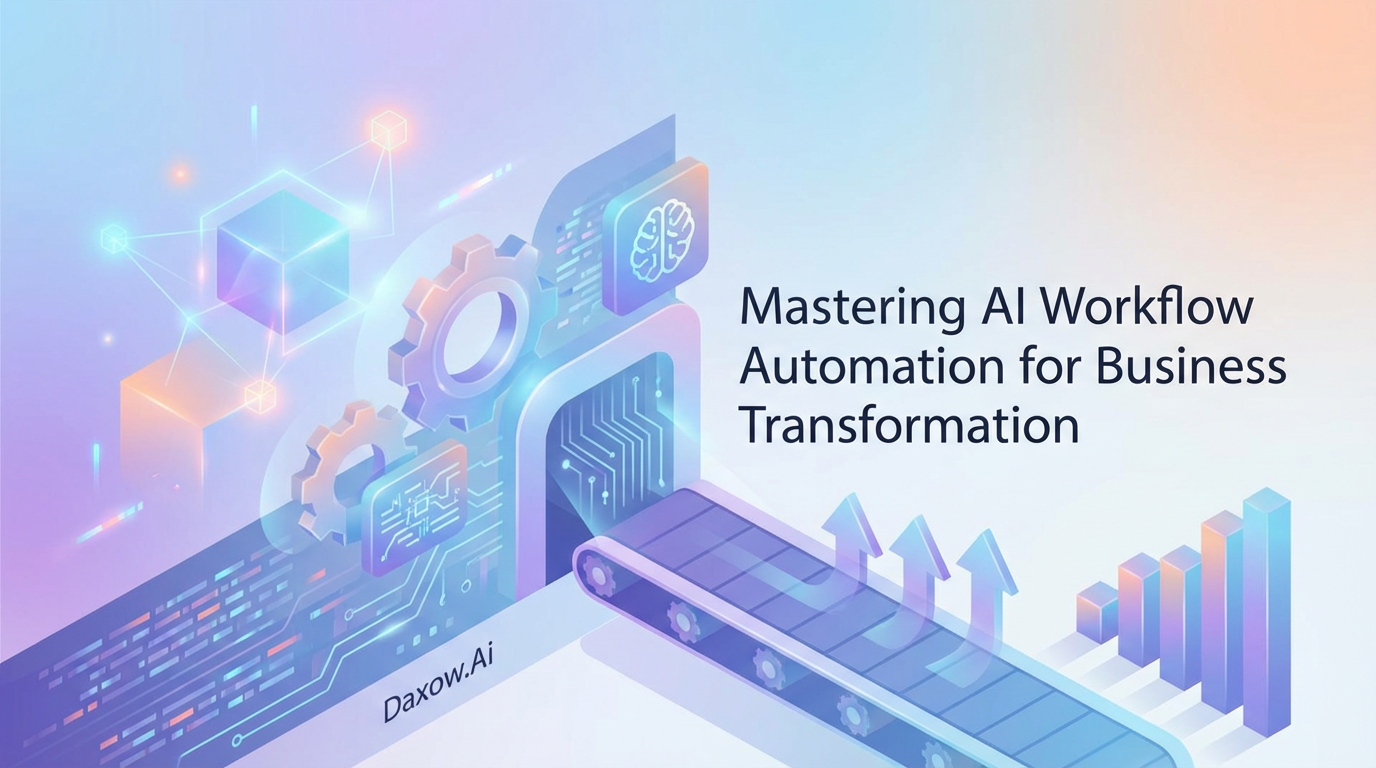
Daxow.ai's guide to AI workflow automation: industry use cases, a 90-day roadmap, and measurable ROI to cut costs and boost productivity.
Mastering AI Workflow Automation: A Strategic Imperative for Business Transformation
Estimated reading time: 15 minutes
Key Takeaways
- AI workflow automation transforms manual, repetitive tasks into scalable, error-free processes.
- Industries such as e-commerce, healthcare, finance, real estate, and HR benefit from tailored AI automation use cases.
- AI agents enable multi-step autonomous workflows, improving decision-making and reducing operational costs.
- Successful implementation follows phased steps including assessment, tech selection, data prep, piloting, and ongoing optimization.
- Daxow.ai provides custom AI systems, integrations, and continuous support to deliver measurable ROI.
- Early pilot projects speed time-to-value and pave the way for organizational scale and strategic advantage.
Table of Contents
- Mastering AI Workflow Automation: A Strategic Imperative for Business Transformation
- Practical Use Cases Across Industries
- How AI Agents and Automation Deliver Value
- Implementation Steps and Best Practices
- Measuring ROI and Business Value
- How Daxow.ai Builds and Delivers AI Workflow Automation
- Rapid Action Plan — First 90 Days for Decision-Makers
- Frequently Asked Questions
Mastering AI Workflow Automation: A Strategic Imperative for Business Transformation
Defining the opportunity
AI workflow automation integrates artificial intelligence into business processes to automate repetitive, rule-based tasks, enhance decision-making, and orchestrate multi-step operations across systems. The result is a shift from manual, error-prone activities to continuous, scalable processes that operate 24/7.
Business outcomes to expect
- Reduce manual tasks and administrative overhead by automating data entry, routing, and approvals.
- Boost productivity with teams redirected to higher-value work, often yielding 15–30% productivity gains.
- Cut operational costs in targeted processes by 30–50% through streamlined workflows and fewer exceptions.
- Improve customer satisfaction via faster response times and consistent, accurate interactions.
- Create data-driven advantages by collecting structured insights across automated processes.
Practical Use Cases Across Industries
AI workflow automation shines where volume, predictability, and data exist. Below are concrete use cases and how automation delivers tangible value.
E-commerce — Order processing, inventory, returns
- Use case: Automate order verification, fraud screening, fulfillment routing, and returns handling.
- Impact: Faster fulfillment, fewer cancellations, and improved customer experience. Companies see up to 40% faster fulfillment and reduced manual touches.
- Daxow.ai approach: Build AI agents that integrate with your e-commerce platform and ERP to classify orders, trigger fulfillment workflows, predict stock reorder points, and manage returns automatically. We combine sales automation and inventory orchestration to reduce time-to-ship and minimize stockouts.
Healthcare — Scheduling, triage, claims
- Use case: Automate patient scheduling, chatbot triage, insurance claim routing, and documentation extraction.
- Impact: Lower administrative burden, faster patient access, and improved compliance handling.
- Daxow.ai approach: Implement HIPAA-aware automation that extracts data from forms, automates claims submission, and triages patient queries via conversational AI—reducing manual scheduling time and administrative costs while preserving regulatory compliance.
Finance — Invoicing, reconciliation, fraud detection
- Use case: Automate invoice capture, reconciliation against purchase orders, exception routing, and real-time anomaly detection.
- Impact: Faster close cycles, fewer errors, and quicker fraud response. Fraud detection systems can deliver outsized ROI, sometimes recovering value within a year.
- Daxow.ai approach: Deploy document automation and AI models that reconcile transactions, identify anomalies, and trigger escalations. Integrate with accounting systems and CRMs for end-to-end financial process automation.
Real Estate — Lead qualification, tours, reporting
- Use case: Qualify leads through automated outreach, schedule virtual tours, and generate property reports from multiple data sources.
- Impact: Faster lead conversion, more efficient broker time, and data-driven pricing suggestions.
- Daxow.ai approach: Build AI agents that score leads, book appointments, and synthesize market data into concise reports—empowering sales teams to close deals more quickly.
HR — Recruiting, onboarding, payroll approvals
- Use case: Screen resumes, schedule interviews, automate onboarding checklists, and route payroll approvals.
- Impact: Reduced time-to-hire, consistent candidate experience, and lower administrative cost.
- Daxow.ai approach: Create workflow automation that integrates applicant tracking systems, calendar tools, and HRIS platforms to automate candidate screening and onboarding tasks while preserving audit trails and data security.
How AI Agents and Automation Deliver Value
What are AI agents?
AI agents are autonomous systems that perceive inputs (emails, chat, documents), make decisions using models and business rules, and act by updating systems or executing tasks. Unlike basic chatbots, AI agents handle multi-step workflows and integrate across tools—escalating cases, retraining on new data, and logging actions.
Typical capabilities and benefits
- Natural language understanding for customer support automation.
- Predictive models for prioritizing leads and spotting fraud.
- Document intelligence for extracting structured data from invoices, contracts, and forms.
- System orchestration to update CRMs, ERPs, and ticketing systems automatically.
- Business impact: 70–80% of routine queries can be resolved without human intervention, reducing response times and freeing agents for complex issues.
Practical orchestration example
A customer support AI agent receives a chat about a refund, verifies order details via the CRM, authorizes a refund if criteria are met, updates the ticket, and notifies accounting for reconciliation. If the case is exceptional, the agent escalates to a human with a complete context summary—minimizing back-and-forth and improving SLA adherence.
Implementation Steps and Best Practices
Phase 1 — Assess and plan (4–8 weeks)
- Actions: Map processes, identify high-impact bottlenecks, set clear objectives (e.g., reduce invoice processing cost by 30%).
- Deliverables: Prioritized use-case list, baseline metrics, success criteria.
- Success factor: Executive alignment and measurable KPIs.
Phase 2 — Select technology and build team (6–12 weeks)
- Actions: Choose platforms compatible with your stack, assemble cross-functional teams (technical, business, compliance, change management).
- Deliverables: Architecture blueprint, vendor evaluations, integration plans.
- Success factor: Scalability and integration capability with CRM/ERP.
Phase 3 — Prepare data and systems (4–8 weeks)
- Actions: Clean and label data, build knowledge bases, map API integrations, and document compliance requirements.
- Deliverables: Ready datasets, integration endpoints, training materials.
- Success factor: Data quality and a maintainable knowledge base.
Phase 4 — Pilot and deploy (4–20 weeks)
- Actions: Launch a focused pilot (e.g., e-commerce chat support), iterate on feedback, expand across teams and channels.
- Deliverables: Pilot results, refinement plan, rollout schedule.
- Success factor: Fast feedback loops and stakeholder training.
Phase 5 — Monitor, govern, optimize (ongoing)
- Actions: Track KPIs, retrain models, refine workflows, and maintain governance and change management.
- Deliverables: Continuous improvement plan and performance dashboards.
- Success factor: Strong monitoring and responsive optimization cycles.
Best practices to ensure success
- Start small for quick wins, then scale.
- Prioritize data readiness to avoid delays.
- Invest in change management and training.
- Measure ROI upfront using pilots and clear metrics.
- Maintain compliance and auditability in regulated industries.
Measuring ROI and Business Value
Quantifiable outcomes
- Speed to value: Implementations that follow best practices can be 3–5x faster.
- Cost reduction: Automated tasks typically produce 20–50% cost savings in target areas.
- Productivity: Expect 15–30% improvement in staff productivity where repetitive tasks are automated.
- Error reduction: Automation can reduce human error by up to 90% in structured processes.
How to quantify ROI for pilots
- Track baseline metrics: cost per transaction, average handling time, error rate, and customer satisfaction.
- Define target improvements: percentage reduction in handling time, automation rate, or cost per unit.
- Calculate payback: Estimate operational savings versus implementation and running costs to produce clear payback periods and expected ROI.
How Daxow.ai Builds and Delivers AI Workflow Automation
End-to-end delivery model
- Discovery and process analysis to identify high-impact opportunities.
- Proof-of-concept pilots to validate assumptions and measure early ROI.
- Custom AI agent and workflow development tailored to your systems and compliance needs.
- Integrations with CRMs, ERPs, ticketing systems, and document repositories.
- Deployment, training, and change management to ensure adoption.
- Ongoing monitoring, retraining, and optimization for continuous improvement.
Core services aligned to business needs
- AI Agents: Autonomous systems that perform real tasks — from lead qualification to automated claims handling.
- Workflow Automation: Orchestration of cross-system processes to eliminate manual handoffs.
- Chatbots & Support Automation: Conversational automation that reduces ticket volumes and improves first-contact resolution.
- Lead Qualification: Predictive lead scoring and automated outreach to increase sales conversion.
- Data Extraction & Document Automation: Capture and structure data from invoices, contracts, and forms to reduce manual entry.
- Integrations: Seamless connectivity with existing business tools and CRMs to ensure data flows without disruption.
Reducing costs and improving ROI with Daxow.ai
- Target high-frequency tasks first to capture rapid savings.
- Use pilots to demonstrate measurable ROI and build stakeholder buy-in.
- Maintain a clear governance model to control costs and reduce technical debt.
Rapid Action Plan — First 90 Days for Decision-Makers
Day 0–30: Discovery and prioritization
- Conduct a process analysis workshop.
- Identify 1–3 high-impact processes for automation.
- Define KPIs and success criteria.
Day 31–60: Pilot design and setup
- Build a lightweight pilot: data prep, integration endpoints, and MVP AI agent.
- Run pilot in a controlled environment with real users.
- Collect performance and experience metrics.
Day 61–90: Pilot evaluation and scale planning
- Analyze pilot outcomes against KPIs.
- Prepare scale roadmap and estimated ROI.
- Plan change management and team training for rollout.
Daxow.ai can execute this 90-day plan alongside your team, delivering a validated pilot and a clear path to scale.
Frequently Asked Questions
What is AI workflow automation?
AI workflow automation integrates AI technologies into business processes to automate routine, multi-step tasks, improve accuracy, and enable faster decision-making while reducing manual intervention.
How does Daxow.ai tailor AI solutions for different industries?
Daxow.ai customizes AI agents and workflows by analyzing industry-specific processes, compliance requirements, and system integrations to deliver automation that aligns with each business's unique needs and objectives.
What are AI agents compared to chatbots?
AI agents are more advanced than chatbots, capable of handling multi-step automated workflows, integrating across various enterprise systems, making decisions based on data and business logic, and escalating when necessary.
How does Daxow.ai ensure compliance and data security?
Daxow.ai incorporates regulatory requirements like HIPAA and GDPR into automation design, implements robust audit trails, data encryption, and access controls to protect sensitive information and maintain compliance.