
Mastering AI Workflow Automation: Roadmap & Business ROI
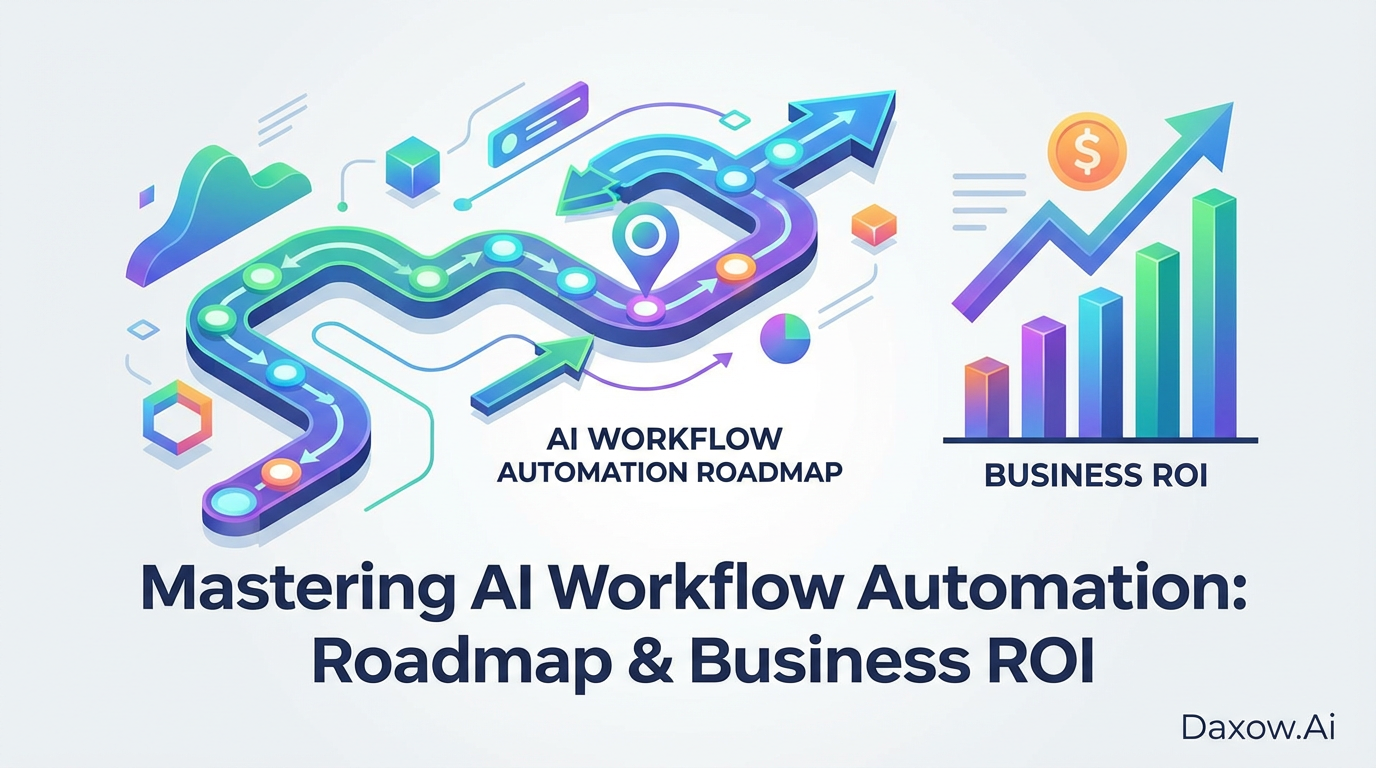
Strategic guide to mastering AI workflow automation - industry use cases, phased roadmap, KPIs and ROI examples from Daxow.ai.
Mastering AI Workflow Automation: A Strategic Imperative for Business Transformation
Estimated reading time: 15 minutes
Key Takeaways
- Mastering AI workflow automation enables organizations to reduce costs by 30–50% and accelerate project timelines 3–5x.
- AI agents combine rule-based automation with adaptive intelligence to deliver end-to-end process orchestration.
- Practical applications span multiple industries including e-commerce, healthcare, finance, real estate, HR, and customer support.
- A phased implementation roadmap and best practices ensure successful AI automation deployments.
- Daxow.ai delivers custom AI systems that integrate seamlessly, maintain governance, and ensure measurable ROI.
Table of Contents
- What Mastering AI Workflow Automation Means for Businesses
- Practical Use Cases Across Industries
- How AI Agents and Automation Drive Transformation
- Implementation Roadmap and Best Practices
- Measuring ROI and Business Value
- How Daxow.ai Delivers End-to-End AI Automation
- Next Steps — How to Start Mastering AI Workflow Automation
- Frequently Asked Questions
What Mastering AI Workflow Automation Means for Businesses
Mastering AI workflow automation means moving from isolated process improvements to intelligent, end-to-end orchestration that combines rule-based automation with adaptive AI agents. The result is processes that:
- Execute repetitive tasks reliably and at scale.
- Apply reasoning, natural language understanding and predictive analytics where rules are insufficient.
- Reduce operational costs and free human teams for higher-value work.
Key outcomes organizations achieve when they master this capability include 30–50% cost reductions in targeted workflows, 3–5x faster project timelines, and improvements such as 40% faster fulfillment in logistics and e-commerce operations. For decision-makers, the point of view must shift: automation is a multiplier of human potential, not a replacement in isolation.
Practical Use Cases Across Industries
E-commerce
Use case: Automated order processing, inventory management, and personalized customer interactions.
How it works:
- AI agents validate orders, trigger warehouse allocations, and update inventory across systems via integrations with ERP and WMS.
- Chatbots handle routine customer inquiries and escalate exceptions to human agents with context.
Impact:
- Reduced fulfillment time by up to 40%.
- Lowered manual order corrections and returns through automated validation.
- Increased conversion and repeat purchases from personalized recommendations and faster support.
Healthcare
Use case: Patient scheduling, triage, claims processing, and compliance monitoring.
How it works:
- Natural language chatbots perform symptom triage and schedule appointments.
- Document automation extracts key fields from claims and flags inconsistencies for human review.
- Built-in compliance modules ensure HIPAA-safe handling and auditable trails.
Impact:
- Reduced administrative overhead and faster patient response times.
- Fewer billing errors and improved regulatory readiness.
Finance
Use case: Invoice reconciliation, fraud detection, and KYC/AML workflows.
How it works:
- Intelligent agents match invoices to PO and receipt data, posting reconciled transactions or flagging exceptions.
- Real-time monitors surface anomalous transactions for investigation.
- Document extraction automates ID verification and compliance reporting.
Impact:
- Lower error rates and reduced regulatory risk.
- Faster close cycles and less time spent on manual reconciliation.
Real Estate
Use case: Lead qualification, property matching, and contract review.
How it works:
- AI scores incoming leads, prioritizes high-intent prospects, and schedules virtual tours automatically.
- NLP extracts clauses and key dates from lease and sale contracts to populate CRMs and trigger follow-ups.
Impact:
- Shorter sales cycles and better lead-to-close ratios.
- Reduced administrative time for agents and faster contract turnaround.
HR
Use case: Candidate screening, onboarding, and payroll queries.
How it works:
- Resume parsing and AI-led screening reduce initial review time.
- Automated onboarding workflows provision systems, collect documents, and schedule orientation.
- Chatbots answer payroll and benefit questions with escalation paths for exceptions.
Impact:
- Time-to-hire reduced by up to 50%.
- Improved candidate experience and higher internal productivity.
Customer Support & Sales Automation
Use case: Ticket routing, SLA-driven escalations, and lead qualification.
How it works:
- AI classifies and routes tickets to the right team or agent, reducing resolution time.
- Sales automation agents qualify leads, enrich profiles and schedule demos.
Impact:
- Higher first-contact resolution rates.
- Faster qualification and improved close rates.
How AI Agents and Automation Drive Transformation
AI agents are the differentiator that shifts automation from task execution to decision orchestration. They:
- Perceive: ingest multi-source data (text, documents, APIs).
- Reason: apply models and business rules to make decisions.
- Act: trigger downstream systems, update records, and escalate when needed.
Use-case orchestration example:
An AI agent handling an e-commerce refund:
- Ingests the ticket and order history.
- Verifies purchase and return policy via rule engine.
- Issues a refund through the payment gateway if criteria are met.
- Updates inventory and notifies warehouse for return pickup.
- Escalates to a human agent with context when fraud risk is detected.
Benefits:
- Significant reduction in human intervention — Daxow deployments often reduce manual handoffs by around 70%.
- 24/7 operations with consistent SLAs.
- Continuous learning: agents improve over time via feedback loops and retraining.
Implementation Roadmap and Best Practices
Phase 1 — Assess and Plan (4–8 weeks)
Actions:
- Conduct process audits to identify high-volume, high-cost workflows.
- Define measurable objectives (e.g., 20% cost reduction, 30% faster response).
- Map stakeholders and success metrics.
Checklist:
- Prioritized list of candidate processes.
- Baseline KPIs for cost, cycle time, and error rates.
Pitfall to avoid: vague objectives that lead to scope creep.
Phase 2 — Select Technology and Build Team (6–12 weeks)
Actions:
- Evaluate platforms for integration capabilities with CRM, ERP, and databases.
- Form a cross-functional team: business SMEs, IT, data engineers, and change managers.
- Define compliance requirements (GDPR, HIPAA).
Checklist:
- Integration matrix and security assessment.
- Governance model for agents.
Pitfall to avoid: choosing tools without proven integration capabilities.
Phase 3 — Prepare Data and Systems (4–8 weeks)
Actions:
- Cleanse and label data used for NLP and model training.
- Build knowledge bases and decision rules.
- Document escalation paths and exception handling.
Checklist:
- Data quality scorecard.
- Connectivity tests with target systems.
Pitfall to avoid: neglecting data governance leading to bias and drift.
Phase 4 — Pilot and Deploy (4–20 weeks)
Actions:
- Implement a no-code or low-code prototype for a single use case.
- Measure KPIs: cost per transaction, error rate, NPS, average handling time.
- Iterate based on operational feedback.
Checklist:
- Pilot KPI dashboard.
- Feedback loop for retraining models.
Pitfall to avoid: skipping user testing and stakeholder feedback.
Phase 5 — Optimize and Scale (Ongoing)
Actions:
- Retrain models regularly and monitor for model drift.
- Expand to adjacent workflows and integrate additional systems.
- Institutionalize change management and training to ensure adoption.
Checklist:
- Continuous monitoring dashboard.
- Governance policies for agent creation and deployment.
Pitfall to avoid: “agentic sprawl” — unmanaged proliferation of agents without governance.
Best practices summary:
- Start small with high-impact, low-complexity workflows.
- Ensure data readiness and governance from day one.
- Invest in change management to reach 90%+ adoption.
- Maintain compliance and audit trails for all automated actions.
- Use no-code prototyping to validate value before full engineering investment.
Measuring ROI and Business Value
Proving ROI requires a combination of upfront pilots and ongoing measurement. Key metrics to track:
- Cost per transaction before and after automation.
- Average handling time and throughput.
- Error rate and rework percentage.
- Customer satisfaction (NPS) and employee satisfaction.
- Time to value and payback period.
Typical outcomes observed in validated deployments:
- 20–50% cost savings on targeted workflows.
- 3–5x acceleration of project timelines and process throughput.
- Payback on investments commonly achieved within 6–12 months when pilots are chosen and executed correctly.
How Daxow.ai Delivers End-to-End AI Automation
At Daxow.ai we design and implement custom AI systems that align with business goals and integrate with your existing technology stack. Our approach is pragmatic and results-driven:
- Discovery and Process Analysis: We map workflows, identify quick wins, and quantify expected ROI.
- No-Code Prototyping: Rapidly validate hypotheses with low-cost prototypes to prove value.
- Custom AI Agents: Build agents that orchestrate tasks across systems — from CRM updates and ticket routing to predictive forecasting and document automation.
- Integrations and Data Connectivity: Seamlessly connect to ERPs, CRMs, payment systems, and third-party APIs with secure, auditable connectors.
- Governance and Scale: Implement policies to control agent creation, monitor performance, and prevent agentic sprawl.
- Continuous Optimization: Retrain models, refine rules, and add capability modules based on live performance data.
Real example engagements:
- A mid-market e-commerce client reduced manual order exceptions by 60% and accelerated fulfillment by 35% through integrated AI agents that manage order validation, inventory updates, and customer messaging.
- A financial services firm automated invoice reconciliation and anomaly detection to reduce close-cycle errors by 45% and strengthen compliance reporting.
- A healthcare provider implemented patient triage and appointment automation to reduce administrative workload and improve patient access times.
Why choose Daxow.ai
- End-to-end expertise from process analysis to enterprise-grade deployment.
- Focus on measurable business outcomes and quick time-to-value.
- Industry experience across e-commerce, finance, healthcare, real estate, and HR.
- Secure, compliant integrations and governance frameworks that meet regulatory needs.
Learn more about our services on the Daxow.ai Services page.
Next Steps — How to Start Mastering AI Workflow Automation
If your organization is ready to reduce manual tasks, improve productivity, and unlock scalable business automation, begin with a focused evaluation:
- Select one high-volume process with clear KPIs.
- Run a 6–8 week assessment with a no-code prototype.
- Measure results and plan phased rollouts based on impact.
Book a free consultation with Daxow.ai to request a process analysis for your company. Our team will evaluate your most repetitive workflows, quantify potential savings, and design a clear roadmap to deploy AI agents and workflow automation that deliver tangible ROI.
Frequently Asked Questions
What is AI workflow automation?
AI workflow automation uses artificial intelligence to automate repetitive business processes, combining rule-based logic with adaptive intelligence such as natural language understanding and predictive analytics.
How can AI workflow automation benefit my business?
It reduces manual work, lowers operational costs, accelerates project timelines, improves accuracy, and allows human teams to focus on higher-value tasks.
Which industries can leverage AI workflow automation?
E-commerce, healthcare, finance, real estate, HR, customer support, and sales are notable industries already benefiting from AI workflow automation.
How does Daxow.ai support AI automation implementation?
Daxow.ai offers end-to-end services including process analysis, no-code prototyping, custom AI agent development, integration, governance, and continuous optimization to maximize business value.