
Mastering AI Workflow Automation: Roadmap & Use Cases
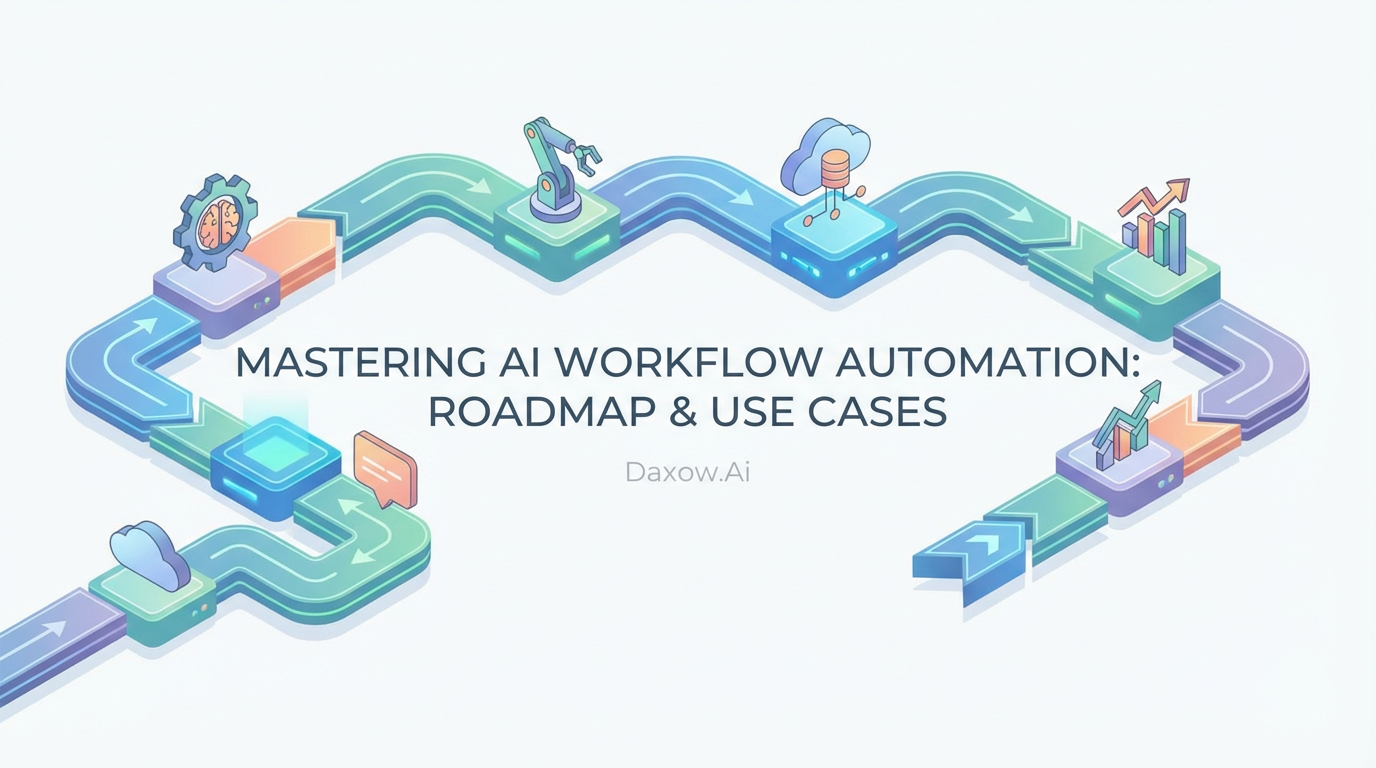
Daxow.ai’s practical guide to AI workflow automation: roadmap, industry use cases, integrations, governance, and ROI strategies to cut manual work.
Mastering AI Workflow Automation: A Strategic Imperative for Business Transformation
Estimated reading time: 15 minutes
Key Takeaways
- AI workflow automation is essential for scaling, reducing costs, and enhancing customer experiences.
- Daxow.ai offers end-to-end solutions integrating AI agents with existing business systems for measurable ROI.
- Industry-specific use cases demonstrate significant efficiency and cost benefits.
- Successful AI automation requires a disciplined implementation roadmap and strong governance.
- Continuous optimization and clear KPIs ensure sustained business value from automation investments.
Table of Contents
- Why Prioritize AI Workflow Automation Now?
- What AI Workflow Automation Means for Businesses
- Practical Use Cases Across Industries
- How AI Agents and Automation Drive Success
- Implementation Roadmap and Best Practices
- Governance, Risk, and Change Management
- Measuring ROI and Business Value
- Practical Checklist: How to Start Automating Today
- Why Partner with Daxow.ai
- Frequently Asked Questions
Why Prioritize AI Workflow Automation Now?
Mastering AI Workflow Automation: A Strategic Imperative for Business Transformation is no longer a theoretical advantage — it is a practical necessity for organizations that want to scale, reduce costs, and deliver superior customer experiences. For decision-makers, this means moving beyond point solutions and adopting a structured, measurable approach to AI automation that targets high-impact processes, integrates with existing systems, and delivers clear ROI. This article synthesizes best practices, real use cases across industries, and a step-by-step implementation roadmap — framed around how Daxow.ai designs and deploys custom AI systems to automate workflows, build AI agents, and reduce manual tasks.
- Competitive pressure: Customers expect faster, personalized service. Manual processes slow response times and erode margins.
- Operational scale: As transaction volume grows, manual tasks create bottlenecks and errors.
- Measurable outcomes: AI automation can deliver 20–50% efficiency gains, faster project timelines, and lower operating costs when applied to the right processes.
Daxow.ai helps organizations identify these high-impact opportunities and translate them into production-grade automation that integrates with CRMs, ERPs, ticketing systems, and data stores.
What AI Workflow Automation Means for Businesses
Core capabilities and business outcomes
AI workflow automation combines machine learning, natural language processing (NLP), robotic process automation (RPA), and API-driven integrations to:
- Automate repetitive, rule-based work (data entry, invoice processing).
- Triage and respond to customer inquiries via chatbots and AI agents.
- Extract structured data from documents and feed it into workflows.
- Orchestrate cross-system processes with minimal human intervention.
Expected business outcomes:
- Reduced manual tasks across teams (support, sales, finance, HR).
- Improved productivity as staff focus on strategic work.
- Faster decision-making through automated insights and recommendation engines.
- Lower operational costs with reliable, scalable automation.
Daxow.ai constructs end-to-end solutions — from process discovery to production monitoring — to ensure these outcomes are achieved and sustained.
Practical Use Cases Across Industries
E‑commerce
- Use case: Automated order processing and returns handling
- What it does: Extracts order data, validates inventory, triggers fulfillment, and routes exceptions to human agents.
- Business value: Reduces fulfillment errors, shortens delivery cycles, and improves conversion rates through faster order confirmation.
- Daxow.ai role: Build integrations with e-commerce platforms, implement demand-forecasting models, and deploy AI agents to manage exception workflows.
Healthcare
- Use case: Patient scheduling and claims pre-processing
- What it does: Automates appointment booking from multiple channels, pre-screens insurance details, and flags compliance issues.
- Business value: Reduces administrative burden, accelerates triage, and maintains compliance with data protection requirements.
- Daxow.ai role: Implement secure data pipelines, design HIPAA-aware automation, and deploy conversational agents for patient engagement.
Finance
- Use case: Invoice reconciliation and fraud detection
- What it does: Extracts invoice data, reconciles against purchase orders, auto-approves routine invoices, and escalates suspicious items to analysts.
- Business value: Cuts invoice processing costs by 40–60%, shortens cycle times, and improves control over payments.
- Daxow.ai role: Build document extraction models, integrate with accounting systems, and create monitoring dashboards for finance teams.
Real Estate
- Use case: Lead qualification and contract automation
- What it does: Qualifies incoming leads by parsing intent and property criteria, automates listing updates, and prepares contract templates.
- Business value: Speeds deal cycles, reduces manual entry, and improves conversion rates by prioritizing hot leads.
- Daxow.ai role: Deploy AI agents for lead scoring, set up CRM integrations, and automate document generation.
HR and Administration
- Use case: Resume screening and onboarding
- What it does: Screens resumes for fit, schedules interviews, and automates routine onboarding tasks.
- Business value: Reduces time-to-hire, improves candidate experience, and frees HR for strategic initiatives.
- Daxow.ai role: Create fair, bias-aware screening models and automate onboarding workflows across collaboration platforms.
Customer Support Automation
- Use case: Ticket triage and self-service
- What it does: Classifies and routes tickets, provides instant answers via chatbots, and escalates complex issues to human agents with context.
- Business value: Improves first-response times, increases resolution rates, and reduces support headcount pressure.
- Daxow.ai role: Design conversational flows, integrate knowledge bases, and train agents to continuously improve accuracy.
How AI Agents and Automation Drive Success
What makes AI agents different
AI agents are not static scripts. They:
- Make decisions using predictive models and business rules.
- Learn from feedback and retrain on new data to prevent performance drift.
- Act across systems through APIs — creating end-to-end automation that replaces manual handoffs.
Integration and orchestration
To avoid isolated automation “sprawl,” agents must:
- Connect to core systems (CRM, ERP, ticketing).
- Maintain data lineage and auditable logs.
- Be governed centrally for security and compliance.
Daxow.ai builds AI agents that execute real tasks: qualifying leads, updating records, escalating exceptions, and triggering follow-up actions — all while maintaining traceability and governance.
Implementation Roadmap and Best Practices
Phase 1 — Assessment and Planning (4–8 weeks)
- Activities: Map processes, identify high-impact candidates, define KPIs (e.g., reduce manual touches by 50%).
- Deliverable: Prioritized automation backlog and data readiness assessment.
- Best practice: Start with a process that is high-value and low-complexity to prove value quickly.
Phase 2 — Technology and Vendor Selection (6–12 weeks)
- Activities: Evaluate platforms for scalability and integration capabilities.
- Deliverable: Architecture blueprint and vendor selection.
- Best practice: Choose solutions that enable easy API integration and support retraining.
Phase 3 — Preparation (4–8 weeks)
- Activities: Assemble cross-functional teams (IT, business SMEs, security), clean and label data, build knowledge bases.
- Deliverable: Test datasets, integration connectors, and governance plan.
- Best practice: Ensure compliance requirements (e.g., data residency, HIPAA) are addressed early.
Phase 4 — Pilot Deployment and Gradual Rollout (4–20 weeks)
- Activities: Deploy a single use case, measure KPIs (resolution rate, processing time), iterate quickly.
- Deliverable: Validated pilot with measured outcomes.
- Best practice: Expand horizontally by adding channels, languages, or adjacent processes only after achieving target metrics.
Phase 5 — Ongoing Optimization
- Activities: Monitor performance dashboards, set retraining cadences, implement feedback loops.
- Deliverable: Continuous improvement plan and drift mitigation strategy.
- Best practice: Use alerts for performance dips and schedule regular reviews with stakeholders.
Governance, Risk, and Change Management
Avoiding common pitfalls
- Poor data quality: Leads to unreliable automation.
- Scope creep: Causes delays and budget overruns.
- Lack of governance: Risks noncompliance and performance degradation.
What Daxow.ai enforces
- Governance from day one: Roles, versioning, and audit trails.
- Bias detection and fairness checks: Especially important in HR and finance.
- Clear SLA and rollback paths: Ensures business continuity.
Measuring ROI and Business Value
KPIs to track
- Efficiency: Reduction in manual touches and processing time.
- Financial: Labor cost saved, error reduction, and processing cost per transaction.
- Customer: CSAT, NPS, first-response time.
- Operational: Model accuracy, escalation rates, and throughput.
Example ROI scenarios
- Invoice automation: 40–60% cost reduction in manual processing and 3–5x faster cycle times.
- Support automation: 20–50% reduction in average handle time and improved first-contact resolution.
- Sales automation: Higher lead conversion by prioritizing qualified leads and faster follow-ups.
Daxow.ai helps set realistic baselines and builds dashboards so stakeholders can monitor ROI and make data-driven decisions to scale automation.
Practical Checklist: How to Start Automating Today
- Identify 3–5 processes consuming the most manual effort.
- Quantify baseline metrics (time, cost, error rates).
- Choose a single pilot with measurable outcomes.
- Secure executive sponsorship and assemble a cross-functional team.
- Ensure data accessibility and compliance readiness.
- Deploy a minimum viable automation, measure results, iterate, and scale.
Daxow.ai supports every step: from process discovery to building production-grade AI agents and integrating them with business tools and CRMs.
Why Partner with Daxow.ai
- Custom AI systems: We design tailored agents and workflows that execute real tasks and integrate with your systems.
- End-to-end automation: From discovery and data preparation to deployment, governance, and continuous optimization.
- Cost reduction and ROI focus: We prioritize high-impact use cases that deliver measurable savings and productivity gains.
- Systems and integrations: We connect automation to CRMs, ERPs, ticketing systems, and knowledge bases to eliminate silos.
- Operational readiness: Our teams ensure secure, compliant deployments with monitoring and retraining strategies to prevent drift.
Clients work with Daxow.ai because we combine technical depth with business-first thinking: building solutions that reduce manual tasks, improve customer experiences, and accelerate growth.
Frequently Asked Questions
What is AI workflow automation?
AI workflow automation uses artificial intelligence technologies such as machine learning, NLP, and RPA to automate and optimize business processes that are repetitive or require decision-making.
How can AI agents improve business operations?
AI agents are capable of autonomous decision-making and integration across systems, enabling end-to-end automation that reduces manual handoffs, improves accuracy, and accelerates process cycles.
What industries benefit most from AI workflow automation?
Industries such as e-commerce, healthcare, finance, real estate, HR, and customer support have demonstrated measurable gains through AI workflow automation.
How does Daxow.ai support AI automation implementation?
Daxow.ai offers end-to-end services from process assessment and planning to technology selection, pilot deployments, governance, continuous optimization, and integration with existing business systems.