
Master AI Workflow Automation: Transform Your Business Operations
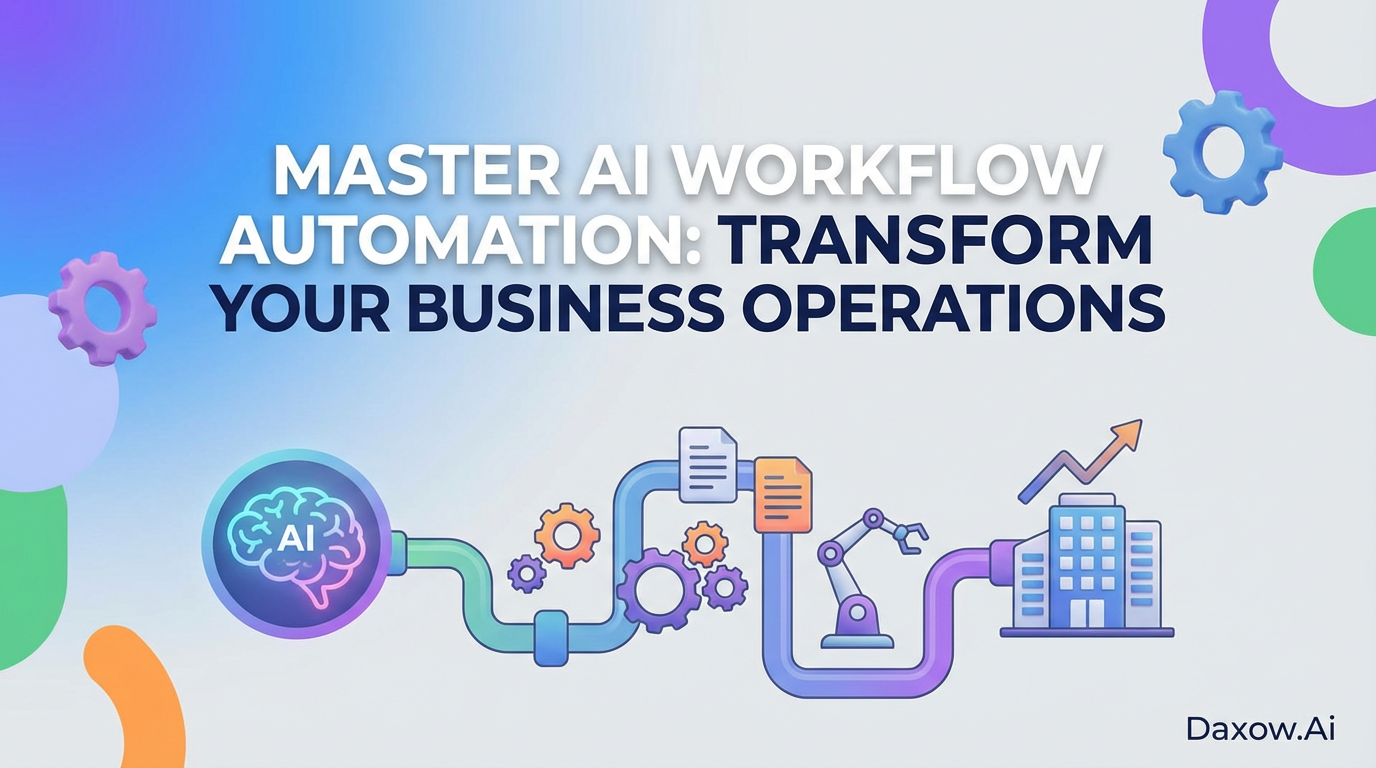
How AI agents and workflow automation cut costs, boost productivity, and scale operations. Includes implementation steps, industry use cases, and Daxow.ai examples.
Mastering AI Workflow Automation: Transform Your Business Operations
Estimated reading time: 15 minutes
Key Takeaways
- AI workflow automation reduces manual tasks, increases productivity, and scales operations efficiently.
- AI agents paired with automation create resilient, end-to-end business processes with measurable ROI.
- Industries including e-commerce, healthcare, finance, real estate, and HR benefit from targeted AI workflows.
- A phased implementation approach minimizes risk and accelerates value realization.
- Daxow.ai provides custom AI systems integrating core enterprise tools for maximum operational impact.
Table of Contents
- Mastering AI Workflow Automation: Transform Your Business Operations
- Practical Use Cases Across Industries
- Implementation Steps and Best Practices
- Measuring ROI and Business Value
- How Daxow.ai Designs and Delivers End-to-End AI Workflow Automation
- Final Recommendations for Decision-Makers
- Conclusion — Take the Next Step
- Frequently Asked Questions
Mastering AI Workflow Automation: Transform Your Business Operations
AI workflow automation integrates artificial intelligence into operational processes to automate routine tasks, optimize decisions, and orchestrate end-to-end flows. At the center of this shift are AI agents — autonomous software entities that perceive data, make decisions, and execute actions across systems without constant human oversight. When combined with workflow automation, AI agents create resilient, scalable processes that reduce manual work, raise productivity, and improve customer and employee experiences.
What AI Workflow Automation Means for Your Business
- Reclaim employee time: Many teams spend the majority of their time on repetitive tasks. With AI workflow automation, businesses can reclaim a significant portion of this effort — increasing focus on strategic work and innovation.
- Increase productivity and accuracy: Automated workflows reduce human error and speed up processing times. Typical improvements include productivity gains of up to 40% and process acceleration of 40–60%.
- Scale without linear headcount growth: Automation allows companies to handle higher volumes — in many cases 10x — without proportionate hiring.
- Faster, measurable ROI: When implemented correctly, AI automation can produce 20–50% cost savings in the first year and deliver 200–400% ROI within 18–24 months.
How AI Agents and Automation Drive Success
AI agents serve as intelligent orchestrators that bridge systems (CRMs, ERPs, ticketing, knowledge bases) and human teams. They use natural language processing to interact with customers and staff, machine learning to predict outcomes and optimize decisions, and APIs to trigger actions in your existing tools.
- Complementary capabilities:
- Workflow automation handles rule-based tasks (data entry, approvals, routing).
- AI agents provide reasoning for non-deterministic tasks (escalations, triage, recommendations).
- Together, they create hyperautomation: end-to-end automation that self-improves via feedback loops, reducing the need for manual intervention by 60–80%.
- Operational resilience: AI-driven workflows adapt to load, detect anomalies, and maintain compliance in regulated environments.
Practical Use Cases Across Industries
E-commerce — Order-to-Cash and Customer Experience
- Use case: Automate order confirmation, inventory verification, payment reconciliation, fraud detection, and returns processing.
- Result: Faster order fulfillment, reduced cart abandonment, and fewer manual refund disputes.
- Practical example: An AI agent checks inventory in real time, applies dynamic pricing rules, flags suspicious transactions for review, and updates the ERP and CRM automatically. This reduces order processing time by 50% and decreases chargeback rates through automated fraud scoring.
- Daxow role: Build AI agents that integrate your storefront, ERP, and payment gateway, and deploy workflows that reduce manual interventions and increase conversion. Explore our AI agent solutions in the E-commerce Solutions page.
Healthcare — Patient Intake and Claims Processing
- Use case: Automate patient onboarding, appointment scheduling, insurance verification, and claims triage while ensuring compliance.
- Result: Reduced administrative burden, faster patient responses, and fewer claim denials.
- Practical example: A patient-facing chatbot collects intake forms, verifies insurance via API, schedules appointments, and routes complex cases to clinical staff. Back-office agents extract and validate claims data, flag anomalies, and push claims to payers.
- Daxow role: Implement HIPAA-compliant automation, integrate EMRs, and deploy AI agents that improve throughput and reduce administrative costs by up to 30–50%. Learn more on our Healthcare Automation page.
Finance — Invoicing, KYC, and Fraud Monitoring
- Use case: Automate invoice capture, accounts payable approvals, KYC verification, real-time transaction monitoring, and compliance reporting.
- Result: Faster close cycles, fewer manual reconciliations, enhanced detection of suspicious activity.
- Practical example: Optical character recognition (OCR) extracts invoice data, an AI agent verifies supplier details and matches PO lines, and automated approvals follow business rules. For risk, agents monitor transactions and escalate suspicious patterns to compliance teams.
- Daxow role: Connect banking, accounting, and compliance systems with secure automation to cut processing times and improve auditability.
Real Estate — Lead Qualification and Contract Automation
- Use case: Automate listing syndication, lead qualification, virtual tour scheduling, and contract review/closure workflows.
- Result: Faster lead-to-close cycles, better agent productivity, and standardized contract compliance.
- Practical example: An AI agent parses incoming leads, scores them against buyer criteria, schedules viewings, and prepares standardized contracts for signature. It also integrates market data to provide pricing recommendations.
- Daxow role: Create AI agents that integrate MLS data, CRM systems, and e-signature platforms to accelerate transactions and reduce manual paperwork.
HR — Recruitment, Onboarding, and Retention
- Use case: Automate resume screening, initial interviews via chatbots, onboarding checklists, and payroll/vendor coordination.
- Result: Higher quality hires, faster onboarding, and reduced churn.
- Practical example: AI screens applicant resumes, schedules interviews, and the onboarding bot guides new hires through compliance forms and benefits enrollment. Workforce analytics predict attrition and trigger retention workflows.
- Daxow role: Deploy recruitment automation connected to ATS, HRIS, and collaboration tools to streamline the entire employee lifecycle.
Implementation Steps and Best Practices
1. Assessment and Planning (4–8 weeks)
- Define measurable goals (e.g., reduce processing time by 50%).
- Conduct a process audit to identify repetitive, high-impact workflows.
- Evaluate data quality and accessibility.
Outcome: A prioritized roadmap of processes primed for automation.
2. Technology and Team Selection (6–12 weeks)
- Choose platforms compatible with your stack and compliance needs.
- Assemble a cross-functional team: IT, business SMEs, compliance, and change leads.
Outcome: A technology selection and staffing plan ready for pilot deployment.
3. Preparation and Data Readiness (4–8 weeks)
- Cleanse and label data.
- Build knowledge bases and decision trees.
- Design integration workflows and risk/rollback plans.
Outcome: Reliable input data and documented workflows for pilot.
4. Pilot and Deployment (4–20 weeks)
- Launch a single high-impact use case.
- Monitor KPIs, gather feedback, and iterate.
- Expand to additional teams, regions, and channels gradually.
Outcome: Validated automation with performance baselines and refinement paths.
5. Continuous Optimization
- Implement monitoring for model drift, bias, and performance.
- Establish feedback loops for updates and retraining.
Outcome: Long-term adaptability and improved accuracy.
Best Practices Summary
- Start small with low-complexity, high-impact processes.
- Prioritize data readiness and ethical AI practices (bias audits, transparency).
- Drive change management with clear communication and training.
- Plan for scalability with a 3–5 year technology roadmap.
- Avoid common pitfalls like skipping pilots or neglecting data quality, which derail many initiatives.
Measuring ROI and Business Value
Quantify impacts early and often. Key metrics to track:
- Efficiency: process time reductions (target 40–60% faster).
- Cost savings: labor and error reduction (target 20–50% in year one).
- Productivity: reclaimed employee time and output increases (up to 40%).
- Customer impact: faster response times and improved satisfaction.
- Scalability: volume handled per unit of headcount.
- Revenue uplift: improvements in forecasting and conversion (sales forecasting accuracy can improve 15–30%).
With disciplined execution and the right partner, organizations commonly see 200–400% ROI within 18–24 months. Daxow focuses on measurable outcomes and ties KPIs back to business goals to ensure you realize this value.
How Daxow.ai Designs and Delivers End-to-End AI Workflow Automation
Daxow.ai builds custom AI systems that move beyond point solutions to automate entire processes end-to-end. Our approach combines domain expertise, systems integration, and operational change management.
- Process discovery and analysis: We map your current workflows, identify automation opportunities, and quantify expected savings.
- Custom AI agent development: We design agents that execute real tasks — from data extraction and decisioning to multi-system orchestration.
- Workflow automation and integrations: We connect CRMs, ERPs, ticketing systems, and data stores to create seamless processes.
- Compliance and security: We implement governance, logging, and controls for regulated environments.
- Pilot, deploy, and scale: We pilot focused use cases, iterate quickly, and scale across teams and geographies.
- Continuous optimization and support: We monitor performance, retrain models, and update automations as your business evolves.
Specific ways Daxow.ai drives value:
- Reduce manual tasks by building agents that perform repetitive work autonomously.
- Improve productivity via integrations that eliminate context switching and duplicate data entry.
- Lower operational costs through faster processing and fewer errors.
- Enhance customer support automation with conversational AI that resolves routine queries and escalates complex issues.
- Increase sales efficiency with sales automation and lead qualification that prioritizes high-value prospects.
Practical Engagement Example
- Discovery (2–4 weeks): We identify 3 priority workflows and baseline current metrics.
- Pilot (6–12 weeks): We deliver an AI agent integrated with your CRM and helpdesk that automates lead qualification and customer triage.
- Scale (3–6 months): After proving results, we expand to billing, support SLAs, and cross-department automations, delivering consolidated ROI reporting.
Learn more about our approach on the About Daxow.ai page.
Final Recommendations for Decision-Makers
- Begin with a focused pilot that maps directly to revenue or cost objectives.
- Invest in data hygiene and a governance framework before large-scale model deployment.
- Choose a partner with integration experience and a track record of building production-grade AI agents.
- Communicate early and often with impacted teams to secure adoption and collect iterative feedback.
Conclusion — Take the Next Step
AI workflow automation is a strategic lever for companies that want to reduce manual tasks, improve productivity, and transform customer and employee experiences. Mastering AI workflow automation unlocks measurable savings, faster throughput, and the ability to scale with confidence.
Book a free consultation with Daxow.ai to request a process analysis for your company. Let us design a custom AI system that automates your highest-impact workflows, reduces operational costs, and delivers measurable ROI. Contact us to build AI agents and end-to-end business automation tailored to your operations.
Frequently Asked Questions
What is AI workflow automation?
AI workflow automation is the integration of artificial intelligence technologies with business process automation to manage routine and complex tasks autonomously, improving efficiency and decision-making.
How quickly can my organization see ROI from AI automation?
Organizations typically see measurable cost savings and productivity improvements within the first year, with 200–400% ROI achievable in 18–24 months when implemented correctly.
What industries benefit most from AI workflow automation?
E-commerce, healthcare, finance, real estate, and human resources are notable industries where AI workflow automation drives significant operational improvements.
How does Daxow.ai support compliance and security?
Daxow.ai incorporates governance, security controls, and logging to comply with regulatory requirements such as HIPAA, ensuring secure and auditable AI workflow implementations.