
Master AI Workflow Automation: Roadmap, Use Cases & ROI
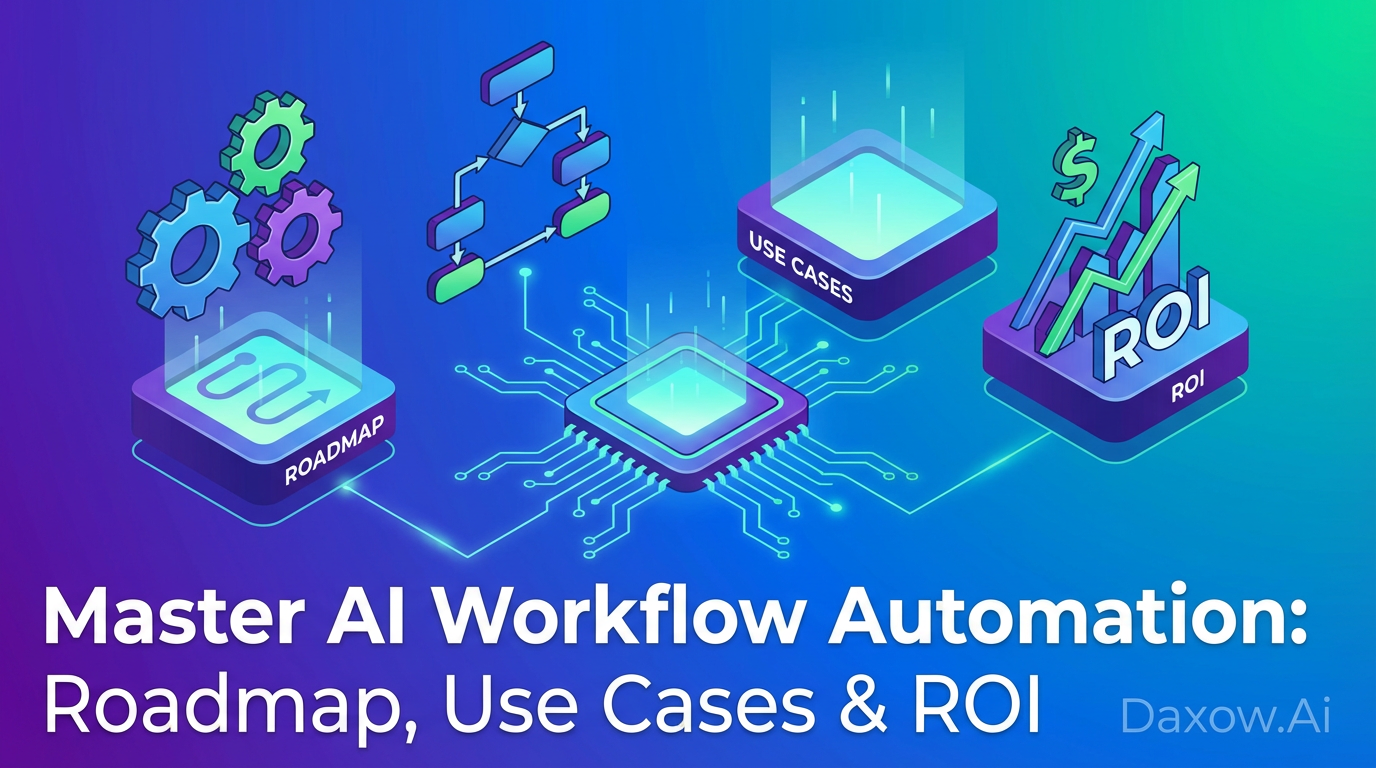
Practical roadmap to implement AI workflow automation with industry use cases, ROI benchmarks, and Daxow.ai's approach to reduce costs and scale operations.
Mastering AI Workflow Automation: A Strategic Imperative for Business Transformation
Estimated reading time: 15 minutes
Key Takeaways
- AI workflow automation transforms repetitive tasks into auditable, scalable processes, cutting costs by 30–60% and reducing human intervention by up to 80%.
- Core AI automation capabilities include data extraction, intelligent routing, predictive models, conversational agents, and orchestration across business tools.
- Cross-industry use cases demonstrate rapid business value in e-commerce, healthcare, finance, real estate, and HR.
- A phased implementation roadmap and best practices minimize risk and maximize ROI, supported by Daxow.ai’s custom AI solutions.
- Effective governance and continuous improvement ensure AI automation delivers sustainable competitive advantage.
Table of Contents
- Mastering AI Workflow Automation: A Strategic Imperative for Business Transformation
- What AI Workflow Automation Means for Businesses
- How AI Agents and Automation Drive Success
- Practical Use Cases Across Industries
- Implementation Roadmap and Best Practices
- Measuring ROI and Business Value
- Common Risks and How Daxow Mitigates Them
- How Daxow.ai Designs and Delivers Custom AI Systems
- Example Implementation — A Compact Case Scenario
- Next Steps for Leaders Ready to Transform
- Frequently Asked Questions
Mastering AI Workflow Automation: A Strategic Imperative for Business Transformation
Mastering AI Workflow Automation: A Strategic Imperative for Business Transformation is not just a headline — it is a practical roadmap for companies that want to reduce manual tasks, scale operations, and unlock measurable productivity gains. As AI automation moves from pilot projects to production-grade systems, decision-makers must understand how AI agents, workflow automation, and integrations with core business tools deliver real ROI. This article explains what AI workflow automation means for businesses, presents cross-industry use cases, outlines a clear implementation roadmap, and shows how Daxow.ai helps organizations design and deploy custom AI systems that reduce operational costs and improve customer experience.
Why this is strategic
- AI automation turns repetitive, rule-based work into reliable, auditable processes.
- When combined with intelligent agents and analytics, it transforms decision-making and customer interactions.
- Organizations that execute well can cut operational costs by 30–60% in targeted workflows and reduce human intervention in routine tasks by 70–80%, freeing teams for higher-value work.
This shift affects every function: customer support, sales, finance, HR, operations, and product. Successful programs deliver faster cycle times, improved accuracy, and the agility to adapt to market changes — all key components of sustainable competitive advantage.
What AI Workflow Automation Means for Businesses
Core capabilities
- Automated data capture and extraction from invoices, contracts, and forms.
- Intelligent routing and triage of service requests and sales leads.
- Predictive models for decision support (fraud detection, churn prediction, inventory forecasting).
- Conversational AI agents for first-line support, lead qualification, and virtual assistants.
- Orchestration across systems (CRMs, ERPs, ticketing, document repositories).
Business outcomes
- Faster execution: Shorter cycle times for approvals, claims, and order fulfillment.
- Higher accuracy: Reduced human error in data entry and compliance tasks.
- Scalability: Ability to handle volume growth without proportional headcount increases.
- Improved customer satisfaction: Faster, more consistent responses across channels.
- Cost reduction: Targeted cost savings of 30–60% on automated activities and faster time-to-value.
How AI Agents and Automation Drive Success
AI agents are software entities that can perform tasks autonomously, learn from interactions, and execute workflows across systems. When built into a broader automation strategy, they enable:
- End-to-end orchestration: Agents coordinate actions across multiple systems, handling exceptions and escalating complex cases to humans.
- Adaptive learning: Agents improve via feedback loops and retraining, which keeps performance high as conditions change.
- Human-AI collaboration: Agents take over repetitive tasks while humans focus on oversight, strategy, and edge-case handling.
Practical impact: organizations using AI agents and workflow automation report dramatically reduced manual workload, higher throughput, and continuous process improvement through analytics.
Practical Use Cases Across Industries
E-commerce — Faster fulfillment and better conversions
Use case:
- Automate order validation, inventory reconciliation, returns processing, and customer inquiries.
- Deploy conversational AI to handle order status, returns initiation, and personalized product suggestions.
Outcomes:
- 30–50% reduction in fulfillment times.
- Lower return processing costs and improved customer NPS.
How Daxow helps:
- Build AI agents that integrate with commerce platforms and warehouses.
- Automate pricing and stock alerts with predictive models and runbooks.
Healthcare — Streamlined administration and safer care
Use case:
- Automate patient scheduling, pre-authorization, claims triage, and clinical documentation capture.
- AI agents flag urgent cases and support triage workflows while maintaining compliance.
Outcomes:
- Reduced administrative burden on clinicians.
- Faster claims processing and fewer denials.
How Daxow helps:
- Design HIPAA-aware automation, integrate with EHRs, and implement secure data pipelines.
Finance — Accurate reconciliation and stronger compliance
Use case:
- Automate invoice matching, KYC verification, AML monitoring, and audit trail generation.
- Real-time transaction monitoring and predictive fraud alerts.
Outcomes:
- Lower error rates and faster month-end close.
- Reduced regulatory risk and audit readiness.
How Daxow helps:
- Connect AI agents to core finance systems and implement robust logging and governance.
Real Estate — Accelerated lead-to-deal cycle
Use case:
- Automate lead qualification, contract reviews, appointment scheduling, and market trend analysis.
- Use NLP to extract clauses from contracts and surface negotiation points.
Outcomes:
- Faster response to prospects and increased conversion rates.
- Better risk control in contract execution.
How Daxow helps:
- Build lead qualification agents that integrate with CRMs and calendar systems to automate follow-ups.
HR — Faster hiring and smarter retention
Use case:
- Automate resume screening, interview scheduling, onboarding workflows, and sentiment analysis for retention risk.
Outcomes:
- Hiring time reduced by up to 40%.
- Better candidate experience and lower early turnover.
How Daxow helps:
- Implement AI screening workflows that surface qualified candidates and automate offer and onboarding sequences.
Implementation Roadmap and Best Practices
1. Assess and Plan (4–8 weeks)
- Map current workflows and identify high-volume, high-impact tasks.
- Define measurable targets (cost reduction, response time, accuracy).
- Assess data quality, compliance and integration needs.
Daxow role: Conduct a process analysis and ROI scoping workshop. Prioritize use cases for quick wins.
2. Select Technology and Build Team (6–12 weeks)
- Choose platforms optimized for integrations, NLP, and model management.
- Assemble a cross-functional team: process owners, data engineers, developers, and change managers.
Daxow role: Recommend vendor-neutral technology stacks. Provide certified engineers and project leads to augment your team.
3. Prepare Data and Systems (4–8 weeks)
- Cleanse and label data, build knowledge bases, and design integration touchpoints.
- Define security and governance controls.
Daxow role: Implement secure data pipelines, build document extraction models, and set up logging and monitoring.
4. Pilot, Deploy, and Scale (4–20 weeks)
- Run a focused pilot, collect metrics, refine models, and expand across departments.
- Establish ongoing retraining cycles and monitoring KPIs.
Daxow role: Execute pilot deployments, manage rollout, and provide continuous optimization support.
Best practices (practical)
- Start small: Prioritize high-volume, low-complexity workflows to demonstrate value quickly.
- Invest in change management: Train users, communicate benefits, and define new role responsibilities.
- Monitor continuously: Track KPIs and retrain models to maintain performance.
- Govern proactively: Implement escalation rules to prevent agentic sprawl and ensure ethical usage.
Measuring ROI and Business Value
KPIs to track
- Cost per transaction or case.
- Cycle time reduction (e.g., time-to-resolution).
- Automation rate: percentage of tasks fully automated.
- Accuracy improvements: error rates before vs after.
- Customer satisfaction and employee productivity.
Benchmarks from implementation programs
- Cost reductions on automated tasks commonly range 30–60%.
- Routine manual intervention can decline by 70–80%, enabling headcount redeployment.
- Payback periods are frequently under 12 months for well-scoped pilots.
How to calculate expected ROI
- Estimate current cost of a process (labor, error remediation, tooling).
- Project automation rate and efficiency uplift from pilot data.
- Factor in ongoing maintenance, model retraining, and integration costs.
Daxow role: Provide a detailed business case and KPI dashboard to monitor ROI and guide decisions.
Common Risks and How Daxow Mitigates Them
- Risk: Poor data quality
Mitigation: Data profiling, cleansing, and robust validation layers. - Risk: Lack of adoption
Mitigation: Change management, role-based training, and early involvement of end-users. - Risk: Compliance and security gaps
Mitigation: Design with privacy-by-default, audit trails, and role-level access controls. - Risk: Agentic sprawl and uncontrolled automation
Mitigation: Governance frameworks, clear escalation paths, and continuous auditing. - Risk: Overly broad scope and long timelines
Mitigation: Agile pilots with measurable milestones and rollback plans.
How Daxow.ai Designs and Delivers Custom AI Systems
Services overview
- Process discovery and value mapping: Identify opportunities with fast ROI.
- Custom AI agent development: Build agents that execute real tasks — from lead qualification to claims triage.
- Workflow automation and orchestration: Connect agents to CRMs, ERPs, and ticketing systems for seamless execution.
- Data engineering and integrations: Secure connectors, transformation pipelines, and monitoring.
- Continuous improvement: Model retraining, performance monitoring, and feature expansion.
Delivery model
- Rapid discovery sprint to validate high-value use cases.
- Iterative development with pilot deployments and measurable KPIs.
- Clear governance and support for change management and operational handover.
Realistic outcomes we deliver
- Reduced manual tasks and processing times.
- Improved customer support automation and faster sales cycles.
- More accurate data across finance and compliance workflows.
- Predictable ROI with transparent dashboards.
Example Implementation — A Compact Case Scenario
Scenario: Mid-size e-commerce company
- Challenge: High volume of customer support tickets and slow returns processing.
- Daxow solution:
- Deploy conversational AI agents for first-line support across chat and email.
- Automate returns ingestion, validation, and refund approvals through workflow automation tied to the ERP.
- Results:
- First-response time cut by 70%.
- Returns processing costs reduced by 40%.
- Customer satisfaction increased and support headcount shifted to higher-value tasks.
These results reflect achievable outcomes when you pair focused use-case selection with robust integrations and governance.
Next Steps for Leaders Ready to Transform
If your priority is to reduce manual tasks, improve productivity, and unlock scalable growth through AI automation, you should:
- Start with a targeted process analysis to identify quick wins.
- Define measurable KPIs and a realistic pilot timeline.
- Choose a partner that delivers both technical expertise and process change capability.
Daxow.ai specializes in designing, building, and operating custom AI systems that deliver these outcomes. We combine deep process engineering, secure integrations, and AI agent development to automate work end-to-end and maximize ROI.
Book a free consultation or request a process analysis for your company to identify the right AI workflow automation strategy. Contact us to build a custom AI system that reduces operational costs, improves productivity, and transforms customer and employee experiences.
Frequently Asked Questions
What is AI workflow automation?
AI workflow automation uses intelligent agents and integrated systems to automate routine business processes, reducing manual work and improving efficiency.
How quickly can businesses see ROI from AI automation?
Many implementations see payback within 12 months by targeting high-impact workflows and leveraging proven processes.
Which industries benefit most from AI workflow automation?
E-commerce, healthcare, finance, real estate, and HR are among the key industries seeing rapid gains, though the technology is broadly applicable.
How does Daxow.ai support change management during automation projects?
Daxow offers governance frameworks, user training, stakeholder engagement, and ongoing support to ensure successful adoption and sustainable results.