
Mastering AI Workflow Automation for Business Transformation
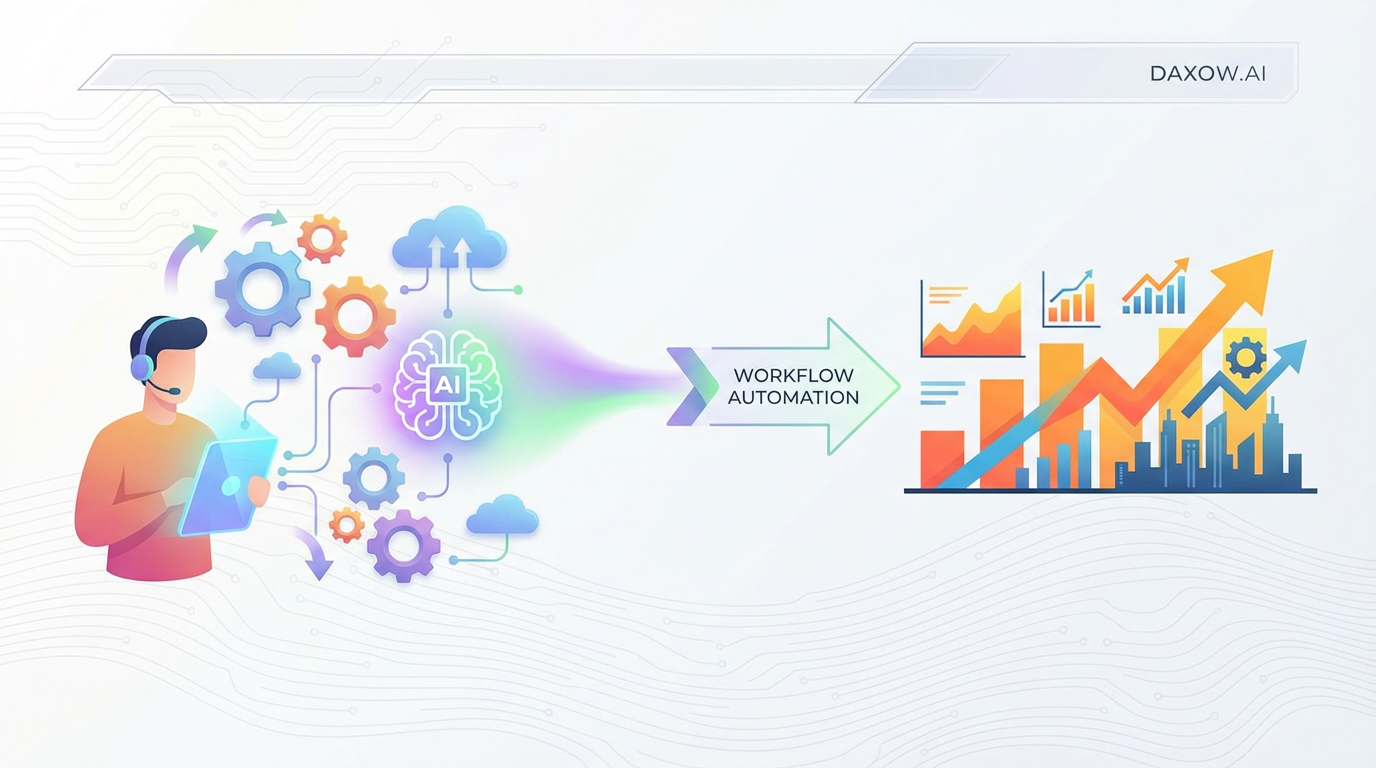
Plan and scale AI workflow automation for faster, cheaper operations: benefits, industry use cases, ROI metrics, phased roadmap, and Daxow.ai's agent-driven approach.
Mastering AI Workflow Automation: A Strategic Imperative for Business Transformation
Estimated reading time: 15 minutes
Key Takeaways
- AI workflow automation is essential for operational resilience, data-driven decisions, and competitive differentiation.
- Advanced AI agents incorporate machine learning, NLP, and predictive analytics for handling complex tasks.
- Implementing AI automation can reduce operational costs by 30–50% and improve task speed by up to 70%.
- Successful adoption follows a phased roadmap focusing on assessment, technology selection, team assembly, pilot, and full rollout.
- Daxow.ai offers end-to-end AI automation solutions with measurable ROI, compliance, and scalable architectures.
Table of Contents
- Mastering AI Workflow Automation: A Strategic Imperative for Business Transformation
- What AI Workflow Automation Means for Businesses
- Practical Use Cases Across Industries
- How AI Agents and Automation Drive Success
- Implementation Roadmap and Best Practices
- Measuring ROI and Scaling AI Automation
- How Daxow.ai Helps You Master AI Workflow Automation
- Getting Started — Practical First Steps
- Frequently Asked Questions
Mastering AI Workflow Automation: A Strategic Imperative for Business Transformation
Mastering AI Workflow Automation: A Strategic Imperative for Business Transformation is no longer optional for competitive organizations — it is a business necessity. Integrating artificial intelligence into operational workflows turns slow, error-prone processes into adaptive, self-optimizing systems that deliver measurable cost savings, faster cycle times, and better customer outcomes. For business owners, operations leaders, and technology teams, the priority is clear: adopt scalable AI automation that reduces manual tasks, increases productivity, and advances revenue and retention objectives.
This article synthesizes best practices, research-backed outcomes, and practical use cases across industries to help decision-makers plan and execute AI-driven change. It explains how AI agents, workflow automation, and tailored integrations deliver business automation that produces rapid ROI, and how Daxow.ai partners with organizations to design, deploy, and scale these systems.
Why this is strategic
- Operational resilience: AI workflow automation scales with demand, minimizes downtime, and reduces human error.
- Data-driven decisions: Real-time analytics identify inefficiencies and areas for optimization.
- Competitive differentiation: Faster responses and personalized service improve customer loyalty and revenue.
Research shows organizations that follow structured best practices achieve objectives 3–5x faster. Typical operational cost reductions range from 30–50% in automated processes, with task completion speeds improving by 30–70%. For leaders, these gains translate directly into freed budget, higher throughput, and more time for strategic initiatives.
What AI Workflow Automation Means for Businesses
Beyond traditional RPA
AI workflow automation advances beyond rule-based robotic process automation by incorporating:
- Machine learning for predictive decisions.
- Natural language processing (NLP) to understand and route unstructured text.
- Predictive analytics to anticipate demand and prevent bottlenecks.
These capabilities let systems handle complex tasks like triage, document understanding, fraud detection, and personalized customer interaction — tasks previously reserved for human judgment.
Business outcomes to expect
- Reduce manual tasks: Routine, repetitive work is automated, freeing employees for higher-value activities.
- Improve productivity: Teams operate faster and with fewer errors.
- Enhance customer support automation: Round-the-clock agents handle common inquiries and escalate only when needed.
- Enable sales automation: From lead qualification to follow-up, processes run without constant manual oversight.
Practical Use Cases Across Industries
AI workflow automation delivers measurable value when applied to high-volume, repeatable workflows. Below are practical examples showing how AI automation and AI agents generate impact.
E-commerce
Use case: Order processing and customer support automation
- AI agents sort and route customer inquiries by intent using NLP.
- Automate returns, refunds, and inventory updates integrated with ERP and CRM.
- Results: Fulfillment times reduced by up to 40%, lower manual support load, and improved Net Promoter Score (NPS).
Healthcare
Use case: Scheduling, triage, and claims processing
- AI agents prioritize appointments by urgency using symptom descriptions.
- Automated claims extraction and validation reduce administrative steps.
- Results: Administrative burden cut by ~30%, faster patient triage, and more accurate claims.
Finance
Use case: Invoice reconciliation and fraud detection
- Predictive models analyze transaction patterns to flag anomalies in real time.
- Automated reconciliation routes exceptions to appropriate approvers with audit trails.
- Results: Faster approvals, fewer errors, and a material reduction in fraud losses.
Real Estate
Use case: Lead qualification and document automation
- AI agents score leads based on interactions and property preferences.
- Automatic extraction of contract clauses and key dates accelerates closings.
- Results: Faster deal cycles and fewer manual document reviews.
Human Resources
Use case: Resume screening and onboarding
- AI parses resumes, matches skills to roles, and generates tailored interview lists.
- Automated onboarding workflows provision accounts, schedule training, and complete compliance checks.
- Results: Hiring time reduced by up to 50% and improved candidate experience.
These use cases represent low-risk, high-value starting points. They are repeatable across organizations and produce immediate ROI when implemented with proper data governance and integration.
How AI Agents and Automation Drive Success
What AI agents do
AI agents are autonomous software entities that perceive environments, make decisions, and execute actions. They transform workflow automation from static sequences into living systems that:
- Orchestrate intelligently: Dynamically route tasks, escalate exceptions, and complete end-to-end processes.
- Predict and optimize: Forecast demand spikes and reallocate resources before problems appear.
- Integrate seamlessly: Connect CRM, ERP, knowledge bases, and databases to create unified workflows.
- Learn continuously: Improve from feedback and new data without continuous manual retraining.
Business benefits
- 24/7 operations: Agents run continuously, reducing response times and enabling global coverage.
- Lower oversight: Routine decisions are automated, while humans handle exceptions.
- Faster scaling: Organizations scale services without proportional headcount increases.
At Daxow.ai, we build AI agents that execute real tasks — from qualifying leads in sales automation to handling customer support inquiries and orchestrating cross-system approvals. Our agentic frameworks focus on measurable business outcomes and secure, auditable operations.
Implementation Roadmap and Best Practices
Successful AI automation requires a phased, risk-mitigated approach. Typical time to initial value is 3–6 months when executed correctly.
Phase 1 — Assessment and Goal Definition (4–8 weeks)
- Map current workflows and identify high-impact targets (e.g., invoice processing, ticket sorting).
- Define measurable goals such as cost reduction percentage, SLA improvements, or throughput increases.
- Assess data quality, integration points, and compliance needs (GDPR, HIPAA, etc.).
- Outcome: Prioritized backlog of automation opportunities and clear KPIs.
Phase 2 — Technology and Vendor Selection (6–12 weeks)
- Evaluate platforms for NLP capability, model management, security, and API integrations.
- Prefer vendor-agnostic architectures to support 3–5 year growth and avoid lock-in.
- At Daxow.ai we recommend solutions that allow modular upgrades and transparent model governance.
- Outcome: Technology stack that supports current use cases and future expansion.
Phase 3 — Team Assembly and Preparation (4–8 weeks)
- Build cross-functional teams: IT, data engineers, business SMEs, compliance, and change managers.
- Clean and enrich data sources. Document decision points and build knowledge bases.
- Outcome: Ready-to-deploy environment with documented processes and trained stakeholders.
Phase 4 — Pilot Deployment and Iteration (4–12 weeks)
- Launch a single, high-value use case as a pilot (e.g., HR resume screening).
- Track metrics: resolution rates, error rates, time-to-resolution, and user satisfaction.
- Iterate using feedback and ensure audit trails and compliance reporting.
- Outcome: Validated model and process improvements ready for scale.
Phase 5 — Full Rollout and Optimization
- Expand horizontally (more processes) and vertically (more channels and regions).
- Implement continuous monitoring, drift detection, and retraining pipelines.
- Embed change management to maintain high adoption rates.
- Outcome: Broadly deployed automation with measurable business impact.
Best Practices and Pitfalls to Avoid
- Start small: Pilot rule-based, high-volume tasks first to demonstrate ROI.
- Prioritize data quality: Accurate inputs are essential for reliable outputs.
- Embed change management: Communicate benefits and train users to achieve adoption.
- Design for scalability and ethics: Mitigate bias and ensure compliance in HR and finance workflows.
- Avoid over-scoping: Overly ambitious projects often fail — focus on achievable, incremental wins.
Measuring ROI and Scaling AI Automation
Typical ROI metrics
- Cost savings: 30–50% reductions in operational costs on automated processes.
- Efficiency gains: 40–70% faster process completion.
- Error reduction: 50–90% fewer mistakes in repeatable tasks.
- Revenue uplift: 10–25% increase attributable to better customer experiences and faster cycles.
For example, a mid-sized e-commerce firm automating customer inquiries and returns could realize annual labor savings of $500K and increase NPS by 20 points. Daxow.ai clients typically reach break-even in 4–6 months and realize 3x ROI within the first year through our agentic frameworks and integration-led approach.
Scaling strategies
- Prioritize processes with the highest frequency and lowest variance.
- Use a modular automation architecture to reuse components (NLP models, connectors).
- Centralize monitoring to detect drift and performance degradation early.
- Implement governance for model updates, explainability, and compliance reporting.
How Daxow.ai Helps You Master AI Workflow Automation
Daxow.ai is an end-to-end partner for organizations that want to adopt AI automation with confidence. Our approach includes:
- Process discovery and analysis: We map your workflows, quantify automation potential, and define KPIs.
- Custom AI systems and agent design: We design AI agents that execute real tasks — from lead qualification to claims processing.
- Workflow automation engineering: We build robust, integratable automations that connect CRMs, ERPs, databases, and communication platforms.
- Data engineering and model management: We clean data, train models, and implement retraining pipelines with governance.
- Security and compliance: We design solutions to meet industry requirements such as GDPR and HIPAA.
- Change management and training: We work with your teams to ensure adoption and operational handover.
- Continuous optimization: Post-deployment, we monitor performance and iterate to increase accuracy and automation coverage.
By focusing on measurable business value and secure integrations, Daxow.ai helps clients reduce manual tasks, boost productivity, lower operational costs, and scale automation across the organization.
Getting Started — Practical First Steps
If you’re evaluating AI automation, here are actionable first moves:
- Identify one high-volume, rule-based process with measurable KPIs.
- Audit the data sources feeding that process for completeness and quality.
- Run a lightweight feasibility study to estimate time-to-value and expected savings.
- Assemble a small cross-functional team to sponsor and manage the pilot.
- Engage a vendor or partner with experience in AI agents, integrations, and compliance.
Daxow.ai can perform a rapid process analysis to identify the highest-return opportunities and build a pilot roadmap tailored to your organization.
Frequently Asked Questions
What is AI workflow automation and how is it different from traditional automation?
AI workflow automation uses artificial intelligence techniques such as machine learning, natural language processing, and predictive analytics to automate complex and dynamic tasks beyond rule-based robotic process automation (RPA).
How long does it typically take to see ROI from AI automation?
Organizations typically begin to see initial value within 3–6 months of a focused pilot. Full ROI, including cost savings and productivity gains, often materializes within 12 months, depending on scope and scale.
What industries benefit most from AI workflow automation?
Industries with high-volume, repeatable workflows such as e-commerce, healthcare, finance, real estate, and human resources benefit significantly. However, AI automation is increasingly applicable across virtually all sectors.
How does Daxow.ai ensure compliance and data security in AI automation?
Daxow.ai designs solutions with built-in compliance for standards such as GDPR and HIPAA, incorporates secure data handling practices, audit trails, and implements governance frameworks to maintain security and privacy.