
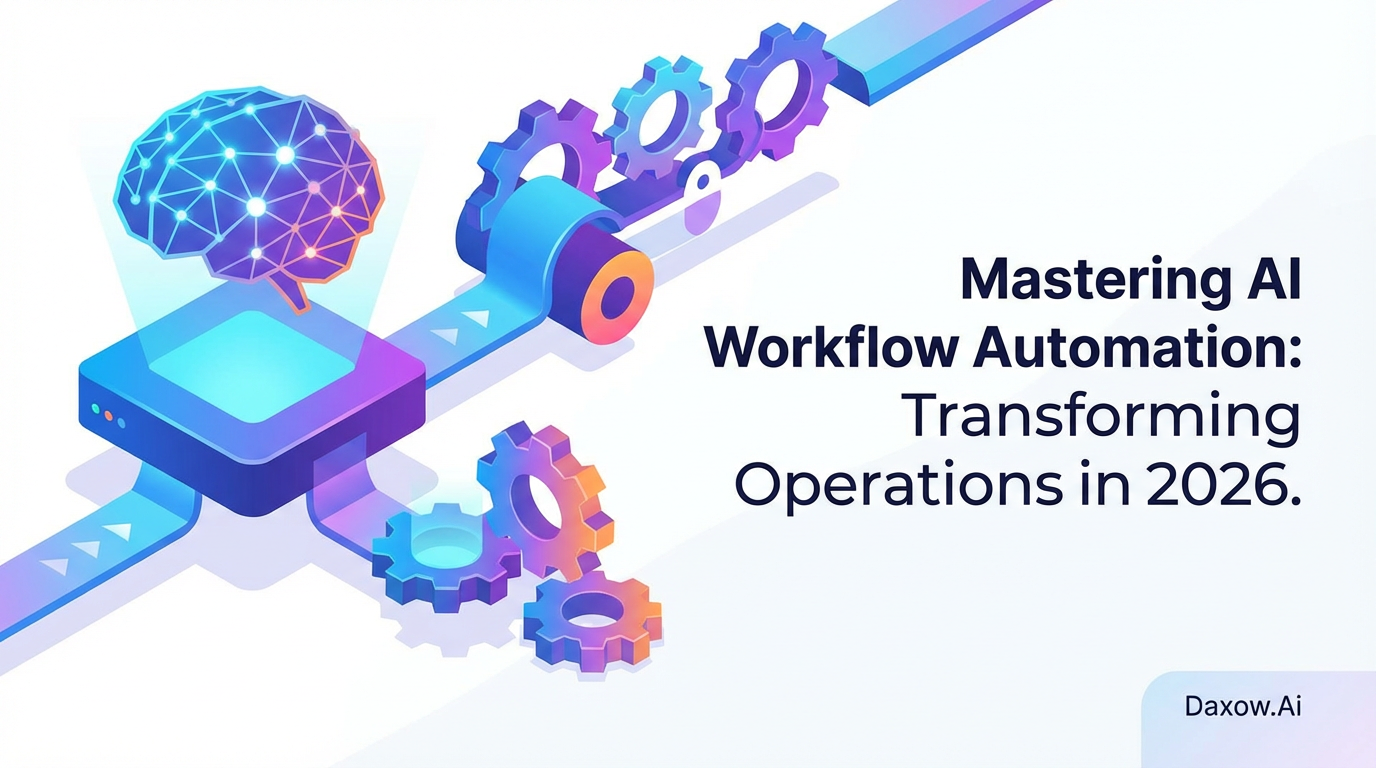
Mastering AI Workflow Automation: Transforming Operations in 2026
A practical guide to implementing AI workflow automation in 2026 — use cases, roadmap, ROI benchmarks, and how Daxow.ai builds governed AI agents.
Mastering AI Workflow Automation: Transforming Business Operations in 2026
Estimated reading time: 12 minutes
Key Takeaways
- AI workflow automation delivers up to 50% cost reduction and 70% faster processing in high-volume business tasks.
- Industry-specific use cases demonstrate AI agents improving order processing, patient triage, fraud detection, lead qualification, and HR operations.
- Daxow.ai designs AI agents that integrate with CRM, ERP, and ticketing systems, ensuring governance and auditability.
- A phased implementation roadmap reduces risk and accelerates value capture from discovery through scaling and governance.
- Security and compliance are embedded from day one, covering encryption, role-based access, and regulatory adherence.
- Measurable ROI includes 3-5x returns within 18 months by improving cost efficiency, cycle times, and customer satisfaction.
Table of Contents
- Mastering AI Workflow Automation: Transforming Business Operations in 2026 — Why it matters
- Practical Use Cases Across Industries
- How AI Agents and Automation Drive Value
- Implementation Roadmap — Practical steps to deploy AI workflow automation
- Measuring ROI and Business Value
- Security, Compliance, and Governance
- How Daxow.ai Delivers End-to-End Business Automation
- Frequently Asked Questions
Mastering AI Workflow Automation: Transforming Business Operations in 2026 — Why it matters
AI workflow automation integrates artificial intelligence into business processes to autonomously handle repetitive, rule-based tasks. The result is faster throughput, reduced errors, and scalable operations.
Key business impacts:
- Significant cost reduction: Organizations can see cost savings of 30–50% on high-volume processes by automating manual steps.
- Time savings: Automated tasks yield 30–70% reductions in processing time for many routine workflows.
- Accuracy and compliance: Automation reduces error rates by up to 90% in structured tasks and improves regulatory adherence.
- Faster innovation: Freed capacity lets teams focus on customer strategy, product improvements, and growth initiatives.
For decision-makers, AI workflow automation elevates operational agility. Whether you’re streamlining order-to-cash cycles, invoice processing, or customer support, focusing on high-ROI processes delivers quick wins and a measurable path to scale.
Practical Use Cases Across Industries
AI workflow automation and AI agents are industry-agnostic tools that adapt to specific processes. Below are actionable use cases with expected outcomes and example automations Daxow.ai builds.
E-commerce — Order processing, inventory, and personalization
- Automation examples:
- Automated order validation, fraud checks, and fulfillment orchestration.
- Inventory reconciliation across warehouses and marketplaces.
- Dynamic product recommendations and personalized follow-ups.
- Business outcomes:
- Fulfillment times cut by up to 40%, fewer stockouts, and improved conversion rates.
- Automated returns processing reduces manual handling and accelerates refunds.
Healthcare — Scheduling, triage, and claims
- Automation examples:
- Patient scheduling and reminders via AI chatbots with HIPAA-aware data handling.
- Intake form processing and pre-authorization workflows for claims.
- Triage assistants that route patients based on symptoms and urgency.
- Business outcomes:
- Reduced administrative burden on staff, faster patient throughput, and improved compliance with health-data regulations.
Finance — Reconciliation, fraud detection, and reporting
- Automation examples:
- Automated invoice matching and reconciliations.
- Real-time anomaly detection for transactions and automated alerts.
- Scheduled compliance reporting and document extraction for audits.
- Business outcomes:
- Shorter close cycles, lower audit costs, and stronger regulatory adherence.
Real Estate — Lead qualification, valuations, and listings
- Automation examples:
- AI-driven lead scoring from website, portal, and email sources.
- Automated property valuation models that ingest market data and documents.
- Listing management and tenant screening workflows.
- Business outcomes:
- Faster deal cycles, higher lead-to-client conversion, and better client matching.
HR — Recruitment, onboarding, and payroll queries
- Automation examples:
- Resume parsing, candidate pre-screening, and interview scheduling.
- Onboarding checklists, document collection, and policy acknowledgment tracking.
- Automated answers to payroll and benefits queries via chatbots.
- Business outcomes:
- Hiring time reduced by up to 50%, better candidate experience, and more strategic HR focus.
Each use case demonstrates how AI agents and workflow automation handle repetitive work at scale, while humans retain oversight for complex decisions.
How AI Agents and Automation Drive Value
AI agents are autonomous or semi-autonomous systems combining machine learning, natural language processing, and integration capabilities. They extend traditional workflow automation by handling unstructured data, predicting outcomes, and taking multi-step actions.
Core capabilities:
- Processing unstructured content (emails, invoices, contracts) and extracting structured data.
- Triggering cross-system actions — for example, updating a CRM, creating a support ticket, and notifying a human.
- Escalating exceptions intelligently and learning from user feedback for continuous improvement.
How Daxow.ai leverages AI agents:
- We design AI agents that execute end-to-end tasks — from data extraction and decisioning to integrations with CRMs, ERPs, ticketing systems, and project tools like monday.com.
- Agents are built with governance, audit trails, and retraining pipelines to ensure reliability and transparency.
- Hybrid approaches ensure seamless handoffs: bots handle predictable work and surface exceptions to employees with contextual summaries and recommended next steps.
Value outcomes:
- Operational scale without proportional headcount growth.
- Faster SLAs for customer support and sales qualification.
- Predictive capabilities that reduce risk and uncover revenue opportunities.
Implementation Roadmap — Practical steps to deploy AI workflow automation
1. Discover & Prioritize
- Run a process audit to identify repetitive, high-volume tasks.
- Prioritize processes by ROI potential, complexity, and data readiness.
- Define measurable objectives (e.g., reduce processing time by 30%, cut error rate by 80%).
2. Assess Data & Systems
- Inventory data sources and integration points (CRMs, ERPs, shared drives).
- Evaluate data quality and compliance requirements (e.g., HIPAA, GDPR).
- Choose platforms and tools that support your scale and integrations.
3. Design & Prototype
- Build a minimal viable automation for one high-impact process.
- Map the automation flow, decision rules, and exception paths.
- Define KPIs and retention/rollback strategies for safety.
4. Build & Integrate
- Develop AI agents for data extraction, classification, and decisioning.
- Implement workflow orchestration with connectors to your systems.
- Embed role-based access, logging, and auditability.
5. Pilot, Measure, and Iterate
- Run a controlled pilot with real data and a limited user group.
- Measure performance against KPIs (processing time, error rate, NPS).
- Iterate models and rules; expand coverage based on results.
6. Scale & Govern
- Roll out across teams in phases.
- Establish governance: model retraining schedules, change controls, and a catalogue of automated processes.
- Train users and run adoption programs to prevent shadow automation.
Best practices to follow:
- Start small to build stakeholder buy-in.
- Prioritize integration to minimize disruption to existing operations.
- Maintain data hygiene to avoid the garbage-in, garbage-out problem.
- Plan for ongoing governance to manage AI sprawl and ensure continuous improvement.
Measuring ROI and Business Value
Quantifying benefits helps secure budgets and justify scale. Typical performance benchmarks seen in deployments include:
- 30–50% cost savings on high-volume manual processes.
- 30–70% time savings on transactional tasks.
- Error reductions up to 90%, especially in data entry and reconciliation.
- 3–5x return on investment within 12–18 months through cost efficiencies and faster revenue realization.
Key metrics to track:
- Processing time per transaction
- Error or exception rate
- Cost per transaction
- Employee time reallocated to strategic tasks
- Customer satisfaction (CSAT/NPS)
- Time-to-resolution for customer issues
- Lead-to-conversion rate for sales automations
Daxow.ai approach to ROI:
- We produce a business case during discovery that includes target KPIs and projected savings.
- Pilots are instrumented to provide validated outcomes that justify phased investment.
- Ongoing dashboards and performance reviews ensure ROI continues to improve as agents learn and workflows optimize.
Security, Compliance, and Governance
Automation must protect data and comply with regulations. Key controls include:
- Encryption at rest and in transit.
- Role-based access and audit trails for all agent actions.
- Data minimization and retention policies aligned with compliance regimes.
- Regular model audits and explainability reports for critical decisioning.
Daxow.ai embeds compliance requirements into solutions from day one, ensuring systems meet sector-specific standards (for example, HIPAA for healthcare workflows) and internal governance expectations.
How Daxow.ai Delivers End-to-End Business Automation
- Discovery and process analysis to identify high-ROI opportunities.
- Custom design of AI agents and workflow orchestration tailored to business logic.
- Integrations with CRMs, ERPs, ticketing systems, and legacy databases for seamless data flow.
- Implementation of chatbots and support automation to reduce manual customer handling.
- Ongoing monitoring, retraining, and governance to sustain performance and compliance.
Why partner with Daxow.ai:
- We combine practical business process expertise with AI engineering to ensure automations deliver measurable value.
- Our projects prioritize business outcomes: reduced operational costs, improved productivity, and better customer experiences.
- We build solutions that are maintainable, auditable, and designed for future expansion as your needs evolve.
Frequently Asked Questions
What is AI workflow automation?
AI workflow automation uses artificial intelligence to perform repetitive, rule-based business tasks automatically, improving speed and accuracy while reducing operational costs.
How does Daxow.ai ensure compliance in AI solutions?
Daxow.ai incorporates encryption, role-based access, audit trails, data minimization, and sector-specific compliance such as HIPAA into every AI solution from the design phase onward.
What industries benefit most from AI workflow automation?
Industries including e-commerce, healthcare, finance, real estate, and human resources have high-impact use cases, but the technology is adaptable across sectors.
How long does it take to see ROI from AI automation?
Organizations typically realize 3–5x return on investment within 12–18 months through cost savings, efficiency gains, and improved revenue generation.