
Mastering AI Workflow Automation in 2026: ROI & Roadmap
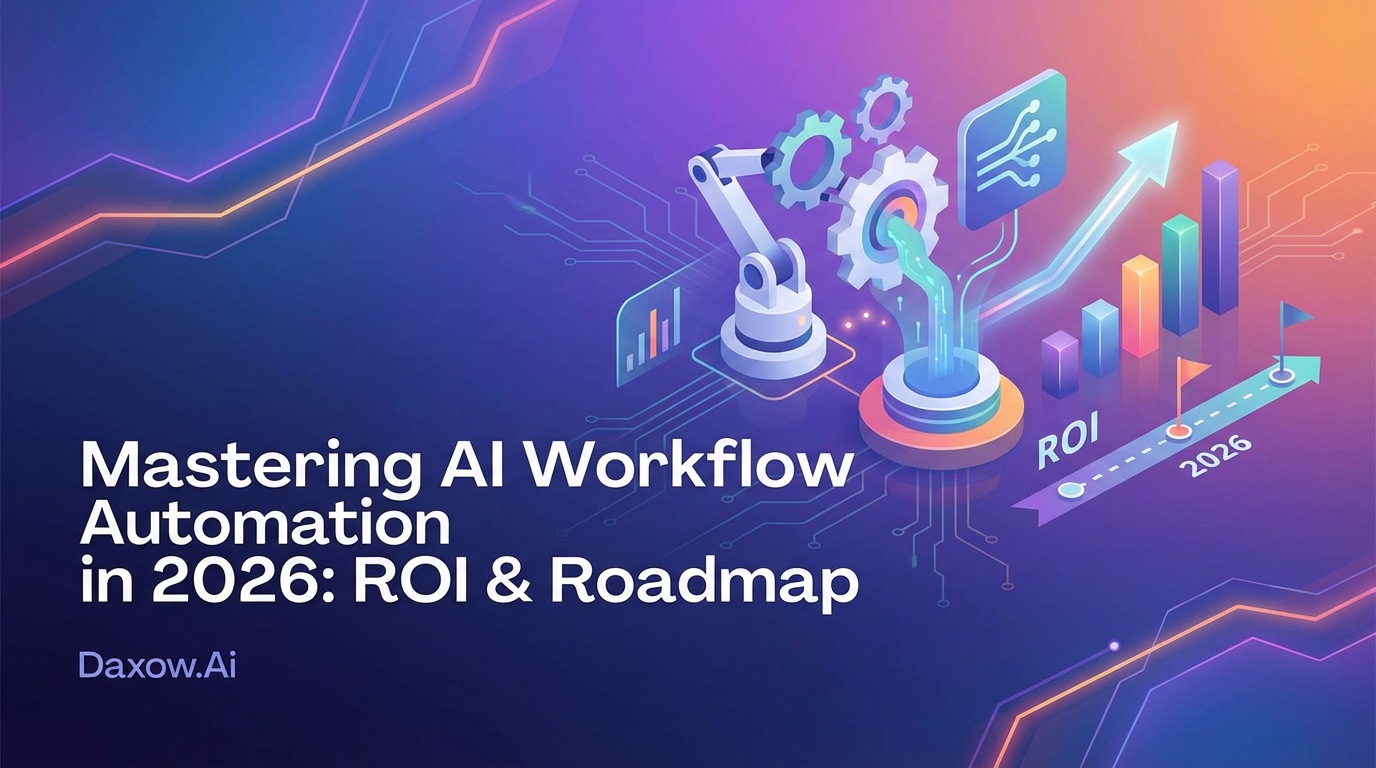
AI workflow automation explained: use cases, a 3-6 month implementation roadmap, measurable ROI, and how Daxow.ai builds scalable, compliant automation.
Mastering AI Workflow Automation: Transforming Business Operations in 2026
Estimated reading time: 15 minutes
Key Takeaways
- AI workflow automation transforms businesses by reducing manual tasks, increasing productivity, and improving accuracy.
- Successful implementations provide 20–50% operational cost savings and 30–40% productivity gains.
- Industry-specific AI agents automate repetitive, data-intensive workflows in e-commerce, healthcare, finance, real estate, HR, and customer support.
- A phased, data-driven approach is essential for rapid ROI and sustainable automation scaling.
- Daxow.ai offers tailored AI agents, integrations, and continuous support to maximize business value from workflow automation.
Table of Contents
- Mastering AI Workflow Automation: Transforming Business Operations in 2026
- What AI Workflow Automation Means for Your Business
- Practical Use Cases Across Industries
- How AI Agents and Automation Deliver Value
- Implementation Steps and Best Practices
- Measuring ROI and Business Value
- How Daxow.ai Helps You Implement and Scale AI Workflow Automation
- Actionable Next Steps and Quick Wins
- Frequently Asked Questions
Mastering AI Workflow Automation: Transforming Business Operations in 2026
What this trend means in practice is a shift from human-heavy, error-prone processes to intelligent systems that perceive, decide, and act. AI agents orchestrate end-to-end workflows—handling data extraction, routing, decisions, and execution—while workflow automation enforces business rules and integrates tools. The result: faster decision cycles, fewer errors, and scalable operations without proportional headcount increases.
Why this matters now
- Speed to value: Proven pilots can deliver results in 3–6 months when focused on high-volume, well-defined tasks.
- Cost pressure: AI automation reduces repetitive labor and rework, producing 20–50% operational cost savings in many implementations.
- Competitive differentiation: Companies that automate service, sales, and back-office processes gain responsiveness and consistency that drive customer loyalty and revenue.
Research shows that well-scoped AI workflow automation programs produce 3–5x faster ROI when paired with disciplined implementation practices such as data readiness, cross-functional teams, and iterative pilots.
What AI Workflow Automation Means for Your Business
Definition and core components
- AI agents: Autonomous software entities that perceive inputs (emails, forms, sensors), evaluate options using ML/knowledge bases, and execute tasks (update CRM, route tickets, trigger payments).
- Workflow automation: Rule-based orchestration that sequences steps, enforces SLAs, and integrates systems.
- Integrations and data layer: Connectors to CRMs, ERPs, databases, and communication channels provide the data and actions agents need.
Business outcomes
- Reduce manual tasks: Automate data entry, reconciliation, and routing to free staff for higher-value work.
- Improve productivity: Typical implementations report 30–40% productivity gains and faster task completion.
- Increase accuracy and compliance: Automated checks and audit trails reduce errors and regulatory risk.
- Scale operations: Handle volume spikes (e.g., seasonal demand, campaign surges) without hiring proportional headcount.
Practical Use Cases Across Industries
E-commerce
Use case: Order-to-cash automation—AI agents validate orders, reconcile payments, update inventory, and trigger fulfillment.
Impact: Reduce fulfillment time by up to 50%, lower stockouts through predictive replenishment, and improve conversion by offering faster responses via chatbots.
How Daxow helps: Build agents that integrate your e-commerce platform, ERP, and shipping partners to automate end-to-end order flows.
Healthcare
Use case: Patient intake and claims processing—agents extract patient data from forms, triage appointments, pre-fill billing codes, and flag anomalies.
Impact: Less administrative burden for clinicians, faster claims turnaround, and improved patient experience while maintaining HIPAA compliance.
How Daxow helps: Implement secure automation with audit trails and policy controls that meet regulated-data requirements.
Finance
Use case: Invoice reconciliation and fraud detection—AI automates PO-matching, reconciles vendor invoices, and identifies anomalous transactions.
Impact: Cut manual invoice handling by ~80%, reduce fraud exposure, and speed month-end close.
How Daxow helps: Connect financial systems and build ML models tuned to your transaction patterns to automate approvals and alerts.
Real Estate
Use case: Lead qualification and contract automation—agents score inbound leads, schedule viewings, generate tailored property matches, and extract contract terms.
Impact: Faster deal cycles, higher lead-to-appointment conversion, and reduced legal review time on standard contracts.
How Daxow helps: Deploy lead qualification agents integrated with CRM and calendaring tools to automate first-touch engagements.
HR and People Ops
Use case: Recruitment and onboarding—automate resume parsing, initial screening chats, interview scheduling, and benefits enrollment.
Impact: Shorter time-to-hire, better candidate experience, and lower administrative overhead for HR teams.
How Daxow helps: Create pipeline automation that integrates ATS, payroll, and learning systems, with analytics for retention prediction.
Customer Support and Sales
Use case: Customer support automation with AI chatbots that escalate to human agents when necessary; sales automation for lead routing and follow-up workflows.
Impact: Faster response times, better first-contact resolution, higher conversion rates, and consistent SLA adherence.
How Daxow helps: Implement customer support automation and sales automation that tie into your CRM, ticketing systems, and knowledge base.
How AI Agents and Automation Deliver Value
Capabilities of modern AI agents
- Process unstructured content (emails, PDFs, chat logs).
- Execute multi-step workflows (e.g., identify issue → gather context → apply resolution → update systems).
- Learn over time from feedback and outcomes to improve accuracy and decision-making.
- Escalate complex cases to humans with clear context and suggested actions.
Integration and orchestration
AI agents do not replace core systems; they orchestrate them. Agents integrate via APIs, RPA, and middleware to perform cross-system tasks—updating CRMs, generating invoices, and posting status updates—creating end-to-end automation that reduces handoffs.
Measurable benefits
- Efficiency gains: Automate 70–80% of repetitive tasks in target processes.
- Error reduction: Near-perfect accuracy in structured tasks like data entry and reconciliation.
- Scalability: Handle 3–5x volume without proportional staff increases.
- Insight: Real-time dashboards highlight bottlenecks and areas for process improvement.
Daxow builds agents to be transparent and auditable, ensuring business users understand decisions and can override or refine rules as necessary.
Implementation Steps and Best Practices
Successful implementations follow a phased, measurable approach. The recommended timeline for an initial value delivery is 3–6 months.
Phase 1 — Assess and Plan (4–8 weeks)
- Audit workflows to find high-volume, rule-based tasks.
- Define clear objectives and KPIs (cost reduction %, CSAT improvement, resolution time).
- Baseline metrics and data quality assessments.
- Identify integration points (CRM, ERP, ticketing, payroll).
Phase 2 — Select Technology and Team (6–12 weeks)
- Choose platforms that scale and support compliance (GDPR, HIPAA as required).
- Assemble cross-functional teams: IT, operations, domain experts, and change managers.
- Favor no-code/low-code tools for rapid prototyping when appropriate.
Phase 3 — Prepare Data and Processes (4–8 weeks)
- Cleanse and structure data; build knowledge bases and decision trees.
- Document workflows, SLAs, and escalation paths.
- Align stakeholders on scope and success metrics.
Phase 4 — Pilot and Test
- Deploy a single, high-impact use case (e.g., email triage or invoice processing).
- Monitor KPIs, gather user feedback, and iterate quickly.
- Validate compliance, bias checks, and model accuracy.
Phase 5 — Scale and Optimize
- Expand to additional processes and channels.
- Retrain models periodically to prevent drift.
- Maintain dashboards for continuous monitoring and improvement.
Best practices summary
- Start small to build confidence and secure stakeholder buy-in.
- Ensure data quality; poor data produces poor AI outcomes.
- Involve IT early for secure integrations and governance.
- Monitor continuously with dashboards and periodic audits.
- Manage change with clear communications and training for affected teams.
Avoid common pitfalls such as over-scoping initial projects, neglecting change management, or ignoring ethical and regulatory concerns.
Measuring ROI and Business Value
Quantify benefits using clear KPIs and financial models. Typical outcomes from structured implementations include:
- Payback: 6–12 months for many pilots.
- Operational cost savings: 20–50% depending on scope and process complexity.
- Productivity improvement: 30–40% through automation of repetitive tasks.
- Customer satisfaction: 15–25% improvement by reducing response times and errors.
- Scalability: Ability to handle 3–5x volume without proportional labor increases.
Sample metric targets to track
- Time to resolution or processing time (hours → minutes).
- Percentage of tasks automated.
- Error rate and rework frequency.
- Cost per transaction.
- CSAT or NPS changes after automation.
Daxow designs measurement plans as part of every engagement to ensure ROI is visible and attributable to specific automation initiatives.
How Daxow.ai Helps You Implement and Scale AI Workflow Automation
End-to-end process automation
Daxow conducts detailed workflow audits, identifies quick wins, and builds roadmaps that align with your strategic goals. From strategy to deployment, we manage the full lifecycle.
Custom AI agents that execute real tasks
We design and deliver AI agents tailored to your operations—capable of extracting data, making decisions, performing transactions, and interacting with humans. Our agents integrate with CRMs, ERPs, ticketing systems, and communications channels to deliver real-world outcomes.
System integrations and data connectivity
Daxow connects disparate systems using secure APIs and middleware, ensuring data flows reliably between platforms. We prioritize data governance, compliance, and encryption to meet industry standards.
Reducing operational costs and improving ROI
We focus on high-impact workflows for rapid ROI and create scalable automation that reduces manual tasks and increases productivity. Our clients typically see measurable cost reductions and performance improvements within the first 6–12 months.
Continuous support and optimization
Post-deployment, Daxow provides monitoring, retraining, and feature expansion to prevent drift and keep automation aligned with business changes.
Actionable Next Steps and Quick Wins
If you’re evaluating AI automation, start with this checklist:
- Map 3–5 high-volume workflows and estimate time spent per task.
- Define 2–3 measurable objectives (cost reduction, speed, CSAT).
- Run a 6–8 week pilot for one targeted process (e.g., invoice processing or lead qualification).
- Prepare data samples and identify integration endpoints.
- Allocate a small cross-functional team to champion implementation and change management.
Quick wins often include:
- Automating email triage and routing to reduce response time.
- Deploying a lead qualification bot to increase sales pipeline quality.
- Automating invoice matching to cut AP processing hours.
Daxow can run a process analysis that identifies these quick wins and builds a prioritized implementation plan.
Frequently Asked Questions
What is AI workflow automation?
AI workflow automation uses intelligent software agents combined with rule-based systems to automate repetitive, data-intensive business processes, improving efficiency and accuracy.
How fast can businesses see results from AI automation?
Many organizations experience measurable benefits in 3–6 months when focusing pilots on well-defined, high-volume workflows.
Which industries benefit most from AI workflow automation?
E-commerce, healthcare, finance, real estate, HR, and customer support all see strong ROI, especially for repetitive and rules-driven tasks.
How does Daxow.ai support automation implementation?
Daxow.ai provides end-to-end consulting, custom AI agent development, system integrations, and ongoing monitoring to ensure scalable, secure, and compliant automation.