
Pick an AI Topic — We’ll Write a 1,500–2,000 Word Article
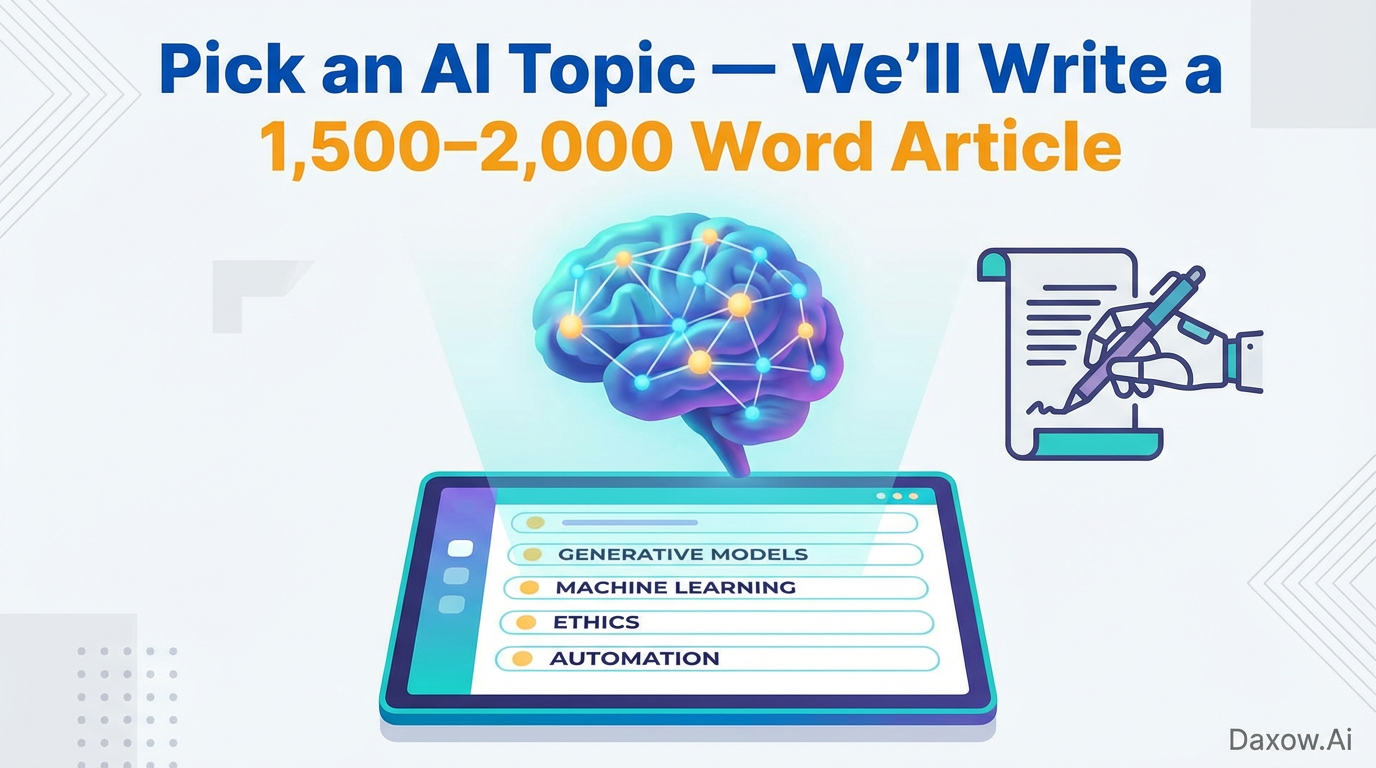
Pick one of the listed AI topics (or provide your own), share research, industry focus, keywords, CTA and deadline so we can write a tailored 1,500–2,000 word article.
AI Agents for Business Automation: Revolutionizing Workflow and Productivity
Estimated reading time: 12 minutes
Key Takeaways
- AI agents automate repetitive and manual business processes, increasing efficiency and reducing errors.
- Integrating AI agents enhances workflow optimization, supporting seamless operations across departments.
- Businesses experience improved customer service and lead qualification with AI-driven automation.
- Deploying AI agents enables enterprises to progress toward full digital transformation.
- Implementing AI-powered solutions drives measurable productivity gains and operational cost savings.
Understanding AI Agents in Business Automation
Artificial Intelligence (AI) agents are intelligent software systems designed to perform tasks autonomously by interpreting and acting upon data. In business automation, AI agents range from simple rule-based bots to advanced machine learning-driven systems capable of complex decision-making. They replace or augment human efforts in handling repetitive, time-consuming processes, allowing teams to focus on strategic objectives.
The core advantage of AI agents lies in their ability to reduce manual tasks, streamline workflows, and improve accuracy — all critical for driving productivity in modern enterprises. By integrating natural language processing, predictive analytics, and automated data extraction, AI agents become indispensable in creating agile, scalable business systems.
Harnessing AI for Workflow Optimization
AI agents advance workflow optimization by mapping current processes, identifying bottlenecks, and dynamically adjusting task execution. Unlike traditional automation scripted for fixed workflows, AI agents adapt to changing requirements using intelligent learning models. This flexibility helps businesses reduce processing times, minimize errors, and reallocate resources more effectively.
For example, AI can automate invoice processing in finance departments by extracting data from documents, validating entries, and triggering payments without manual intervention. In logistics, AI-powered scheduling agents analyze delivery routes and optimize shipments in real time, trimming operational costs and enhancing customer satisfaction.
Workflow automation with AI agents connects previously siloed systems, enabling seamless data flow and collaboration across departments, boosting overall organizational agility.
AI-Driven Customer Service Transformation
Transforming customer service with AI agents goes beyond simple chatbots. Advanced AI-driven customer support automation understands context, predicts customer needs, and personalizes interactions to enhance satisfaction and retention.
AI agents handle tier-one inquiries, freeing human agents to focus on complex resolutions. They also deliver instant responses 24/7 across channels including chat, email, and voice systems, improving responsiveness without increasing headcount.
Moreover, AI-driven sentiment analysis assists support teams in prioritizing cases and proactively resolving potential escalations. This transformation leads to faster problem resolution and optimized staffing, ultimately providing a competitive business advantage.
Enterprise Digital Transformation with AI Agents
AI agents serve as a foundational pillar in enterprise digital transformation initiatives. By automating workflows, enabling intelligent decision-making, and integrating data sources, AI agents accelerate the modernization of legacy systems and processes.
Enterprises experience enhanced operational transparency and agility, fueled by continuous learning AI models that evolve with business needs. The convergence of AI automation and business process management supports scalable, compliant, and secure workflows essential for regulated industries.
Daxow.ai offers tailored AI agent solutions designed to seamlessly align with corporate digital transformation strategies, helping businesses unlock new efficiencies and innovation opportunities.
Real-World Industry Applications
AI agents have proven impactful across multiple industries, including:
- E-commerce: AI-driven sales automation enables personalized product recommendations, lead qualification, and order fulfillment optimization.
- Healthcare: Document automation streamlines patient data extraction and regulatory compliance processes.
- Finance: AI agents support fraud detection, automated claims processing, and customer support automation in sensitive, regulated environments.
- Real Estate: Sales automation improves lead capture and follow-up through AI-powered virtual agents.
- Logistics: Workflow optimization automates shipment tracking, delivery scheduling, and resource allocation.
These examples highlight the versatility of AI agents in transforming core operations and delivering measurable ROI.
Implementing AI Agents Successfully
Successful deployment of AI agents for business automation requires strategic planning, clear objectives, and ongoing performance monitoring. Best practices include:
- Conducting process analysis to identify automation opportunities and pain points.
- Choosing AI agent technologies that integrate smoothly with existing enterprise systems.
- Starting with pilot projects to validate impact and refine agent capabilities.
- Training staff on AI collaboration and managing change effectively.
- Leveraging analytics to continuously improve and scale automation initiatives.
Daxow.ai supports organizations through every step of this journey, ensuring AI agent implementations deliver enhanced productivity, reduce manual tasks, and accelerate business automation.
Frequently Asked Questions
What are AI agents and how do they differ from traditional automation?
AI agents are intelligent systems capable of autonomous decision-making and learning, whereas traditional automation typically follows predefined rules without adaptability. AI agents can handle complex tasks, understand context, and improve over time, enabling more dynamic business automation.
Which industries benefit the most from AI-driven business automation?
Industries such as finance, healthcare, e-commerce, real estate, and logistics benefit significantly. AI agents help these sectors comply with regulations, accelerate workflows, enhance customer engagement, and reduce operational costs.
How can AI improve customer service automation?
AI improves customer service by providing instant responses, context-aware interactions, personalized solutions, and proactive issue resolution. This reduces wait times and increases customer satisfaction while reducing the workload for human agents.
What are common challenges when implementing AI agents?
Common challenges include integration with legacy systems, data quality issues, staff training, and managing change resistance. Careful planning and partnering with experienced AI automation providers like Daxow.ai help overcome these hurdles.