
Workflow Optimization with AI Agents: Cut Manual Tasks & Boost ROI
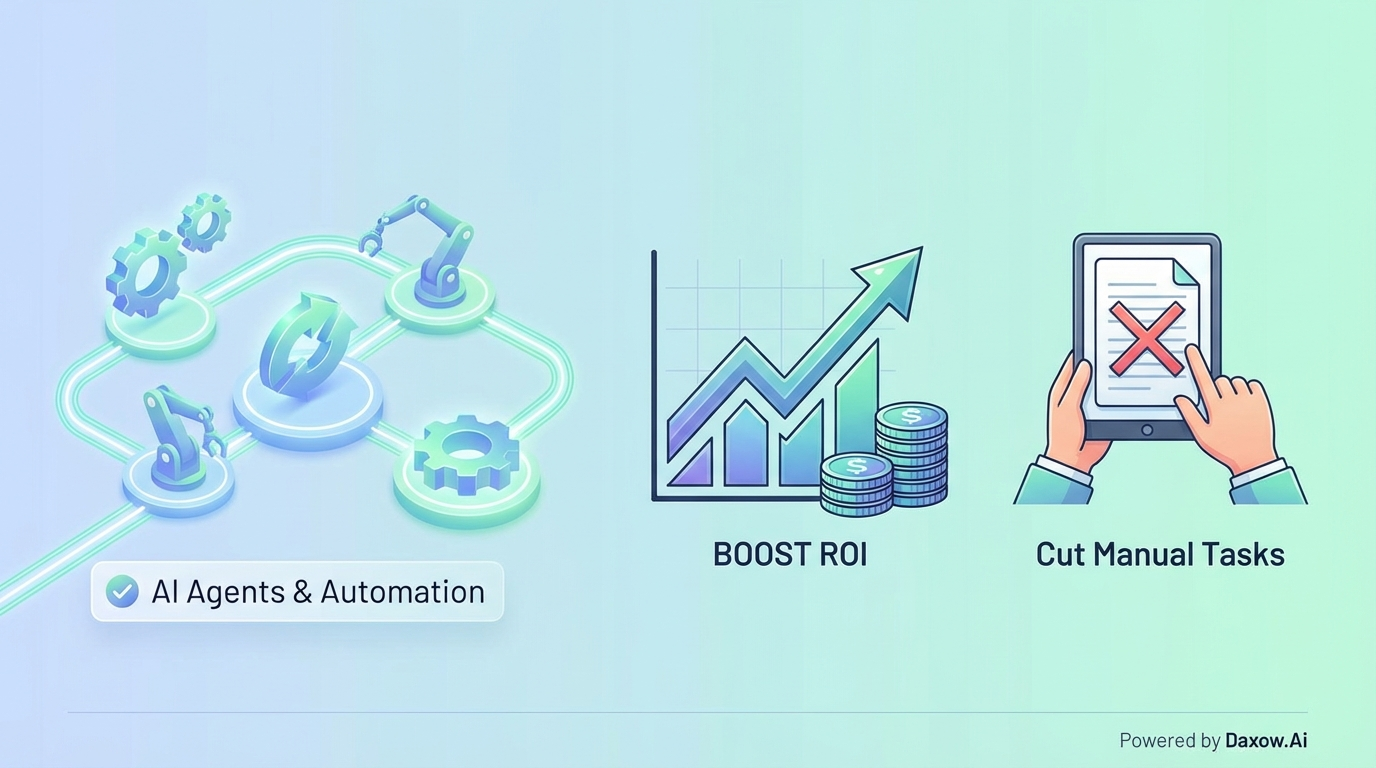
How AI agents automate workflows to cut manual tasks, speed decisions, and deliver measurable ROI across core business functions.
Workflow Optimization with AI Agents: How to Reduce Manual Tasks, Boost Productivity, and Automate Core Business Processes
Estimated reading time: 15 minutes
Key Takeaways
- AI agents automate repetitive manual tasks across business functions to increase efficiency and reduce errors.
- Workflow optimization integrates systems like CRM, ERP, and ticketing for seamless, data-driven automation.
- Industry-specific AI agent use cases include customer support, sales, finance, HR, real estate, and healthcare.
- A structured implementation roadmap ensures measurable ROI, risk mitigation, and scalable deployment.
- Data quality, system security, and model explainability are critical technical considerations for success.
Table of Contents
- Workflow Optimization with AI Agents — Why it Matters
- Practical Use Cases for Workflow Optimization with AI Agents
- How Daxow.ai Builds AI Agents and Automates Workflows
- Technical Considerations for Successful Workflow Optimization with AI Agents
- Measuring ROI: KPIs and Metrics That Matter
- Implementation Roadmap: From Pilot to Enterprise-Scale Automation
- Common Pitfalls and How to Avoid Them
- Why Choose Daxow.ai for Workflow Optimization with AI Agents
- Frequently Asked Questions
Workflow Optimization with AI Agents — Why it Matters
Businesses face constant pressure to do more with less. Manual, fragmented workflows slow down operations, increase error rates, and create poor customer experiences. Workflow optimization with AI agents addresses these problems by automating routine decisions and actions, freeing humans to focus on high-value work.
Key benefits:
- Reduce manual tasks: AI agents can perform data entry, reconciliation, triage, and content generation—cutting repetitive labor.
- Increase productivity: Automating handoffs and approvals shortens cycle times and improves throughput.
- Improve customer support automation: AI agents provide faster, consistent responses and escalate complex issues to humans.
- Enhance sales automation: Agents qualify leads, enrich contact records, and trigger tailored outreach.
- Ensure data connectivity: Workflow automation integrates disparate systems (CRM, ERP, ticketing, document stores) to create a single source of truth.
The difference between automation and AI agents
Traditional workflow automation runs rules and scheduled jobs. AI agents add intelligence: they understand context, infer intent, learn from interactions, and take multi-step actions across systems. AI agents can:
- Interpret unstructured text (emails, forms, contracts)
- Make decisions based on historical patterns
- Coordinate multi-system workflows (e.g., create a support ticket, update CRM, notify SLA owners)
- Continuously optimize their behavior using monitoring data
Practical Use Cases for Workflow Optimization with AI Agents
Customer support and service operations
Use case: Automated tier-1 support and escalation
- AI agent ingests incoming support requests (email, chat, forms).
- It extracts intent and key entities (account number, product, error code).
- It performs knowledge-base lookup and attempts resolution.
- For unresolved cases, it creates a ticket, populates relevant fields in the CRM and ticketing system, assigns priority, and notifies a specialist.
Business value:
- Reduce manual triage and routing time.
- Improve first-contact resolution rates by surfacing context and suggested responses for agents.
- Lower support costs while maintaining SLA compliance.
Sales and lead qualification
Use case: AI-driven lead qualification and nurture
- AI agent monitors inbound leads from website forms, chat, and marketing platforms.
- It enriches lead data using internal and external sources, scores leads using historical conversion models, and qualifies leads.
- Qualified leads trigger CRM updates and personalized email or sequence automation; low-potential leads are placed into nurture workflows.
Business value:
- Reduce manual qualification time for sales reps.
- Increase lead-to-opportunity conversion by prioritizing high-value prospects.
- Enable scalable sales automation without sacrificing personalization.
Finance and accounting
Use case: Invoice processing and exception management
- AI agent extracts data from invoices and purchase orders using document automation.
- It matches invoices to POs and payment schedules, posts entries to the accounting system, and flags exceptions for human review.
- For recurring vendors, the agent can auto-approve below-threshold invoices.
Business value:
- Cut AP processing costs and accelerate payment cycles.
- Reduce errors from manual entry and minimise late-payment penalties.
- Improve audit trails and compliance with consistent logging.
HR and administrative workflows
Use case: Candidate screening and onboarding automation
- AI agent screens resumes against job requisitions, ranks candidates, and schedules interviews.
- Once hired, the agent coordinates document collection, IT provisioning, and onboarding checklists across HRIS and collaboration tools.
Business value:
- Shorten time-to-hire and reduce recruiter workload.
- Improve new-hire experience with automated, consistent onboarding.
- Reduce administrative overhead for HR teams.
Real estate and property management
Use case: Tenant intake and maintenance coordination
- AI agent routes tenant requests, schedules contractors, and updates property management systems.
- It automates lease renewals and rent reminders while maintaining communication logs.
Business value:
- Improve tenant satisfaction through faster responses.
- Lower operational costs by reducing manual scheduling and follow-up.
Healthcare and compliance workflows
Use case: Prior authorization and documentation automation
- AI agent extracts medical codes and patient details from referrals.
- It prepares and submits prior authorization requests, monitors status, and escalates denials for clinician review.
Business value:
- Reduce administrative burden on clinicians and billing staff.
- Accelerate revenue cycle by reducing authorization delays.
- Enhance compliance through structured tracking and auditability.
How Daxow.ai Builds AI Agents and Automates Workflows
At Daxow.ai we follow a structured, business-focused approach that aligns technical execution with measurable outcomes.
Discovery and process mapping
- We start with a short, targeted workshop to map current workflows and identify pain points.
- Prioritize automation candidates by impact (time saved, cost reduced, risk mitigated) and feasibility.
- Deliverable: a prioritized automation roadmap and estimated ROI.
Design and prototype
- We design AI agents that address specific tasks—intent recognition, document extraction, decision logic, and action orchestration.
- Build rapid prototypes to validate accuracy and user experience with real data.
- Integrate with your systems (CRM, ERP, ticketing, HRIS) using secure connectors.
Implementation and integration
- Deploy agents within a controlled pilot environment.
- Use workflow automation platforms and APIs to orchestrate end-to-end processes.
- Implement logging, monitoring, and error handling to ensure reliability.
Training, governance, and scaling
- Provide training for staff and define handoff rules between agents and humans.
- Establish governance for data access, model updates, and performance thresholds.
- Scale proven automations across teams and geographies.
Continuous improvement
- Monitor performance metrics, user feedback, and exception rates.
- Tune models, refine rules, and expand functionality to increase automation coverage and ROI.
Technical Considerations for Successful Workflow Optimization with AI Agents
Data quality and access
- Connect systems and centralize data where possible. AI agents rely on timely, accurate data.
- Implement data cleansing and standardization before automation to reduce exceptions.
Security, privacy, and compliance
- Ensure role-based access and encryption in transit and at rest.
- Embed privacy controls to meet regional regulations and industry compliance.
- Maintain auditable logs for each agent action to support governance and audits.
Model selection and explainability
- Use a mix of pre-trained models and custom fine-tuning depending on tasks.
- Incorporate explainability for decisions that affect customers or compliance (e.g., credit decisions, medical coding).
System reliability and error handling
- Design deterministic fallback logic for when an AI agent is uncertain.
- Route ambiguous cases to humans with contextual summaries to minimize resolution time.
Measuring ROI: KPIs and Metrics That Matter
To quantify the impact of workflow optimization with AI agents, track KPIs tied to business outcomes.
Primary KPIs:
- Time saved per task (hours reduced)
- Percentage of workflows automated end-to-end
- First-contact resolution rate (for support)
- Lead-to-opportunity conversion rate (for sales)
- Invoice processing cost per invoice and cycle time
- Error/exception rate and human intervention rate
Secondary metrics:
- Employee satisfaction and attrition in operational teams
- Customer satisfaction (CSAT, NPS)
- Compliance incidents and audit findings
Example ROI calculation (illustrative):
If an AI agent reduces average handling time for support triage by 10 minutes and processes 10,000 tickets/year, the annual time saved is ~1,667 hours. Multiply by fully loaded hourly rate to estimate cost savings, then add downstream benefits from faster resolution and improved retention.
Implementation Roadmap: From Pilot to Enterprise-Scale Automation
A practical sequence to deploy workflow optimization with AI agents:
-
Discovery (2–4 weeks)
- Map processes, gather data samples, define success criteria.
-
Pilot development (4–8 weeks)
- Build and test a narrow-scope AI agent in a live environment.
- Validate accuracy and measure KPIs.
-
Pilot evaluation (2–4 weeks)
- Review results, quantify ROI, and capture operational feedback.
-
Scale and integrate (3–6 months)
- Expand automation to additional workflows, integrate with more systems, and enforce governance.
-
Continuous operations (ongoing)
- Monitor performance, update models, and optimize workflows.
Common Pitfalls and How to Avoid Them
- Over-automation without governance: Start small with high-impact, low-risk workflows.
- Ignoring data quality: Invest in data prep before building agents.
- Poor change management: Engage stakeholders early and train users.
- Lack of monitoring: Implement KPIs and alerts to detect drift and errors.
Why Choose Daxow.ai for Workflow Optimization with AI Agents
Daxow.ai combines domain expertise in AI automation with practical, business-centric delivery. We offer:
- End-to-end process automation from discovery to production.
- Custom AI agents tailored to your data, systems, and compliance needs.
- Deep system integrations across CRMs, ERPs, ticketing systems, and document stores.
- Proven methodology that focuses on ROI, operational reliability, and user adoption.
- Ongoing support for model maintenance, monitoring, and scaling.
We partner with business owners, CTOs, operations leaders, and support teams to reduce manual work, increase productivity, and unlock measurable savings across industries.
Learn more about our workflow automation solutions and custom AI agent services to start your journey toward intelligent automation.
Conclusion — Take the Next Step Toward Automation
Workflow optimization with AI agents is not a theoretical advantage — it is a practical path to lower operational costs, increased productivity, and improved customer experience. Whether you want to automate support triage, accelerate lead qualification, streamline finance operations, or build industry-specific AI agents, Daxow.ai can design and implement solutions that execute real tasks and deliver measurable ROI.
Book a free consultation with Daxow.ai to request a process analysis for your company and start a pilot that demonstrates the value of AI automation. Contact us to build a custom AI system that reduces manual tasks and scales your business.
Frequently Asked Questions
What types of workflows can AI agents automate?
AI agents can automate repetitive, rule-based, and decision-driven workflows across departments such as customer support, sales, finance, HR, property management, and healthcare compliance.
How does Daxow.ai ensure data security?
We implement role-based access controls, encrypt data in transit and at rest, maintain auditable logs, and adhere to regional privacy regulations to safeguard your data throughout automation processes.
Can AI agents integrate with existing systems?
Yes. Daxow.ai specializes in deep integrations with common enterprise platforms such as CRMs, ERPs, ticketing, HRIS, and document management systems to create seamless workflow automations.
What is the typical timeline to deploy AI agents?
Deployment varies by scope, but typical timelines include 2–4 weeks for discovery, 4–8 weeks for pilot development, 2–4 weeks for evaluation, and 3–6 months to scale and integrate across the enterprise.