
Optimize Workflows with AI Agents: Automate and Boost Productivity
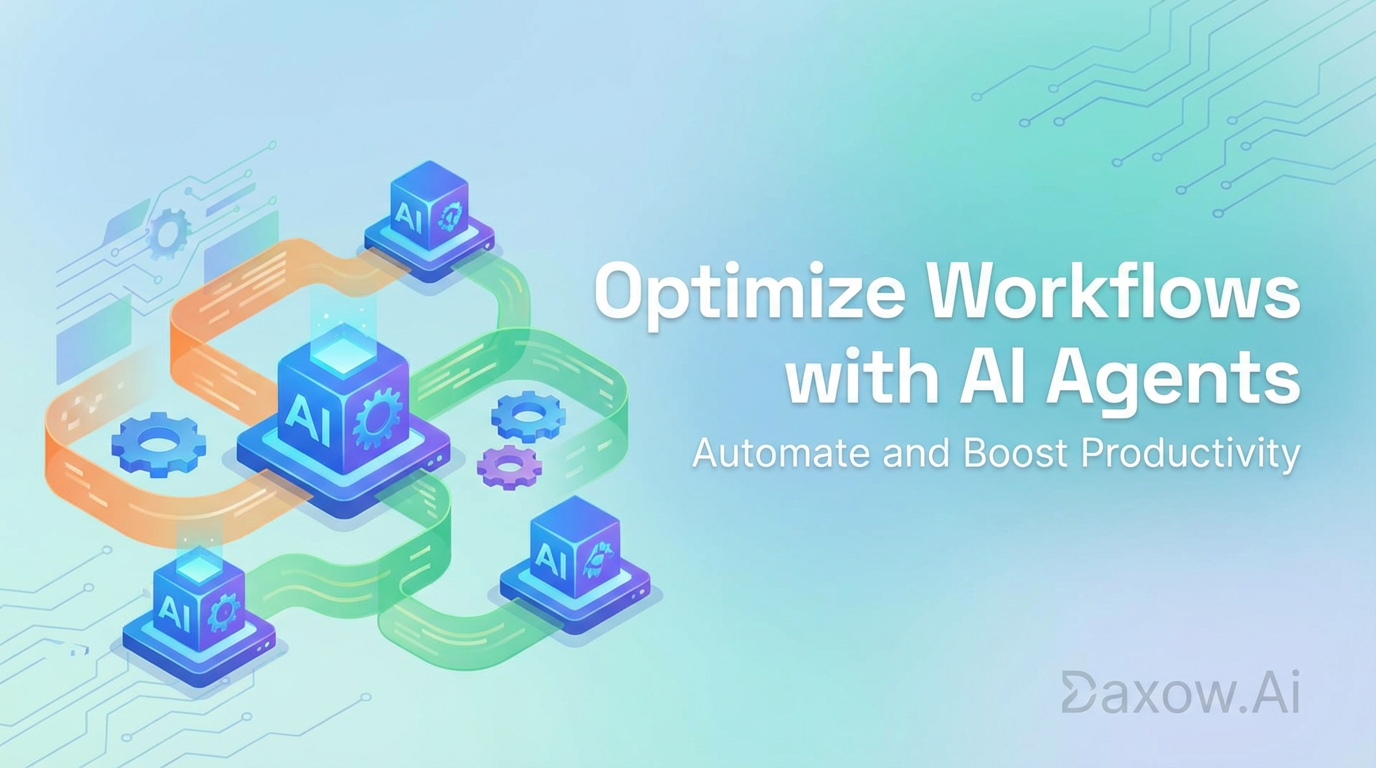
Learn how AI agents automate workflows to reduce manual work, improve customer experience, and deliver measurable ROI. Includes use cases and a practical deployment roadmap.
Workflow Optimization with AI Agents: How to Automate Workflows, Reduce Manual Tasks, and Boost Productivity
Estimated reading time: 12 minutes
Key Takeaways
- AI agents automate repetitive tasks to improve productivity and reduce operational costs.
- Industries benefit from AI-driven workflows in customer support, sales, finance, HR, healthcare, and e-commerce.
- A practical roadmap guides discovery, design, build, pilot, and deployment of AI agents.
- Measuring KPIs and ROI is critical to track success and justify automation investments.
- Partnering with Daxow.ai ensures custom integrations, governance, and operational readiness for scalable automation.
Table of Contents
- Workflow Optimization with AI Agents — Why It Matters Now
- What We Mean by AI Agents in Workflow Automation
- Key Use Cases and Industry Examples
- A Practical Roadmap to Deploy AI Agents for Workflow Optimization
- Measuring ROI and Business Impact
- Integration, Data Connectivity, and Governance
- Common Pitfalls and How to Avoid Them
- Why Partner with Daxow.ai for Workflow Optimization with AI Agents
- Frequently Asked Questions
Workflow Optimization with AI Agents — Why It Matters Now
Modern organizations face three persistent challenges: rising operational costs, inconsistent customer experiences, and slow time-to-value for technology initiatives. AI agents—autonomous or semi-autonomous software agents powered by AI—address these issues by executing targeted tasks within workflows, bridging systems, and reducing human intervention.
Key drivers making this the right time to act:
- Growing expectations for instantaneous, accurate customer interactions make manual processes unsustainable.
- Availability of more robust APIs, pre-trained models, and MLOps tools simplifies integration and production deployment.
- Organizations that automate intelligently can reallocate talent to higher-value strategic work and accelerate innovation.
Business leaders should view AI agents as strategic enablers of workflow automation: not a replacement for human judgment, but a way to remove repetitive work, accelerate decision cycles, and improve reliability.
What We Mean by AI Agents in Workflow Automation
AI agents are configured to perform tasks such as:
- Parsing and extracting structured data from documents.
- Triaging and routing customer requests.
- Qualifying leads and populating CRM records.
- Orchestrating multi-step processes across systems (ERP, CRM, ticketing).
They combine capabilities from NLP, computer vision, rules engines, and RPA, often running as always-on services or event-driven processes.
Key Use Cases and Industry Examples
Customer Support Automation — Reduce Response Time and Manual Handoffs
Use case:
- AI agents handle first-line support: classify queries, retrieve knowledge-base answers, and escalate to specialists only when needed.
Business impact:
- Lower average handle time, higher first-contact resolution rates, and reduced staffing pressure during peak periods.
Practical example:
- A SaaS company routes 70% of inbound tickets to an AI agent that resolves common issues via automated responses and prepares a pre-populated ticket for complex cases—reducing human touchpoints by 50%.
How Daxow.ai helps:
- Build custom chatbots and support automation integrated with your ticketing system and knowledge base.
- Implement fallback rules and human-in-the-loop workflows to ensure quality and compliance.
Sales Automation and Lead Qualification — Convert More with Less Effort
Use case:
- AI agents score and qualify leads using CRM data, interaction history, and external enrichment.
Business impact:
- Sales reps focus on high-intent leads, shortening sales cycles and improving conversion rates.
Practical example:
- An enterprise implements an AI agent that qualifies inbound leads, schedules discovery calls, and updates CRM records—resulting in a 20–30% uplift in qualified pipeline.
How Daxow.ai helps:
- Integrate AI agents with CRMs and calendar systems, design lead-scoring models, and automate outreach sequences.
Finance and Document Automation — Speed Up Processing and Compliance
Use case:
- Extract invoices, contracts, and receipts using document AI; validate entries against business rules and post to accounting systems.
Business impact:
- Reduced manual data entry, faster month-end close, and improved audit trails.
Practical example:
- A mid-sized company uses document automation to process vendor invoices: an AI agent extracts line items, applies coding rules, and routes exceptions to a finance analyst—reducing processing time by 70%.
How Daxow.ai helps:
- Implement end-to-end data extraction, validation rules, and ERP integrations to automate bookkeeping workflows.
HR and Onboarding — Improve Employee Experience and Reduce Admin Load
Use case:
- AI agents pre-screen candidates, schedule interviews, and automate onboarding tasks like account provisioning and paperwork.
Business impact:
- Faster hires, consistent onboarding, and reduced HR administrative burden.
Practical example:
- An organization uses AI agents to verify candidate responses, book interviews, and kick off automated onboarding sequences—cutting new-hire setup time from days to hours.
How Daxow.ai helps:
- Connect AI agents to HRIS systems, design compliant data flows, and automate repetitive HR tasks.
Healthcare and Compliance — Manage Sensitive Workflows Securely
Use case:
- AI agents assist with patient intake, claims pre-processing, and compliance checks while preserving data privacy.
Business impact:
- Faster administrative processing, more time for patient care, and better regulatory compliance.
Practical example:
- A clinic automates insurance pre-authorization and claim triage, freeing staff to focus on clinical tasks and reducing claim denials.
How Daxow.ai helps:
- Build secure, auditable systems with data governance and role-based access controls; integrate with EHRs and billing systems.
E-commerce and Supply Chain — Improve Fulfillment and Customer Satisfaction
Use case:
- AI agents manage order exceptions, inventory alerts, and automated carrier communications.
Business impact:
- Reduced fulfillment errors, improved on-time delivery, and fewer manual interventions.
Practical example:
- An online retailer deploys AI agents that reconcile orders with warehouse status and trigger exception workflows—reducing order delays by 40%.
How Daxow.ai helps:
- Integrate agents with e-commerce platforms, WMS, and shipping APIs for end-to-end automation.
A Practical Roadmap to Deploy AI Agents for Workflow Optimization
1. Discovery and Process Mapping
- Map current workflows end-to-end and identify manual touchpoints.
- Measure baseline metrics: cycle time, cost per transaction, error rates, and ticket volumes.
- Prioritize workflows by ROI potential and feasibility.
Deliverable: Prioritized automation backlog and baseline metrics.
2. Design the AI Agent and Integration Architecture
- Define agent responsibilities, decision boundaries, and escalation paths.
- Identify data sources and integration points (CRM, ERP, ticketing, document stores).
- Select model approaches (NLP for text, CV for images, rules/RPA for deterministic tasks).
Deliverable: Solution design, integration plan, and success criteria.
3. Build and Train
- Develop models and connectors; create synthetic training data if required.
- Implement business rules, audit logs, and monitoring hooks.
- Use staged environments to test behavior with sample traffic.
Deliverable: Tested agents, integration connectors, and documentation.
4. Pilot and Validate
- Run pilots with a subset of users or transactions.
- Use human-in-the-loop where needed to ensure quality and establish trust.
- Measure against predefined KPIs and collect stakeholder feedback.
Deliverable: Pilot report, KPI improvements, and production readiness checklist.
5. Deploy, Monitor, and Iterate
- Roll out incrementally, enable observability, and implement automatic rollback for anomalies.
- Monitor performance, retrain models as data drifts, and continuously refine rules.
Deliverable: Production AI agents with ongoing improvement processes.
Measuring ROI and Business Impact
Decision-makers need clear metrics. Below are core KPIs to track and a sample ROI model.
Core KPIs:
- Reduction in manual touchpoints (number of human interventions per transaction).
- Time saved per transaction (minutes or hours).
- Cost per transaction before and after automation.
- Throughput increase (transactions processed per day).
- Customer metrics: CSAT, time-to-resolution, NPS.
- Accuracy and error rates (invalid entries, rework).
Sample ROI Scenario:
- Baseline: 4 FTEs processing 1,000 transactions per month, avg 15 minutes per transaction.
- After automation: AI agents handle 60% of transactions autonomously, human time per handled transaction reduced to 5 minutes for exceptions.
- Result: Headcount-equivalent reduction or reallocation of ~2 FTEs, processing time cut by ~50%, faster SLAs, and lower processing costs.
Conclusion: With conservative estimates, automation often pays back within 6–12 months for high-volume operational processes.
Integration, Data Connectivity, and Governance
Successful AI agents depend on reliable data connectivity and robust governance.
Best practices:
- Use API-first integrations to connect CRMs, ERPs, ticketing systems, and document repositories.
- Implement role-based access control, encryption in transit and at rest, and data minimization.
- Maintain audit trails and explainability layers for decisions that affect customers or compliance.
- Establish a data quality and retraining cadence to address drift.
Daxow.ai ensures secure integrations, builds data pipelines, and implements governance frameworks tailored to industry and regulatory needs.
Common Pitfalls and How to Avoid Them
Pitfalls:
- Automating the wrong processes—mirror inefficient legacy steps.
- Ignoring human-in-the-loop for edge cases.
- Overlooking change management—staff resistance or unclear roles.
How to avoid:
- Prioritize use cases by measurable ROI.
- Start with hybrid automation and expand as trust builds.
- Communicate benefits, retrain staff for higher-value roles, and document processes.
Why Partner with Daxow.ai for Workflow Optimization with AI Agents
Daxow.ai combines hands-on operational consulting and engineering delivery to transform workflows into automated, measurable systems. Our approach focuses on business value, not just models.
What Daxow.ai offers:
- End-to-end process automation: From discovery and design to deployment and monitoring.
- Custom AI agents that execute real tasks: Not proof-of-concepts—production-ready agents integrated with your systems.
- Systems integrations and data connectivity: Connect CRMs, ERPs, ticketing, and document stores securely.
- Cost reduction and ROI focus: Prioritized automations with clear metrics and payback models.
- Cross-industry expertise: Solutions tailored for technology, e-commerce, finance, healthcare, real estate, and more.
- Operational readiness and governance: Secure, auditable systems built for regulation-heavy industries.
Daxow.ai was founded to help organizations not only adopt AI but operationalize it—turning automation into predictable business outcomes.
Learn more about our custom AI agent solutions and integration services to accelerate your digital transformation journey.
Frequently Asked Questions
What are AI agents in workflow automation?
AI agents are autonomous or semi-autonomous software systems that perform specific tasks within workflows by leveraging AI technologies like natural language processing, computer vision, and rules engines to automate repetitive or complex processes.
How can AI agents improve customer support?
AI agents can handle initial customer inquiries, classify and resolve common issues, retrieve answers from knowledge bases, and escalate complex cases to human agents, reducing response times and manual handoffs while improving customer satisfaction.
What industries benefit most from AI workflow automation?
AI workflow automation provides value across industries including technology, finance, healthcare, e-commerce, human resources, and supply chain management by optimizing processes, reducing errors, and enabling faster decision-making.
How do you measure the ROI of deploying AI agents?
ROI can be measured by tracking KPIs such as reduction in manual touchpoints, time saved per transaction, cost per transaction improvements, throughput increases, and customer satisfaction metrics like CSAT and NPS, combined with financial metrics including headcount reduction or efficiency gains.